Categories
Demolition East St. Louis, Illinois Industrial Buildings Metro East

The Pens

by Michael R. Allen

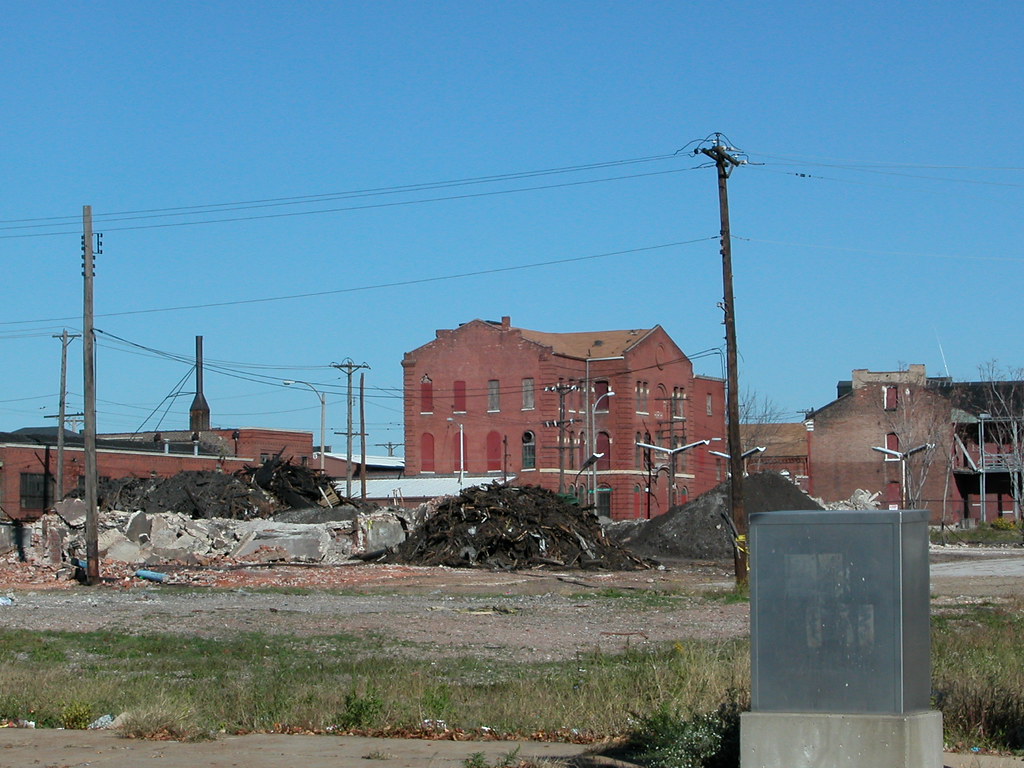
The new Mississippi River Bridge entails construction of an extension of I-70 that will run parallel to St. Clair Avenue in East St. Louis. As part of this project, much of the National City Stockyards in East St. Louis will be demolished. While the abandoned Armour and Hunter packing plants will not be disturbed, the landmark concrete stock pens will be gone forever by year’s end. The flip side is that the Illinois Department of Transportation will be conducting archaeological work on the site that will help us learn more about the history of the stockyards.

Yesterday, I led a group of sixth graders from the College School on a tour of East St. Louis. We stopped at the stockyards, and got out of the bus to look inside the long cattle pen shown above. A security guard ushered us away, and told teacher John Colbert that we should leave because the pens were about to be demolished. In fact, we were there precisely because the pens will be demolished, removing the chance for future generations to physically connect with an important part of St. Louis’ industrial past as well as a lost system of food production. While I am not prepared to strongly advocate for saving any of the ruins of the stockyards, yesterday’s tour led me to wonder how any of the sixth graders will explain what they saw to their children. Will they drive on the I-70 connector and explain that once upon a time they stood in cattle pens on that site? Will their children care about a history that has no living physical embodiment?

Categories
Demolition North St. Louis Old North St. Louis Place

Crown Mart Plaza is a Missed Opportunity

by Michael R. Allen

City Block 599 is bounded by North Fourteenth Street on the west, Cass Avenue on the south and North Florissant Avenue on the east and north. Starting with the construction of Florissant Avenue in 1935, the block was slowly cleared across the 20th and early 21st centuries. Once a dense near north residential and commercial mixed-us block, by the 1980s the block only held two buildings. By October 2005, when I took the photograph above, the block was fully clear of buildings.

Since November, the block has risen with construction again. This time, the building that will occupy City Block 599 will be a strip mall and gas station known as Crown Mart Plaza. While a strip mall is better than an empty block, and the area desperately needs stores, the site deserves something better. The photograph above shows the Mullanphy Emigrant Home (before the April 2006 storm struck) and buildings in the Old North St. Louis neighborhood in the background. This site is a visual gateway to Old North and St. Louis Place. While Tucker Boulevard and North 13th Street are currently closed, that combined major thoroughfare will open again. When it reopens, the new Mississippi River Bridge will be completed, with its ramps dropping cars on Cass Avenue just one block east. Thousands of people will pass by this block on their way to the historic neighborhoods of the near north side.

The Crown Mart Plaza is a missed opportunity to build something on the site that is an appropriate architectural entrance to great north city neighborhoods. The first impression of north city made on many people will be another gas station rather than a building that is distinct and proclaims community support for high design standards. Some day, the Emigrant home will be rehabilitated, and Old North and St. Louis Place will begin seeing infill construction. MetroLink will pass by City Block 599 on Florissant Avenue. The Crown Mart Plaza does not anticipate the changes to come, or encourage them.

Crunden Branch Library photograph by Rob Powers, Built St. Louis.

Of course, many of us anticipated such a future for the block when the former Crunden Branch Library, owned by the city’s Land Reutilization, abruptly disappeared in August 2005. Students at Washington University recently had submitted a nomination to the National Register of Historic Places of the landmark building when the city’s Building Division wrecked the Crunden Library building. Built in 1909 and designed by Eames and Young, the Crunden Branch Library served the educational needs of area residents until 1954, when the branch moved west and the building was remodeled for use by Pulaski Bank. This building signaled the greatness of its surrounding neighborhoods, and its loss was a huge blow to the Cass Avenue street scape.

Just north of the Crunden Branch Library on Fourteenth Street stood a bus maintenance garage that dated to the 1930s. This building was a utilitarian building, and not an outstanding work of architecture, but a building that could have been adapted to many uses — including a retail strip. Since the land between this building and North Florissant was vacant, its footprint is remarkably similar to that proposed for Crown Mart Plaza.

The bus garage was destroyed in a large fire on September 15, 2005, so soon after the Crunden Library demolition that bits of terra cotta from the old library still littered the straw-covered earth. Since that fire and the garage’s subsequent demolition, City Block 599 has stood vacant as rumors of retail development have swirled. If only the planned retail use could have aligned with an effort to improve the architectural character of Cass and North Florissant avenues, the tone for great development on these streets could have been set.

Categories
Downtown Historic Preservation Mid-Century Modern

Gentry’s Landing Remodeling Mars Modern Buildings

by Michael R. Allen

What’s wrong with this picture?

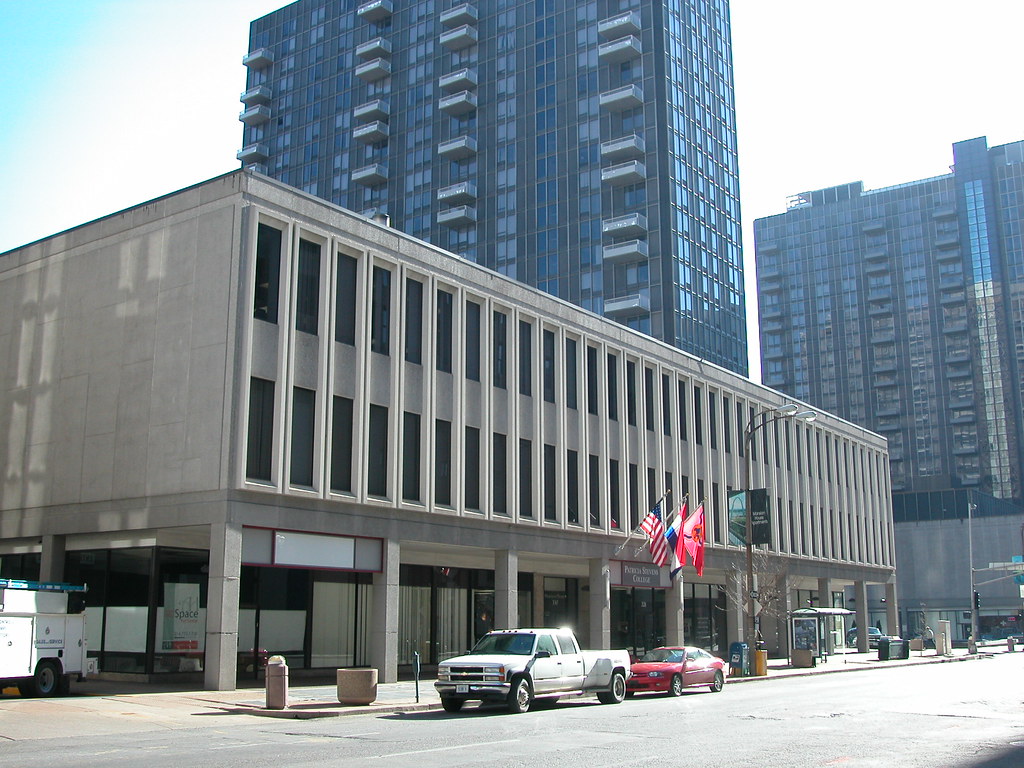
If you answered “two perfectly fine mid-century buildings have been given ugly pink brick socks,” you are right. This is a view looking northwest across Fourth Street at the Gentry’s Landing apartment tower and the three-story office building to the north. These buildings are part of the Mansion House Center, whose three nearly-identical towers and three nearly-identical office buildings are part of an urban renewal project completed in 1966 and designed by renowned St. Louis architects Schwarz & Van Hoefen. The Mansion House Center is a solid work of mid-century architecture, although like many of its contemporaries is somewhat hostile to its urban setting. The buildings are a homespun working of Mies van der Rohe, replacing the sleekness of pure glass and steel compositions with a more pedestrian mix of glass, steel and concrete.

The Mansion House Center is connected by a large parking garage on the east with a delightful upper garden deck. The garage blocks Olive, Locust and St. Charles streets to form a super-block, and is interrupted only by the already-extant Peabody Coal Company Building (1958, Ralph Cole Hall) and a former Washington University alumni club building built as part of Mansion House Center. The garage causes the project to present a public face to Fourth Street and a dull, mostly-utilitarian wall to the Arch grounds on the east.

However, the towers and office buildings were meant to harmonize with the new monument. Schwarz & Van Hoefen designed the Mansion House buildings to frame view of the Arch through downtown with equally-modern architecture. The architects wisely avoided upstaging the Arch with innovative design, instead providing an architectural supporting player. The garage’s monotony belies the fact that its garden roof was supposed to extend the lushness of the Arch grounds into downtown via a unique vantage point. Architecturally, Mansion House does well, although functionally its garage is a barrier between downtown and the Arch grounds that could stand some alteration. (Read Steve Patterson’s ideas for changes here at Urban Review.)

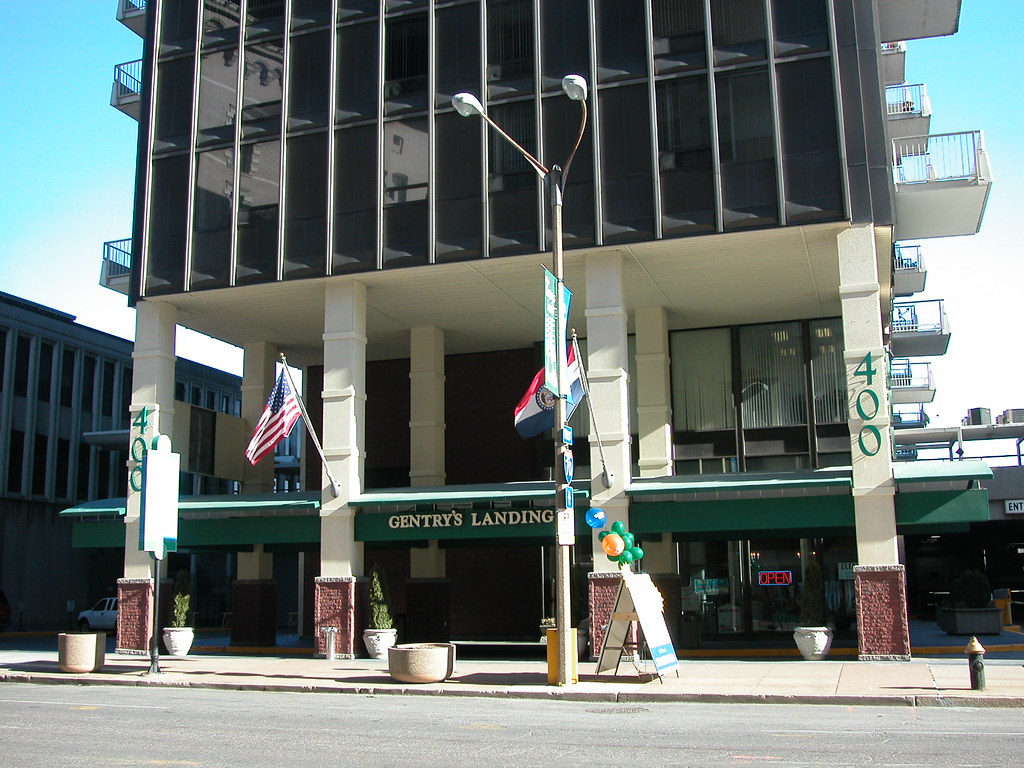
Yet none of the needed alteration involves changing the architectural vocabulary of the Mansion House buildings, whose minimal modern lines evoke the mid-century optimism of St. Louis and only enhance the presence of the Arch. The pink brick applied to the column bases at Gentry’s Landing and its neighbor undermine the grace of the original architectural gesture by making the buildings stick out. Perhaps this gesture is good for leasing apartments, but it is not good for the street scape on Fourth Street.

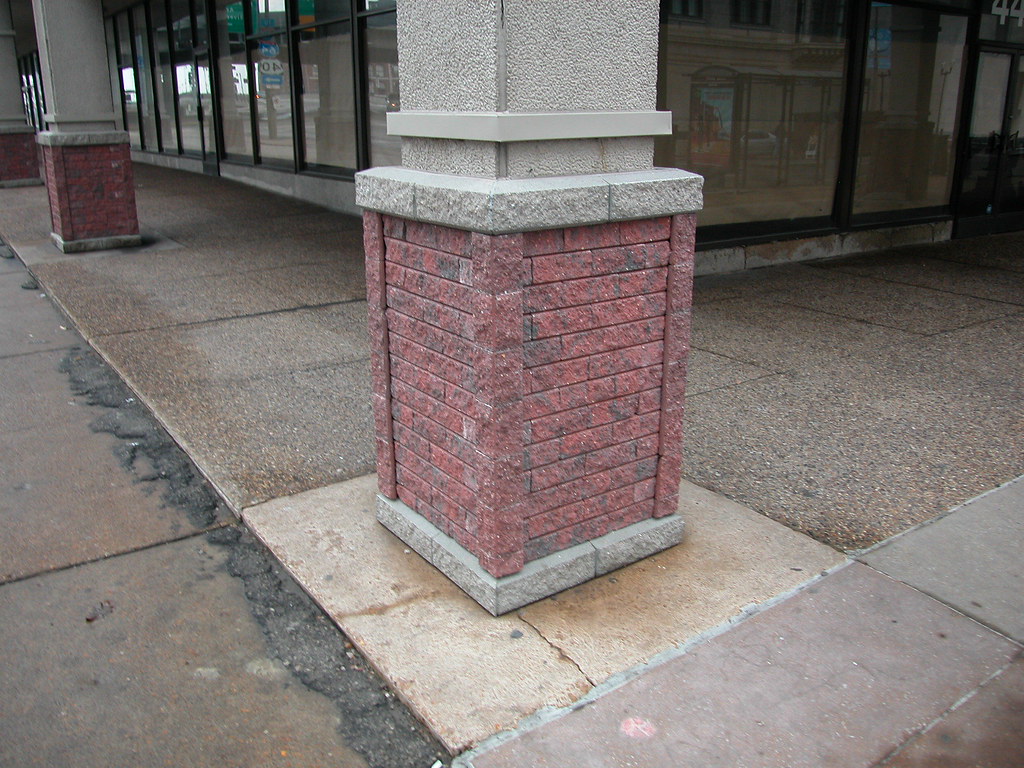
Up close, the brickwork reveals itself to be thin applied rough-faced brick sandwiched between fake stone. The contrast between these bases and the straight lines of the pale concrete columns could not be stronger. Additionally, the columns have been given little concrete bump-outs above these bases.


The photograph above shows the original appearance of the column bases of the next office building south of Gentry’s Landing, which falls under different ownership. One can see how the straight lines of the columns accentuate the projecting window surrounds of the upper two floors.

The restrained modern entrance to Gentry’s Landing is now ablaze with the pink brick bases, a yellow paint on the concrete and green signage. Yes, times change, and developers need to be profitable, but there are many ways to make changes and make money without making bad design decisions. In fact, bad decisions might turn out to be less profitable in the long turn as applied materials age and appear dated while original materials — even mid-century concrete, I submit — retains a sobriety that is attractive.

The entrance of the south tower at Mansion House Center retains its original appearance despite changes of use (apartment to hotel) and addition of awnings (which can be removed). The curved concrete canopy and hotel lobby have been extended through replication of form and material. Changes here have retained the modern lines of the building.

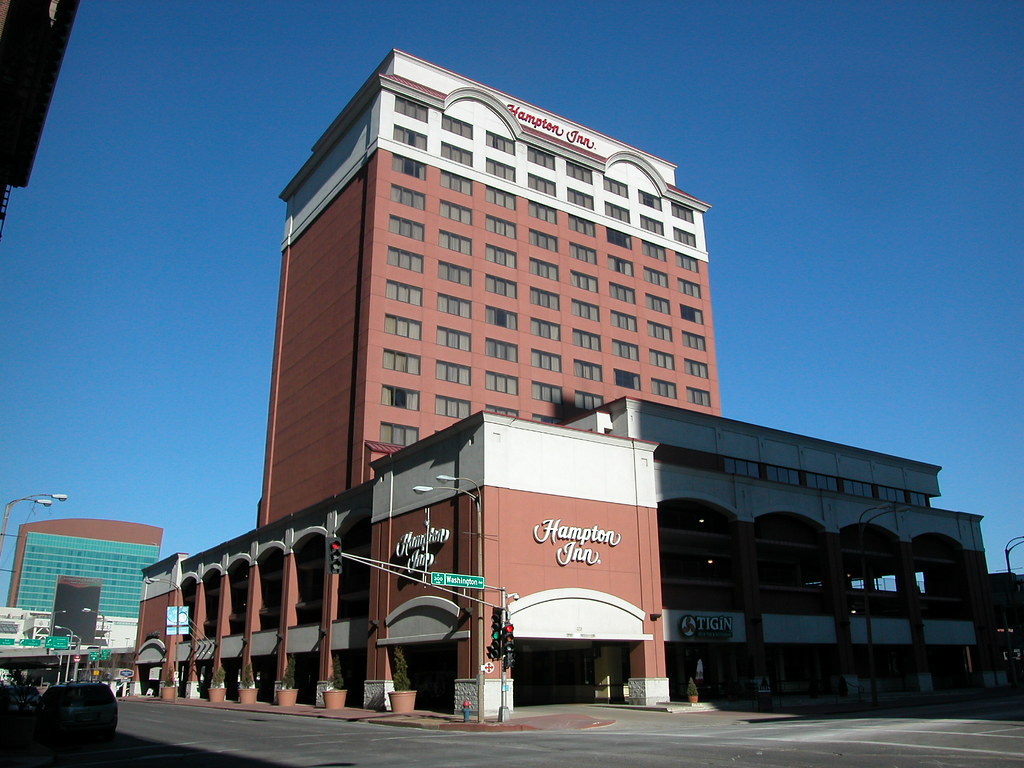
Alas, the Gentry’s Landing project is not the only remodeling project to mar a mid-century building on Fourth Street. Just to the north across Washington Avenue is one of the worst architectural slipcover jobs to hit downtown St. Louis, the 2003 conversion of the former Bel Air East into a Hampton Inn.

Opened in 1964 replete with a Trader Vic’s tiki lounge, the Bel Air East was also a complementary modern building that embraced its location near the Gateway Arch. While the Bel Air East was imperfect, none of its flaws justified the complete covering of the building in pink EIFS. The result of the cladding project is reminiscent of the works of the 1980’s American postmodern classical movement — that is, dull and pretentious.

Of course, one could take the retroactive view further back in time and look at the Adam’s Mark Hotel, whose 1985 construction entailed the complete covering of the Pierce Building (1906, Frederick Bonsack) with flat gray granite and unarticulated brown brick. That disaster destroyed an earlier office building in favor of a work of architecture that doesn’t even deserve the descriptor “mediocre.” Who knew that what happened to the Pierce would happen again to the street’s mid-century buildings?

Categories
South St. Louis Storefront Addition

Storefront Addition: 2839 Cherokee Street

by Michael R. Allen

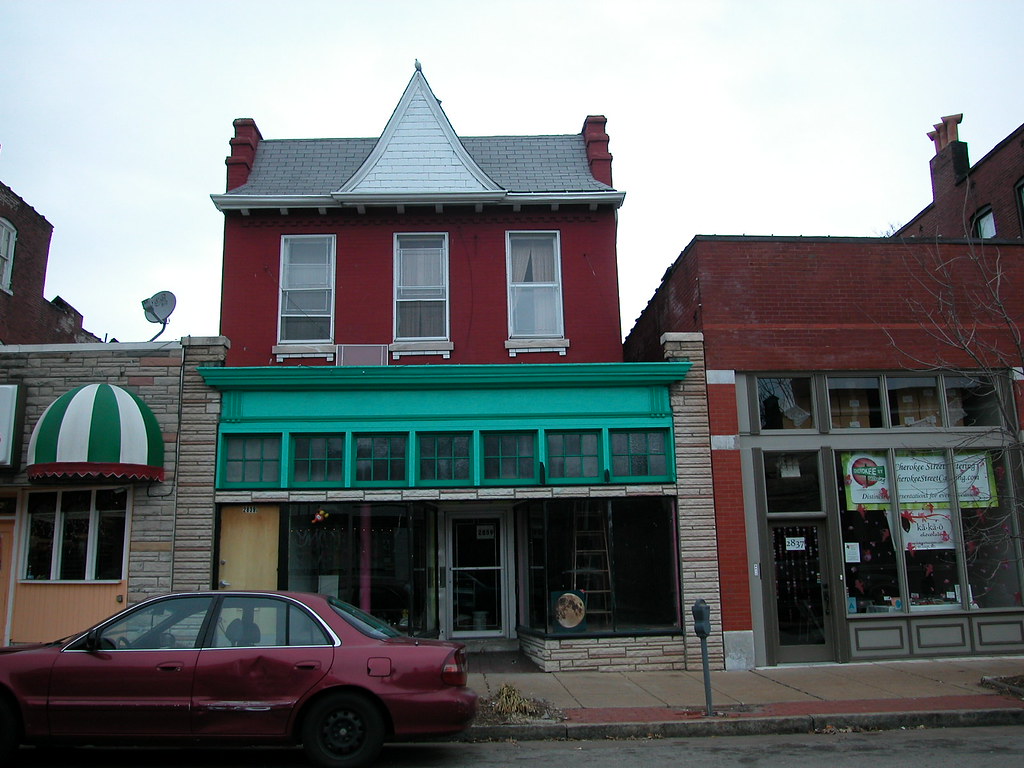
Within the rich architectural range of Cherokee Street’s commercial buildings is the neat storefront addition at 2839 Cherokee (north side of street between Oregon and Nebraska). The parent building, which dates to 1904, is striking with its stepped parapet walls and center gable. The addition is covered in a Permastone-like material, except for the transom ribbon and cornice, which remain in original condition under bright paint. The three vertical lines at each end of the cornice add a subtle elegance to the composition. While the cornice is quite plain, and I am sure the builder was being economical, the spare geometry gives those lines a visual punch they would never have in a more ornate design.

Categories
Central West End Historic Preservation Mid-Century Modern

Scenes from the San Louis Love-In

by Michael R. Allen

Jeremy Clagett captured the following videos at Saturday’s San Luis Love-In that honored the Central West End mid-century motel now known as the San Luis Apartments, threated with demolition for a parking lot by the St. Louis Archdiocese.

In the first video, Jeff Vines offers a rousing poem and I read two “proclamations” in support of the Love-In.

In the second video, Randy Vines talks to reporter Joe Crawford from the St. Louis Post-Dispatch.

Categories
Central West End Historic Preservation Mid-Century Modern

Love-In Raises Awareness of San Luis’ Plight

by Michael R. Allen

Yesterday’s San Luis Love-In was a huge success, with over 75 people in attendance to show their love for the mid-century gem. There was no protesting anything, just a strong stand in favor of restoring the retro-fabulous motel, preserving the integrity of the elegant Lindell Boulevard street-scape and in favor of keeping the major corners of the Central West End anchored by great buildings. True to the spirit of Valentine’s Day, those who attended kept the focus on love — for great architecture, great urban neighborhoods like the CWE and the great power of groups of people to effect change in St. Louis.

Perhaps the best part about the love-in was the media bounce for the San Luis issue. The St. Louis Post-Dispatch provided coverage on Saturday and Sunday, with substantial articles on both days.

Categories
Historic Preservation Schools SLPS

AIA Chapter Issues Response to SLPS Facilities Plan

The American Institute of Architects – St. Louis Chapter has issued the following response to the St. Louis Public Schools’ draft Facilities Management Plan, one that is consistent with the statement earlier published by Landmarks Association of St. Louis:

AIA St. Louis Response to the Comprehensive Facilities Review:

The members of the American Institute of Architects St. Louis Chapter, of whom approximately forty percent reside or work in the City of St. Louis, commend the St. Louis Public Schools for undertaking the Comprehensive Facilities Review. We are pleased that a local architectural firm, David Mason & Associates participated in the study.

We believe, however, that the study focuses on creating a more effective 20th century school system, rather than a visionary 21st century school system to graduate students ready to lead our community into the future. We need to think differently, envision bolder and ponder a different kind of future.

We believe that the MGT plan falls far short of its goal as a “visionary plan” that considers “all options” and strives to find “ways to revitalize St. Louis neighborhoods.” Those statements are noble and deserve to be brought front and center in the SLPS plan. We challenge the St. Louis Public Schools and the Special Administrative Board to envision an urban school system that can be a model of efficiency and the keystone to the redevelopment of languishing St. Louis neighborhoods.

– We encourage community-based schools

Neighborhood schools are the anchors to Livable Communities: The local school, with its athletic and cultural resources, stabilizes the community and provides a place of pride that unites generations of residents. A livable community is one where residents can live, learn, work, and play without using an interstate highway, one where children can walk to their school and learn alongside their neighbors.

– We encourage the pursuit of mixed-use partnerships

Mixed-use occupancy is another hallmark of livable communities. Private-public partnerships could bring significant investment resources to the district while serving community needs. We encourage the pursuit of creative mixed-use partnerships to renovate portions of the buildings with venues for social services, senior housing, government offices, or other functions perhaps through innovative lease or land-lease agreements. Creative partnerships can assist in the funding and maintenance of schools. We believe that cross generational uses of school buildings benefits both generations and provides a synergy otherwise left untapped.

– We encourage sustainability through renovation vs. new construction

The best way to limit our environmental footprint is to continue to use and maintain the resources we have already accumulated. Sustainability begins with re-use and the old recycling adage “re-use, reduce, and recycle” starts with re-use with good reason. High-performance energy efficient buildings do not have to be new. Many of today’s emerging green building technologies can be easily adapted to the existing, historic, architecturally-significant buildings in the St. Louis Public Schools portfolio.

Exposure to sustainable design solutions within schools offers an incredible teaching opportunity and aids in the development of young stewards for the environment and transforms the buildings themselves into learning opportunities. Schools across the country are developing ways for schools to manufacture energy that is then used by the schools and even sold on the market. We see no innovative thinking along these lines.

– We support protection of the historic legacy of the schools

In cases of resale, we support the current contract terms which require renovation of historic school properties in accordance with the standards set forth by the Department of the Interior, and encourage the use of design and construction professionals trained in these standards. We do not support the deed restrictions placed on the property.

We suggest re-visiting the current restrictions to allow new approaches which help St. Louis Public Schools continue their legacy of innovation and show bolder leadership.

The St. Louis Public Schools are challenged to play a key role in revitalizing and rebuilding St. Louis neighborhoods, and its stewardship responsibility must go well beyond its students. We believe that the students’ needs are best met when their schools meet that long range responsibility.

The American Institute of Architects St. Louis chapter does not just wish to comment and leave. In years gone by, a close collaborative relationship with AIA St. Louis and the St. Louis School Board was forged and we suggest that once again, we work closely with you to view the plan with sustainable vision.

Categories
Historic Preservation Missouri Missouri Legislature Public Policy

Missouri Historic Rehab Tax Credits May Be Modified

by Michael R. Allen

In this time of Missouri state budget crunching, the state historic rehabilitation tax credits are again under fire. While the threat to cap, eliminate or modify the credits returns every year and is usually soundly defeated, this year is different. Missouri has hard choices to make about the state budget, and Governor Jay Nixon is under pressure from members of both parties to overcome a massive revenue shortfall.

An Associated Press article published February 12 details the renewed hostility toward the tax credits from Republican Senators Brad Lager, a perennial foe of the credits, and Jason Crowell. This week, Lager placed a $150 million cap on the program in a substitute version of economic development bill SB 45, but the substitute seems defeated after lobbying from developers and legislators who understand the benefits of the tax credit. The big threat now seems to be a counter-proposal to reduce the coverage of the credits from 25% of qualified costs to 20%, the percentage of federal historic rehab tax credit. That change would be disastrous to projects already underway that have not yet collected credits, and it is needless.

Of all of the state’s many tax credit programs, the historic rehab tax credit is one of the most successful and most popular. The best part about it is that its use is wide — from big developers to homeowners in north St. Louis to inn keepers in Augusta, the users are a diverse group. The other undeniable good is that the credit is a sure bet for continuing to create skilled, well-paid construction jobs in Missouri. Historic rehab work requires specialized labor that does not come cheaply, and the stimulus for such work in Missouri has not only kept many tradesmen employed but has created new jobs in fields like plastering, masonry and finish carpentry. Workers who were paid entry-level wages to hang drywall have gone on to work on tax credit-financed projects where they gain skills that land them solid pay. In this downturn, we can’t afford to let these skilled workers out of a job.

Meanwhile, the National Trust for Historic Preservation lauds the Missouri rehab tax credit as a model in stimulating small development projects and in creating skilled construction jobs. (The Trust’s page inexplicably features a photograph of the James Clemens, Jr. House in St. Louis in a line-up of otherwise rehabbed Missouri buildings.)

Keep up on the latest news in the Missouri historic rehab tax credit struggle at the Save the Historic Tax Credit website. Contact your legislators immediately and urge them to support the historic rehab tax credit the way it is now — working for Missouri!

Categories
Central West End DeVille Motor Hotel Historic Preservation Mid-Century Modern

Stories from the DeVille Motor Hotel

by Michael R. Allen

Photograph of the DeVille Motor Hotel in context by Jeff Vines.

There’s nothing quite like a posh urban hotel. A fine hotel has long been the ultimate urban meeting place. From big convergences of finely-dressed party-goers to small groups of martini-lunch businessmen to encounters even more discreet — the hotel is the place. The hotel is a fashionable but not ostentatious place for all manner of meetings, dining and drinks.

Hotels like the Chase, Park Plaza, the Mayfair and the Coronado are the legendary settings. How do we know this? The stories people tell. People talk about the restaurants, the dances, the political meetings, the bars, the music, the celebrities and all the things that made these more than just pretty buildings. we know that these buildings connected a lot of lives, and became part of thousands of memories.

The mid-century DeVille Motor Hotel at 4483 Lindell Boulevard, later the Holiday Inn Midtown, is not as old as the stalwarts of St. Louis’ golden age of hotels, but it was the cream of the crop for the modern era. The DeVille definitely was a social hub in the 1960s and early 1970s. Perhaps we don’t think of stories from that recent past as part of our history, but we should. The DeVille was the meeting spot for a different generation — one that shaped contemporary St. Louis and breathed life into a city struggling with depopulation and sprawl. At the DeVille, the Central West End extended its glory days long enough to survive, and thousands of St. Louisans passed through its doors in the process.

What are their stories?

At B.E.L.T, Toby Weiss is collecting those tales from our recent past. Submit one of of your own here. This is a great project! Too often, we don’t know how much a role a place has played in our lives until its lost. That’s a shame, because we have the power to keep history alive in our own time simply by saving our own stories for future generations.

Categories
Historic Preservation Schools SLPS

SLPS to Open Its Own Charter Schools?

by Michael R. Allen

The Slay for Mayor website posted an interesting item today. The writer mentions a Suburban Journals article that featured quotes from St. Louis Public Schools Superintendent Kelvin Adams:

According to the Sub Journal reporter, Dr. Adams said the public school district could open five charter schools of its own next year. He said that these charters, like the public charter schools currently attended by about 9,000 of the City’s children, would have autonomy in their administration and governing board and more flexibility in their school days and types of curriculum.

Does this possibility merely coincide with the current facilities management planning process and its potential to generate massive school closures?

Read more here.