Categories
Historic Preservation JeffVanderLou North St. Louis Northside Regeneration

Not Long for This World?

by Michael R. Allen

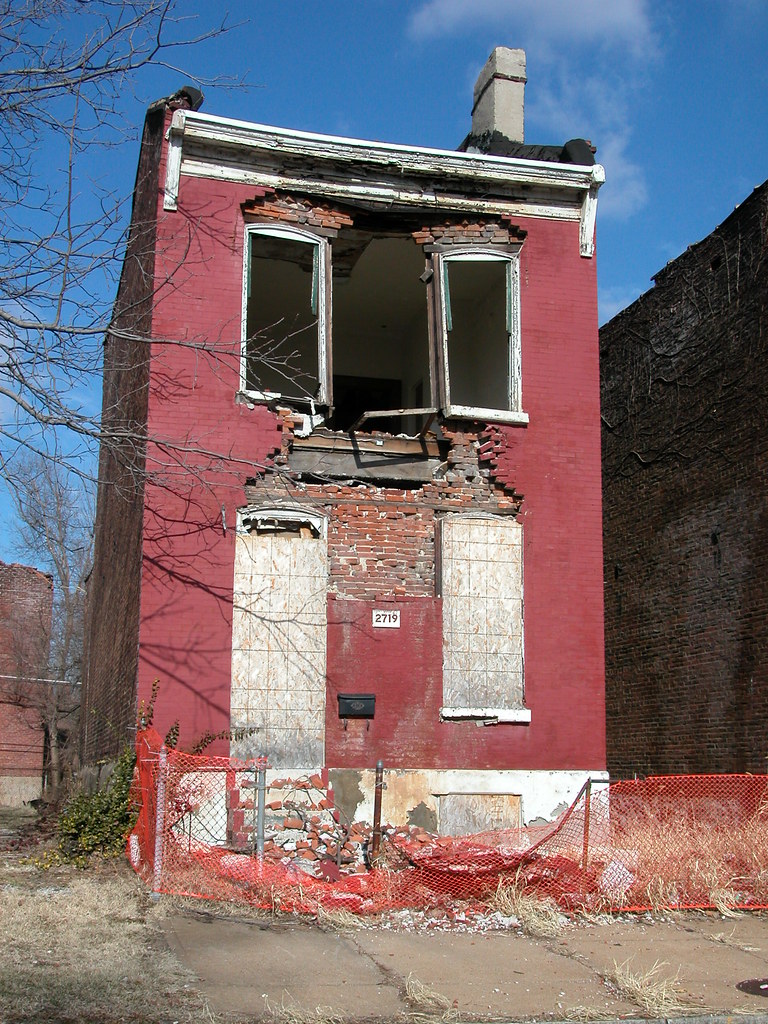
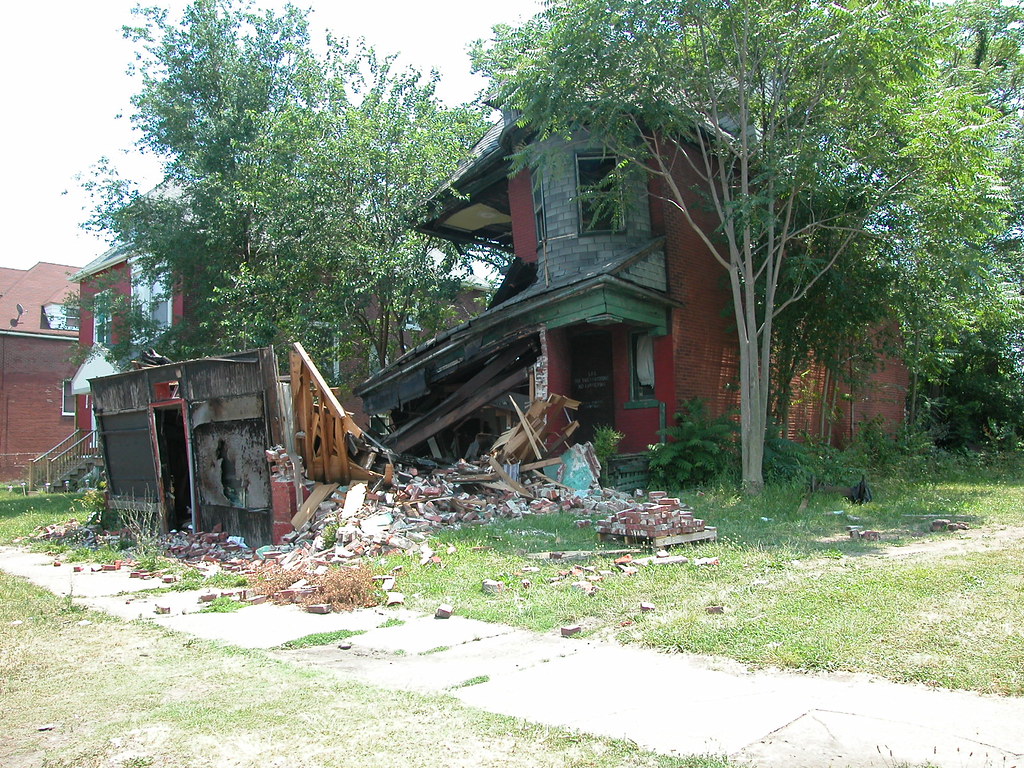
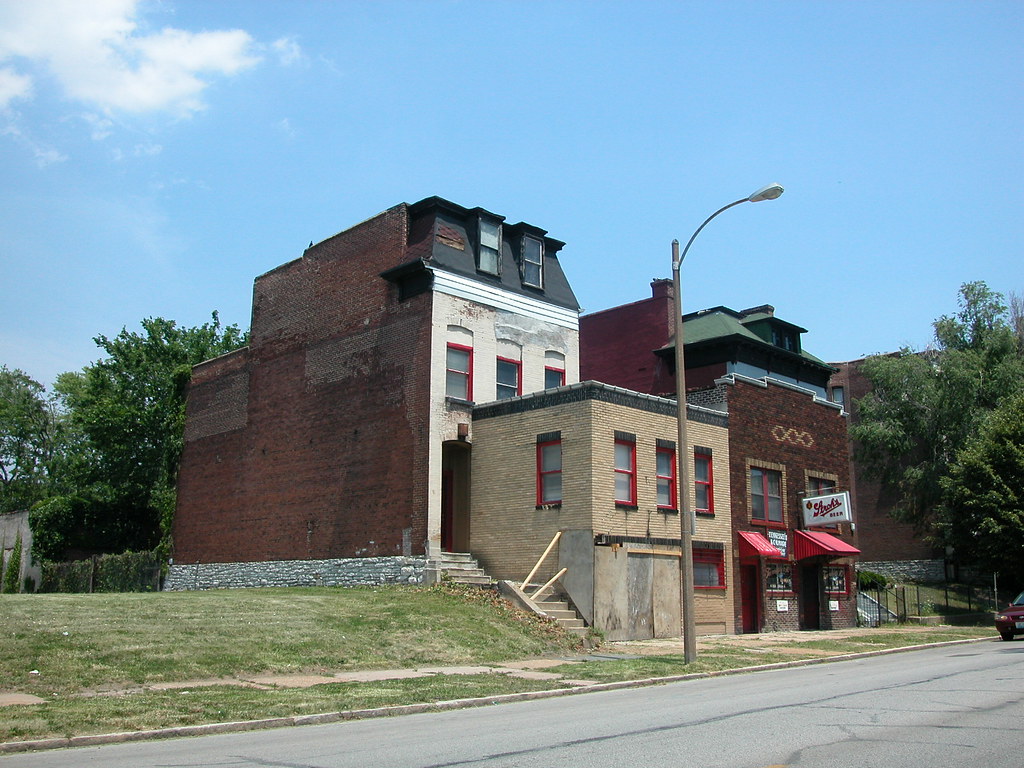
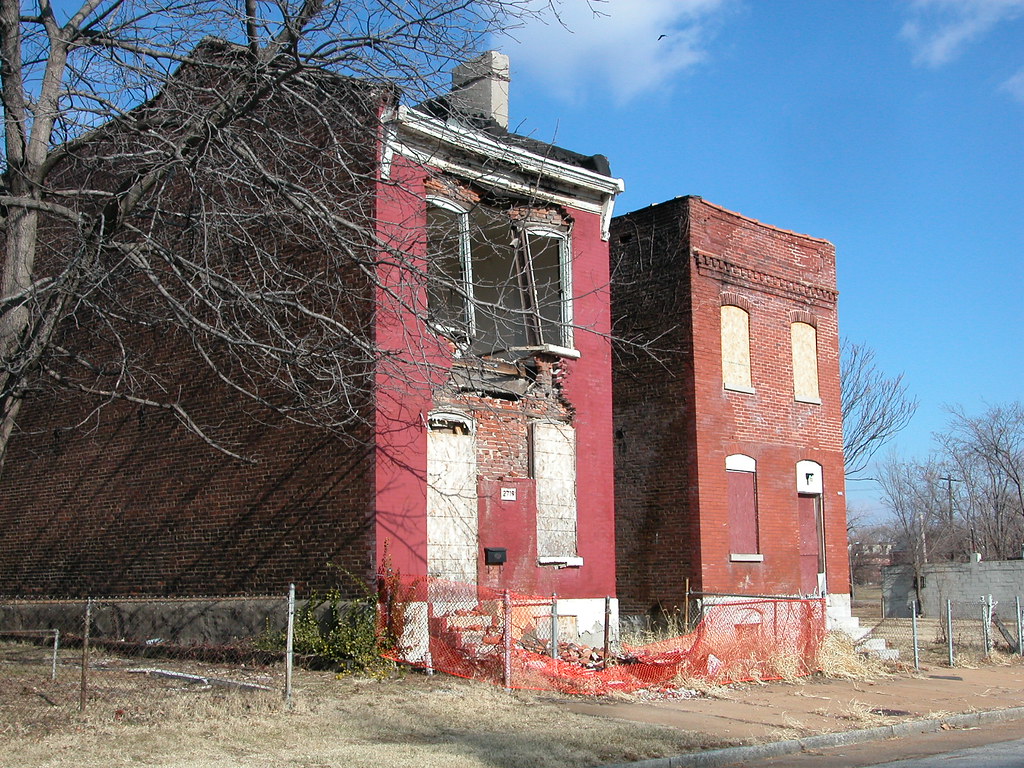
The house at 2719 Madison Street (left), owned by N & G Ventures since 2006, is obviously facing serious problems. The front wall collapsed in early 2008. While the joists run parallel to the front wall and are in no way compromised by the wall collapse, the roof structure is clearly sagging. The old house in JeffVanderLou dates to 1879 and managed to dodge decades of area decline. Two blocks east is the Pruitt-Igoe site. All around this block are vacant lots and derelict historic buildings. In the past five years, the speed of abandonment has rapidly increased, but the worst toll hit this area between 1950-1980.

The surviving buildings hung on, due to better ownership or physical condition than neighbors. Will the survival of remaining resources be only momentary? That’s up to current owners and political leaders — especially the aldermen who have the power to craft a redevelopment ordinance that will detail requirements for preservation, land use and eminent domain. For every house with a wall collapse is one like the next-door neighbor here, which is vacant but as solid as ever. No matter what, this poor house at 2719 Madison Street does not seem long for the world.

Categories
Historic Preservation North St. Louis Old North Signs

Park’s Sign Once Again Aglow in Old North

by Michael R. Allen

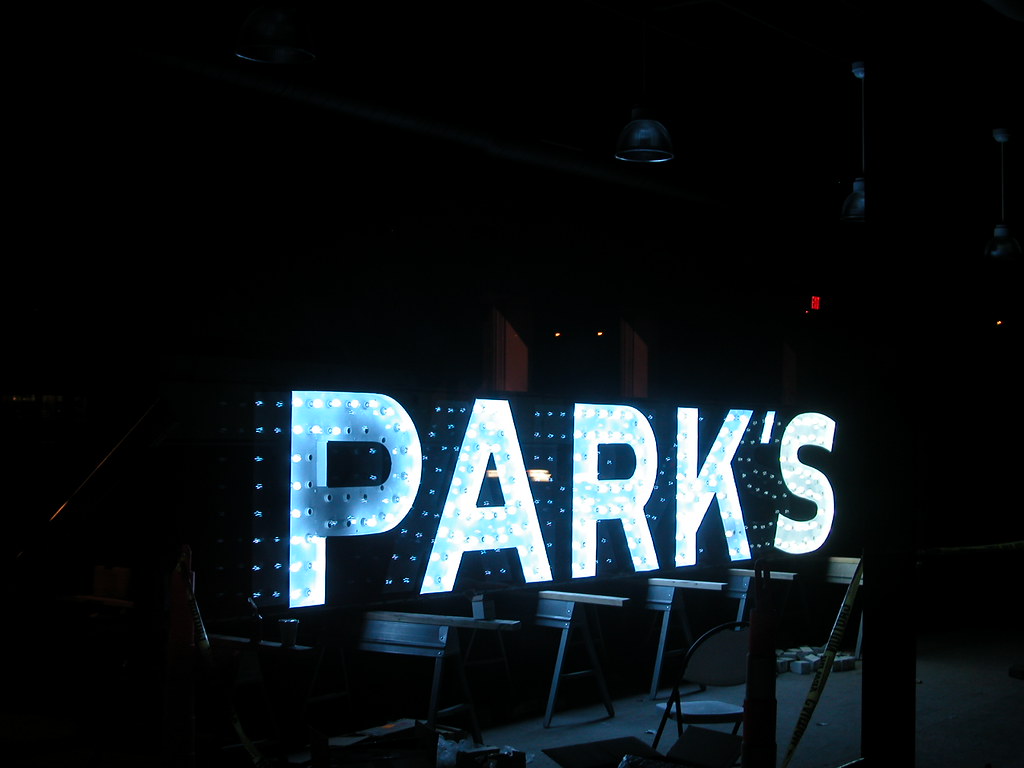
This week, night-time pedestrians trying to catch a glimpse of the rehabilitation progress on 14th Street in Old North St. Louis saw the light — the light of the newly re-lit Park’s Drugs sign that has been a fixture of the intersection of 14th Street and St. Louis Avenue for decades. Although the sign resides inside of the building that once housed Park’s Drugs, soon it will return to the side of the building.

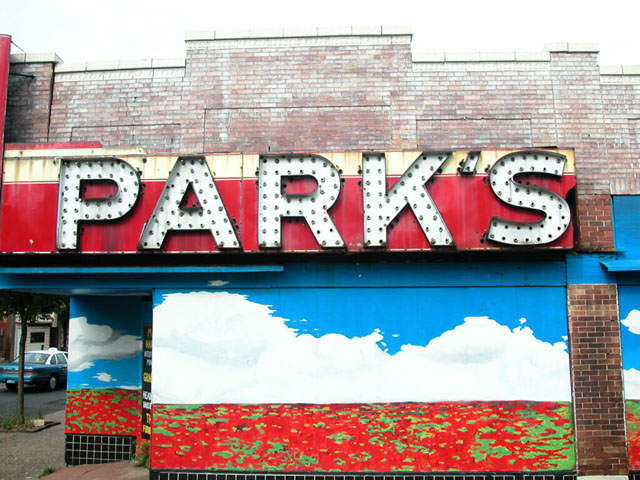
The sign’s restoration is testament of a dramatic rescue of both the sign and the building. In 2004, this is what the Park’s building (built in 1931) looked like:

Colorful murals adorned plywood hiding the sad fact that most of the roof had collapsed inside of the building. The sign had once been symmetrical, wrapping the corner with the word “DRUGS.” The sign was reduced through overzealous actions by the state pharmacy license coordinator in 2000. The coordinator was enforcing a state law that forbids use of the word “drugs” in signage on a business that does not have a pharmacy license. The Park’s building was fire-damaged, vacant and owned by the city’s Land Reutilization Authority.

The scrap value of the enameled metal sign board was high enough that many wondered when the sign would simply disappear. However, the worst never came. Instead, the Park’s building became part of the transformational Crown Square redevelopment project that started in September 2007 and is slated for completion this April. That project entails gut rehabilitation of 27 buildings as residential and retail spaces and the reopening of the closed section of 14th Street.


The Park’s building will even return to its original life. The entire building will be returned to retail use soon. Substantial work is complete and the building has been used for art openings, community events and educational events in recent months.

Categories
Historic Preservation Ladue Mid-Century Modern St. Louis County

More Mid-Century Modern Rehabbing Ahead?

by Michael R. Allen

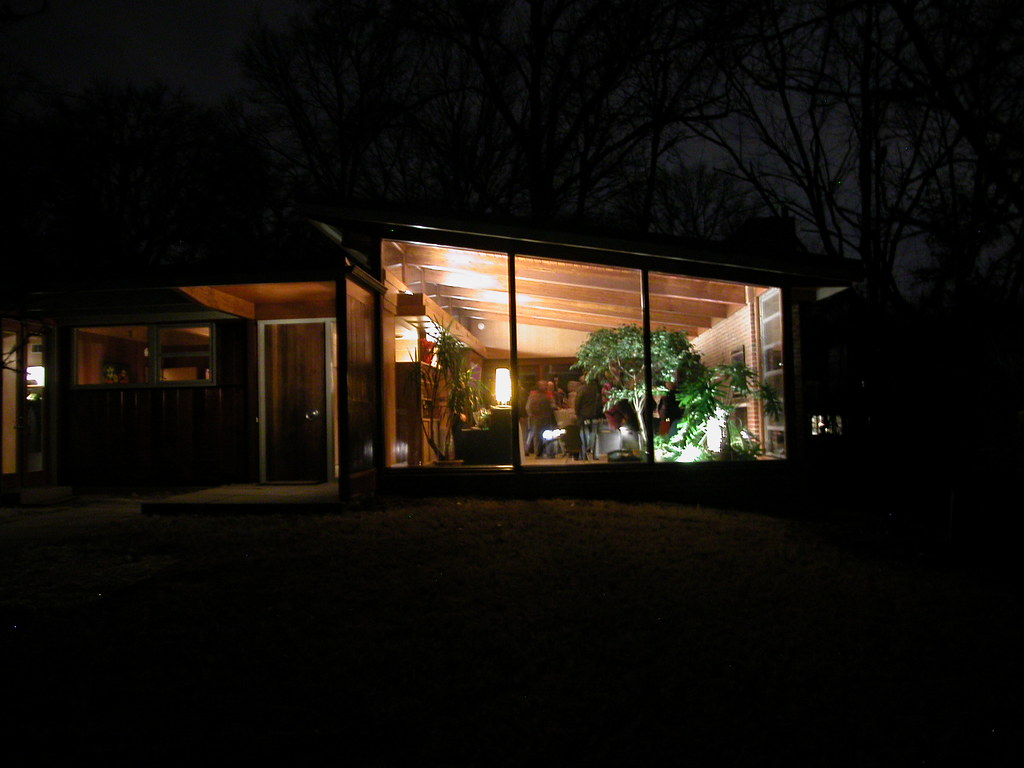
At a swinging party on Sunday, architect and rehab trend-setter Ray Simon celebrated completion of the rehabilitation of the Harry Hammerman House in Ladue. Guests enjoyed a look at the amazing realized potential that small mid-century homes offer. While the Hammerman House, a Usonian-inspired gem from 1952, is quite unique, its plight before Ray’s purchase was not. Designer, builder and occupant Hammerman passed away in 2001, and the house sat vacant until Simon’s purchase. Meanwhile, it was considered for a tear-down by an intervening owner. During this time, Ladue lost the Morton May House, the Louis Zorensky House and countless other mid-century modern houses large and small. On Graybridge Road, where the Hammerman House is located, one other modern home has fallen to the tear-down trend.

The rehab of the Harry Hammerman House breathes new life into a fine mid-century home, uses historic rehabilitation tax credits and allows a unique street to retain its character. What Ray Simon did can and should be done elsewhere across St. Louis County. The sobriety of the current housing market may help convince homeowners that conservation, retro-cool design, energy economy and modest scale are better for long-term investment than the super-sized, vinyl-clad villas that fed on the abundant east credit. St. Louis County is a treasure trove of opportunities for getting the most out of the new market!

Read more about the Harry Hammerman House here.

Categories
Downtown

Approaching St. Louis

Approaching St. Louis

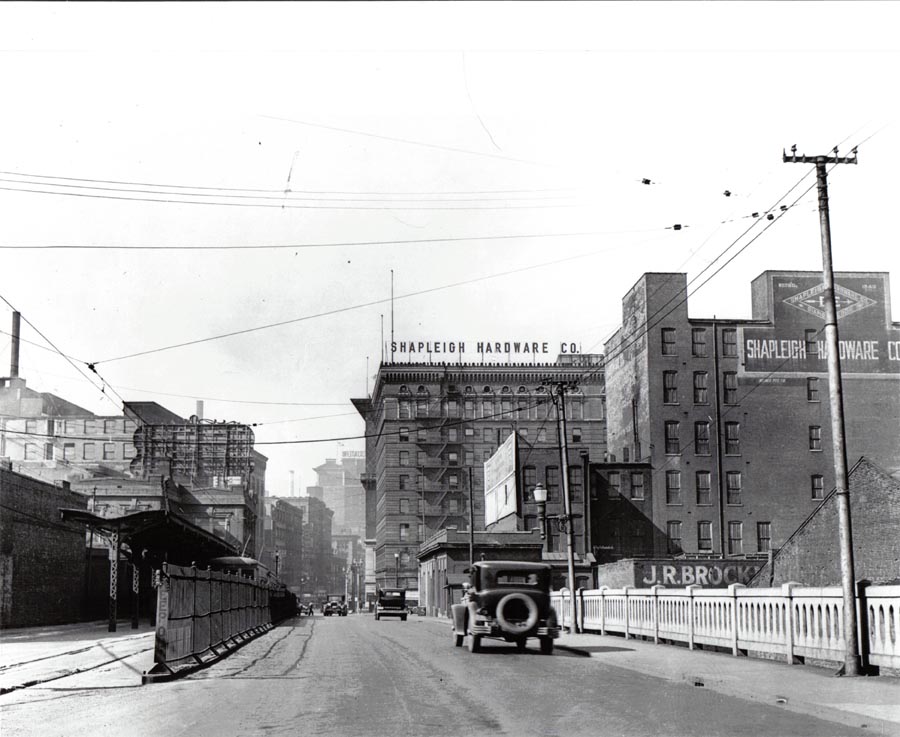
View west from the upper deck of the Eads Bridge, c. 1930. Photograph from the collection of Landmarks Association of St. Louis.

Categories
Historic Preservation North St. Louis Wells-Goodfellow

A Corner in Wells-Goodfellow

by Michael R. Allen

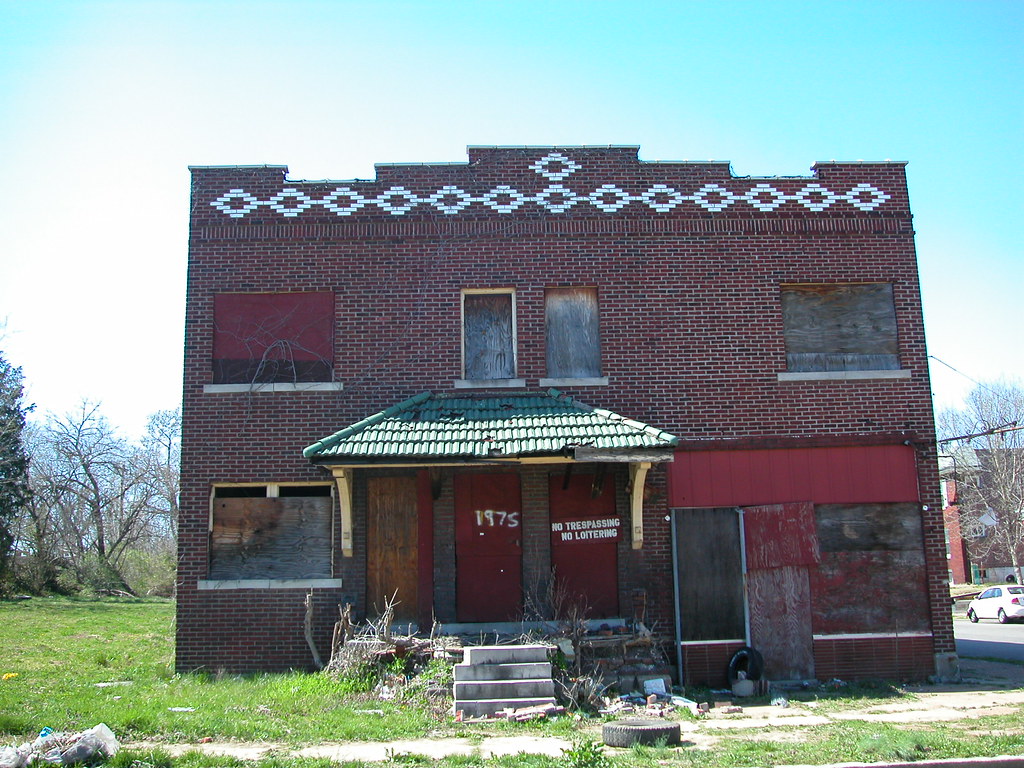
1975
This photograph shows the corner building at 1975 Burd Avenue (at Wabada) in April 2005, before its demolition in October 2005. The bakery brick pattern at the cornice and the tiled roof porch over the entrance were fine distinctive features. Like many north side neighborhoods, Wells-Goodfellow, where this building was located, has lost many mix-used corner storefront buildings. These losses erode the bookends that hold blocks together. While walking the streets around here, one turns the corner to find a vacant lot rather than a landmark signifying this location. The impact of such loss on the neighborhood is obvious. Residents complain about the loss, but they also complain about having to live around so many vacant buildings.

Consequently, Alderman Jeffrey Boyd (D-22), whose ward includes Wells-Goodfellow, and residents have been working to leverage federal block grant funds to pursue historic district designation for buildings and sections of the ward. These designations create incentives for rehabilitation and investment. Sure, it is a long road, but the neighborhood has been down a longer road of decline. Things aren’t going to change overnight, but things won’t change at all without laying groundwork for reinvestment.

Categories
Martin Luther King Drive North St. Louis Streets

MLK Clean Up

From State Senator Jeff Smith:

Closer to home, I’m organizing our second annual Martin Luther King, Jr., Day Cleanup of MLK Jr. Blvd in the city, on Monday, Jan. 19 – the state holiday honoring the civil rights leader. This is a great opportunity to honor the life and memory of Dr. King, and last year, (in spite of the weather), we had a great time doing it. I invite any of you, along with your friends, friends, neighbors and any organizations to which you belong, to meet at the corner of MLK Jr. Boulevard and Union at 12 p.m. on Monday. Gloves, trash bags, donuts, and hot chocolate will be provided!

If you can make it, just call my district aide Johnny Little at (314) 601-4252, or reply to this email (jeff.smith.reply@gmail.com).

Categories
2009 St. Louis Election Infrastructure South St. Louis Streets

Pointless Change at Grand and Chouteau

by Michael R. Allen

At last night’s candidate forum sponsored by the 15th Ward Democrats, Comptroller Darlene Green received applause for an issue not directly related to her campaign. When asked about red light cameras, she said that she definitely knew of a camera that needs to be removed: the red light camera at Grand and Chouteau. Mayor Francis Slay arrived during this time, so Green directly addressed the mayor from the podium.

The problem with the light, Green said, is that it is part of changes to the intersection that forces the three lanes of southbound traffic on Grand into two with a left-turn-only lane at Chouteau. Past Chouteau, the road is back to three lanes. Rarely do left turns clog the southbound lanes, and there are always vehicles in the inside lane that have to move over at the last minute to avoid getting a camera ticket from running straight in a turn-only lane.

The audience burst into applause, for good reason. That intersection reconfiguring is one of the silliest in the city. Before the camera went up, I joined many drivers in ignoring the changes. Since I am not an alderman, getting a red light ticket fixed might be difficult, so I now reluctantly obey the pointless changes there.

All of the red light cameras violate the spirit of the Fourth Amendment to the U.S. Constitution and any sensible view of law enforcement. I hope that Comptroller Green’s recommendation is followed, but we need to pull them out completely. The changes at Grand and Chouteau are blatantly revenue-driven, and impede smart traffic flow there. They need to be undone. Then we need to get rid of the remaining red light cameras and find a more dignified, constitutional way of enhancing city revenue.

Categories
Churches Fire North St. Louis Old North

Inside Fourth Baptist Church

A Flickr photographer has posted despressing photographs from the interior of the Fourth Baptist Church at 13th and Sullivan in Old North St. Louis. The worst part of these photographs is how much combustible material is evident.

Readers may recall that the church was struck by a huge fire on September 20, 2008. The fire severely damaged the sanctuary, while firefighters’ hose spray caused structural damage to an adjacent house and an attached annex. To date, a fence has been erected on the sidewalks around the wrecked church, but the windows are not yet boarded and evidently the interior is accessible. The small congregation has promised that stabilization work will begin in the spring, and assistance from the St. Louis Baptist community is on the way. Hopefully this promise holds true, because the Fourth Baptist Church, founded in 1851, is one of the region’s oldest congregations and deserves wide support in a heroic effort to save the church building.

The photographer concludes that “even after such a gigantic disaster, one can still see how reposed and fine it once was.” I concur, although I hold little hope that the entire complex will be rescued from tremendous damage. The sanctuary is vital, however, because it anchors not only the corner but site lines from the south on 13th Street and east on Sullivan Avenue. One can see the church from as far south as Warren Street, and from the east at Ames School. To have that view opened would be a tremendous loss to Old North.

Categories
Gravois Park Hyde Park LRA North St. Louis South St. Louis Storefront Addition

Storefront Additions: Two Inserted Fronts

by Michael R. Allen

All across the city are examples of residential buildings adapted to later commercial use. As neighborhoods changed, so did uses. In early 19th century walking neighborhoods, commercial uses needed to be abundant to serve residents who could not travel far to get food, shoes or a hair cut. Later, after the streetcars gave middle- and working-class residents greater mobility, residential buildings located along street car lines were ripe for commercial use, especially in areas where property values declined because of the new street car lines.

Many examples of the common storefront addition involve the construction of connected one- or two-story buildings in the lawn space of houses and flats. However, in neighborhoods east of Grand, many early converted buildings stood at the sidewalk line. Here, the best way to create commercial space was through the insertion of storefront openings in existing front elevations. Typically, cast iron columns and combined beams would “jack” the new opening in the brick wall. Often, floor levels inside of the building would be altered to draw the shop floor down to sidewalk level from is common position at the head of foundation walls.

Two examples of similar buildings from different neighborhoods illustrate how this practice happened across the city.
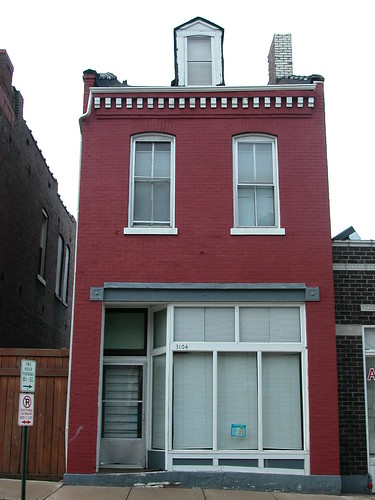
3104 Cherokee Street
The flats at 3104 Cherokee Street in Gravois Park date to the middle 1880s, some time after G.M. Hopkins published his atlas of the city in 1883. The side-gabled house is two bays wide, with some decoration evident in the brick cornice. The roof bears a single dormer. Each floor originally was configured as three rooms laid out shotgun style, front to back with no hall. The first floor has obviously been changed, with a storefront opening inserted. The side entrance, angled wall, beam box above the opening and generous window sizes are typical of the period of alteration, the 1890s.

In some ways, the house at 1419 Mallinckrodt Street in Hyde Park is the sister to the house at 3104 Cherokee. Size, fenestration, cornice treatment, roof line and original floor plan match. The building does appear on the 1883 Hopkins atlas. However, the storefront inserted is much different and later than the other. A simple beam heads the store opening, supported by two cast iron columns with Doric capitals forming a central entrance. To each side is brick infill with double-hung wooden windows in segmental arch openings. Now the building is vacant. Broclyn Real Estate Investment of Jefferson City purchased the building from the Land Reutilization Authority in 2006, but has completed no work to date and is close to a Sheriff’s sale for back taxes owed.

Categories
Architecture Demolition Storefront Addition

Storefront Additions: Delmar Boulevard West of Vandeventer

by Michael R. Allen

My recent post on the demolished Delmar Foods storefront addition reminded me of the trove of storefront additions on Delmar Boulevard between Vandeventer and Whittier streets. Some were lost before my time, for sure, but the remaining examples are impressive.

Of course, I cannot attest to whether or not the storefront addition and house across the street from Delmar Foods was impressive. On June 10, 2006, I photographed the storefront addition at 4162 Delmar in the midst of demolition:

The remaining gems are one block east, all on the north side of the block. Two fancy additions stand adjacent to each other at 4033 (right) and 4035 (left) Delmar.

The vacant storefront at 4035 Delmar dates to the early 1930s, and its parent house is a Second Empire town house from 1884. The storefront at 4033 Delmar houses Tennessee’s Lounge, and is less obviously an addition. The original house also dated to around 1884, and the addition to 1925. However, this was not the usual attachment, because the developer severely altered the house, removing its original roof line and building the addition into the house to completely
obscure it. According to records, the house at 4033 Delmar was the home of Gus C. Meissonier, a member of the Merchant’s Exchange. The conversion of the house of a member of the civic elite into commercial space was quite a big change.

A similar storefront addition project happened at 3963 Delmar eastward on the block, and coincidentally the space is also occupied by a lounge, Waldorf’s.

These additions tell us about the rapid and abrupt changes of our city in the early days of the twentieth century. We were booming!