Categories
Downtown Green Space JNEM

Needed: Public Input

by Michael R. Allen

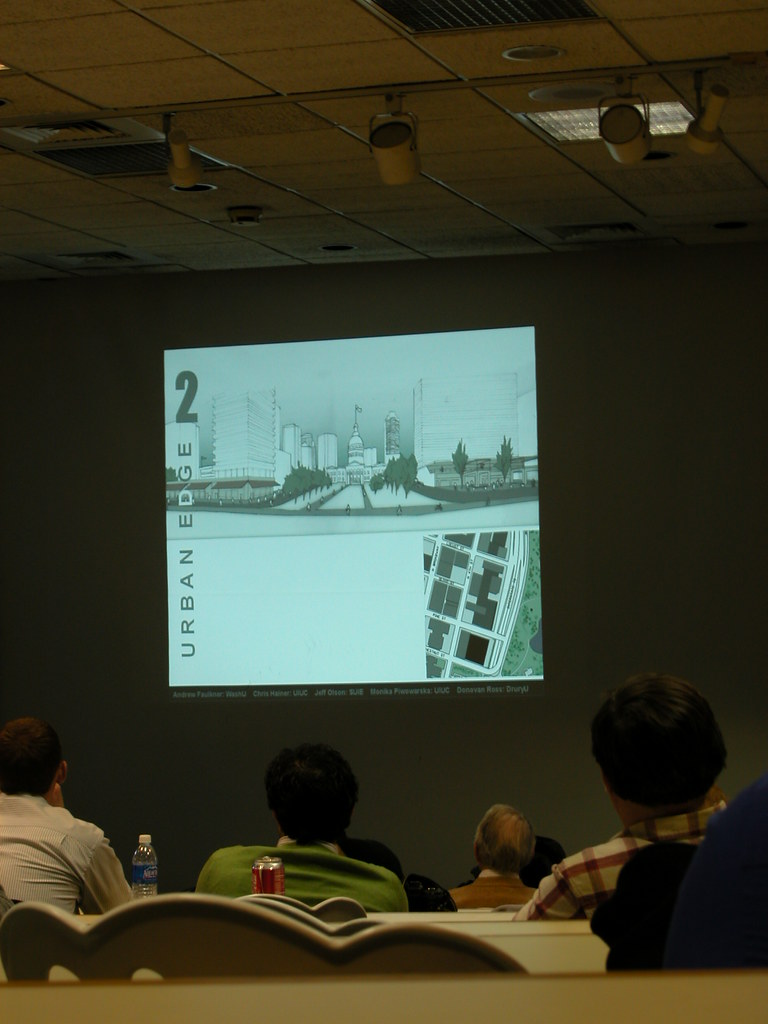
As I sat in the Steinberg auditorium on Friday night waiting for the start of a panel discussion on the Jefferson National Expansion Memorial, I wondered where the crowd might be. The panel discussion was part of this weekend’s student charrette sponsored by the local chapter of the American Institute of Architects and the Transportation Engineering Association of Metropolitan St. Louis, and featured the public match-up of Danforth Foundation President Peter Sortino and Jefferson National Expansion Memorial Superintendent Tom Bradley. Joining the panel were moderator Robert Duffy of the St. Louis Beacon, George Nicolajevich of Cannon Design and Professor Eric Mumford of Washington University. The line-up promised to be provocative.

Alas, the spirit of debate was rather tepid, although the panelists were in top form. First, the critical mass of interested citizens that I expected did not attend. Most of the audience were students participating in the charrette, university faculty and charrette speakers. Curious citizens were not present, nor was the pack of urbanist bloggers who usually pack meetings. The panel was widely advertised, too, so people did know this was going on.

At Sunday, student presentations at Mansion House, I felt the same disappointment. Where were my fellow St. Louisans? Where were even those people already disposed to caring? Where was Sortino? The press, aside from intrepid Post-Dispatch editorial writer Eddie Roth? (Tom Bradley was present.) Even I was late, scheduling something else during that time. The students put considerable intellectual energy into their projects and presentations, and generated many useful ideas. The students were, quite frankly, buzzed by the charrette. There were even smiles!

I am wondering what sort of attention the region’s citizens have paid the Arch grounds debate. With minimal attention and input, proceeding with any plan now is reckless. First, the public needs to be drawn out from whatever barriers that keep them from caring about the fate of the region’s front door. Perhaps the distance of the Arch from our citizens’ daily lives is a block to investment in discussion about design changes. The Arch grounds occupy a spot on the far east edge of the city, and terrible highway infrastructure cuts them off from even immediate urban surroundings. Maybe people don’t think of the Arch grounds as “theirs.”

Perhaps the debate has been too mired in polarization to draw interest. If the discussion is framed in terms of the Danforth proposal, the outcome may seem quite the fait accompli to most people familiar with business as usual in Mound City. The discussion needs to be recast. After all, we are talking about the future of public land. It belongs to the people, and the people ought to direct or at least inform the future of the Jefferson National Expansion Memorial.

One thing that I think is keeping people from becoming interested: there are no visuals to back up any of the ideas about the grounds. The Arch itself is such a powerful visual symbol. Every St. Louisans knows it. Few know what the Danforth Plan looks like, or what a revamped Memorial Drive looks like or even what a lid over I-70 looks like. To most people, ideas for changing the grounds are painfully abstract. To build public excitement, visuals are needed — showing problems and solutions.

Good news: the students participating in the charrette just created a bunch of such images. Hopefully the student charrette ideas can be spread around — the proposals will be exibited starting in late November — and amplified. The Memorial is public land, and we are the owners — that is, as long as we act like we are.

TAKE A LOOK YOURSELF: Over at the Post-Dispatch‘s blog The Platform, Eddie Roth has posted his thoughts and a lovely, impressionistic video featuring sounds and sights from Sunday’s presentations. Check it out here.

Categories
Flounder House Historic Preservation Housing Hyde Park LRA North St. Louis

Floundering Frame Flounder House

by Michael R. Allen

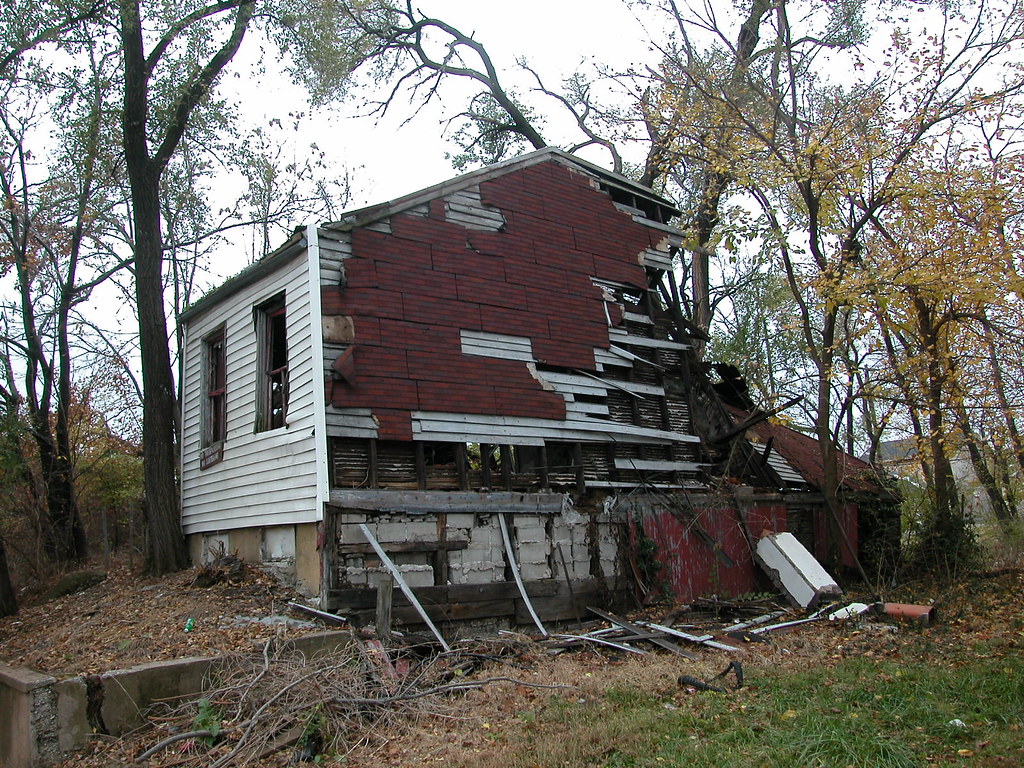
This morning, I attended a meeting where Alderman Freeman Bosley, Sr. (D-3rd) pledged to never support another demolition in Hyde Park again. Historic buildings’ value will surely increase, reasoned the alderman, “even the ones with only one wall left.” On the way back, I passed a Hyde Park house that nearly matches the alderman’s welcome remarks.

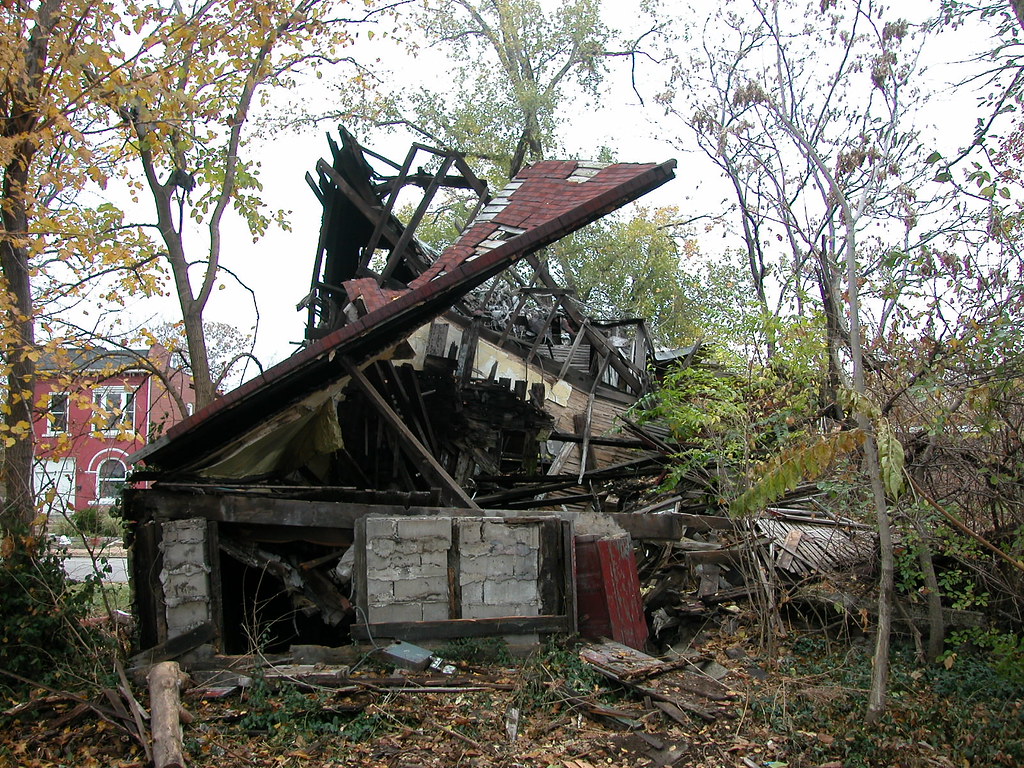
The frame house at 2911 N. Florissant Avenue is, to put it mildly, derelict. The rear half of the house has collapsed and the front has a severe lean. Owned by the city’s Land Reutilization Authority and vacant since 1996, the house has reached a point where demolition — either by condemnation or simple collapse — is a foregone conclusion.

That conclusion is sad, because the house itself is quite a unique specimen of that peculiar house type known as the flounder house. Historians have only found the flounder house form in St. Louis and parts of eastern Virginia. The origin of the flounder house is unknown, but the form is easy to spot: the roof slopes sharply from one side of the building to the other. The form garnered its name because the roof pitch made the house look like half of the head of a flounder fish.

In St. Louis, there are probably less than 30 flounder houses left. Most are small one-and-a-half-story homes, but a few are two-and-a-half stories tall. Benton Park, Gravois Park, Marine Villa, Soulard, Old North St. Louis, St. Louis Place and Hyde Park all have flounder houses. The noteworthy thing is that, of all of the examples that are known to survive, the house on North Florissant is the only frame flounder house. While others may exist, perhaps altered beyond recognition, none have been identified by historians at the Cultural Resources Office or Landmarks Association of St. Louis. The house in Hyde Park is quite unique.

Another interesting element to the house is that the side walls of the foundation seems to consist of two wooden sills spaced by a fachwerk wall atop a shallow rubble stone base. Fachwerk is essentially the use of covered masonry to fill in spaces between studs. Outside, a fachwerk wall looks like clapboard, timbered stucco or whatever cladding conceals it. This foundation’s original cladding and masonry are gone, with concrete block and weatherboard substituted.

Alas, being a badly-deteriorated frame building in Hyde Park does not distinguish the house. Hyde Park has many ailing frame structures that are worthy of preservation. Most are in better shape than the flounder house.

Categories
Abandonment Housing JeffVanderLou LRA North St. Louis Planning

Side by Side on Sheridan Avenue

by Michael R. Allen

Left: 2944 Sheridan Avenue, abandoned and owned by the city’s Land Reutilization Authority. Right: 2946 Sheridan, privately owned and well maintained. Left to right: one historic building in the city’s JeffVanderLou neighborhood.

Categories
Abandonment Housing JeffVanderLou LRA North St. Louis

Abandoned in Less Than Thirty Years

by Michael R. Allen

The sight of abandoned buildings less than thirty years old can be particularly unsettling. Urban housing that has been built and abandoned within a thirty year time frame tells a tale of acute failure. Blame it on the design, cheap construction, bad tenants or shady landlords — no matter. That a society can discard relatively new buildings shows fundamental problems with our values.

These buildings in JeffVanderLou are good examples.

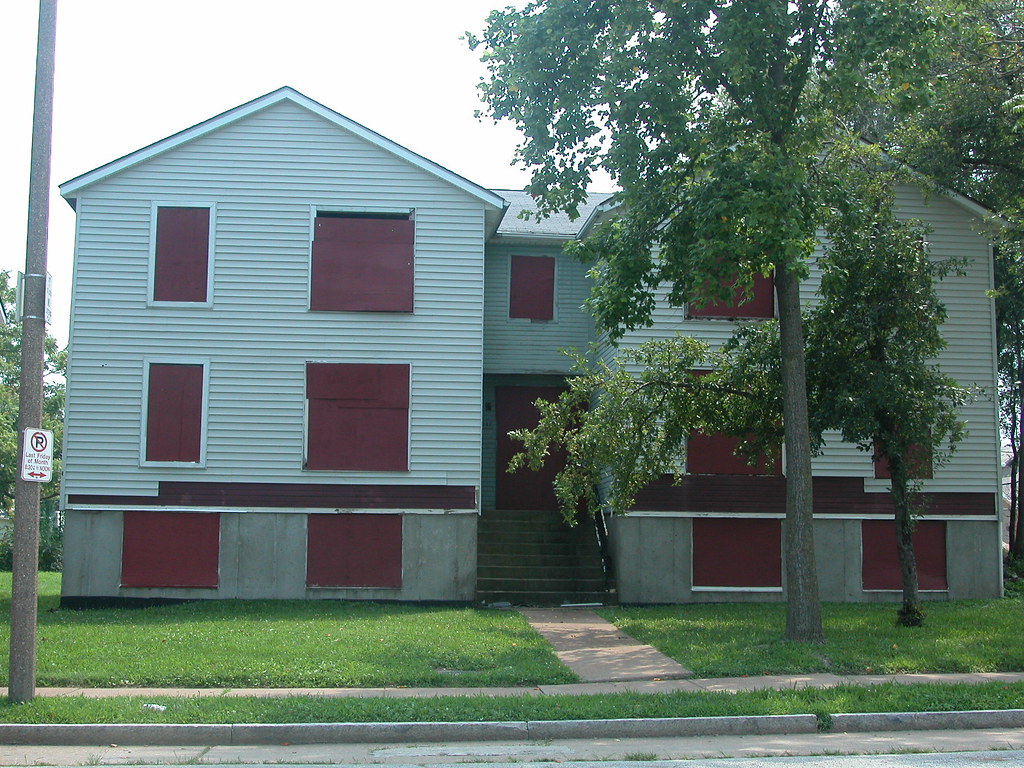
The two-story apartment building at 3032 Sheridan Avenue was built in 1980 and boarded up in 2008. The owner is JVL 1998 Apartments LLC, whose organizers are Mark Jaffe and Martin Jaffe according to the Secretary of State’s Office. The frame building stands on a concrete foundation. While not particularly attractive, the scale, fenestration and setback are fairly urban. The high basement creates another level of living space and maxinmizes density — perhaps that is too much when there are not separate external entrances?

The two-story apartment building at 3042 Sheridan Avenue was built in 1980 and vacated in 2002. The owner is JVL 1998 Apartments LLC. Even smaller than its next-door neighbor, this building is not doomed by its decent (not great) design.

This pair of two-story apartment buidlings on platform founations stands east of the other two, at 148 and 1418 Glasgow Avenue. City records indicate that these buildings were built in 1978. Now owned by the city’s Land Reutilization Authority, the buildings were owned in 2007 by JVL Affordable Housing LP, a subsidiary of Austin, Texas-based Delphi Affordable Housing Group. Delphi must have defaulted on its property taxes here. Delphi purchased these and dozens more in JVL, St. Louis Place and JeffVanderLou from an Arizona-based company in 2005. The Arizona company had run the properties in the ground. Delphi rehabilitated most of its inventory, but many of its buildings again have become the source of frequent citizen complaints about nuisances and drug dealing.

Categories
Historic Preservation JeffVanderLou North St. Louis Northside Regeneration Old North Soulard St. Louis Place

Learning Lessons from Soulard

by Michael R. Allen

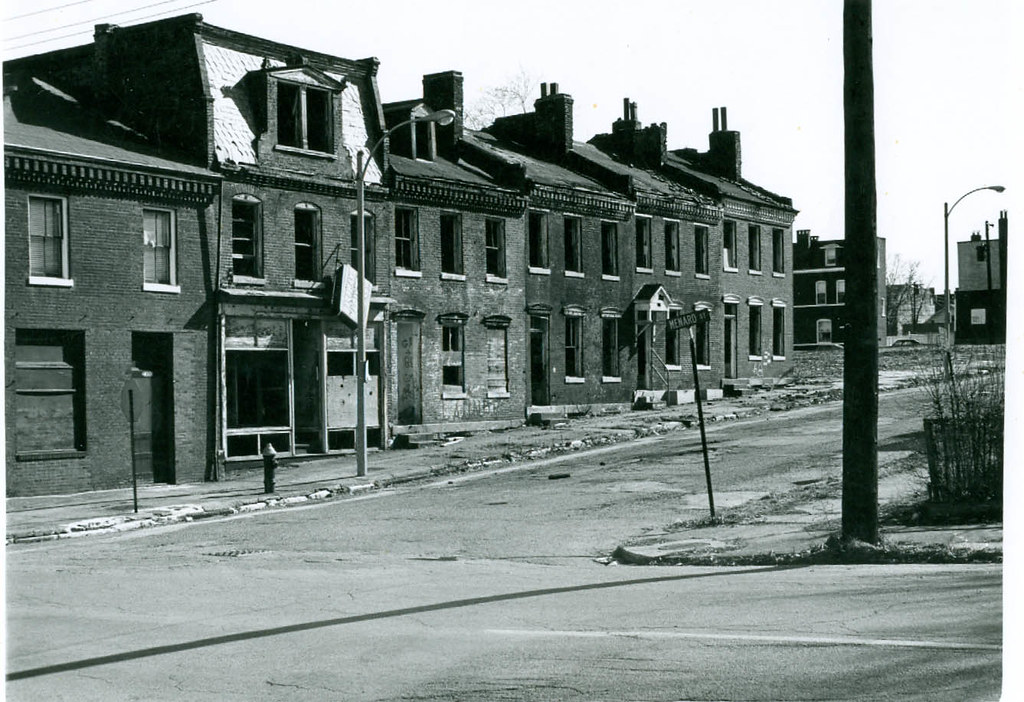
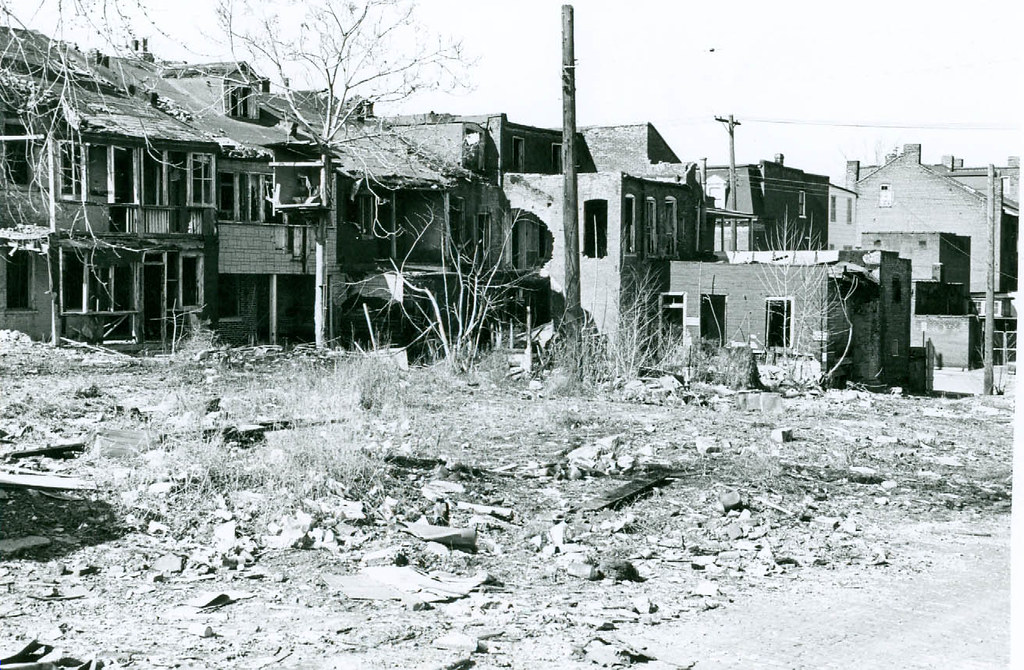
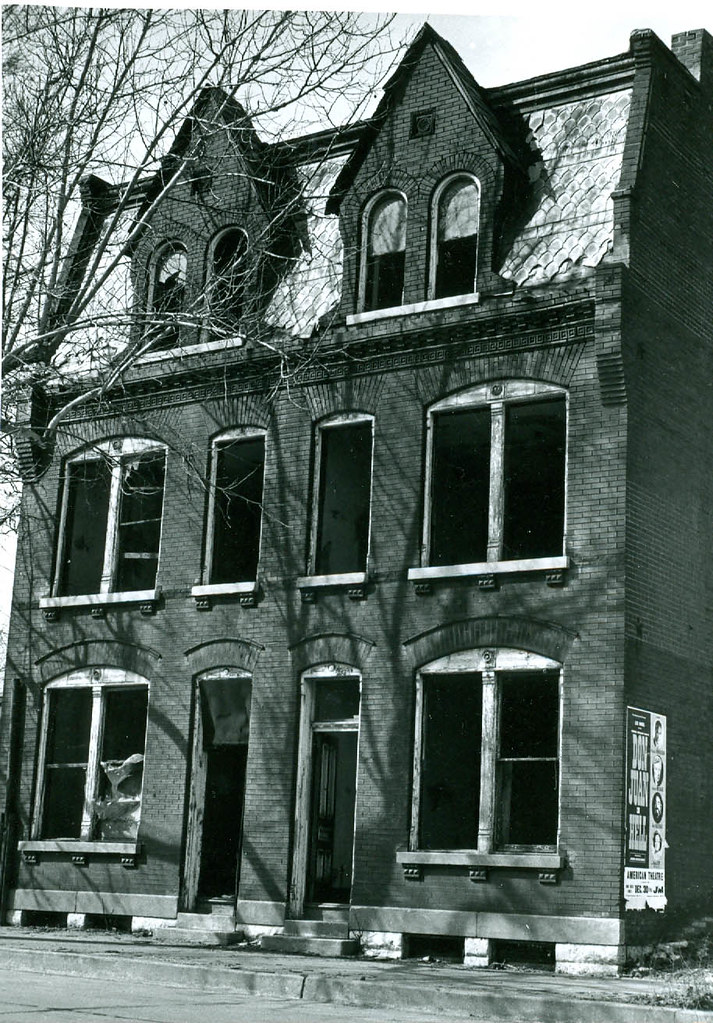
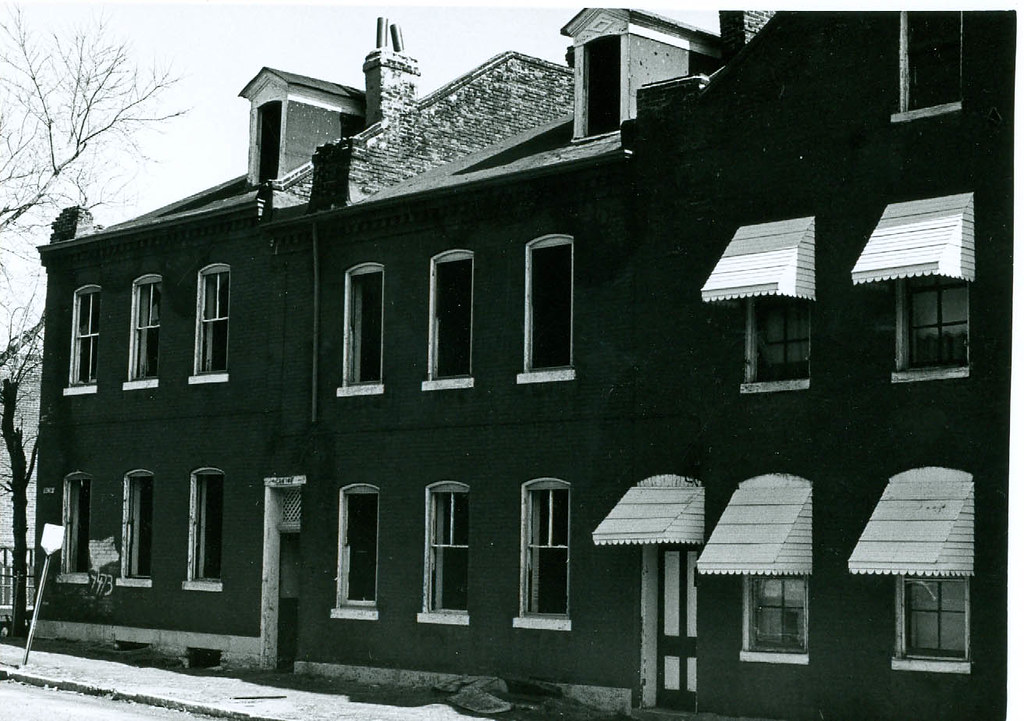
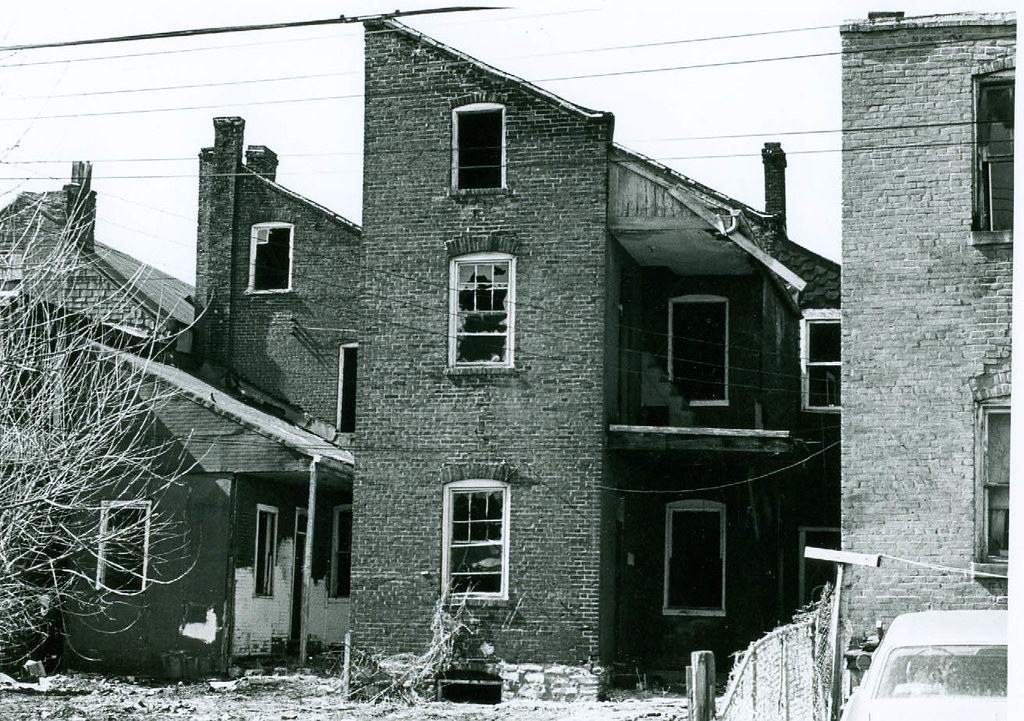
Photographs taken in the 1970s (probably in 1977) by a Soulard resident and now in the collection of Landmarks Association of St. Louis provide interesting parallels between that neighborhood’s renaissance and current efforts underway to renew near north side neighborhoods like Old North St. Louis and St. Louis Place.

The photographs here show derelict historic buildings. From condition to building type, these shots are a lot like those from the north side that have flooded urbanist blogs in the last two years. Perhaps few in Soulard then would have imagined that thirty-one years later the same conditions would persist and remain the subject of controversy. Certainly that neighborhood’s history is testament to the power of concerted effort to resolve thse conditions through smart historic preservation strategy. Still, there were glaring blunders in Soulard that north siders today can avoid. While Soulard in the 1970s faced a dense neighborhood with a high level of vacancy, the north side today faces conditions that combine low density with a rising level of building vacancy. Soulard could not afford the losses shown here; we really can’t afford to lose another building!

Here is the southeast corner of Menard and Shenandoah streets. One of the striking features of the row are four nearly-identical side-hall signle-family dwellings dating to the 1850s. Those first floor pediments are cast iron. Clearly, the row has experienced hard times, but the vernacular buildings retain their architectural beauty. Again, I can’t help but think of a project like Rob Powers’ “Daily Dose of Blairmont” series. This is the sort of urban grouping Powers and others have documented with passionate cries for preservation.

Here is the rear of that row. Again, conditions we now as common — and reversible. Surely, that is what happened to this row. Wrong. Developers Guy McClellan and Sedge Mead wrecked all but the corner building after these photographs were taken. Their firm, Mead McClellan, was widely recognized as the private developer that tackled Soulard on a large scale. Mead McClellan rehabbed dozens of Soulard buildings, but tore down a few as well. In the 1980s, the firm also demolished downtown’s “terra cotta” district on Olive Street These buildings would have been gold when the 1998 Missouri rehab tax credit went into effect, but their existence didn’t suit the incentives that existed before.

The hard lesson learned — and one that Paul McKee ought to consider in north city — is that large scale development tends to create collateral damage among historic properties. No developer can do it all, and none should try. The second lesson is that historic buildings will simultaneously be subjects to and victims of tax credit incentive programs. Developers will always try to discard buildings that are “unworkable” under incentive programs. That’s where city preservation ordinances do their duty.

Another sad tale from Soulard concerns this Romanesque Revival six-flat in the 2300 block of South Seventh Street. Union Electric demolished this house for a sub-station. The trade-off was so lop-sided, it is mind-boggling. No doubt the location on a neighborhood edge made the demolition more palatable. The lesson here is that neighborhood edges tend to attract retail, gas stations, utility stations and other projects that are unsightly and entail demolition. While it may seem sensible to locate such things on the perimeter off a neighborhood, every neighborhood does the same thing to the point where once-grand streets like South Seventh, Gravois, and North Florissant have become placeless seas of marginal uses.

These next two photograph show unidentified buildings.

Please send identification if you know what these photographs show.

There are obvious and much-mentioned good lessons for near north St. Louis neighborhoods to take from Soulard, but the harder lessons need to be heeded as well. The situation on the near north side makes each historic building extremely fragile, and preservation an urgent cause. McKee’s project lurks in every discussion of the area because it involves so much of the area’s remaining historic building stock. Mead McClellan never owned enough of Soulard to remove the neighborhood character from whole swaths; in St. Louis Place and JeffVanderLou, McKee does. What he intends to do with that power is unknown, but what residents want him to do with it should be clear. Other property owners — ranging from churches to out-of-town landlords — also hold the future of many near north side buildings in jeopardy.

The best lesson from Soulard may be the power of vigilance at the community level. So many residents decided that they simply would not let the buildings be lost. While not always successful in individual attempts, Soulard’s residents won the larger battle of retaining the historic character of the neighborhood. Can near north side residents do the same? Can we draw the line on preserving our buildings? At this critical point, we must. Even Soulard lost the beautiful buildings I’ve shown above, and many others.

Categories
Chicago Urbanism

Obama’s House

by Michael R. Allen

Photograph by Katherine Hodges.

Illinois Senator Barack Obama will soon be living in a famous historic home, and for that we are thankful, but his current residence is not unremarkable. Famously an owner of only one house, Obama resides in a spacious, historic home in Chicago’s Kenwood neighborhood. The hipped-roof Colonial Revival home and adjacent lot — regrettably made infamous during the campaign — are found on a block familiar to millions of urban Americans.

While we all don’t live in homes as large as Obama’s or in neighborhoods as tony as Obama’s pocket of Kenwood Kenwood, us city-dwellers can see ourselves in Obama more so than in any president in our lifetimes. Obama lives in a red brick house close to the sidewalk on a public street in a densely-populated neighborhood. Near the Obama family home is Washington Park, a magnificent but somewhat-untended city park. Washington Park mixes the aesthetics of Gilded Age aspiration with the contemporary reality of human life. Its paths are mostly full of people enjoying the beauty, but it has its share of vice and crime. West of the park is the CTA’s Green Line, an elevated train line that carries thousands of Chicagoans to work, school church and nightlife.

To the south, Hyde Park and the University of Chicago place academic refinement smack-dab against neighborhoods where poverty is a real problem. North of Kenwood are neighborhoods whose fortunes are equally mixed. Barack Obama bought a wonderful home for his family, surrounded by the urban reality of his city. Obama’s life is sheltered by necessity, but not by location. His home is in the middle of the diversity, wonder, agony and mystery of American urban life — “real America” to many Americans. At times, cities seem to be as real as it gets.

Many American presidents — including Richard Nixon and Bill Clinton — have relocated to New York City at points in their career, but none in the last fifty years have come straight out of an urban neighborhood to the White House. These past fifty years have been terrible years for American cities. Seems like little coincidence that we have had presidents who come from that ether between the real life of the cities and the real life of the rural areas — one place widely defamed by national politicians, the other mythologized in speech and neglected by policy.

Barack Obama has walked streets like ours and lived in a red brick house in the city. He has called an urban neighborhood in south Chicago home. At last, America has an urban president. At times, Obama will displease urban Americans — after all, he is governing a nation with a suburban culture that is entrenched in national government. Yet Obama has actually lived urban America, and I can’t help but think that will make a crucial difference in transportation policy, housing allocation, block grant funding and other areas.

Of course, Obama holds only the pen that signs the laws. The laws originate with our representatives. We have an urban president, and to make the most of that, urban America needs to step up and make its voice heard. Change doesn’t end with Obama, it starts with us.

Categories
Downtown Mississippi River Riverfront

Pinnacle Third Quarter Report Mentions Admiral Relocation

by Michael R. Allen

Pinnacle’s third quarter earnings report, released yeterday, contains this sentence:

The Company is evaluating the feasibility, subject to gaming commission and other regulatory approvals, of relocating The Admiral Riverboat Casino to another location within the city of St. Louis.

Categories
Downtown Green Space JNEM National Historic Landmark National Register

Tell Senator McCaskill There’s No Need to Pass Arch Grounds Legislation Now

by Michael R. Allen

On October 3, Congressman William Clay (D-MO 1st) introduced HR 7252, which would downgrade the Jefferson National Expansion Memorial grounds from the current National Historic Landmark status to listing on the National Register of Historic Places and, most important, authorize the Secretary of the Interior to enter into an agreement with the Jefferson National Expansion Memorial Trust that would allow the Trust to manage the Memorial grounds and construct a museum there. The Danforth Foundation incorporated the Trust in June, with Peter Raven, Walter Metcalfe and Bob Archibald as the corporation’s directors.

Now, Missouri Senator Claire McCaskill has felt pressure to introduce a companion in the Senate. Believe it or not, word is that some parties want the bill to pass in the current lame duck Congress, while privatization-friendly President George W. Bush and Interior Secretary Dirk Kempthorne are still in office. McCaskill has yet to cave to the pressure. If she did, and the bill were to become law, a public process already underway for planning improvements to the Jefferson National Expansion Memorial would be stopped, and a private vision would be enshrined in federal law.

Clay’s bill is inappropriate on several fronts:

  • The bill short-changes the public, which has yet to see the National Park Service’s draft management plan for the Memorial or participate in the planned 45-day public comment period. NPS has released a summary of its preferred alternative, but has not issued the actual draft General Management Plan/Environmental Impact Statement. NPS will release that draft in January, with the comment period immediately afterward.
  • The National Park Service has called for an international design competition to be held next year where changes to the grounds could be visualized and a winning entry would be selected by a jury. This process would allow for a wide range of possibilities to be explored. The winning entry might call for something other than a museum on the grounds.
  • Congress should not exercise the power to remove National Historic Landmark status for political reasons (there is a formal process for removing the designation in place within the Department of the Interior).
  • It is an abuse of the purpose of the National Park system for Congress to direct the National Park Service to lease a National Park to a private group solely for construction. We can build a museum at the Memorial — although we already have two there — but we need not cede control to a private entity to do so. Without a public input process, we have no idea if there is support for the museum idea or what sort of museum is appropriate for the site.

    I urge my readers to contact Senator McCaskill (via this page) and tell her that the Clay bill is flawed and premature. Sending the same thoughts to Representative Clay (via this page) would be helpful as well.

  • Categories
    Historic Preservation North St. Louis Old North

    Six Months is Easy, Ten Years is Hard

    by Michael R. Allen

    Here is the sanctuary of the Fourth Baptist Church at 13th and Sullivan in Old North St. Louis after the devastating fire on September 20 (see “Beautiful Fourth Baptist Church,” September 24). As we come upon winter, the condition of the destabilized complex is heavy on my mind. Will the church make it to spring? Of course; gravity is a slow process, and this building will resist its pull. Will it still stand ten years hence? I have no idea. The old church can stand another six months if its fate is left to chance. Chance, however, is no guarantor of a future; after all, chance brought the flames that engulfed the sanctuary less than two months ago. A ten-year plan will take planning, and action. The church can win its war with gravity, but not by itself.

    Categories
    Events South St. Louis Southwest Garden

    Walking Tour of Southwest Garden This Saturday

    Landmarks Association Sponsors Tour of Southwest Garden Neighborhood Led by Edna Gravenhorst

    When: Saturday, November 8 at 10:30 a.m.

    Where: Meet at the Southwest Garden Neighborhood Association Office, 4950 Southwest Avenue

    Contact: Landmarks Association, 314-421-6474

    FREE

    On November 8, Landmarks Association sponsors a free walking tour of the Southwest Garden neighborhood, one of south city’s best-kept secrets. Edna Campos Gravenhorst, author of the new pictorial history Southwest Garden, will lead people down charming residential streets, robust commercial districts and the scene of the famous Great St. Louis Bank Robbery.

    The tour starts at 10:30 a.m. at the office of the ever-busy Southwest Garden Neighborhood Association (4950 Southwest Avenue), where President Floyd Wright will welcome the crowd and discuss current projects in the neighborhood. Then the tour moves to the Southwest bank where former bank president Ed Berra will provide a tour and tell people about the famous 1953 robbery that was immortalized in the Steve McQueen film The Great St. Louis Bank Robbery. After the bank, Edna will narrate a walk to houses ranging from 20th century Craftsmans to 19th century revival-style beauties. The tour will include Gurney and Heger Courts as well as the storefront commercial architecture of the area. Visitors will see all sides of a beautiful neighborhood near the garden.

    Southwest Garden was commissioned by the Southwest Garden Neighborhood Association in celebration of the associationʼs 30th anniversary. The book is divided into four historical walking tours with twenty sites in each tour. The oldest landmarks in the book are the Botanical Garden, Tower Grove Park, the State Hospital, Campbell Plaza and Fire Station 35.