Categories
Architecture Fire Historic Preservation Missouri

Inn St. Gemme Beauvais Survives Fire

by Michael R. Allen


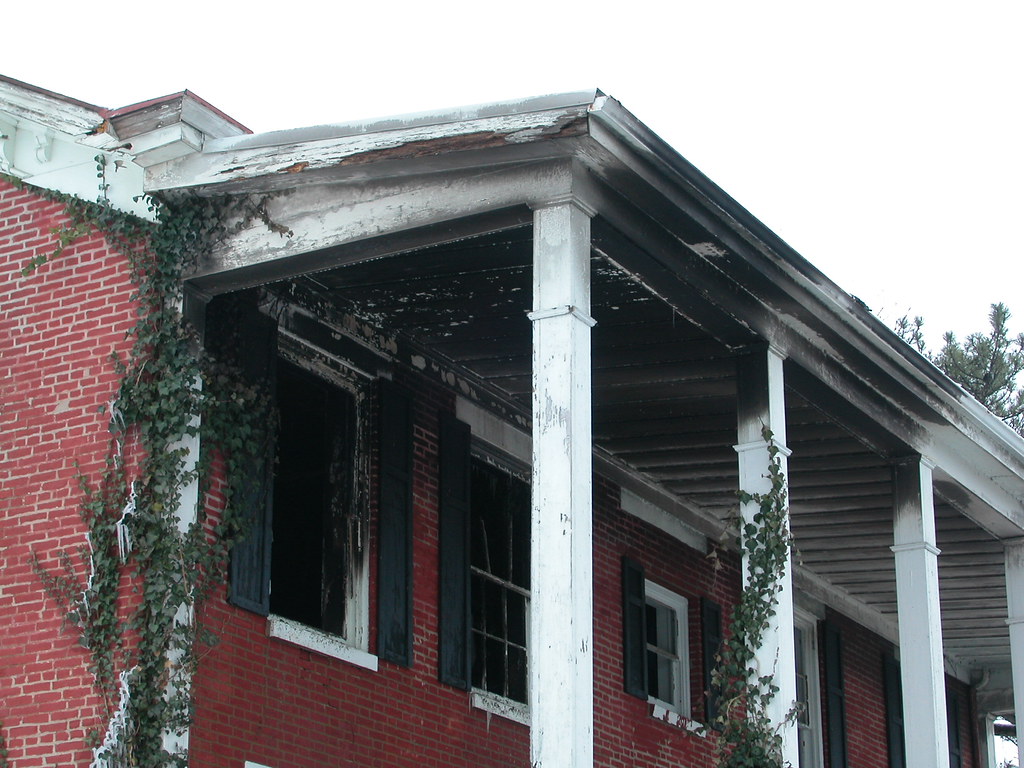
News of the demise of the Inn St. Gemme Beauvais on Main Street in Ste. Genevieve, Missouri, was premature. The historic home was severely damaged by an electrical fire on February 22, leading to reports of total destruction. However, the fire seems to have hit the interior hard but spared the shell of the building. The brick walls are intact, without any collapses, and most of the roof is intact. Windows and doors are charred or stained, and much glass has been broken, but only a few were lost completely. Overall, the exterior is remarkably intact.

The worst damage is on the rear section of the home, where it appears that the roof has partly collapsed.

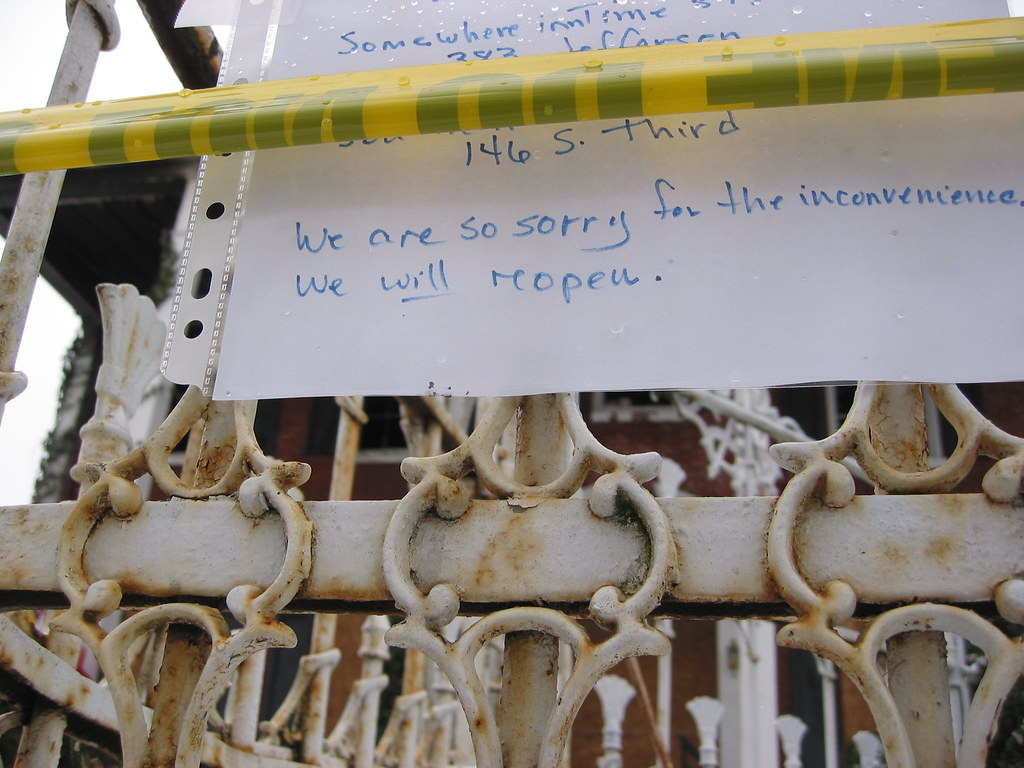
After the fire, the Colonial Revival style building was boarded up. The roof condition will prevent thorough water infiltration as the owners’ insurance claim is processed. The owner, Janet Joggerst, plans to rebuild and reopen the bed and breakfast.

The Inn St. Gemme Beauvais was built in 1848 by prominent citizen Felix Rozier as his mansion. The home’s rear faced the Mississippi River, and the front faced to the town. Over time, this section of Main Street became commercial in character and the house remained as a counterpoint to the surrounding storefronts, shops and apartment houses.

Photograph by Lynn Josse.
Categories
Architecture Demolition Fountain Park Historic Preservation North St. Louis

Demolition Imminent at Page and Kingshighway?

by Michael R. Allen


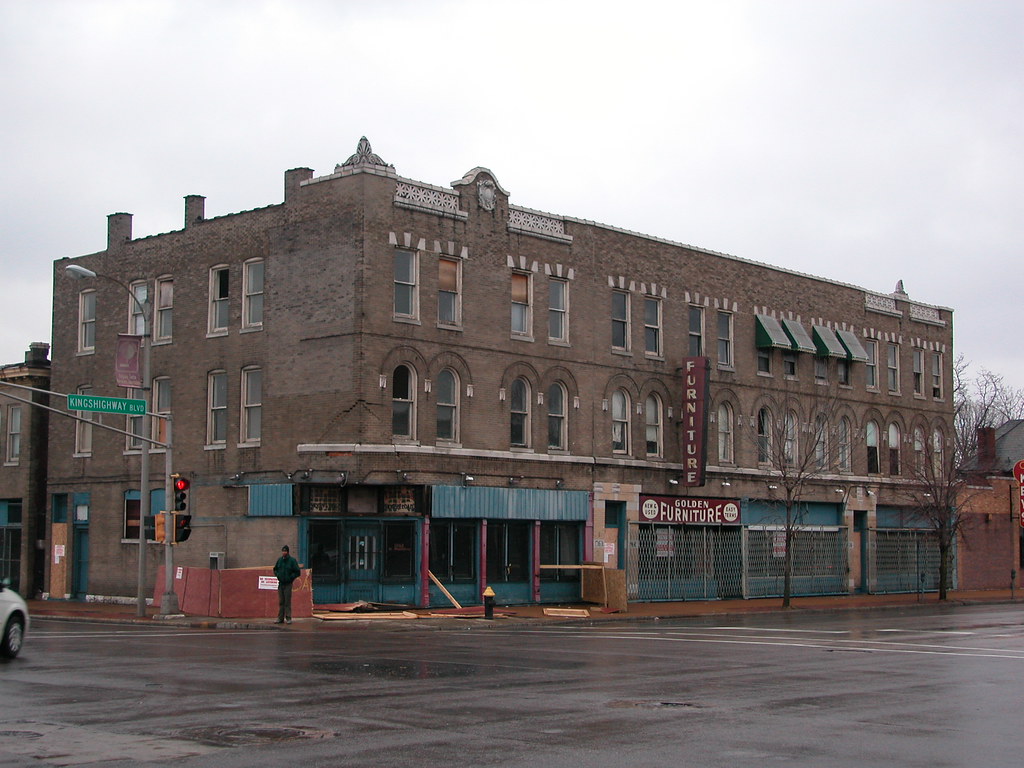
On January 10, the city’s Building Division issued emergency condemnation (for demolition) of the landmark building at the southeast corner of Page and Kingshighway boulevards. The Roberts Brothers Properties LLC owns the building and two adjacent two-story commercial buildings. A motorist struck and toppled the corner iron column on the building, which has been vacant for a year or two since Golden Furniture moved out. The Building Division has not yet followed up with any emergency demolition permit, although such action is almost certain. (Curious Feet St. Louis reported the news awhile ago.)

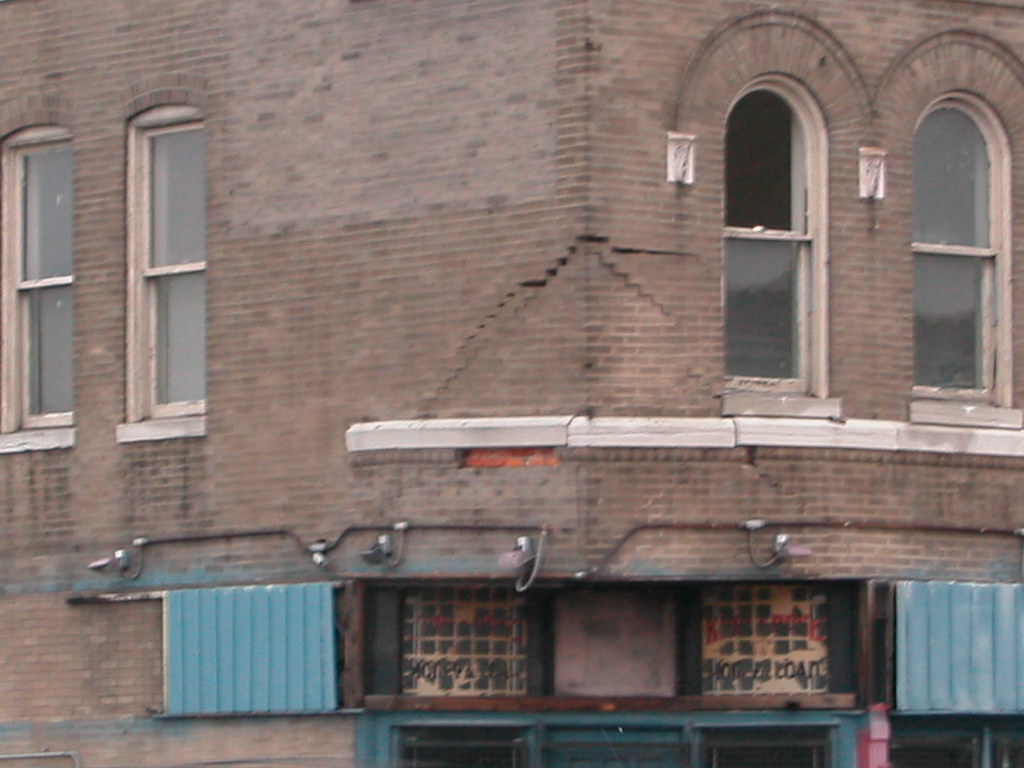
The loss of the corner column has already led to significant shifting of the building’s weight downward at the corner. The brick wall shows how the bottom of the second floor is pulling downward. At the moment, this is a problem that can be corrected with a jack or another iron column. (What happened to the building’s original column? Why not just re-install it?)

The situation has become one of those self-fulfilling prophecies that dampens one’s attempt to be hopeful for the commercial buildings of north St. Louis. Here we have beautiful commercial buildings that define a major intersection, and which were in use until recently. A big-time owner lets leases lapse, perhaps plotting demolition for replacement with some silly strip mall like the owner’s project across Page. Then, an accident happens. The Building Division steps in, goes through its procedures, while the owner does nothing. The owner does not jack up the corner with a support, which would avert further damage. The corner pulls down, triggering a major collapse. The Building Division rushes in to get demolition started. The owner sits back and lets events unfold, while hatching plans for new development. Preservation and minimal code enforcement never had chances.

This is frustrating because the building is elegant and obviously in decent shape. The Roberts brothers could view ownership of these buildings as great fortune — they get to possess unique historic buildings at a major intersection. They get to take a step to ensure that north city retains the level of historic character that makes real estate in south city so valuable. They could renew a cultural resources and pave the way for long-term rising of real estate values in north city, instead of falling into the temptation to build a short-lived retail center with short-term pay-off.

The Building Division is not a preservation agency. Yet the Building Division could step in and make the owners put a support at the corner. After all, that’s stipulated by the building code. The owners’ intentions should not influence the Building Division’s enforcement. Whether or not the owners want to tear down the buildings is a moot point until there is a demolition permit. Up to that point, the division should seek to force the owners to make repairs of structural necessity.

Beyond code enforcement, preservation makes sense. Page Boulevard has many threats to corner commercial buildings at the moment, and has already lost several. Kingshighway north of Delmar is likewise losing its lines of commercial buildings. Presence of anchor landmarks sometimes makes the difference between people remembering having been to a neighborhood or not. These buildings are in Fountain Park, which possesses a memorable interior. Yet its perimeter would lose a little less character with the loss of these buildings. The oval park, the famous curved storefront, the historic homes, schools and churches present a distinct and impressive identity. A corner strip mall, festooned with a developer’s name, with litter blowing across black asphalt in front of squat little retail boxes demonstrates no distinct character and in fact could have a blighting effect on neighboring block that retain their character. Fountain Park is a little less remarkable with every lost landmark.

These buildings are inherently remarkable, too. Built between 1904 and 1908 from designs by architect Otto J. Wilhelmi, the group shows a mix of modern sensibility and Victorian-era stylishness. The two-story buildings are rather plain expressions of the commercial storefront form while three three-story building is a blend of stark iron storefronts, paired Romanesque windows with pronounced archivolts on the second floor and windows with terra cotta keystones and voussoirs that suggest the Georgia Revival style. Then there is the white glazed terra cotta ornament of the parapet, which draws upon Classical Revival styles and features a projecting acanthus and the corner and near the south end. The building permit for the building mentions a galvanized cornice, long-gone. All three buildings are clad in buff speckled brick prevalent in north city commercial architecture of the period. In all, the buildings are unusually eclectic for this part of north city — and that statement means a lot. If only the owners recognized the treasures that they already have.

Categories
Downtown Housing Media

The Mark Twain Hotel Fills Important Niche Downtown

by Michael R. Allen

The Mark Twain Hotel at 9th and Pine streets downtown opened in 1907 as the Maryland Hotel. Albert B. Groves was the architect.

A recent article in the St. Louis Post-Dispatch again raised complaints against downtown’s Mark Twain Hotel at the corner of Ninth and Pine streets. The article informed readers that the venerable residential hotel housed more registered sex offenders than any other downtown address. The old cries against the supposed degenerate effect of the Mark Twain emerged, despite the fact that the Post article itself quoted a downtown police officer who remarked on the lack of crime at the address.

The trouble with the rumors is there is almost nothing behind them. Downtown is not teeming with vice and crime, and neither is the Mark Twain. In fact, the most remarkable and least-mentioned aspect about the Mark Twain is it is the last single-room occupancy hotel east of Tucker Boulevard in the heart of downtown. That should trouble us.

The phrase “single room occupancy” (SRO) came into parlance in the 1930s in New York City. It describes a type of residential building, frequently a converted guest hotel, in which residents can rent single rooms on a weekly or monthly basis. These rooms may come with a private bath or small kitchen area, but most don’t. SROs became popular due to massive migration into cities. Workers new to a big city could procure lodging at an SRO while seeking employment or seizing a better opportunity elsewhere. Residents tended to be laborers at factories, railyards or docks. Many residents lived in an SRO for years or decades due to economic circumstance or because they enjoyed what the SRO offered: cheap living in the heart of downtown; with employment, entertainment and transportation literally outside of the front door.

The Mark Twain is located in the ornate former Maryland Hotel, built in 1907. The hotel became an SRO some time after World War II. As downtown areas in large American cities declined, SROs closed up. Urban renewal projects targeted legendary SRO districts in San Francisco and Chicago, while age of buildings, lack of employment and other factors spurred others to close. In downtown St. Louis, a few have held on into the modern era, but none as visible as the Mark Twain.

While the hotel deserved a sordid reputation by the 1980s, the Mark Twain was fully renovated by 1998. Amos Harris, a developer from New York City, bought the hotel in 1995 expressly to rehabilitate it for continued SRO use. Harris wisely reasoned that there was a need for such housing downtown, especially as economic prospects changed and downtown saw the creation of service jobs in hotels, restaurants and later casinos. Harris reformed the management, improved the rooms, cleaned the exterior and made the Mark Twain a decent, affordable place to live.

The hotel has since become a haven for people who would otherwise be left behind in downtown’s renaissance. Indeed, some of its residents have criminal records and can’t rent elsewhere. Others are disabled or elderly and need access to public transportation, social services and hospitals. Still others are just new to town. Some were recently homeless, and would be without the Mark Twain. One of the most important factors: Few residents own cars.

Negative publicity might blind us to the important role of the Mark Twain Hotel. Flexible in length of occupancy, affordable and small, SRO rooms are quintessentially urban. They offer a gateway into urban living outside of ownership and traditional renting. The Mark Twain is not incompatible with the expensive condominiums around it, but is a complement that ensures diversity in the downtown population and equal access to the amenities only downtown can provide. A downtown with too much of either type of housing would be segregated, monotonous and vulnerable to economic forces like the current recession.

We could probably use a few more SROs in St. Louis. In the meantime we are lucky to have the stable, affordable Mark Twain Hotel ensuring downtown can be a residential option for everyone

This article originally appeared in the February 22, 2008 issue of the Vital Voice

Categories
Demolition Flounder House Historic Preservation North St. Louis Preservation Board South St. Louis

Preservation Board Agenda Includes Demolitions of Flounder House, Building on Page

by Michael R. Allen

The St. Louis Preservation Board meets on Monday to consider a rather short agenda.

Notable items on the agenda include:

  • Preliminary review of an application by Alderwoman Kacie Starr Triplett (D-6th) to demolish a one-and-a-half-story flounder house at 2915 Minnesota Avenue. The house, built before 1884, is an example of a true flounder house. Flounder houses have half-gabled roofs with a slope from one side of the front wall to the other. Flounder houses were popular in nineteenth century St. Louis due to the speed of construction, but few survive. Many have been successfully rehabbed in recent years, and the smaller ones seem well-suited as economical alternatives to the glut of expensive, energy-inefficient multi-family conversions. Staff recommends denial of the permit.
  • Preliminary review for a new building at 1412 Mississippi Avenue in Lafayette Square. This building would occupy one of the last gaps in the street faces surrounding Lafayette Park — the vacant lot at the southeast corner of Park and Mississippi. The Lawrence Group proposes a three-story building with heavy Romanesque massing topped by a Mansard roof with numerous dormers. The building is reminiscent of the ungainly building that houses the Soda Fountain Square restaurant. Hopefully the board and staff will provide guidance to improve the design.
  • Appeal of staff denial of a demolition permit for the building at 5100-2 Page Boulevard, subject of an earlier post in this blog. Staff recommends upholding the denial. Alderman Frank Williamson (D-26th) supports demolition.
  • Categories
    Chicago Historic Preservation

    Watching and Waiting

    by Michael R. Allen

    City of Destiny offers insightful commentary on the failure of Chicago preservation groups to reach their logical audiences and actually spotlight endangered buildings. Katherine, author of the blog, takes as her starting point the annual endangered buildings lists of Preservation Chicago and Landmarks Illinois:

    I feel I should join both these preservation groups because I support their goals, but I’m so frustrated at how little opportunity there seems to be for interaction, for publicizing other buildings that deserve attention, for getting updates on the status of buildings they’ve put on the lists.

    Read all of it here: “Watching the watch lists”

    Categories
    Downtown Green Space Housing JNEM Mid-Century Modern Parking

    Venturo Capitalism

    by Michael R. Allen


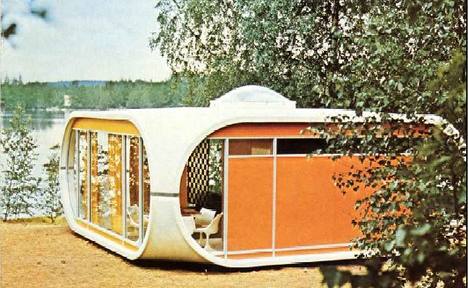
    Rumors are circulating that the Danforth Foundation has arrived at a surprising plan for the Arch grounds: resurrect the 1970s Venturo House by Finnish architect Matti Suuronen by placing a line of one hundred of the houses on the western perimeter of the grounds. Apparently, the Foundation’s planners realized that without strong connections to a residential population, any plan to develop the grounds would fail. The Venturo House has appeal due to the shared nationality and similar last name of Suuronen and Arch architect Eero Saarinen. (In this vein, the Foundation could ask band Rilo Kiley to perform on Dan Kiley’s historic modernist landscape.)

    If successful, city leaders have discussed the potential for building steel frames with elevators on several blocks of the Gateway Mall. Venturo homes could be hooked up to utilities that would run to each level of these towers. When a resident moved, that person could take their home with them and make way for a new resident.

    Accompanying zoning and code changes would allow downtown building owners to place Venturo homes or similar modular homes on roofs — or adjacent surface parking lots. The changes would allow parking garages to be preserved and their historic architectural features left intact should they fall vacant. Venturo homes — arranged on special steel shims to adjust for the typical garage floor slope — will allow preservation-minded garage owners to avoid demolition.

    If true, exciting news!

    Categories
    Abandonment Grafitti South St. Louis

    "Be Good to One Another"

    by Michael R. Allen

    This work by prolific graffiti creator Ed Boxx can be found down near the eastern terminus of Espenschied Street, by the former Carondelet Coke plant. Who can disagree with the message? Admittedly, few will see it but perhaps those who do need the instruction more than those who won’t. Such work raises questions: What does one make of positive messages inscribed on private property not being used and not likely to be reused? This “graf” graces the side of a damaged box trailer on the old St. Louis Ship property, which no doubt will be scrapped if its owner ever does anything more than let it sit and rust. Why not let one person’s scrap become another’s momentary canvas?