Categories
Abandonment Demolition Fairground O'Fallon

Six Years Pass on Warne Avenue

by Michael R. Allen

The row of houses in March 2005.

When I first photographed these six vacant buildings in the 4200 block of Warne in the Fairground neighborhood in March 2005, I was struck by what a statement they made as a row. Besides the four-flat shown at left, the rest of the group consisted of St. Louis’ bread-and-butter building, the two-flat. The variety of styles in the group could very well have been a textbook illustration of St. Louis’ streetcar-fueled late 19th and early 20th century neighborhood development.  Instead, in abandonment, the row served as a different, disturbing illustration.

The block in August 2009.

By August 2009, the four-family building was demolished. An amazing apartment building across the street was also gone. The rest of the row was in bad shape, although each building was structurally sound. I confess to having low hopes for the group. Located in the city’s Third Ward, the five remaining buildings were owned by the Land Reutilization Authority and outside of any historic district. Had these buildings been inside of a historic district, they would have made a great historic tax credit project for a community development corporation.

The row in March 2011.

In the last three weeks, the row has finally disappeared. These buildings were on the edge of Fairground, located across the street from the O’Fallon neighborhood. Their loss is felt strongest in the O’Fallon neighborhood, where a historic district nomination is underway, by dissolving a visual edge.
Categories
Abandonment Industrial Buildings JeffVanderLou North St. Louis

Public Meeting on Carter Carburetor

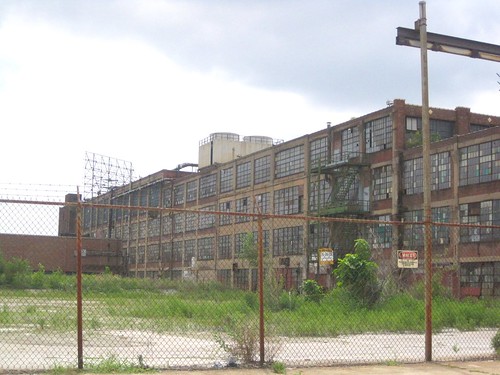
Looking southwest at the Carter Carburetor plant from Dodier Street.

WHAT: Presentation on Thermal Desorption Process for Carter Carburetor Site
WHEN: Tuesday, March 29, 2011
TIME: 7:00 p.m.
LOCATION: Urban League, 3701 Grandel Square, St. Louis, Missouri 63108

EPA is following up with leaders from the St. Louis north side community on questions received about the in-situ thermal desorption process, an alternative method for addressing contamination at the Carter Carburetor Site. An expert on the thermal desorption process will be available to meet with community leaders and other interested residents.

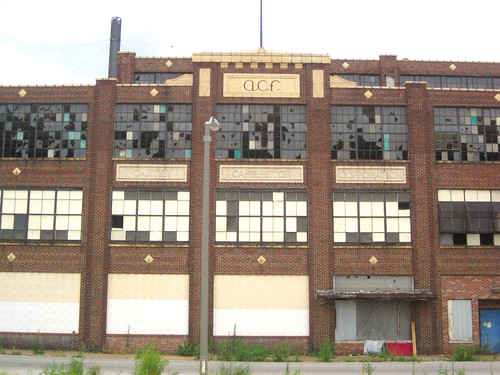
West elevation of the Carter Carburetor plant, facing Spring Avenue.
Categories
Events

Talk: Three Mid-Century Modern Houses

Lunch Talk: Three Mid-Century Modern Houses
Wednesday, March 30 at 11:00 am
Cafe DeMenil 3352 DeMenil Place

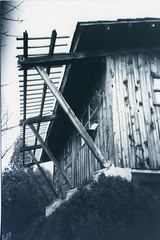
Michael R. Allen will discuss three of St. Louis mid-century modern houses and their relationship to each other and to national housing trends. These houses are the Joseph and Ann Murphy Residence in University City (1939; Murphy & Wischmeyer), Stonebrook in Jefferson County (1959; Harris Armstrong — shown at left) and the Harry Hammerman House in Ladue (1952; Harry Hammerman). The talk will last about 20 minutes, with lunch served afterward.

Lunch Special for $6.95, plus full menu available. Reservations recommended.  More Information: 314-771-5829.

Categories
Central West End Hospitals Mid-Century Modern

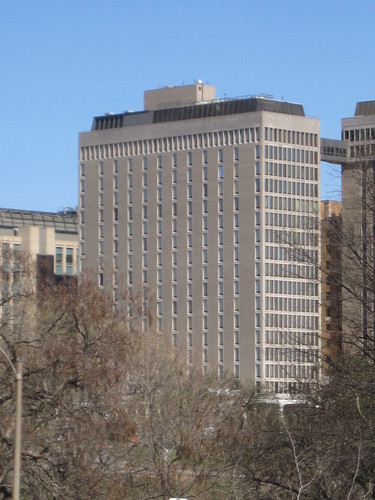
Queeny Tower (1965 – ?)

by Michael R. Allen

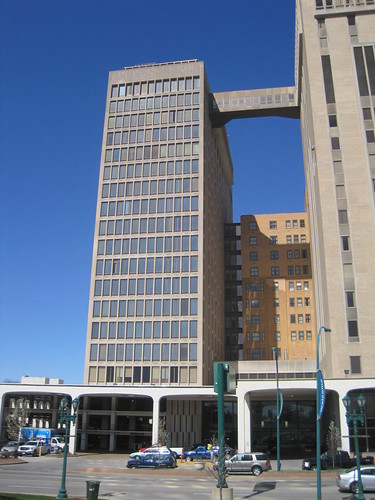
Upon completion in 1965, the Queeny Tower at Barnes Hospital — located in the northeast corner of Kingshighway’s original 90-degree bend — was the city’s third tallest building. The 19 stories of the proudly modern high-rise stood at some 97 meters, slightly taller than the Park Plaza Hotel (1930; Schopp & Baumann) to the north, which is 94.4 meters tall. The Gateway Arch had yet to top out, so the two tallest buildings in 1965 remained the Southwestern Bell Tower at 1010 Pine Street (1926; Mauran, Russell & Crowell), 121 meters, and the Civil Courts (1930, Klipstein & Rathmann), 117.6 meters. Nowadays, the Queeny Tower is the twelfth tallest building in St. Louis, if the Arch is included, so the achievement of its construction may be somewhat lost. Yet at its completion the city had few tall buildings, and the most recent in the range of Queeny were already 35 years old. (An interesting illustrated chart of St. Louis building heights can be found here.)

Thus Queeny Tower was a milestone in the rise of Barnes Hospital, which today is corporate amalgam BJC and remains a prolific builder of tall buildings at its Central West End campus. Again, the escalation of ability to finance and build large, tall buildings means that Queeny Tower has become less than a star attraction at the hospital. Plus the current trend in hospital architecture is to treat all buildings, even those designed by revered masters, as simple machines to be discarded upon obsolescence. Shall Queeny somehow be exempt from the race to replace? Not likely. Queeny, which replaced an older medical building itself, was born from the economy that will eventually destroy it.

Categories
Events

Tomorrow: “Visions of Autonomy”

Tomorrow’s City Seminar at Washington University is led by Ben Looker, professor at St. Louis University and chronicler of urban cultural movements of the recent past.

Visions of Autonomy: Surveying the 1970s Neighborhoods Movement, from New Left to White Ethnic Revival
March 25, 2011 at 3:00 pm – 5:00 pm
Busch Hall Room 18, Washington University in St. Louis

Benjamin Looker, Assistant Professor of American Studies at St. Louis University (and a Washington Univ. alum) examines the radical politics of neighborhood autonomy that characterized the utopianist vanguard of the broader 1970s neighborhoods movement. After sketching its leaders’ New Left origins, Looker investigates the tensions and fissures that defined this growing urban network as leftists, libertarians, white ethnic activists, civil rights organizers, and alternative-technology evangelists jostled in provisional and unstable alliances. By tracing the often conflicted ideas of “neighborhood” and “democracy” deployed by movement intellectuals and activists, the presentation suggests that this emphatic thrust for neighborhood-level autonomy eventually contributed both to the rise of the New Right and to the formation of a dissident, localist urban counterculture.

Categories
Historic Preservation

Landmarks Seeking Most Enhanced Award Nominees

Landmarks Association of St. Louis is looking for nominees for the 15th Annual Most Enhanced Awards.

Landmarks Association of St. Louis, Inc. initiated its Most Enhanced Awards in 1996 to recognize the city’s best examples of quality rehabilitation, adaptive reuse and outstanding new construction within historic contexts. To be considered for our 2011 citations, a project must be completed between January 1, 2010 and May 2011. ln determining award recipients, a jury will consider geographical balance, different building types exhibiting various styles, and dates of construction along with a range of ownership and financial collaborations.

Please return the nomination form by Friday, April 8th 2011 with no more than five photos. Photographs submitted from digital cameras must be high resolution and quality. All photographs become the property of Landmarks Association of St. Louis and may be used for publicity regarding the Enhanced Award program. If your project is chosen for further consideration, Landmarks may request additional photos/digital images at that time. For more information, please call 314.421.6474. Please print and return the following form with photos to: 911 Washington Ave., Suite 170 St. Louis, Missouri 63101. Check out some of our past award winners.

Details and the form are here.

Categories
North St. Louis O'Fallon

Around Green Lea Place

Late last week our team photographed in the eastern end of O’Fallon on Green Lea Place, Harris Avenue and Clay Avenue. This pocket of the neighborhood is in the Third Ward of the city,while the rest lies in the Twenty-First. As with much of the rest of the center of O’Fallon, the development here is marked by a diversity of forms, periods and materials. There is a notable concentration of frame buildings here. Harrison School at Fair and Green Lea Place, vacant and for sale after an aborted rehab effort, is an anchor.

The influence of Romanesque Revival style is seen in the round arches, corbelling and shaped parapets of this group in the 4100 block of West Green Lea Place.
We find use of bakery and glazed brick patternwork throughout the neighborhood.
On the west face of the 4200 Harris Avenue, three-story houses with three-sided mansard roofs alternate with other brick buildings.
Categories
Events

Lecture on Gustav Stickley, April 13

From the Frank Lloyd Wright House in Ebsworth Park

Kevin W. Tucker, The Margot B. Perot Curator of Decorative Arts and Design at the Dallas Museum of Art, will speak about “Modernity, Medievalism, and the American Home: Gustav Stickley and the American Arts & Crafts Movement”, on Wednesday, April 13, 2011 at 7 P.M. at the Missouri History Museum Lee Auditorium. The lecture is co-sponsored by The Frank Lloyd Wright House in Ebsworth Park and the Missouri History Museum. It is free and open to the public. A book signing will follow the lecture.

Categories
Events Public Policy

Open/Closed Conference Highlights Common Ground, Need for More Action

by Michael R. Allen

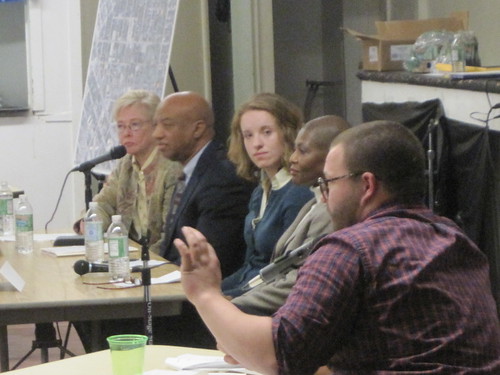
My view from the "Regeneration" panel.

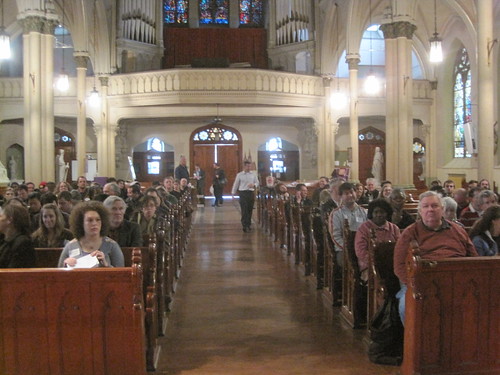
Yesterday I had the pleasure of joining Paul J. McKee, Jr., Antonio French and Stephen Acree for the panel on “Regeneration” during Open/Closed, a groundbreaking conference on vacant property in St. Louis. Perhaps the majesty of Joseph Conradi’s design of the Most holy Trinity Church sanctuary prevented any expected rancor, but I credit both the deft moderation of Cynthia Jordan and the spirit of the conference itself for leading the discussion away from any predictable drama.

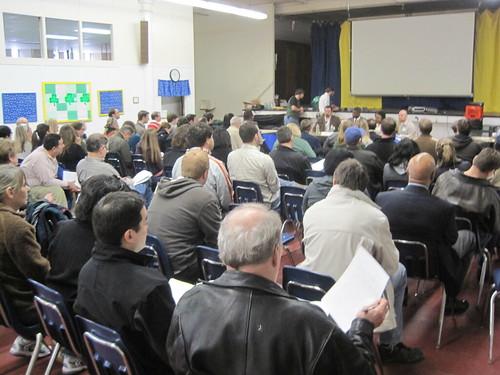
Moderator RJ Kocielniak asks questions of panelists Michelle Duffe, Otis Williams, Audrey Spalding and Yvonne Sparks during the panel.

Drama would have been a distraction. I confess to wanting deliberately to focus on specific goals and actions during what was often an abstract — but healthy — conversation. The reason for this was that Open/Closed showed how much common ground exists between people supposedly diametrically opposed in goals. What I heard was that most panelists want to dream big but work hard, and everyone wants to revitalize the economy of the city as well as cure its cultural defects. Vacant property is a huge problem, but we all know that it is a symptom of regional stasis and city disease that we must end.

Andrew Weil, Roderick Jones, Romona Taylor-Williams and Tom Moes on the "Vacancy and Schools" panel.

We have a lot of work ahead, and we need to develop the 21st century approach to renewing St. Louis. Every panelist and speaker at Open/Closed is working on a version of that approach, sometimes — as with Paul McKee, Jr. and I — in conflict. Differences in approach are not big problems so long as there are so few people searching for a new way forward. Our challenge is to use our common ground to grow the number of people and resources being deployed to transform the city and make the region a national magnet. We can debate the finer points of Land Reutilization Authority policy or Northside Regeneration’s development program, but until there is robust demand for vacant land held by the city, McKee or anyone else, we are chasing minor targets.

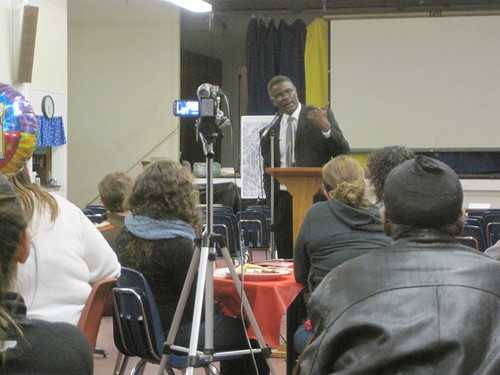
Sylvester Brown, Jr. delivering the keynote address.

The challenge ahead is transforming such wide agreement on the major problems facing St. Louis into workable actions. Otherwise we are just having lovely conversations about some very ugly problems that will continue to worsen. I hesitate to offer a string of abstract things we need to do to rebuild city government, cut through racism, rally behind entrepreneurs and other things that people talked about this weekend. The bottom line really is that anyone who recognizes that vacancy in St. Louis — especially the intensive abandonment of north St. Louis — is the symptom of a declining culture has to get to work rebuilding that culture. Some of us can afford to have our family foundations target grants or loans, others can start organizing block units, some can buy and rehab vacant buildings and others can use their official positions to create policies that direct scarce resources to  neighborhoods that actually need targeted public money. (Oh, and we all can vote.) The problem in enormous, but the cure is collective.

I commend Next STL, Frontier St. Louis, Rebuild Foundation and the other organizers of Open/Closed. Your work itself is an action step — the next step is ours.

Categories
Benton Park Carondelet Cherokee Street Marine Villa North St. Louis Pruitt Igoe South St. Louis

St. Louis Mythory Tour

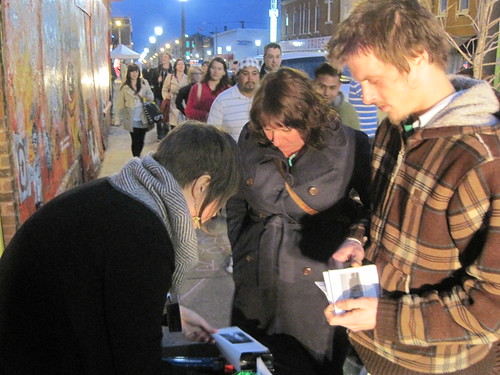
Emily Hemeyer helps two people assemble their zines at the Mythory Tour.

On Friday, as part of the epic Southern Graphics Council (SGC) Convention night on Cherokee Street, the St. Louis Mythory Tour made its debut. An expanded version will return soon, as will a new edition of the ‘zine guidebook, printed in a limited edition of 70 for Friday.

St Louis Mythory Tour
a collaborative tour and zine making workshop
by Emily Hemeyer & Michael R. Allen
May 12th, 2011. 6-9pm. Cherokee ReAL Garden. Cherokee Street. St Louis, MO

“[M]yth is speech stolen and restored.”
-Roland Barthes, Mythologies

ABOUT THE PROJECT

The built environment of St. Louis reveals itself through our observations, often clouded by nostalgia, ideology and comparison. We look around us and see inscriptions of what we imagine St. Louis to be, be that a “red brick mama”, an emergent Rust Belt powerhouse, a faded imperial capital or simply our home. St. Louis offers back its own narrative mythologies, presented through chains of linked sites with collective meanings. We quickly find that the city’s own presentation of itself is as veiled as our own observation. There is no one St. Louis, but there is no one archetypal St. Louisan.

The Mythtory Tour imagines a landscape of accrued building that has been neglected, in physical form and human consciousness. This tour presents one possible mythology of place centered on traditions of construction converging across disparate neighborhoods and many generations in order to show us St. Louis. Whether you can find this city out there is irrelevant, because using this map you will find some city worth your love and respect.


View St. Louis Mythory Tour in a larger map

THE TOUR

1. THEY BUILT WITH EARTH
Sugarloaf Mound, 4420 Ohio Street

2. THEY BUILT WITH STONE
Stone House, 124 E. Steins Street

3. THEY BUILT TO PRODUCE
Lemp Brewery, southeast corner of Cherokee & Lemp streets

4. THEY BUILT IN THE AIR
Pruitt-Igoe Site, Southeast Corner of Cass and Jefferson Avenues

5. THEY BUILT FOR THE FUTURE
Kingshighway Viaduct, Kingshighway Boulevard Between Vandeventer and Shaw
Avenues

6. THEY BUILT UNDERGROUND
Cherokee Cave, Under Cherokee Street at DeMenil Place

7. THEY BUILT ON THE WATER
U.S.S. Inaugural, Foot of Rutger Street

(Full descriptions and photographs of each location are available in the guidebook. Those interested in ordering a copy can contact Michael Allen at michael@preservationresearch.com.)