Categories
North St. Louis Northside Regeneration

Northside Regeneration: The Process is Still the Problem

by Michael R. Allen

Assessing the future of the Northside Regeneration project in light of Judge Robert Dierker, Jr.’s ruling against the project’s redevelopment ordinances is difficult. For one thing, the ruling has suspended the ordinances but left a loophole for reinstatement. Then, Northside Regeneration’s principal Paul J. McKee, Jr. has announced that his company will file a motion to return to Dierker’s courtroom, and that if that motion does not lead to the judge’s reversal, an appeal will follow. City Hall is cryptic but seems to be placing distance between itself and the developer. Statements from the aldermen involved in the ordinances tip no hands.

McKee makes it clear that the project is still a priority to him, and that it is in no way “over” because of Dierker’s ruling. Yet intention and outcome are joined by a process that requires ultimately convergence of the courts, residents, city government and even state government given the tax credits McKee needs to start the project. That process to date has been convoluted and seriously problematic to everyone involved. Without improving the process, no outcome can be certain except that conflict over the direction of the project will continue.

Categories
Brick Theft North St. Louis St. Louis Place

Another Summer for Brick Thieves

by Michael R. Allen

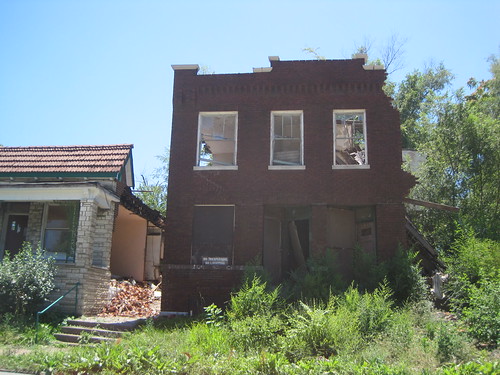
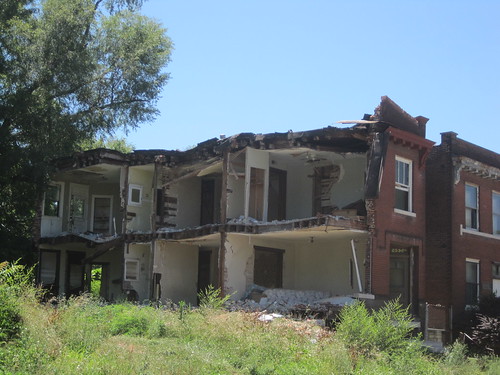
This summer is no different than others in the past few years for brick thieves. On the 2500 block of West Sullivan in St. Louis Place, the south side of the street has been badly ravaged in the last few weeks.  The north face has already been hit hard.  Of course, there are still occupied houses amid this wanton destruction.

Categories
Housing Hyde Park LRA North St. Louis

Slow, Steady Progress in Hyde Park

by Michael R. Allen

Amid ongoing recession, development is continuing in the city’s Hyde Park neighborhood. Irving School LP, owned in part by Duffe Nuernberger, has started work on renovation of fifteen historic buildings scattered across the western side of the neighborhood between North Florissant Avenue, Natural Bridge Road and Glasgow Avenue. The projects utilize state and federal historic rehabilitation and low income housing tax credits.

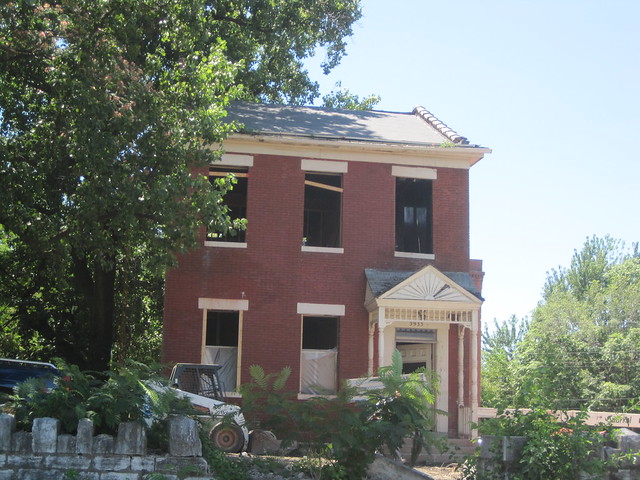
The elegant house at 3933 N. 25th Street is one block north of Irving School, rehabilitated by the same developers last year.  Long vacant, the house retains a wooden porch with intact fretwork.  The house is adjacent to an  owner-occupied house.

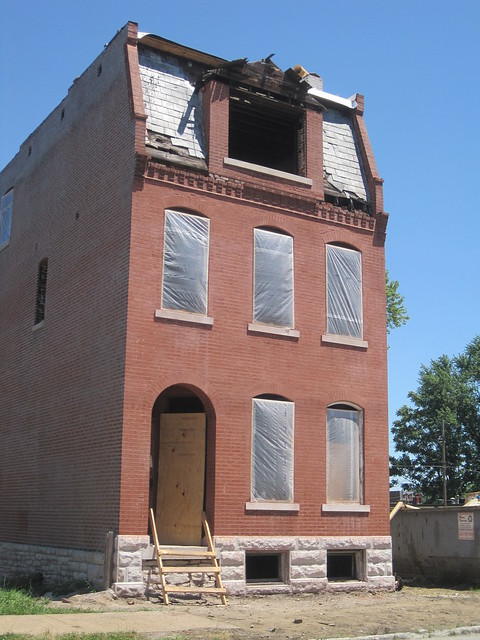
Here is the building at 3906 N. 23rd Street, two blocks east. The venerable two-flat is also a long-vacant building on a block that has lost much of its building stock. Eliot School LP purchased the house from the city’s Land Reutilization Authority.

The affiliated company, Irving School LP, recently completed six new houses on Farrar and 25th streets around Irving School. Above is a new house on N. 25th Street adjacent to existing buildings. While most of these new homes were built on vacant LRA-owned lots, one occupies the site of a historic building demolished by the developers.

The single-family homes offer a rent-to-own option, so the project is not exclusively creating tax-credit affordable rentals. Time will tell if a mix of ownership and rental is created here, but it is important that home ownership is included in the scattered-site development so that past affordable housing mistakes are avoided. Over-concentration of tax-credit rentals can lead to instability. (I do not take similar issue with rental housing in general, because existing market-rate rentals at all price points do not have the potential to unbalance a neighborhood housing economy.)

While I disagreed with last year’s demolition on Farrar Street, I am pleased that it took place in order to make way for a replacement building. That is not often the case in Hyde Park, and speaks to the sensitivity of the approach. The Irving School and Eliot School partnerships have worked with preservation architect Jeff Brambila, whose counsel is evident. Equally important is the fact that the developers are not using eminent domain or aggressively trying to buy out entire blocks. The approach here is slow and steady, and tackles vacant property without creating more of the same.

Potential Additional National Register Designations

Due to this development, Alderman Freeman Bosley (D-3rd) has appropriated funding to survey parts of the Hyde Park neighborhood excluded from the original certified local historic district‘s boundaries. In March, the Riverview-West Florissant Development Corporation issued a request for proposals for survey and any possible National Register of Historic Places nominations. Landmarks Association of St. Louis submitted the winning bid and will be conducting the work.

The areas to be surveyed are:

Area bounded by I-70 on the east, Angelrodt Street on the north, Branch Street on the west and Buchanan Street on the south.

Area bounded by Glasgow Avenue on the west/north, alley east of Vest Street on the east and Natural Bridge Avenue on the south.

Area bounded by Angelica Street on the south, Florissant Avenue on the east and Glasgow Avenue on the west/north.

The creation of such districts will allow developers to leverage tax credits programs for rehabilitation. Additionally, the designations could protect against demolition. While the Third Ward is a preservation review district, one of the arguments employed in favor of demolishing the house on Farrar Street was that it fell across the alley from the historic district boundaries.

Categories
Downtown

Downtown’s Eternal Flame

by Michael R. Allen

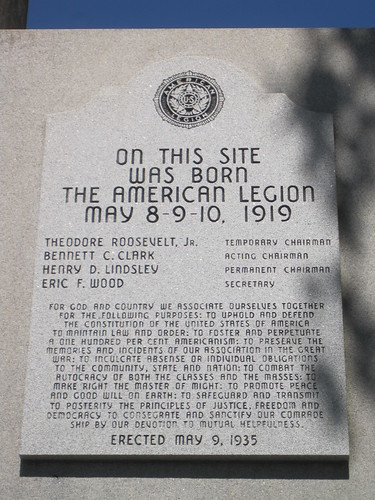
Between May 8 and May 10, 1919, a national gathering of World War I veterans met at the Schubert Theater (located at 12th and Locust streets, now demolished) in St. Louis.  The assembled veterans created the American Legion and elected Theodore Roosevelt, Jr. the organization’s first president.

During the first year of American entry into World War II, the Monument Builders of America met in St. Louis at the Municipal Auditorium (of which Kiel Opera House is the surviving section). The monument builders elected to build a monument to commemorate the founding of the American Legion in St. Louis. The natural site for such a marker was the city’s Memorial Plaza, a seven-block park dedicated in the 1920s as a permanent memorial to the city’s casualties in the Great War. Already, in 1938, the city had completed the somber, art moderne-style Soldiers Memorial by Preston J. Bradshaw and Mauran, Russell and Garden in the heart of the Memorial Plaza.

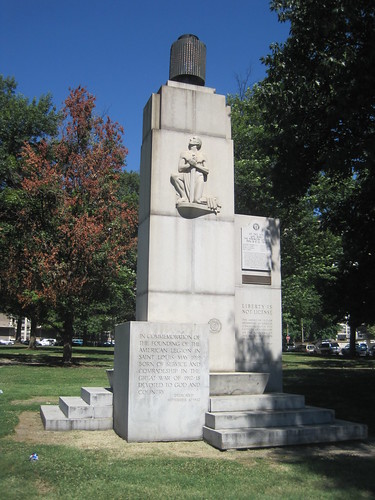
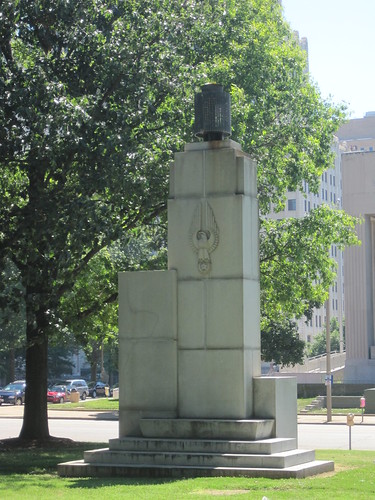
The city and the Monument Builders of America chose a site facing the new Soldiers Memorial on 14th Street between Pine and Chestnut. The monument design consists of a tall granite plinth supporting a copper stand with an eternal flame that burns to this day. Each rib of the copper stand bears the name of one of the 48 states that existed at the time. The plinth is flanked by side blocks and steps arranged asymmetrically. Adorning the cenotaph are a figure of a soldier holding a sword and on bended knee on the east and the American Legion symbol on the west.  Artist Sascha S. Schnittmann (1913-1978) designed the monument and its sculptures. The American Legion Monument was dedicated on September 6, 1942.

In 1969, the American Legion added an inscription on the east face commemorating the fiftieth anniversary of its founding as well as the statement “Liberty in Not License.”  The social, political and military turbulence remaking America in the late 1960s perhaps made the old saw seem particularly pithy.  A historical marker commemorating the founding of the American Legion erected on the Schubert Theater in 1935 also was moved to the east face of the American Legion Monument.

Categories
Fire JeffVanderLou Martin Luther King Drive North St. Louis

3850 Martin Luther King, Destroyed by Fire Today

by Michael R. Allen

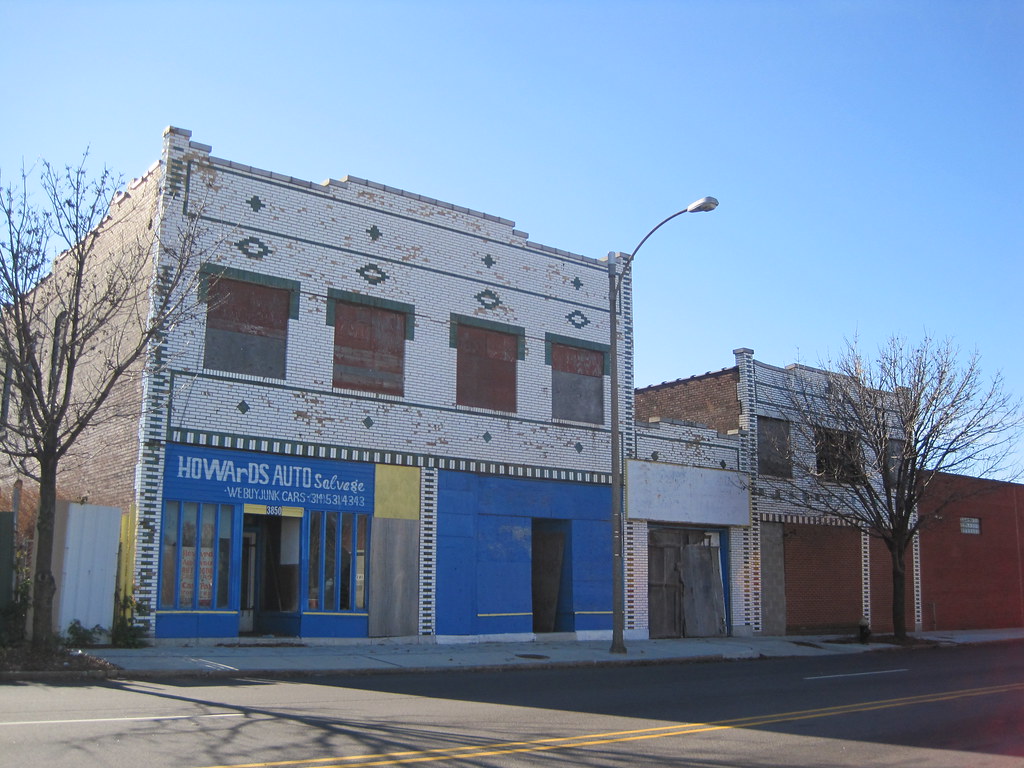
Here is a photograph from December 2009 showing the two-story commercial building at 3850 Dr. Martin Luther King Drive that was destroyed by fire this afternoon (at left here).  The building and its neighbors dated to the 19th century but were damaged in the tornado of 1927.  After the tornado, the owners rebuilt the front elevations in modern white bakery brick with green glazed brick accents.

Categories
Downtown

Scale Model of the Kiel Opera House

by Michael R. Allen

This week’s start of the long-awaited rehabilitation of the Kiel Opera House provides an occasion to post some interesting historic photographs from the collection of the St. Louis Building Arts Foundation.

The city of St. Louis’ Plaza Commission, responsible for completing the development of parks and civic buildings in the Memorial Plaza area, commissioned architectural sculptor Victor Berlendis to create a scale model of the proposed Municipal Auditorium and Opera House before construction began in 1932.

The Plaza Commission had the model photographed from different angles and with various cardboard props to demonstrate how lovely it would look when completed. The sky backdrop was a dramatic touch.

The thorough mock-up included a night scene as well. The model’s whereabouts are unknown. Berlendis sculpted other civic buildings from the 1930s, and half of his model of the Main Post Office at 18th and Market resides at Landmarks Association of St. Louis.

For more history of the opera house, the Kiel Opera House National Register nomination by Lynn Josse is the best source.

Categories
Historic Preservation

Are You a Member of Local Historic Preservation Organizations?

The Campbell House Museum just started a Twitter account.  This is definitely a good move to reach a new and younger audience for an established house museum.  Often missing from the conversations about historic preservation on Twitter and other online spaces are local institutions.  The gap is generational, as older joining is separated from the over-wired, individualized approaches of young advocates today.

Still, does new media have to remain separate from the old movement?  Of course not.  The gap must be spanned to keep long-standing preservation organizations viable.  The Campbell House Museum recognizes that it’s a two-way street.

Readers, I want to know:

Are you a member of local historic preservation organizations?  Which ones?

If not, why not?

Leave your comments here.

Categories
Housing North St. Louis Penrose

Rebuilding Two Blocks in Penrose

by Michael R. Allen

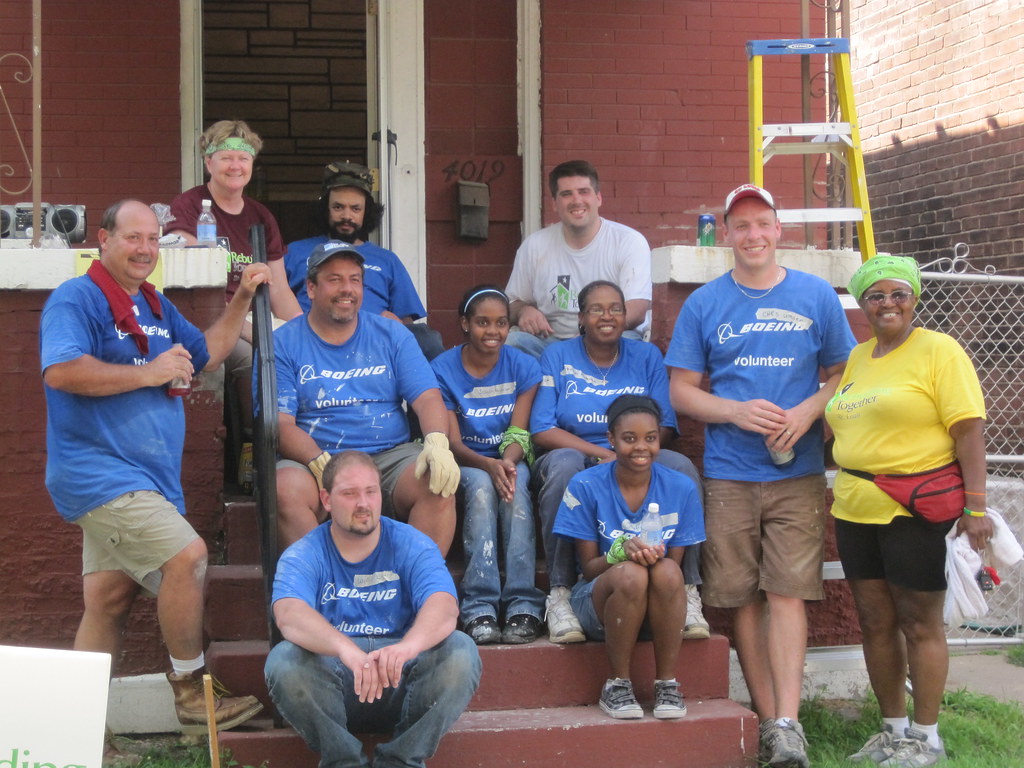
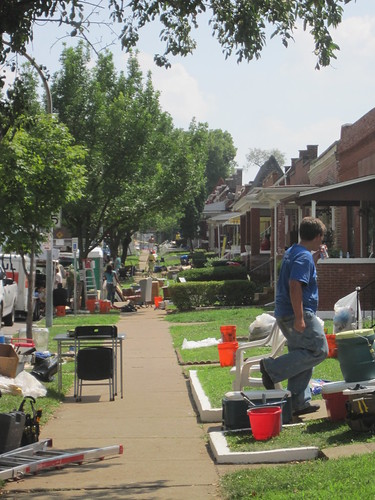
On Saturday, June 26, two blocks of north St. Louis’ Penrose neighborhood were abuzz with rehabilitation work — 15 homes’ and 300 volunteers’ worth of rehabilitation, to be exact.  The 4000 and 4100 blocks of North Taylor Avenue, scene of the action, are lined by mostly one-story brick homes enjoying the same setback line.  A few gambrel-roofed one-and-a-half story homes are peppered in with one-story shaped-parapet and bungalow houses from the first decades of the twentieth century.  At the south end, the street closes at a robust two-story brick fire station — its boxy, flat-roofed form contrasting with the gentle residential setting around it.

This lovely neighborhood setting, however, has its problems.  Every one hundred year old house that has been continually occupied needs repairs, but often accumulated repairs bring costs beyond the reach of residents on modest incomes.  City home repair money is in short supply.  People want to remain in their houses and in their neighborhood.  What to do?

Alderman Antonio French (D-21st), who represents the Penrose and adjacent O’Fallon neighborhoods, is working on a solution.  This year, he has brought in Rebuilding Together St. Louis to bring home repair to residents.  Saturday’s repair blitz was the second of six planned this year.  The operation is simple: residents identify crucial repairs, including structural problems, and apply to be part of the weekend blitz.  Rebuilding Together assesses the problems and, if needed, brings in professionals to prep work that can be completed by general volunteers.  Rebuilding Together coordinates materials donations and volunteer labor.  Then, on the weekend, volunteers and residents work together to get repairs done with amazing speed.
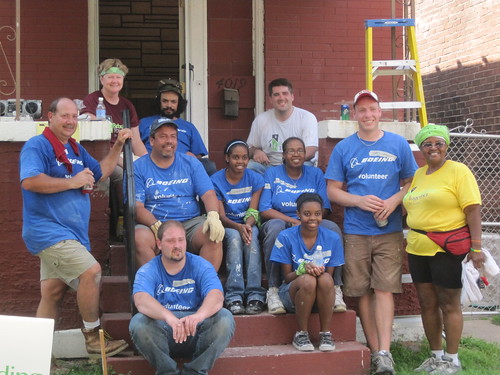
Here is one crew consisting of volunteers from the Boeing Company and the owners and residents of the house that received extensive interior repairs.
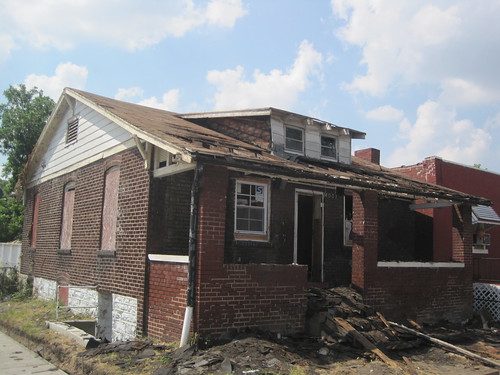
Alderman French is funding architectural survey of Penrose to create a historic district. That designation, which is more than a year away, will bring tax credits to rehabilitation work. However, some buildings needs immediate assistance, like the house at the corner of Taylor and Margaretta avenues. The sturdy bungalow has been vacant and owned by the city’s Land Reutilization Authority for years. Alderman French put it into Saturday’s blitz program. Volunteers removed loads of trash, removed failed roofing and began gutting the interior. In coming weeks, the house will be fully rehabilitated. French is leveraging Rebuilding Together’s presence to turn around a derelict, city-owned property.
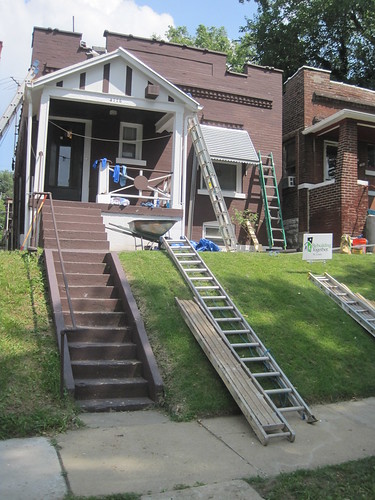
This house on the 4100 block of North Taylor received a new roof Saturday. The old roof was torn off, sheathing and joists replaced as needed, and the new flat roof completed — all in a day.
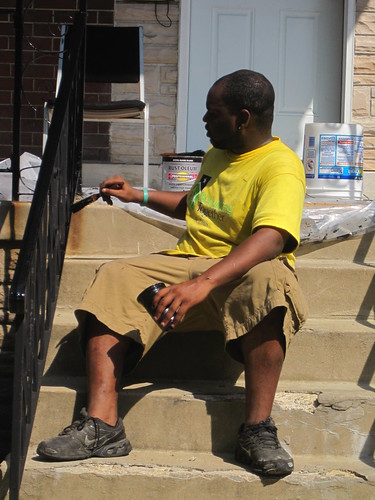
Not all work was as daunting as entirely new roofs, of course. One of the great things about the program is that it responds to needs big and small. The coordinated work schedule means that residents of a block experience an inspiring day where the block’s condition is uplifted at once.

The Rebuilding Together program in the 21st Ward is an excellent model for neighborhood preservation. For one thing, once homes go vacant, their reuse becomes very, very expensive. Tax credit projects are complicated to put together, and are only meaningful amid other more extensive stabilization efforts. Big projects like Crown Square and Dick Gregory Place involve dozens of buildings, not hundreds. And we have thousands of buildings at risk of going vacant through deferred maintenance and the cost of upkeep.

The Rebuilding Together program won’t save all of them, but it is an excellent way to leverage private donations to stabilize neighborhoods and even tackle city-owned property. We need to expand this program to keep existing buildings in use and residents in their neighborhoods. The 21st ward program really is a holistic historic preservation program. Coupling the home repair program with historic district designation puts the widest number of rehabilitation solutions on the table as is possible.
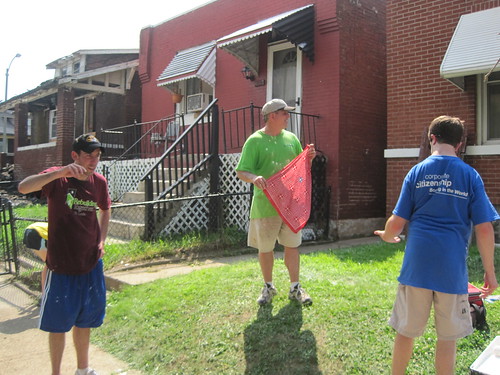
By the way, Rebuilding Together is always looking for volunteers. Find out more on the organization’s web site.

Categories
DALATC Missouri Missouri Legislature Public Policy

Tax Credit Accountability

by Michael R. Allen

The Show-Me Institute’s research on the Missouri Distressed Areas Land Assemblage Tax Credit raises questions about the Department of Economic Development (DED) rules for usage of that credit. One immediate contrast is the state Historic Rehabilitation Tax Credit, which has increased reporting requirements in recent years to maximize accountability and state regulation. DED ensures that users of the historic rehab tax credit have to account for every dollar claimed.

For one thing, projects using the historic rehab tax credit have to receive preliminary approval from DED before work can commence. This requires listing of buildings in the National Register of Historic Places before an application can be made. Then it requires submission of a detailed scope of work that is reviewed by DED as well as State Historic Preservation Office (SHPO) staff. This review must include itemized estimated costs of all aspects of work.

After preliminary approval, work can start. During work, SHPO review staff will usually be involved in making final decisions that impact the historic character of a building. When work is completed, an applicant has to submit a fully itemized account of all project expenses, with receipts proving money was spent as claimed. Homeowners that use the credit can learn the hard way that they needed to save every receipt. Without proof that they bought that $2.39 tube of caulk, it cannot be claimed as an eligible expense. DED’s rules will not allow any wiggle room — not even on a $50,000 project.

There is a lot of concern about the impact of tax credit programs on Missouri’s revenue. One can argue whether the historic rehab tax credit should exist, but one cannot claim that the program’s rules allow for unverified claims. The state gets exactly what it pays for, and gets to decide up front whether to pay at all. All other tax credit programs — especially programs that allow single applicants to claim $20 million in one application — should play by the same rules.

Categories
DeVille Motor Hotel Events

Fort Gondo Sidewalk Sale Benefits San Luis Legal Fund

Tomorrow Galen Gondolfi is cleaning out his basement of wonder, and donating half of the proceeds to the Friends of the San Luis.  (While the San Luis saga is over, the legal bill remains.)  What a generous fellow!  But he needs your help making space in his basement, so buy a few things whydoncha?

The sale is part of the Cherokee Bazaar and Flea Market, so if you go near the street at all tomorrow you probably won’t come home empty-handed.  Architectural remnants may not fit in your hand, though.