Categories
Fox Park Housing South St. Louis

Look Next Door

by Michael R. Allen

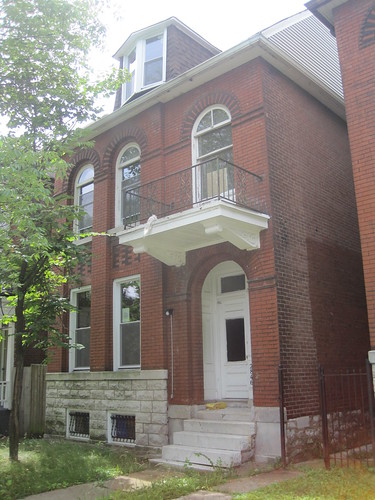
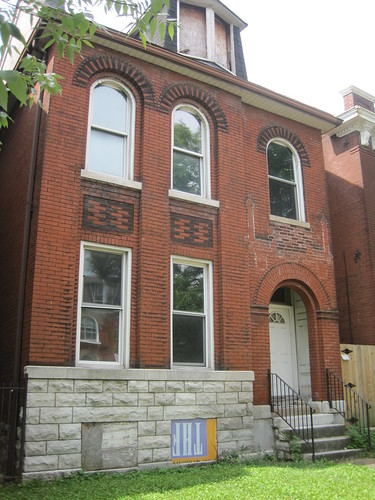
This house on the 2800 block of Victor Street in Fox Park is a lovely house that uses the American Foursquare form.  (The American Foursquare is typified by a rectangular shape, hipped or sometimes gabled roof with central dormer and four-room plan on each floor.)  The use of the rock-faced dark brick is particularly striking.  Yet something clearly is missing!

Look above the entrance — there is a shade of the old balcony.  The outline suggests that the balcony was cantilevered over the entrance, maybe with ornate brackets underneath.

Aha! Indeed, the balcony did have ornate brackets and was cantilevered over the entrance. We know this because the near-twin house next door retains its original balcony.  The next-door house is only a near-twin because it employs paired string courses that connect with the arches of the windows and entrance.  The balconies were probably the same, but the brick work was not made exact.  Such a slight variation is typical in St. Louis vernacular masonry architecture, which produced many near-twins but few exact copies.

Categories
Missouri Public Policy

Governor Nixon’s Tax Credit Commission Criticized

From the Coalition for Historic Preservation and Economic Development:

Governor Nixon’s tax credit commission criticized as lacking enough representation of people who know economic benefits of Historic Tax Credits

For Immediate Release

Contact: Deb Sheals, 573-874-3379
Coalition for Historic Preservation and Economic Development

Columbia, MO – July 22, 2010 – Governor Jay Nixon released his plans for creating a commission to perform a review of the state tax credit programs yesterday. The Missouri Coalition for Historic Preservation and Economic Development (MCHPED) spokesperson Deb Sheals, stated, “We are concerned that the Governor’s commission does not appear to have enough representation from people and organizations that are familiar with the dramatic impact the Historic Tax Credit has had in the production of jobs and economic development across Missouri. There are, for example, no representatives from small main street organizations, community development organizations, or historic preservation organizations, all of whom have firsthand experience in how well the program works for the average citizen. Missouri leads the nation in economic development from the historic tax credit, and any commission that is looking at this issue should include more members that are familiar with how it works.”

It also appears that the members chosen for the commission mirror a previous effort taken midway through the 2010 legislative session to pit education vs. development and redevelopment in communities throughout the state. This is not an either-or situation; economic development through historic preservation creates a stronger tax base and is therefore a benefit to education.

The State Historic Tax Program is a proven economic engine. Historic Tax Credits create jobs, encourage environmentally sensitive redevelopment, and long term revenue sustainability for the state of Missouri. Since 2000, historic tax credits have generated more than $669 million dollars in revenue for the state and local governments while creating 43,150 new and retained jobs with an average salary of $42,732. (See the attached executive summary of a recent study of the impact of this program.) The Governor’s attacks are creating industry-wide uncertainty and have crippled the effectiveness of the program as an economic stimulus.

MCHPED looks forward to once again demonstrating the tremendous state and community benefits generated by the Historic Tax Credit Program.

Categories
South St. Louis St. Cecilia Historic District

St. Cecilia Historic District Launches Website

by Michael R. Allen

The St. Cecilia Historic District — bounded by Grand, Delor, Virginia and Bates avenues — has its own website showcasing its unique architecture and history. Neighborhood resident and historian NiNi Harris provided narrative history and selected contemporary and historic views of the neighborhood. The district is anchored by the twin-steepled, Romanesque St. Cecilia Roman Catholic Church, designed by Henry Hess and completed in 1925. However, the surrounding residential and neighborhood commercial buildings include some of south city’s finest early 20th century brick vernacular architecture.

Check out the website here. Does your historic district have a website?

Categories
Agriculture Gravois Park Shaw South St. Louis Tower Grove East

Chickens in South City

by Michael R. Allen

Sparing readers of chickens coming home platitudes, I will state that there are a lot of chickens in St. Louis city these days. Urban agriculture in the city is becoming more diversified, and many backyard farmers are adding chicken coops with resident hens and roosters. The coops range from formally-designed to organically-built, small to large. Many are made from wooden pieces found in alleys.

On July 11, Travis DeRousse organized the first “St. Louis Chicken Coop Tour” (this is the first by that name, not the first). The tour included eight coops in Shaw, Tower Grove East, Gravois Park, Marine Villa, Benton Park and Dutchtown. The concentration in a relatively small part of south St. Louis suggests that there are dozens of such coops all over the city. Since most coops are low buildings, and most chickens pretty quiet, neighbors may not even realize what is going on next door or down the block. With over 60 people in attendance on the tour, there seems to be strong interest in building more coops and bringing more chickens in the city — which is a return to historic practice, actually.

The first coop on the tour was Greg’s elegant backyard coop in Shaw.  With vergeboards, ornament and a hinged salvaged window, this is a fine work of architecture.

Cara Marie in Tower Grove East built a coop of wood from alleys, with the different pieces almost striated as horizontal siding.

Travis’ own coop in Tower Grove East is a small, neat raised building.  The problem: his dogs shared the backyard, but not for long.  The dogs killed the chickens.  Chickens need to be protected from dogs.  Some coop owners on the tour spoke of how their cats were safe around chickens, and protected them.  Not all cats are created equal, however.

Just one block down the street from Travis, Sara Kate has what was the largest coop of the tour.  Again, the alley salvage craftsmanship shows.  The shed roof is hinged to open for easy access.

I had to leave the tour at the Community Arts and Media Project (CAMP), the fourth stop, but not before peeking in the CAMP coop to see not only a hen but also a duck!  There are certainly lots of possibilities in urban farming.

The contemporary urban coops are just the latest manifestation of chicken-raising in the city.  Old newspapers are full of tales, mostly silly, that illustrate how prevalent chickens were in St. Louis in the 19th and early 20th centuries.  An 1897 article in the St. Louis Post-Dispatch gave a hi-falutin “city farmer” space to describe good practices.  The farmer called for prohibiting chickens in the city so that farms were all-vegetable!

The August 20, 1881 issue of the Post-Dispatch carried the article “The Compton Hill Chickens,” showing that the southsiders of today are really just upholding tradition.  A Mr. Brunaugh of 2744 Lafayette Avenue reported that men were going door to door on Compton Hill trying to sell chickens that they brought along.  The sales ruse included letting the a chicken go, causing a mad dash by the “salesmen” across back yards.  They would capture their hen but also pick up a few others on the way.  “The finest chickens in the city are raised on Compton Hill,” the reporter wrote.

Sometimes chickens led to courtroom drama, too.  The article “Poisoned Fowls Cause of Quarrel” in the October 5, 1904 issue of the Post-Dispatch reported on the curious sudden death of 35 of Mrs. Fox’s chickens.  (There were no limits on number of chickens at that time, and I doubt that today’s chicken farmers have any aspirations to a number as big as 35.)  Mrs. Fox accused next-door neighbor Mrs. Catherine Seher of 2812 Arsenal Street of throwing poisoned bread over the fence.  Justice Kleiber of the Police Court sided with Mrs. Seher, however, after testimony by all parties.  Miss Nellie Seher, daughter of the accused, was a strong witness.  The article notes that Miss Seher “did not use adjectives in her testimony, and was therefore more than ordinarily convincing.”

Categories
Missouri Missouri Legislature Public Policy

Nixon Announces Tax Credit Commission

Contact: Scott Holste, (573) 751-0290
Scott.Holste@mo.gov

Sam Murphey, (573) 751-0290
Sam.Murphey@mo.gov

FOR IMMEDIATE RELEASE
July 21, 2010

Gov. Nixon creates new commission to perform comprehensive review of state tax credit programs
Panel of business and community leaders, legislators will make recommendations to enhance job creation, boost return on investment for state

JEFFERSON CITY, Mo. – Gov. Jay Nixon today announced the creation of a Tax Credit Review Commission that will review the state’s 61 tax credit programs and make recommendations for greater efficacy and enhanced return on investment. Gov. Nixon named 25 business, community and legislative leaders to serve on the commission.

“Missouri must have sharp, effective development tools that will promote growth, create jobs, strengthen our communities and continue to drive our economic recovery forward,” Gov. Nixon said. “This commission will perform a critical analysis to ensure taxpayers receive the greatest possible return on investment from tax credit programs and that those programs are used efficiently and effectively. The work of the commission will play a vital role in reshaping the way the state uses financial incentives to achieve those important goals.”

The commission will analyze the efficacy and return on investment for each of the state’s 61 tax credit programs and make recommendations for modifications as appropriate.

Gov. Nixon appointed Steve Stogel and Chuck Gross to co-chair the Tax Credit Review Commission. Stogel is the President of DFC Group in St. Louis; Gross is the director of administration for St. Charles County. They are joined on the commission by leaders from the development, education, finance and labor communities, as well as members of the Missouri General Assembly.

From the Missouri Senate, Gov. Nixon named Sen. Matt Bartle (R-Lee’s Summit), Sen. Jolie Justus (D-Kansas City) and Sen. Robin Wright-Jones (D-St. Louis). Gov. Nixon’s appointees from the Missouri House are Rep. Tim Flook (R-Liberty) and Rep. Sam Komo (D-House Springs).

Gov. Nixon also named: Zack Boyers of U.S. Bancorp Community Development Corporation in St. Louis; Mark Gardner of Gardner Capital in Springfield; Luana Gifford of the American Federation of Teachers in Jefferson City; Bill Hall of Hallmark in Kansas City; Dee Joyner of Commerce Bank in St. Louis; David Kendrick of the Kansas City Building and Construction Trades Council; Alan Marble, President of Crowder College in Neosho; Troy Nash of Zimmer Real Estate Services in Kansas City; Melissa Randol of the Missouri School Boards Association in Jefferson City; Tom Reeves of Pulaski Bank in St. Louis; Penney Rector of the Missouri Association of School Administrators in Jefferson City; Russ Still, a member of the State Board of Education from Columbia; Craig Van Matre, a member of the Coordinating Board for Higher Education from Columbia; Ray Wagner of Enterprise Rent-A-Car in St. Louis; Todd Weaver of Legacy Building Group in St. Louis; Shannon Weber of the Carpenters’ District Council of Greater St. Louis and Vicinity; Mike Wood of the Missouri State Teachers Association in Jefferson City; and David Zimmerman of the Sheet Metal Workers International Association, Local 36 in St. Louis.

Categories
Missouri Missouri Legislature Public Policy

DED Sort of Explains the New Rule on Historic Tax Credits

by Michael R. Allen

Tim Logan has a good article this morning about the state of Missouri’s historic tax credit program. Recently, the Department of Economic Development (DED) sent letters to already-approved historic tax credit project applicants stating that the projects were going back for further review. This applied to projects approved since July 1. The letters did not cite the substance of any DED rules that will govern further review.

In the article, DED spokesman John Fougere stated that the new rules were created to ensure compliance with the large project cap passed by the legislature in 2009. That cap went into effect January 1, 2010. Did DED miss the chance to ensure that half of this year’s projects are in compliance? And since estimated project cost is a requirement of even having an application reviewed, why are new rules needed to ensure that DED does not award too many tax credits? A calculator would suffice.

DED has not yet shared the language of the new rules with prospective applicants. If the new reviews are taking place, the rules must exist. If the rules exist, they should be shared. The historic rehab tax credit has been orderly, predictable and free from politics since day one. Some want to cut it or change it for budgetary reasons, and their arguments are respectable. What Governor Nixon is doing is something else entirely.

Categories
Historic Preservation Public Policy

U.S. House Committee Approves Full Funding for Historic Preservation Fund

From the Coalition to Fully Fund the Historic Preservation Fund:

Good news! The House Natural Resources Committee passed the CLEAR Act, which includes the provision to fully fund the Historic Preservation Fund. One amendment was offered which would have stripped the guaranteed and permanent funding for the HPF, LWCF [Land and Water Conservation Fund] and a new Oceans Trust Fund, however thanks in part to efforts by Coalition members, the amendment failed. There is still a long way to go to achieve our ultimate goal, however the CLEAR Act will now go forward for a full House vote with the HPF provision included. For the official press release on the bill, you can follow this link.

Categories
Downtown

St. Louis Public Radio Story on Kiel Opera House

On Monday, St. Louis Public Radio aired a story by Adam Allington on the name change in store for Kiel Opera House. Allington included an interview with Preservation Research Office Director Michael Allen.

A transcript and audio is online here.

Categories
Events North St. Louis Old North

Inaugural Exhibit in the Old North Restoration Group Gallery

Featuring the photography of Sean Thomas, Thom Fletcher, Stefene Russell and Michael R. Allen
and the graphic art of neighborhood residents and children, from the Urban Studio

6:00-7:30 PM Thursday, July 15, 2010

The exhibit explores the people and built environment of Old North St. Louis, focusing on the physical transformation as well as the long-time character and traditions of the neighborhood.  Children and adult art looks at what makes Old North the neighborhood it is through drawings, mixed media and photography.

Categories
Housing North St. Louis Northside Regeneration Old North

Community-Driven Development on Northside Continues Despite McKee Ruling

From EcoUrban Homes

CONTACT: Jay Swoboda, 314-231-0400 x4

ST. Louis – Despite the recent ruling against Paul McKee’s plans for a $390 million TIF, strong neighborhood-based development continues to sprout up in many areas covered by McKee’s NorthSide Regeneration Zone. Building on increasing enthusiasm for urban, walkable neighborhoods with a close proximity to downtown, unusually strong development continues to unfold in North St. Louis.

Old North St. Louis Restoration Group, EcoUrban, and Habitat for Humanity St. Louis (currently the largest developer of single-family homes in the region), have all committed to completing projects of significant scope on the Near North Side.

EcoUrban is working with Alderwoman April Ford Griffin, the Regional Housing and Development Corporation (RHCDA), and Community Renewal and Development Inc. to develop eight new single family homes at 25th and Dodier. The homes will be built to the USGBC’s LEED for Homes specifications and feature thoughtful urban design and efficient, green construction. Habitat for Humanity St. Louis, no stranger to LEED certification, is currently completing 17 new homes in Old North St. Louis. These homes feature a modern design and are tracking LEED for Homes Platinum certification. Additionally, Old North St. Louis Restoration Group, will hold a ribbon cutting ceremony for the transformational Crown Square Project, a 27-building project spanning eight blocks in the heart of North St. Louis’ commercial district, is slated to be held on July 29th. By any measure, North St. Louis is undergoing tremendous redevelopment.

“We are proud of our commitment in North St. Louis, remarked Kimberly McKinney, CEO of Habitat for Humanity St. Louis. “Since 2008, Habitat for Humanity St. Louis has invested $8.1 million towards new home development on the North Side with $5.5 million committed for 2010.”

“It’s amazing how much positive feedback we’re receiving from the community up here,” said Sal Martinez, Executive Director of Community Renewal and Development Inc. “With a common-sense approach, and a great green projects, it’s easy to draw the attention of leaders and residents committed to making St. Louis a better place for families.”

———————

Habitat for Humanity Saint Louis is consistently ranked in the top 30 of the leading 100 Habitat affiliates in the country, and is currently the leading housing developer in the St. Louis Metro Area. The Old North St. Louis Restoration Group is a community-based nonprofit organization established to revitalize the physical and social dimensions of the community in a manner that respects its historic, cultural, and urban character. EcoUrban is a developer of efficient, affordable green real estate developments – helping to create sustainable solutions for St. Louis.