Categories
Events

Preservation Month Calendar Posted

I have posted a calendar of Preservation Month events in May 2010, which the National Trust for Historic Preservation recognizes as the national month for historic preservation. Check out the wide range of events, which range from walking tours of mid-century modern buildings to a used book sale benefiting the Chatillon-DeMenil House to a historic St. Louis County farm tour to a liability-waiver tour of the James Clemens House. There are also tours of Harris Armstrong houses, an exhibit on lost riverfront architecture, a rock ‘n’ roll show later in the month and a Pecha Kucha night (head-scratchers, check the calendar).

I’m sure that I have left a few events out, so please point those out to me via email or in the comments section here.

Also, when earlier today I went to reserve my spot in Landmarks Association of St. Louis’ tour of the Beaux Arts Building on Tuesday, May 11, I received a response stating that the tour already was full and that I would be put on a wait list. The tour announcement set no attendance limit, while other Landmarks tours has specific limits. I’d recommend making reservations as soon as possible for these popular tours!

Categories
DALATC Missouri Public Policy

Nixon’s Tax Credit Explanation

by Michael R. Allen

This morning in the St. Louis Post-Dispatch I read the worst-ever explanation of how the Missouri historic rehabilitation tax credit works:

“Right now, if a building is old and somebody in essence wants to develop that, they automatically get certain amounts of these credits,” [Governor Jay] Nixon said. “We want to have an ability to cap that.”

Does that sort of knowing oversimplification even play well out-state any more?

This is no the correct way to describe a program that:

1. Requires buildings to be listed in the National Register of Historic Places — either individually or in historic districts — before a tax credit application can be approved. The National Register has strict criteria for listing and many buildings do not make the cut;

2. Requires owners to submit up-front through preliminary application itemized expenditures and detailed work descriptions, and then subjects the developers to review by design professionals working for the State Historic Preservation Office;

3. Has rules that reimburse only for “qualified rehabilitation expenses”;

4. That last year was capped at $140 million for projects of $1.1 million or more in qualified rehabilitation expenditures (a cap that Nixon supported without stating that he wanted a more drastic cut);

5. Governor Nixon has supported in previous years, including the year he ran for governor.

Nixon also does not mention that last year he signed the economic development bill that increased Missouri’s annual obligation in Distressed Areas Land Assemblage tax credits from $10 to $20 million to allow developer Paul J. McKee, Jr. to receive over $19 million in those credits before the end of 2009. Nixon remains silent on the merits of that particular program while attacking a program used mostly for small-scale neighborhood redevelopment.

Nixon’s push to make tax credits available for the most politically connected is problematic, because that’s a continuation of the worst aspects of Missouri’s tax credit policy. There are other ideas for reform that have merit, such as placing caps on existing programs — including the special-interest programs — or independent study of the economic impact of all existing programs and the courage to eliminate the bad programs.

Categories
Rehabbing South St. Louis Tower Grove East

White Roof Coating, Ahead of Summer

by Michael R. Allen

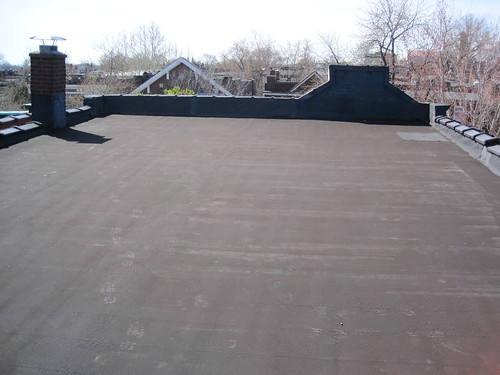
After completing major tuckpointing and chimney rebuilding, we decided to apply a white elastomeric coat to our flat roof this month. This roof was a three-ply modified bitumen roof with a black, heat-trapping emulsion overcoat. The roof was old enough to coat but certainly not getting younger under the toll of ultraviolet rays. A mod-bit roof needs about one year to leech out oils before coating, and ours was well past that mark. Time to coat!

Now why would we go through the trouble of applying a white coat? There are two major reasons:

Energy efficiency and global warming. A white coat can reflect up to 80 percent of solar radiation, reducing overall planet temperature but more immediately reducing building, neighborhood and city temperature. One white roof is small local block against the urban “heat island” effect and many of them can have wide impact. The white roof will reduce the internal temperature and the need for air conditioning, which in turn reduces the electricity usage and so forth. (There is some question about possible heat loss effect of a white roof in winter. At St. Louis’ latitude the sun’s rays are vertical in the summer and at a low slant in the winter, so the available winter solar heat is much less than the summer heat. At other latitudes, a white roof might not be of such benefit as here and points southward.)

Longevity of the roof. An elastomeric coat will block ultraviolet rays that slowly break down asphalt roofing. Coats should be reapplied every 10 years or sooner if needed. With timely reapplication, the coverage can extend the life of the roof to 40-50 years, reducing cost as well as waste of nonrenewable roofing materials.

While the mason had the scaffolding set up, we used his pulley to hoist up the 5 gallon buckets of coating. We used five $72 buckets of Henry Solarflex 287, which completely covered our 1300 square foot roof. When the scaffolding was down, we used a tall ladder for travel to the roof.

Working with a friend, we spent about eight hours washing the roof and applying the coat. Since we had just had masonry work, the roof was dirty and required over two hours of scrubbing. The mod-bit roof dried quickly, however. We applied the coat with a 4″ brush on the parapet sides and 9″ rough rollers on the roof. We avoided a few new flashing repairs made around the rebuilt chimneys.

Most of the roof was covered with two coats, but some areas required three coats. (A one year old roof won’t take this much work). We left a spot near the ladder for exit and came back to finish in a half-hour a day later. Now the roof is too bright to look at, just in time for summer. We’re not big air conditioning users — it’s expensive and not very sustainable, although certainly necessary for a few weeks — so we definitely look forward to the building heat reduction.

Categories
Central West End Events Mid-Century Modern Midtown

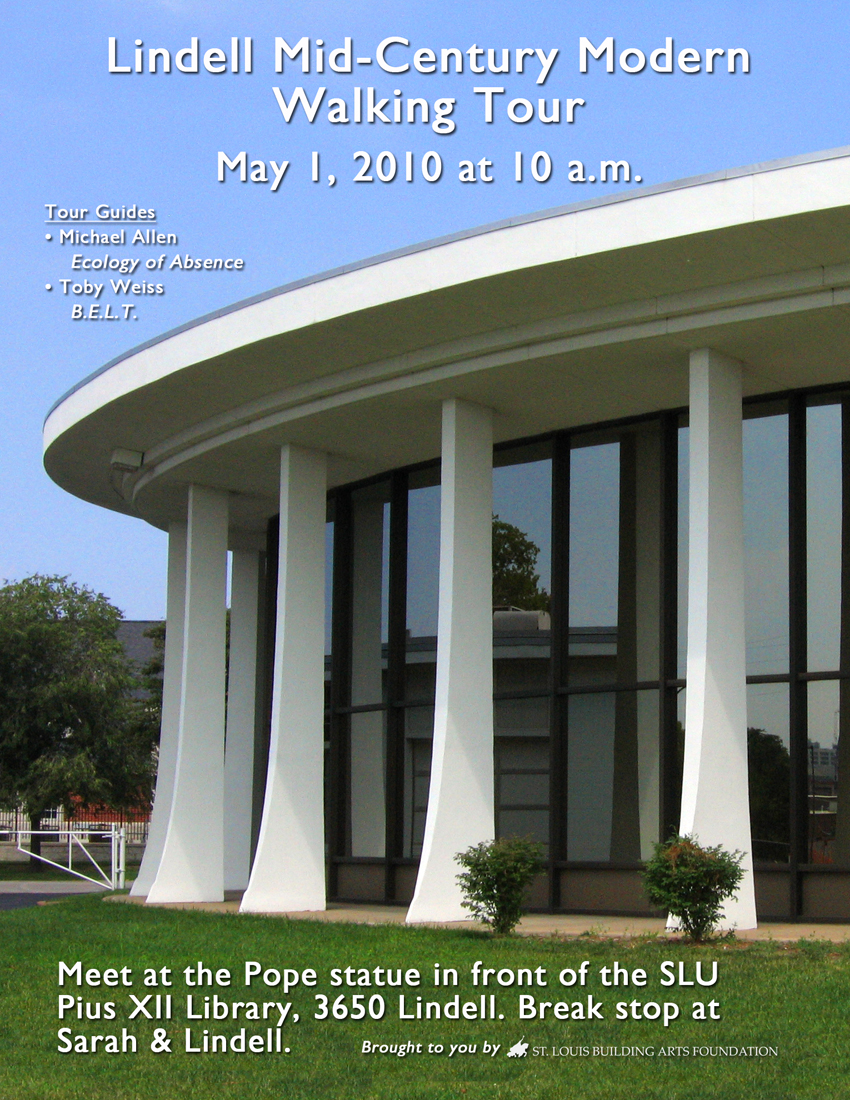
Lindell Mid-Century Modern Walking Tour, May 1

Lindell MCM Walking Tour

On Saturday, May 1, the City of St. Louis presents its first Open Streets 2010 event. From 8:00 a.m. through 1:00 p.m., a route through the city including most of Lindell Boulevard will be closed to vehicular traffic.

The St. Louis Building Arts Foundation is pleased to join the city’s effort by sponsoring an architectural walking tour showcasing the city’s modern architecture.

Lindell Mid-Century Modern Walking Tour

When: 10:00 a.m. (lasts approximately 90 minutes)

Where: Meet at the statue in front of Pius XII Memorial Library, 3650 Lindell Boulevard

What: A narrated tour of Lindell’s unusual array of modern architecture led by Michael Allen and Toby Weiss. From the somber International Style to New Brutalism to playful Googie, this tour has it all!

FREE

Categories
Preservation Board South St. Louis

Saving What Is Left on Chouteau

by Michael R. Allen


So much of Chouteau Avenue has been cleared of street-facing historic buildings that the character remaining is hard to find. The mention of Chouteau is more likely to conjure suburban-style industrial buildings with front lawns and parking lots than a measured urban environment. I hold no complaint against the presence of businesses like Villa Lighting and Andy’s Seasoning, since they provide jobs in a centrally-located part of the city within easy travel of city residents. However, I do lament that the influx of larger uses has meant destruction of the character of the street. Chouteau used to be very different, even just a few decades ago.

But all is not lost — yet.
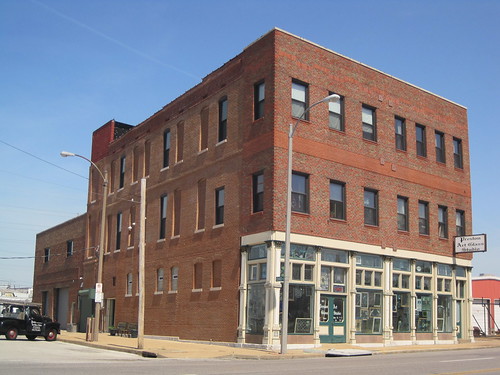
The three-story building housing Preston Art Glass Studio is a reminder of the historic density of Chouteau Avenue. Although the front wall was once relaid, the building retains historic features including a lovely cast iron storefront. The difference between walking past this building and the newer buildings on Chouteau could not be more stark.

Across the street is a row of six historic buildings, two of which are occupied and four of which are now endangered. Right at the corner of Jefferson and Chouteau is a two-story brick building (barely visible here) housing a dental office. There is a Chinese restaurant in the building to the west. There are two gaps in the street face, but this group provides a welcome transition between the residential streets of the Gate District and Lafayette Square, with front gardens and street trees, and the harsh contemporary industrial environment on Chouteau to the west and, to a lesser extent, on the east.

Gas station operator Crown 40 Inc. applied to demolish the four buildings from 2612-2630 Chouteau, and had its application denied last month by the city’s Cultural Resources Office. Crown 40’s appeal is on Monday’s agenda of the St. Louis Preservation Board.

Perhaps the showiest of the buildings is the two-story building at 2612 Chouteau, with a fine cast iron storefront.
No matter how shabby the buildings of the row are, they sure are easier on the eyes — and on the pedestrian — than newer outposts of commerce on Chouteau.

The end building once housed a crude industrial use — it was a print shop for the Lindstrom Wagon Company around the turn of the 20th century. The graceful transition to the street kept the use from oppressing its surroundings. I wish that the same could be said about what is getting built on Chouteau a century later.

The potential for a higher use is strong. There is a lot of consumer power in the vicinity of Jefferson and Chouteau, and the Gate District is woefully under served by neighborhood business — because planners tore down most of the corner storefronts inside of the Duane Plater Zyberk-planned urban experiment. Well, some old urbanism exists here and could serve both the neighborhood and the hundreds of workers employed on Chouteau and the nearby LaSalle Street floral row. A gas station might be handy — of course, there already is a new Crown Mart just north at I-40 and Jefferson — but how about a deli or a neighborhood bar and grille?

The Preservation Board meets at 4:00 p.m. on Monday, April 26 at 4:00 p.m. in the 12th floor conference room at 1015 Locust Street downtown. Send written testimony to Adona Buford at BufordA@stlouiscity.com.

Categories
Missouri Public Policy

What Is Governor Nixon Thinking?

by Michael R. Allen

One has to wonder what is the point of Missouri Governor Jay Nixon (Democrat)’s tax credit reform proposal and why he is going to such great lengths to push it. The House Republican leadership is stonewalling any changes to tax credits this year, so even if Nixon could get reform passed in the Senate it will never make it to his desk. That fact did not stop Nixon from showboating at a press conference yesterday, where he pitched his tax credit proposal flanked by 75 educators whose presence underscored his point that a dollar toward tax credits is a dollar taken from education.

This is a talking point now being used in debate in the General Assembly by Senator Brad Lager (R-Savannah) and his conservative allies, whose commitment to public education has never been so strongly stated. Strange that Lager, Nixon and company have aimed their strongest attack at the historic tax credit, one of the few tax credits in Missouri that does not require expensive consultants and lawyers to understand and use. The low income housing tax credit is second on the list, although its appropriation system is continually politicized along the lines that Nixon is proposing for all tax credits in the state.

I keep wondering if this Jay Nixon is the same man that I met at a fundraiser hosted by Steven Fitzpatrick Smith back in 2008. That Nixon talked a lot about the importance of education, too, but he also emphasized his commitment to the historic rehabilitation tax credit and urban development. Nixon proclaimed to understand that the historic rehab credit creates jobs. That night nearly two years ago, Nixon told a room of us that he was proud of his days living around Tower Grove Park and being a city resident.

Flash forward and now he’s aiming at the state’s only citizen’s tax credit, knowing he won’t hit, because taking aim wins alliances with people who wish that Missouri had no cities larger than Chillicothe. He’s doing this at the same time that Lt. Governor Peter Kinder (R) is building up his urban support to unseat Nixon. He’s doing this at the same time that House Speaker Ron Richard (R) is calling for independent evaluation of all tax credit programs before making cuts — a sensible and needed study that could help Missouri get rid of the bad programs. What could Jay Nixon possibly be thinking? Why let Republicans who know very well how to use the opportunity sound urban-minded and reasonable to St. Louis voters?

I’d like Governor Nixon to embrace real tax credit reform, not a gubernatorial power grab that makes tax credits the sole province of the politically connected who can wheedle part of the annual appropriation. All Nixon needs to do is look at the programs and propose getting rid of the ones that aren’t creating jobs and spurring revenue returns. He needs to drop his current reform proposal fast. After all, every dollar spent in campaign contributions is a dollar not spent on creating jobs or improving neighborhoods. You don’t have to be a teacher to do that math.

Categories
Housing Metro East

Shiloh House With a Cool Brick Chimney

by Michael R. Allen

Suburban place-making can be difficult when builders rely on the build-by-the-material approach through which home designs are derived from dimensions of common materials. That’s why we see so many woefully under-fenestrated tract houses, with wide rear faces of tiny white vinyl windows amid siding that seem to defeat the point of suburban life. Why face the back of the house onto an expansive view and then put puny little windows on that side?

I digress. I was meandering from a job at Scott Air Force Base to lunch in Belleville when I spotted this new house — workers seemed to be applying finishing touches — on Indian Ridge right off of Main Street in Shiloh, Illinois. By and large the houses in Indian Ridge showed modest originality, especially in chimney design. For one thing, the chimneys here are all brick — not vinyl-covered boxes of questionable fireproofing or graceless exposed sheet metal stacks. No, here the chimneys are solid masonry, and one really makes the most of that fact.


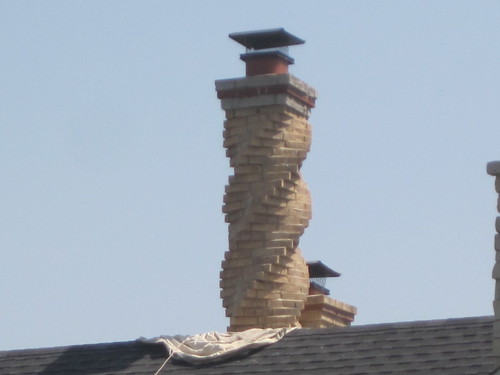
Check it out — a turned chimney in buff brick, with a more traditional cousin behind. the cap is even brick around a genuine clay pot. Should it be said that the suburbs are architecturally lifeless, remove this little house in Shiloh from the observation.

Categories
Adaptive Reuse Downtown Events

Free Tour of Paradowski’s New Digs

On Saturday, April 24, Landmarks Association of St. Louis offers a free tour of the impressive new home of Paradowski Creative. Paradowski is located in the former Missouri Electric Light and Power Company plant at the southeast corner of 20th and Locust streets. Details are available in the organization’s latest newsletter. RSVP requested; 314-421-6474 or landmark@stlouis.missouri.org.

Categories
Historic Preservation Illinois Southern Illinois

2010 Illinois Ten Most Endangered Places

Today Landmarks Illinois announced its 2010 Ten Most Endangered Historic Places. More information is online here.

The list includes:

1. Bass-Mollett House — Greenville
2. Chanute Headquarters and Mess Hall – Rantoul
3. Illinois Main Street Program
4. Manske-Niemann Farm – Litchfield
5. Massac Theater – Metropolis
6. North Pullman – Chicago
7. Prentice Women’s Hospital – Chicago
8. Red Cliff – Moline
9. St. Laurence Complex – Chicago
10. Uptown Theatre – Chicago

This is an assortment indicative of the state’s current preservation problems: there’s a mid-century modern building (Prentice Women’s Hospital), a farm, two theaters and a large church (always hard to adapt) and a popular state preservation program.

I previously wrote about the plight of the Massac Theater: “Massac Theater Crumbles in Metropolis, Illinois” (November 13, 2007).

Categories
Belleville, Illinois Historic Preservation

Arts Center Proposal for Belleville YMCA Gaining Momentum

by Michael R. Allen

Over the weekend, the Belleville News-Democrat carried a story by Laura Girresch entitled “The old YMCA building: Is it worth saving or will it be a money pit?”. Title aside, the article reports that St. Clair County Historical Society member Larry Betz’ proposal to turn the former Belleville YMCA into the Belleville Arts and Cultural Center is gaining traction.

Belleville officials are hopeful that Betz’ plan can come to fruition. A lot of work lies ahead but the city government’s attitude now seems firmly supportive of preservation. One of the issues ahead: how to fund mothballing the building as Betz raises money for the center.