Categories
Historic Preservation Public Policy

Minnesota Passes Historic Tax Credit as Stimulus

by Michael R. Allen

From Preservation Action

Last week, on April 1, Governor Tim Pawlenty signed into law the Minnesota Jobs Stimulus Bill which, of note to preservationists, includes a State Historic Rehabilitation Tax Credit designed to stimulate green job growth, increase local tax bases, and revitalize urban and main street communities through reinvestment in historic properties. Approximately 1,500 to 3,000 construction jobs are projected to be added annually because of the measure.

The new state historic preservation tax credit, like the federal rehabilitation tax credit, will make available a state income tax credit equal to 20 percent of the cost of rehabilitating a qualifying income-producing historic property. Projects are eligible to claim the state credit if they qualify for the federal credit, which requires properties to be listed in the National Register of Historic Places. Minnesota currently has 1,600 listings in the National Register representing almost 7,000 individual properties.

An innovative component of the tax credit allows developers to choose either a certificated, refundable credit or a grant, which will stimulate nonprofit use of the incentive, and also can be used against the insurance premium tax widening the investor pool. There is no cap for the program.

Minnesota joins thirty other states that have similar tax credit programs.

Categories
Historic Preservation Mullanphy Emigrant Home Old North

Mullanphy Emigrant Home, Four Years Later

by Michael R. Allen

The fact that this city still has the Mullanphy Emigrant Home is testament to the amazing mobilization of dedicated Old North St. Louis residents, preservationists and civic leaders across the city. This week’s victory for Proposition A in St. Louis County brought much jubilation to advocates for sustainable urban development, and its close coincidence with the anniversaries of the dates that the venerable north side landmark was struck by storms crossed my mind.

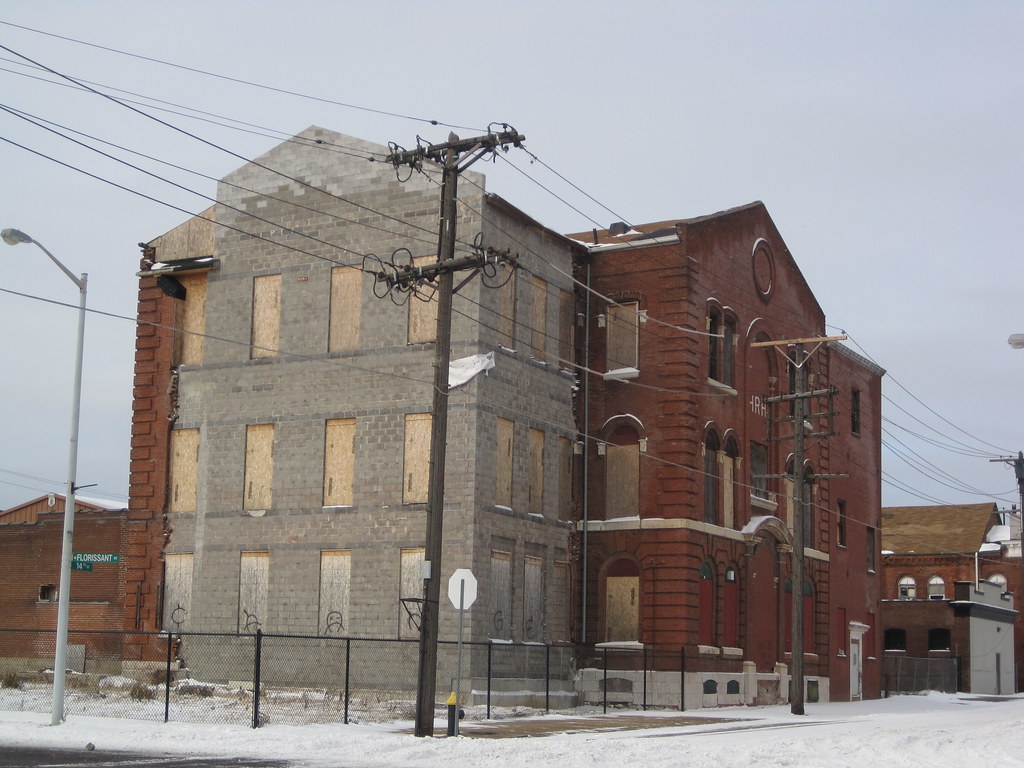
The tale of the Mullanphy Emigrant Home, located at 1609 N. 14th Street at the south end of Old North, is no less remarkable than the overwhelming passage of Proposition A. In the dark days after the storm wrecked the south wall in April 2006, many observers conceded its loss. The Building Division pushed for emergency demolition, the owner was not certain that he wanted to preserve it or even sell it and the neighborhood had so many other pressing needs that taking on a possible lost cause seemed unlikely. Yet residents of Old North rallied around the battered landmark, which defines the south entrance to the neighborhood and has great historic significance. While only used as a transitional home for westward-moving immigrants for ten years after its 1867 construction date, the Emigrant Home was pivotal in that period. Its Italianate masonry design, by celebrated architects George I. Barnett and Alfred Piquenard, is one of the city’s finest surviving 19th century examples of the style.

Cultural Resources Office Director Kathleen Shea helped fend off demolition to buy time. Swift mobilization of the Old North St. Louis Restoration Group allowed for a building sale. Then the hard part: raising money for stabilization and repair. Of course, things would get worse before getting better when a storm inflicted more damage almost one year later in 2007. Still, the preservation effort proceeded against daunting odds and with the generosity of E.M. Harris Construction Company and the Masonry Contractors Association, not to mention countless individual donors. Now, the building is effectively mothballed awaiting reuse as a hostel planned by the Hostelling International Gateway Council.

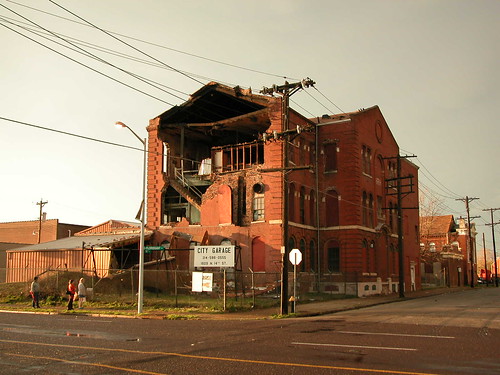
Here’s a look back at the building’s plight.

On March 31, 2007, the Mullanphy Emigrant Home suffered a second collapse due to heavy winds. The south wall already had a gaping hole, but then the east side and north wall were also partly collapsed. Bracing installed after the first damage held the building together although the open southern end created a wind tunnel effect that probably caused the blow-out damage.

The building was already in rough shape following the south end collapse on April 2, 2006.

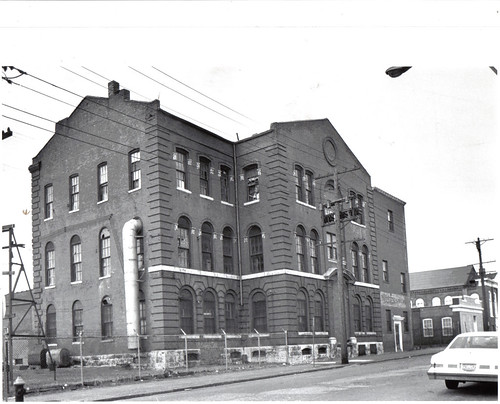
From 1900 through the 1980s, the Absorene Company occupied the building and used it to manufacture wallpaper adhesives, cleaners and removers. Absorene altered the building considerable, adding the bump-out stairwell in 1927, removing the cupola and main entrance, and changing the original profile of the front gable. The photograph above was taken by Landmarks Association of St. Louis in 1982 as part of the documentation for the Mullanphy Historic District, a National Register of Historic Places district.

Artist Pat Baer’s drawing presents the original appearance of the Mullanphy Emigrant Home. The outpouring of civic good will and hard work that saved the building — twice, no less — will hopefully restore this appearance some day.

Categories
Media People

A Hub is Born: UrbanSTL

by Michael R. Allen

With today’s publication of Toby Weiss’ excellent essay “Crying Over Spilt Milk: The Suburbs Happened, Get Over It!”, urbanSTL now has become the web hub for St. Louis region built environment news and commentary. Okay, this guest article goes along with regular blogging by Alex Ihnen, a blog aggregate feed, a rejuvenated Urban St. Louis Forum, a local urban Wiki, videos and many other features. The weaving, not the strands, make urbanSTL a central source.

Alex is the real spark behind this effort, and his dedication is such that he ceased publishing his own excellent St. Louis Urban Workshop to provide steady content for a new hub site. Last year, Alex sent out a call to bloggers for creating a portal into the ever-expanding sea of online content on development and architecture in the region. This blogger was too time-strapped to join the cause, but Toby and others have helped Alex bring the project to life. Bravo!

Categories
Central West End Demolition Historic Preservation Mid-Century Modern

Doctors Building Site: Still Empty

by Michael R. Allen

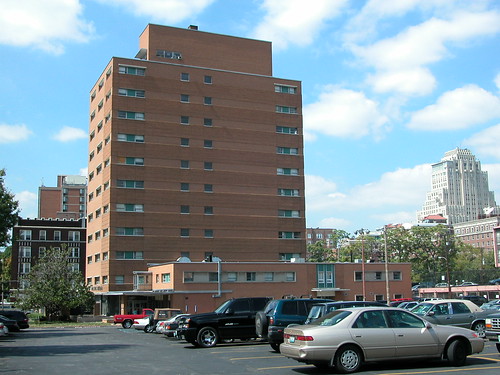
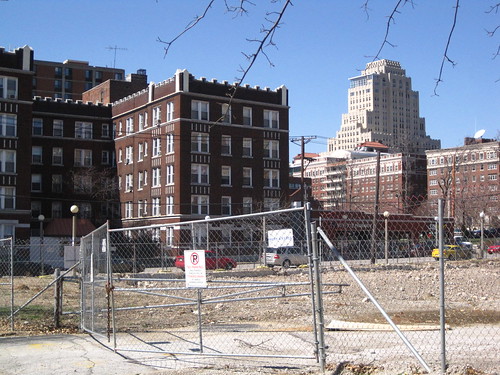
In April 2008, Mills Group demolished the mid-century Doctors Building at Euclid and West Pine the Central West End. An under-appreciated modernist gem fell for a supposed “Citywalk” — a mixed-use building with residential condominiums and street-level retail. Although located in a preservation review district, the building’s demolition was approved by the Cultural Resources Office without a Preservation Board hearing. Fans of urban infill like the Park East Tower and Nine North Euclid down the street rejoiced.

Now, two years later, the site is a vacant lot with a pre-Softball Village condition. Crushed pieces of the Doctors Building are still strewn about the site. In September 2009, Mills announced that a part of Department of Housing and Urban Development financing had fallen into place, but there has been no news since then.

In some instances, the call for preservation may rightly be called an impediment to some developer’s ready-to-build plan. In the case of the Doctor’s Building, it was not so.

Categories
Abandonment JeffVanderLou North St. Louis Storefront Addition

Storefront/Commercial Addition: Ted Foster & Sons Funeral Home

by Michael R. Allen

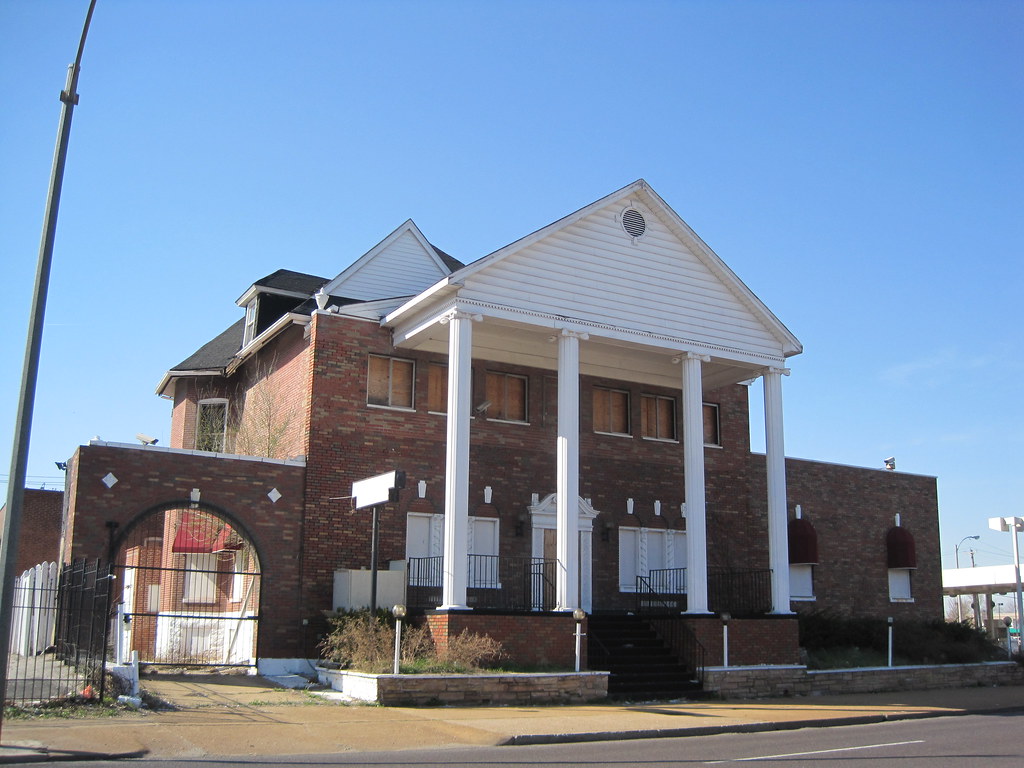
People often ask me about the history of the old, boarded-up funeral home at 1221 N. Grand near Page. This is indeed a curious old building, and it wears clearly its layers of construction history. There is the old house, built in 1895 and tucked away behind the later kinda-sorta Colonial Revival front. The front itself shows its seams, so to speak: there is the 1930s-era first floor, with the scrolled broken pediment entrance and prominent keystones. Then there is the second floor, with slightly different tapestry brick and flat-arch window openings with unmistakable post-World War II metal windows. There is a boxy northern wing and the graceful gated archway on the south, from which a funeral procession would once begin. Tying the whole thing together is a projecting gabled portico, replete with columns topped by authentic Ionic capitals with genuine volutes. There are terra cotta urns on each side of the portico up top.

This is a pretty classy hybrid building, and its history is likewise dignified. This is the former home of Ted Foster and Sons Funeral Home, which had passed its 75th year of business here when it abruptly closed in 2008. When the African-American Foster family took over the old house around 1933, this neighborhood had changed a lot. Now known as JeffVanderLou, this was then called Yeatman or Grand Prairie and the residential population had shifted to being largely African-American. As African Americans migrated to the city, the Mill Creek Valley neighborhood was overwhelmed and African-Americans began moving farther north up toward Cass Avenue.

The Foster family were entrepreneurs and ran a strong business until foreclosure in 2008. the circumstances of the closure remain vague, and the building is now empty awaiting its next life. Perhaps renewed interest in developing this part of time will be a rising tide for this curious dry-docked vessel.

Categories
Belleville, Illinois Historic Preservation

Arts Center Proposed for Belleville YMCA

by Michael R. Allen

Today the Belleville News-Democrat reported on an effort to turn the old YMCA building in Belleville, Illinois — originally the Belleville Turner Hall — into an arts center.

The story included some good news in the saga: members of a city committee charged with selling the city-owned building are impressed with the plan. After a lackluster response to a city-issued Request for Proposals (RFP) last year, Belleville officials have began mentioning demolition as a possible outcome. In February, I joined Belleville preservationists in urging the city to re-issue the RFP, which lacked important information on the building and mostly consisted of a report and asbestos in the building.

Proponents of the arts center have launched a Facebook group for supporters.

Categories
Mass Transit Midtown St. Louis County

Proposition A

by Michael R. Allen

This United Railways streetcar line map from 1903 reminds us of what is possible with mass transit. The red lines mark streetcar lines, which augment the street grid with a separate network of traffic. In 1903, that separate network was primary to many people. The streets where the street car lines ran gave rise to commerce and pedestrian traffic. The streets around them saw secondary benefits.

Now, 107 years later, county residents are faced with a choice on whether to approve Proposition A to fund the region’s public transit system, now doing business as Metro. That the funding comes through a sales tax increase that triggers an already-approved sales-tax increase in the city has generated concern. A sales tax increase is not desirable, but neither is the funneling of tax revenues to a state infrastructure agency, the Missouri Department of Transportation, that exclusively fund roadway construction. The money raised for state highways ought to stay in the region to begin with, to fund the transportation that best serves an urban area — just as Chillicothe’s transportation dollars are probably best spent on roads. If the money must go to the state, then it should return in the form of funding for mass transit operations in addition to highway funding. There is a board political goal from which our leaders cannot shirk after tomorrow, no matter what outcome.

Back to the 1903 map: density of transit lines created and sustained commercial districts at the turn of the last century. The map here shows midtown St. Louis, which soon afterward would be dubbed the “second downtown.” This is entirely due to the placement and density of mass transit street car lines. Today, we don’t have such stark benefit but we have a regional core where bus and MetroLink service is sufficient to support the location of major employment.

In 1903, mass transit made Midtown more desirable than other parts of the city of St. Louis. Today, mass transit makes the core more desirable for major employers than exurban locations. County voters are not voting to build up the city, but to sustain their own place in the regional economy — a place staked by relative density of population and transit lines. Without the sustaining the Metro system, what gives a county municipality like Brentwood a distinct business advantage over St. Peters? Or, for that matter, Chesterfield over Wentzville?

When we lost the street car lines, we found out what would happen when Midtown had to compete with the county in the absence of a strong mass transit system. Midtown faded away. So it could go with St. Louis County. Whether the city or St. Charles County ultimately benefits from the decline of Metro is a gamble of unknown odds. Somehow I doubt that defeat of funding for mass transit will benefit the urbanization of an already too-dispersed region. Yes, if Proposition A fails, the system is not dead — but it will shrink immediately and the prospect of service restoration will diminish. Passage of Proposition A allows time to build a better funding system without regional havoc or further economic dispersal.

Categories
Historic Preservation Missouri Legislature Public Policy

Missouri House Committee to Consider Tax Credit-Busting Bill Tomorrow

by Michael R. Allen

What’s Happening

Tomorrow (April 6th) the Job Creation and Economic Development Committee of the Missouri House of Representatives will consider HB 2399, the bill that would gut Missouri’s successful historic preservation tax credit program. The committee will meet at 1:00 p.m. in Hearing Room 6 of the capitol.

Why It’s Bad

The bill, introduced by Representatives Steve Hobbs (D) and Sam Komo (R), would rescind most of the state’s current tax credit authorizations and institute a new set of provisions. The bill would implement the policy proposed by Governor Jay Nixon (D) and would turn over much discretionary power to the Department of Economic Development, whose director is always a political appointment.

HB 2399’s worst aspects:

  • Eliminates tax credit provisions of all programs except the circuit breaker and homestead preservation credits, and would create six new programs;
  • Place a global credit cap of $314 million on all modified credits with annual fluctuation.
  • Cap “redevelopment” credit issuance at $78.5 million, which is 35% of FY 2009’s level. The historic rehabilitation, low income and land assemblage programs would compete for issuance.
  • Potential eliminate standards and review for the historic rehabilitation credit. There is no provision to continue the current review by the State Historic Preservation Office and no mention of the Secretary of the Interior’s Standards for Rehabilitation.
  • Give the DED director full discretion on whether to issue credits: “The decision of whether to authorize a tax credit under this section and the amount of any credit to be authorized is committed to the discretion of the director of the department of economic development…” (135.841.1)
  • Give DED full discretion to award 20% of all state tax credits to which ever program they choose. (135.840.7)

    The net result will be a highly politicized tax credit environment where one person — the DED director — will have broad discretionary power. The potential for special interest domination of Missouri’s tax credits — now simply a legislative problem — will be realized. Instead of rewarding incentivized economic activity, tax credits will reward personal political connections. Homeowners and small businesses will have hard time using the historic rehabilitation tax credit competing against large companies — and large companies the get the credits won’t be subject to the current level of oversight!

    What You Can Do

    Please contact members of the committee and let them know you oppose HB 2399.

    Flook, Timothy, Chair-Liberty R, Tim.Flook@house.mo.gov — 573-751-1218

    Brandom, Ellen, Vice Chair-Sikeston R, Ellen.Brandom@house.mo.gov — 573-751-5471

    Brown, Michael R. Kansas City D, Michael.Brown@house.mo.gov — 573-751-7639

    Corcoran, Michael George St. Louis County (St. Ann) D, Michael.Corcoran@house.mo.gov — 573-751-0855

    Diehl, John St Louis County (Town and Country) R, John.Diehl@house.mo.gov — 573-751-1544

    Jones, Tishaura St. Louis City D, Tishaura.Jones@house.mo.gov — 573-751-6800

    Komo, Sam Jefferson County (House Springs) D, Sam.Komo@house.mo.gov — 573-751-6625

    Kratky, Michele St. Louis City D, Michele.Kratky@house.mo.gov –573-751-4220

    Kraus, Will Lee’s Summit R, Will.Kraus@house.mo.gov — 573-751-1459

    McGhee, Michael Odessa R, Mike.McGhee@house.mo.gov — 573-751-1462

    Riddle, Jeanie Fulton R, Jeanie.Riddle@house.mo.gov — 573-751-5226

    Scharnhorst, Dwight St. Louis County (Fenton) R, Dwight.Scharnhorst@house.mo.gov — 573-751-4392

    Schoeller, Shane Springfield R, Shane.Schoeller@house.mo.gov — 573-751-2948

    Spreng, Michael St. Louis County (Florissant) R, Michael.Spreng@house.mo.gov –573-751-9628

    Webber, Stephen Columbia D, Stephen.Webber@house.mo.gov — 573-751-9753

    Zerr, Anne St. Charles R, Anne.Zerr@house.mo.gov –573-751-3717

    To find your Representative go to http://www.house.mo.gov/ and enter your nine digit zip code

  • Categories
    Benton Park Churches Events

    Pot Pies for Preservation

    From Jeanette Mott Oxford:

    Epiphany United Church of Christ at 2911 McNair in Benton Park will host a Chicken and Vegetarian Pot Pie Dinner on Saturday, April 10, from 5-7:30 p.m. Reservations may be made by calling 314-772-0263. We had had quite a bit of building repair and maintenance lately and want to preserve our beautiful church as a resource for the community. Please help us meet our expenses while enjoying wonderful food and conversation with others who are committed to the City.

    Tickets for adults and children over 12 are $8. Children under 12 may have a reduced price ticket at $5, and children under five eat free. We are a Just Peace, Open and Affirming, Whole Earth congregation. For more information, visit www.epiphanyucc.org.

    Categories
    Demolition Downtown Lafayette Square Preservation Board

    Neighborhood Involvement and Two Preservation Board Decisions

    by Michael R. Allen

    Among other things, the Preservation Board of the city of St. Louis hears appeals from property owners who have their demolition permits denied by the professional preservation planning staff of the Cultural Resources Office (CRO). However, use of that power to do the right thing does not always lead to preservation of historic buildings. In the past, this writer has covered the impact of the city Planning Commission’s statutory power to overturn Preservation Board decisions on appeal. That’s a route used by owners bent on wrecking their old buildings. Make no mistake: The appellate power of the Planning Commission and the power of the “emergency” demolition permit remain substantial obstacles to smart preservation policy in the city.

    However, in this country, private owners have broad and legally-defensible property rights. Even with the best policy, owners can still take down sound, significant buildings. Hence, there are other paths taken by property owners in the wake of the Preservation Board’s upholding denials of CRO appeals. Here are two divergent outcomes.

    2217 Olive Street (Downtown West)

    The old two-story commercial building at 2217 Olive Street in western downtown is best known for its last tenant, the Original Restaurant. Built as a house in 1888 and converted to commercial use in 1929 following the widening of Olive Street, the building was vacated in the mid-1990s. The owners sought a demolition permit that was denied by CRO. In September 2007, the Preservation Board upheld denial on appeal. In January 2008, the Preservation Board rejected a new application for demolition, despite a growing hole in the roof. The building was still sound under the definition established by city preservation law.

    The owners put a small for-sale sign on the building, but gravity took its course. The hole grew until most of the building’s wooden roof and floor structures collapsed. The walls started failing. In September 2009, the owners again applied for a demolition permit. This time, CRO approved the demolition permit application due to the severe deterioration of the building.

    The site is now paved as a parking lot, while a vacant lot next door (where a 19th century residential stone retaining wall and steps remain) is being seeded with grass. One notable aspect to the loss of 2217 Olive Street is that there was no objection — or indication of support — by downtown organizations, property owners or residents. The only forces working against demolition were the Preservation Board and CRO, joined by preservationists including this writer who testified at the two public meetings. Neighborhood investment in the decision would have strengthened the preservationist case and helped facilitate a sale of the building. Alas, downtown lost another retail storefront — for now.

    1624 Dolman Street (Lafayette Square)
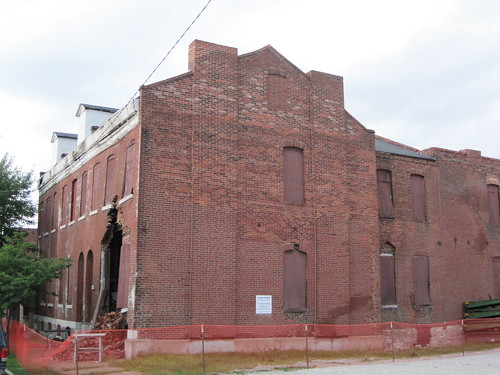
    In August 2009, the Preservation Board considered the appeal of the CRO denial of a demolition permit application for the house at 1624 Dolman Street in Lafayette Square. The Zumwalt Corporation, erstwhile seller of overhead doors located to the south facing Lafayette Avenue, owns the row of which this house is a part. Zumwalt attempted to rehabilitate the row before, but abandoned the project.

    Early last year, the front wall of the house collapsed. There was no serious structural failure to the building since like most every bearing-wall building this one had its joists running between the side walls. The front, unanchored to the building, bowed out until it lost the compressive strength needed to remain standing. No big deal — this happens a lot in the city, and our masons know how to close such wounds.

    Yet Zumwalt decided to see if demolition would be possible. The company was met with fierce neighborhood opposition, and a half-dozen residents testified against the demolition at the August 2009 Preservation Board meeting. The Board upheld denial with no votes to the contrary.

    The Zumwalt Corporation, which apparently is a good neighbor, then proceeded to rebuild the front wall. Now the row is intact and sound, and someday will be rehabilitated. Those who think that every Preservation Board denial will be met with a continued press for demolition should take note, but those who would infer that all’s well that ends well with a Board denial are misled by this example. What is apparent is that strong neighborhood support for preservation is key to actually saving buildings.