Categories
East St. Louis, Illinois Metro East

East St. Louis Videos on New Geography

by Michael R. Allen

Last month, New Geography uploaded the third of a three-part video series on East St. Louis. Alex Lotz created the videos, which started with a whirlwind tour that I gave him and St. Louis University history professor Flannery Burke on New Year’s Day last year. Alex shot footage on that day of the various places we saw, including downtown, Alta Sita and the stockyards district. Then he interviewed me and located archival footage to develop the videos.

Watch the videos:

Part I

Part II

Part III

Categories
Architects Detroit East St. Louis, Illinois

Yamasaki, Inc. Closes

by Michael R. Allen

The Detroit Free Press reports that Yamasaki, Inc. has closed. This is the end of one of modern architecture’s most illustrious American firms. Founded by Minoru Yamasaki in 1959, the firm’s name is found on the drawings for the ill-fated World Trade Center as well as many significant modernist designs.

The firm marked the departure of Yamasaki from the Detroit-based firm Hellmuth, Yamasaki & Leinweber, which Yamasaki had founded in 1949 with St. Louisan George Hellmuth and Joseph Leinweber. The three had worked together at Detroit firm Smith Hinchman & Grylls. Hellmuth, Yamasaki & Leinweber left a tremendous impact in St. Louis, designing the terminal at Lambert Airport (1956) and most of the St. Louis Housing Authority’s projects from the early postwar era, including the Pruitt-Igoe project (1954). When the firm split, Hellmuth created the firm Hellmuth Obata Kassabaum in St. Louis, which went on to become the world’s largest architectural firm and continues to be a giant among American firms.

Categories
DALATC Kansas City Missouri Legislature North St. Louis Northside Regeneration Public Policy

Kansas City Seeks Change to Distressed Areas Land Assemblage Tax Credit

by Michael R. Allen

Once again, state Senator Yvonne Wilson (D-Kansas City) has offered a bill to reduce the acreage ownership requirement of the Distressed Areas Land Assemblage Tax Credit Act from 50 to 30 acres. This bill is SB 682 and was first read on January 6. Wilson’s past attempts to pass this bill have gone nowhere.

However, the bill certainly has merit. If the courts uphold the Distressed Areas Land Assemblage Tax Credit, and the legislature lacks the will to kill it, the credit should be reformed. Wilson and Kansas City lawmakers would like to use the credit to aid in a Kansas City redevelopment project. Why shouldn’t they be able to get the credit changed, if it is truly a public benefit law under the Missouri Constitution?

Of course, the premise of the tax credit remains as dangerous as it was when first proposed in 2007, and the effect of the type of real estate activity it encourages is terrible for struggling neighborhoods. The tax credit’s main beneficiary has spawned copycat buying across north St. Louis. All we have to show are lost buildings, vacant buildings and neighborhoods caught up in a broadly-drawn development project that may not ultimately include them. It’s bad public policy, plain and simple. It could be a little better, though.

Categories
North St. Louis Northside Regeneration St. Louis Board of Aldermen

Now That McKee Has His Money, City Should Slow Process

by Michael R. Allen

At the end of 2009, developer Paul J. McKee, Jr. received $19.62 million in Distressed Areas Land Assemblage Tax Credits. According to the developer’s application, McKee’s Northside Regeneration LLC claims a little over $25 million in assemblage, interest and maintenance costs to date, and projects an additional $66 million in acquisition costs. Only part of the application has been released publicly, so a breakdown of those figures is not yet available.

The $25 million figure corresponds to the amount of a $25 million Second Mortgage and Deed of Trust filed with the St. Louis Recorder of Deeds by Northside Regeneration LLC on December 10. That second deed of trust is guaranteed by Paric Corporation, the construction company founded by McKee and now headed by his son Joe McKee.

Now that McKee has the tax credits he claimed all last year he needed to proceed, what will the developer do with the proceeds of selling them? Pay down his debt.

That use of the credits may surprise those who put stock in the words of supporters of the tax credit, including Lt. Gov. Peter Kinder, who claimed those credits would enable development of north St. Louis. Those who read the tax credit bill realized that it was in effect remuneration for questionable acquisition activity already underway.

Now that McKee has received his first payment and announced his intended use of the proceeds, we know that he will have paid down most of his claimed debt. Since McKee’s company continues to fail to secure and adequately maintain holdings, his holding costs must be minimal. This payment enables him to sit for another length of time.

More importantly, however, this payment enables city government to look more carefully at the Northside Regeneration project. McKee can no longer claim that the Board of Alderman’s lack of action is keeping him from money he needs to survive. The developer has redevelopment rights and TIF financing secured through the ordinances passed in October 2009. Both sides are even. There are going to be additional bills needed to enable redevelopment of the four areas McKee has divided the project into, and to activate the tax increment financing. This time, the Board of Aldermen and Mayor Francis Slay should not rush the process.

There needs to be a full and open debate of whether or not the project’s boundaries are appropriate, whether eminent domain restrictions need to be stronger, whether historic preservation planning ought to be included in additional ordinances, and what happens to McKee’s holdings outside of his project boundaries in the Old North St. Louis neighborhood.

Let’s lay this all on the table before passing more enabling ordinances.

Categories
Fairground North St. Louis

Two Buildings in the Fairground Neighborhood

by Michael R. Allen

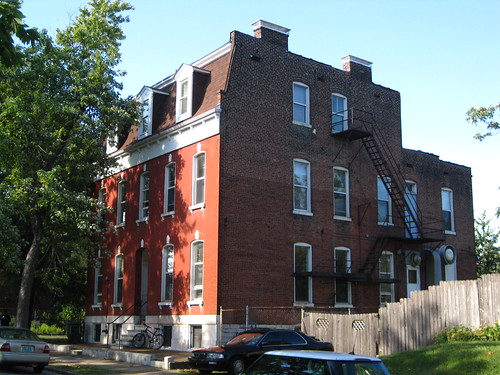
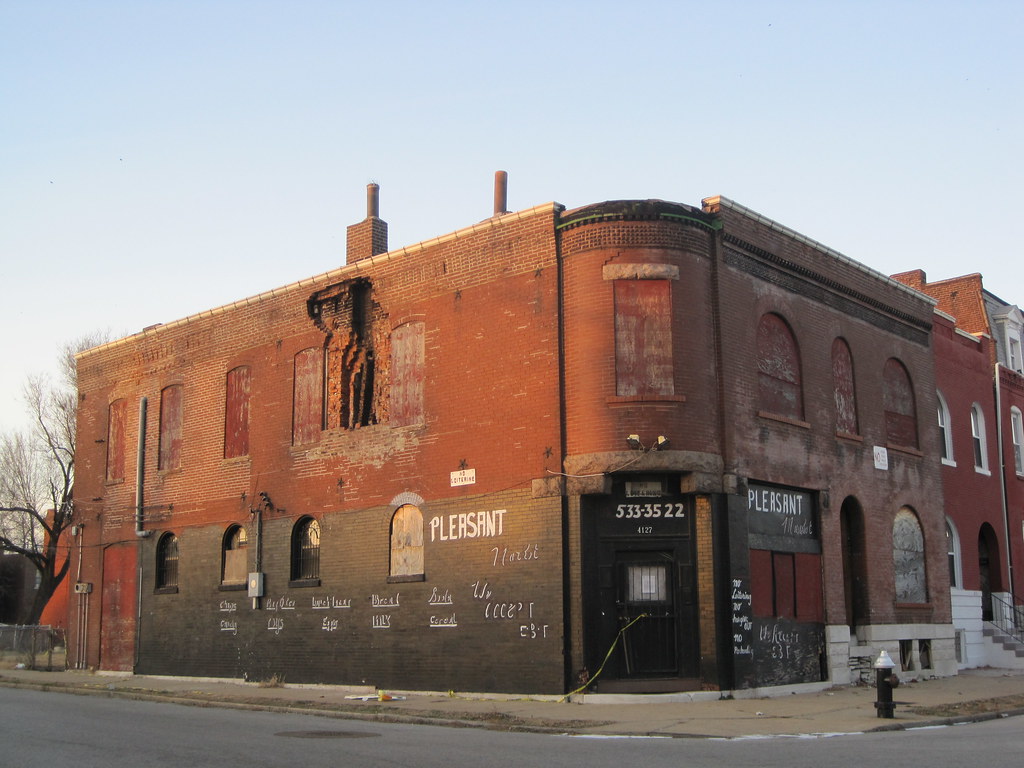
This solid corner building anchors the northwest corner of the intersection of Pleasant Street and Lee Avenue in the Fairground neighborhood. The composition is a classic example of the local Romanesque Revival vernacular, with striking use of rounded corner, rusticated limestone, ornamental pressed bricks and Roman arches. Vacant since 2007, the building recently had a collapse of the outer wythes of a chimney of the Lee Avenue elevation.

This collapse is no big deal. The building’s walls are otherwise straight and sound. However, instead of forcing owner Timothy Williams to make the needed repairs, or doing the work and billing him, the city’s Building Division condemned the building for demolition on August 28, 2009.

The building is located in the city’s 3rd ward, which has preservation review, so demolition is not a foregone conclusion. Still, why can’t the Building Division deal with a small problem like this without resorting to condemnation?

Meanwhile, the small house at 4160 Grove Street sits vacant and for sale. Only two other buildings stand on this block face, and they are located far down the block. This little house is surrounded by vacant lots, many of which are owned by the same owner. This is an urban farmstead in the making! The phone number on the house is 732-5080.

Categories
Historic Preservation North St. Louis St. Louis Place

Accomplishments and Opportunities in St. Louis Place

by Michael R. Allen

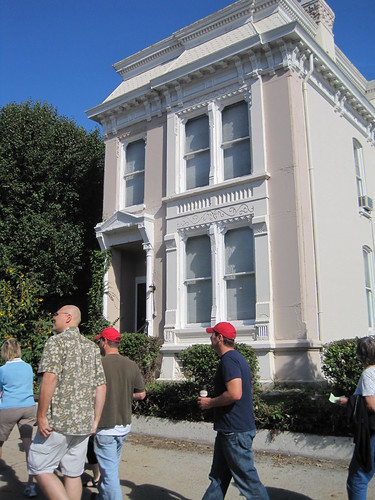
People walk past a house on St. Louis Avenue and 22nd Street during the September 2009 Rehabbers Club tour.

The year 2010 could bring better fortunes to the St. Louis Place neighborhood on the near north side, but that fortune may be wayward and abstract. What the new year ought to bring is strength to the community and its historic fabric. Beset by decades of neglect and targeted land banking, the neighborhood deserves a strong future. St. Louis Place ought to get more attention for what it already has: beautiful historic buildings, an elegant Victorian Park and wonderful proximity to downtown.

In September, the monthly Rehabbers Club tour visited the neighborhood. While the tour included a realistic discussion of problems and a trip to the James Clemens House, the tour started with tours of amazing historic buildings — one being restored and one ready for restoration.


The historic house at 3001 Rauschenbach Avenue dates to the 1890s and fronts St. Louis Place Park (laid out in 1850 and lanscaped in the early 1870s). The rambling mansion was once transformed into a retirement home but the current owner has been restoring the house. She has made great progress.

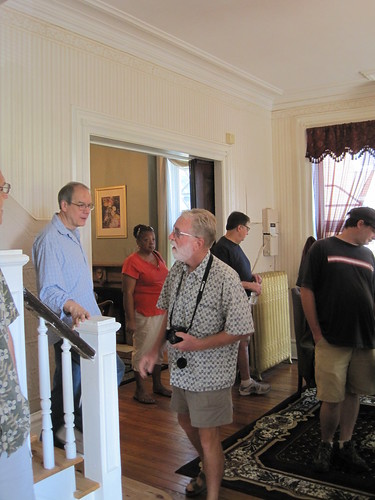
Inside, historic millwork, tall pocket doors, glowing wooden floors and other historic features dazzled those on the tour.

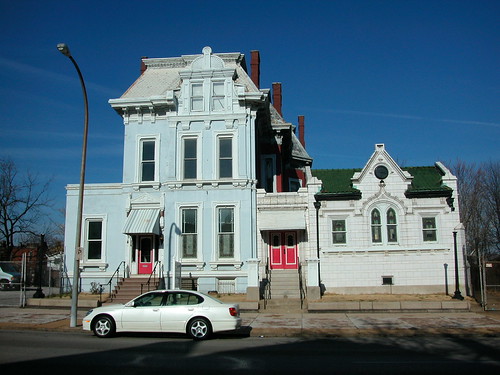
The second stop on the tour was a stone-faced mansion at 2223 St. Louis Avenue built in 1879 but later converted to the Henry Leidner Funeral Home. The connected white glazed terra cotta-faced chapel in the Gothic Revival style dates to 1921. In recent years, the former funeral home has housed the Greater Bible Way Community Church. The church recently moved across the street into a Gothic Revival church at 2246 St. Louis Avenue, and has placed this building for sale. Pastor Tommie Harsley kindly led people through the giant mansion and chapel.

The old Leidner funeral home needs a great deal of work that was beyond the church’s needs. The chapel roof suffered a bad leak, and the house needs new systems and a lot of plaster work upstairs. However, little of the historic fabric has ever been altered. Much of the millwork is unpainted. The funeral home installed the strange, awesome ceiling fan fixtures shown below.

The building at 2223 St. Louis Avenue has the raw historic character sought by rehabbers across the city. No wonder the Rehabbers Club wanted to visit!

The only problem with the Rehabbers Club tour is that its participants included few neighborhood residents and that it only happened once in 2009. St. Louis Place could use regular tours of the wonderful accomplishments and opportunities there. Leaders who support large redevelopment like the Northside Regeneration project ought to invest in educational efforts suited to current and potential neighborhood residents and property owners. Face it: large-scale redevelopment is an unproven strategy. It’s wiser to invest in the proven work of the people already making St. Louis Place tick.

Categories
Infrastructure Mass Transit Public Policy

Jobs for Main Street or Sprawl Road?

by Michael R. Allen

Former Milwaukee Mayor John Norquist published an op-ed in the Charlotte Observer that lays out the problems in the “Jobs for Main Street” bill that Congressional Democrats pushed through the House of Representatives. The bill is yet another instance where the Democratic Party has missed the boat on urban policy under the guise of helping cities and small towns. While the bill includes $8.4 billion for transit and $800 million for Amtrack, its biggest component is a $27.5 billion appropriation for highway construction!

According to Norquist:

The $27.5 billion isn’t targeted to rebuild streets at the heart of older cities and towns. No, it will mostly go to the expansion of wide, motor-vehicle-only highways that go hand-in-hand with energy-wasting sprawl. This follows the earlier stimulus bill that favored massive highway projects, including a batch of expensive “highways to nowhere,” which an examination by the Infrastructurist Web site concluded “make no sense.”

Categories
Churches Demolition St. Louis County

Bethany Deaf Church in Kirkwood Demolished

by Michael R. Allen

Kirkwood’s local historic district ordinance did not prevent the new owner of the Bethany Deaf Church (photograph via link) at 310 E. Argonne from demolishing the building around Christmas. A reader writes that the wreckers destroyed the front doors rather than salvage them, but that the rose window may have been saved.

Categories
Downtown Green Space I-70 Removal Infrastructure JNEM

International Design Competition Will Look at a Big Picture

by Michael R. Allen

The New Year will bring to St. Louis an international architectural competition centered on the Jefferson National Expansion Memorial. The only other such competition to take place in St. Louis also concerned the Memorial; in 1948, a competition selected for the Memorial the designed landscape of architect Eero Saarinen and landscape architect Dan Kiley. That selection gave a declining American river city a triumphant architectural boost and a place in postwar architectural history. The Gateway Arch designed by Saarinen became the internationally-recognized symbol of the city.

Will the new design competition lead to the implementation of a design as boldly modern as the Arch? Probably not. After all, the program for the competition is realization of the National Park Service’s new General Management Plan (GMP) for the Memorial. That plan’s preferred alternative is not a blueprint for radical upheaval of a significant landscape but a corrective program for finding remedies to that landscape’s flaws. The new CityArchRiver 2015 Foundation, spearheaded by attorney Walter Metcalfe, Mayor Francis Slay, Memorial Superintendent Tom Bradley and national parks advocate Lynn McClure, is sponsoring the competition and raising money for implementation of the winning entry.

The competition thus wisely avoids a fruitless effort to construct a parallel icon near the Arch. The architectural genius of the Gateway Arch is elegant and unparalleled. Few contemporary architects — or even starchitects with their tedious “signature” touches — could match Saarinen’s vision. Likewise, the Kiley landscape is a masterpiece. To attempt to add to the Memorial design through iconic design is folly. John Danforth’s museum proposal was fueled by the incorrect assumption that any large new building on the Memorial grounds could be anything other than pretty clutter.

Still, the design competition is a clarion call for vision of a different kind. The GMP acknowledges the spatial obstacles to pedestrian access to the Memorial. In the GMP, there is discussion about the terrible infrastructure on the west and south sides of the Memorial that make pedestrian access difficult. The GMP discusses the moribund riverfront, the dormant east riverfront and other things that make the Memorial grounds a very divine landscape surrounded by an ugly cityscape and divided from urban vitality.

The design competition responds to the GMP by calling for radical reconceptualizing of the cityscape on both sides of the river that frame the Arch grounds. The subtitle of the competition is “Framing a Modern Masterpiece,” indicating the challenge ahead: visionary urban place-making around a magnificent landscape that cuts across the boundaries of many government entities.

This competition thus is as much about politics as design. Mayor Francis Slay and Senator Claire McCaskill are deeply involved in the process. There is little doubt that the competition’s fast track — completion of improvements is slated for 2015 — is driven by political concern rather than interest in truly transformative planning. In an interview, I asked competition manager Don Stastny of Stastny Brun if he had ever been involved in any design competition that had a time line of less than six years between the start of the competition and the projected completion of the design. He said that he had not, save a State Department competition for the destroyed Nairobi embassy.

There is a strong tension between the frank analysis offered by the National Park Service in the GMP and the “get it done” attitude of elected officials. Perhaps that tension is productive in a city that lacks any effective planning ordinance or agency. The National Park Service is playing the catalytic role that a city planning agency should already have done. On the other hand, without the competition’s ambitious pace, good ideas might get lost or watered down through slow implementation. The competition process cuts through parochial politics by forcing St. Louis, East St. Louis, Missouri and Illinois to work together and implement solutions that are not neatly confined to parochial politics of appropriations.

Still, there is no need to have everything done by 2015. I like that early date as a spur to slow-moving local governments. However, I am afraid that date could preclude consideration of larger projects needed for connectivity. The competition cannot produce anything as great as the Memorial, but it need not be reigned in by a fixed, arbitrary timeline. After all, Kiley and Saarinen’s plan was selected in 1948 but not fully completed until 1982.

Boundaries

The boundaries of the competition are exciting, as the map above shows. There are several notable inclusions:

  • The east riverfront, a topic neglected in much of the recent debate on the Arch grounds, is included. In fact, a large part of Malcolm Martin Park is included. Unfortunately, the boundary excludes the Casino Queen site and the MetroLink station. The pedestrian path from Malcolm Martin Park to MetroLink should be included, since the walk currently takes place on an unkempt street without sidewalks.
  • The boundary seems to purposely place both the Eads and Poplar Street bridges inside. The Poplar Street Bridge is aging and due for major overhaul. The competition could create a vision for what a new Poplar Street Bridge would look like. Bike and pedestrian lanes are a must.
  • Kiener Plaza is included in the boundary. While the Old Courthouse is part of the Memorial and needs a more graceful frame than the current state of Kiener Plaza, does the plaza really need to be part of this process?
  • All of the Memorial grounds are included, which is fine, but preservation of the landscape is essential. However, jurors in the competition — and leaders of the CityArchRiver 2015 Foundation — need to be ready to consider proposals that would reloctae or alter the north parking garage (operated by Metro) and the south maintenance facility.
  • I-70 directly west of the Memorial is included, but the boundary does not extend north to capture all of the elevated section. The GMP states that the National Park Service “strongly supports” removal of the highway, but thinks it unfeasible at this time. Why?

Highway Removal

If there has ever been the right time to consider removal of the depressed and elevated lanes, it is now. There is a great converegence between the design competition — where thinking big is encouraged, and reweaving urban fabric is the foundation for the program — and the 2016 opening of the new Mississippi River Bridge that will carry I-70 out of downtown forever. While the end dates of these projects don’t align perfectly, they are too close to leave unexamined. Highway removal need not be underway in 2015 for the ribbon-cutting; if the competition jury endorses any plan for highway removal, the region will have made major progress.
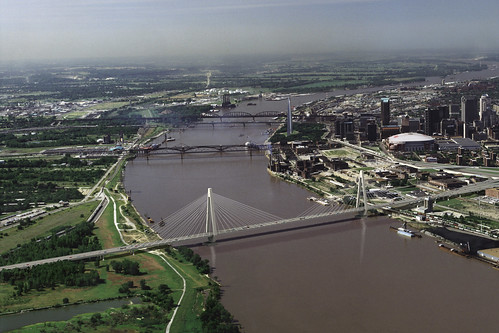
Obviously, the impact of the new bridge on traffic would need to be studied before removal could be planned. The replacement of I-70 should not be set in stone, since a wide boulevard could be as pedestrian-unfriendly as the current I-70/Memorial Drive configuration. Those two considerations are perfect fodder for a team of design professionals to engage. While we have the world’s best architects working on solutions for the Memorial’s connection to the rest of the city, we would be foolish to not encourage them to study one of downtown’s biggest problems.

We have great leadership in the Memorial’s Superintendent Bradley. Tom Bradley has been a patient, thoughtful and progressive player who has managed to channel converging political forces into a positive direction. Bradley weathered the Danforth museum idea, which did nothing to address the real planning issues of the Memorial, and forced normally complacent local leaders into action that has the potential to truly transform downtown. Stastny likewise should be a great manager, since his philosophy is that his clients must determine the choice to have a competition on their own. He’s not a salesman, but an astute facilitator.

A successful competition will consider every entry on its merits, and its jurors will have the courage to endorse the best plan no matter what its political implications may be. We may never again see another international design competition in St. Louis. We must be as wise as our ancestors — nay, wiser.

Categories
North St. Louis Northside Regeneration

Now It’s Only "Northside Regeneration"

by Michael R. Allen

Blairmont is no more.

At least, Blairmont Associates LC and several other McEagle-controlled holding companies no longer exist. On December 14, Northside Regeneration LLC — the public face of McEagle’s NorthSide project — filed two Notice of Merger statements with the Secretary of State.

The first of these merges all of McEagle’s holding companies into Northside Regeneration: Blairmont, N & G Ventures LC, Noble Development Company LLC, VHS Partners LLC, PATH Enterprise Company LLC, Allston Alliance LC, Sheridan Place LC, Dodier Investors LLC, MLK 3000 LLC, Larmer LC and Union Martin LLC.

The second merges into Northside Regeneration all of the shell limited liability entities used to guarantee deeds of trust to the holding companies. That list is online at the Secretary of State’s website.