Categories
Missouri

News from Route 66

The Route 66 Association of Missouri sends along the following news:

The National Park Service Route 66 Corridor Preservation Program is pleased to announce it is accepting applications for the 2010 cost-share grant cycle.

Applications may be submitted to the program office until April 2, 2010. Awards will be announced on or before May 21, 2010.

Read more here.

Also, the Route 66 Corridor Management Plan meetings are coming up in January and February. Details online here.

Categories
Downtown Hotels

Jefferson Arms Up For Sale

by Michael R. Allen


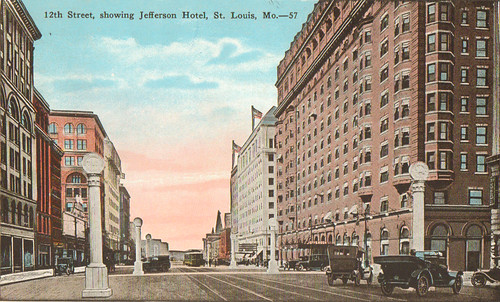
The old Jefferson Arms Hotel at 415 N. Tucker Boulevard, shown at left in the postcard view above, is again for sale. Citicorp foreclosed on the failed Pyramid Companies, the owner, last year. In 2008 after Pyramid’s collapse, Sherman Associates of Minneapolis announced that it had the Jefferson Arms under contract, but the contract was nullified by foreclosure.

The Jefferson Arms was built in 1904 from plans by Barnett, Haynes & Barnett, the renowned St. Louis firm that would design the city’s Cathedral. The hotel opened in time for the Louisiana Purchase Exposition’s throngs of tourists, but remained successful. The owners expanded the hotel to the west in 1928. Eventually, in the 1980s, the old hotel was converted into studio apartments. This use was again successful; the Jefferson Arms was 80% full in 2006 when Pyramid purchased the building for $19 million. Pyramid evicted all of the tenants and boarded the building up.

The Jefferson Arms was listed in the National Register of Historic Places in 2003.

Categories
Industrial Buildings Metro East Venice, Illinois

North End of Venice

by Michael R. Allen

If you have not read the Riverfront Times cover story “Meltdown in Venice” by Keegan Hamilton, please do so. The photograph above shows one of the houses in the very north end of Venice whose residents literally have the former Dow Chemical plant in their backyards. There is a pocket literally surrounded by that plant on the west, the field where Dow and its successors dumped PCB-tainted waste on the north and a foundry on the east. At the foot of this neighborhood is the city’s elementary school. The creation of such a landscape is hardly unique, and its abdication by those who shaped it only commonplace.

Categories
Belleville, Illinois Mid-Century Modern Neon Signs

Harter’s Hobby House Sign Removed

by Michael R. Allen

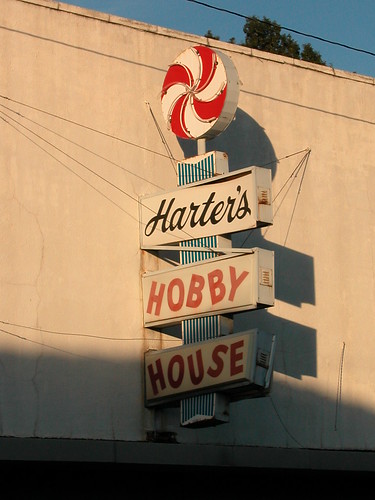
For decades, Harter’s Hobby House at 1001 West Main in Belleville beckoned hobbyists with its colorful sign, which resembled a blue pin-striped stick of dynamite with a starlight mint-like pinwheel fuse. The sign is no more, having been replaced recently with a simple new sign.

The old sign was a complex metal sign with three plastic back-lit name boards, an enameled body and neon tubing on the pinwheel. The letters in the possessive “Harter’s” were proper cursive fit for business, while the words “Hobby House” had a carefree lettering somewhere between kindergarten script and a typesetter’s mistake.

Where did the sign go? Anyone with information is welcome to post in the comments section or email the editor, who missed the changeover.

Categories
Historic Preservation Missouri Legislature Public Policy

State Senator Crowell Bills Threatens Historic Tax Credits

Senate Bill 728 Wipes Out the Historic Tax Credit Legislation Passed Last Year

For Immediate Release
Contact:Eric Friedman
Coalition for Historic Preservation And Economic Development
Office: 314.367.2800 ext. 23, Cell 314.369.4702
Erics@FriedmanGroup.com

ST. LOUIS (January 14, 2010) – Senator Jason Crowell (R-Cape Girardeau) introduced S.B. 728 which places nearly all state tax credits under the budget appropriation process which eliminates all legislative language on historic tax credits approved last year by the Missouri General Assembly. The ability for smaller historic restoration projects to not be counted against the cap has been eliminated. In addition, the application procedures for projects that ensure equity for small and large projects submitted to the Department of Economic Development will be eliminated. All tax credit programs will expire on June 30 2011 unless an allocation is made by the legislature, both chambers , for that specific year, through the appropriations process. This would not impact projects authorized or tax credits issued.
This bill pits all tax credit programs against one another to compete for a specific allocation.

Food pantry, neighborhood assistance, shelters for domestic violence victims, quality jobs, low income housing, brownfields, family farm livestock, pregnancy resource centers, youth opportunities and historic renovation tax credits are just a few of the programs that will be forced to fight for their existence each year and to fight for how much money they get each year. The financial uncertainty that would result from the passage of this bill will end historic preservation projects in cities and towns throughout Missouri, including the 30 Dream communities.

In an article in yesterday’s Southeast Missourian newspaper, Senator Crowell tried to portray these tax credits as a corporate bail-out for big business although, it is the small contractors, their employee, their suppliers and projects that will be hardest hit if the tax credit process is changed. These changes would devastate the construction industry and their suppliers in Missouri as it struggles to recover from the greatest economic challenge since the Great Depression. The Department of Economic Development shows that this program generated 4,000 jobs in one year. We know of no other program that has done that.

At the time of most serious financial and housing crisis since the Great Depression we need stability for investment in our communities and for the Historic tax credit program to continue to be the best Jobs, Housing, Green, Sustainable and Smart Development program in the country. Without that stability and predictability we will not get investments, and jobs we so desperately need in our communities across our state.

# # #

Categories
Architects Chicago Louis Sullivan

An Update on the Louis Sullivan Film

by Michael R. Allen

Two years ago, Mark Richard Smith began filming Louis Sullivan: The Struggle for American Architecture. He visited St. Louis that year, shooting in the city at and Southern Illinois University-Edwardsville, and I spent some time with him talking about the Union Trust Building.

Mark is a remarkably driven first-time filmmaker who spent twenty years as a graphic designer before switching paths. Wanting to make films that visualize history, Mark enrolled in the graduate history program at Loyola University Chicago. In Chicago, Mark saw the photographs of Richard Nickel and their poetic grace drew him to the subject matter of his first film.

Last year, Mark posted a trailer on YouTube.


Then, one month ago, an unfinished scene about the Trading Room of Sullivan’s Chicago Stock Exchange.

Categories
Central West End Historic Preservation Mid-Century Modern National Register

Momentary Reprieve for Two of Lindell’s Modern Buildings

by Michael R. Allen

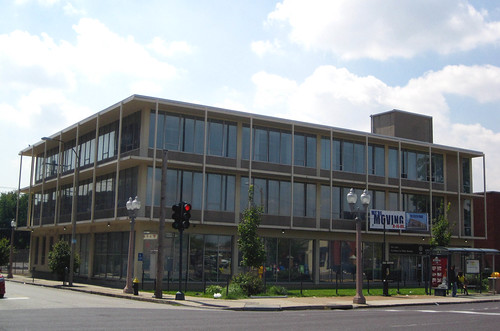
The view here might exist for awhile longer. Today, the St. Louis Post-Dispatch reported that CVS’ plan to demolish the three buildings at the southwest corner of Sarah and Lindell avenues is off. CVS no longer plans to pursue purchase of the buildings. Observers had seen a conspicuous for-sale sign go up in front of one of the buildings a few weeks ago.

Sometimes the market is the strongest preservation force. Of course, the market will be up again, and financing for new construction on the sites of these buildings could be easy to obtain. Thus what happens next is important. These three buildings are attractive, usable urban buildings.

On the corner, at 4100 Lindell, we have Hellmuth Obata Kassebaum’s Sperry-Rand Building (1956), most recently the home of the St. Louis Housing Authority. The minimalist modernism has a lot of potential for commercial or retail space.

The small building next door at 4108 Lindell, originally home of the St. Louis Society for Crippled Children, dates to 1960. This is a supporting player in the cast of local modern architecture, but handsome in its own right. The St. Louis Housing Authority also owns this building.

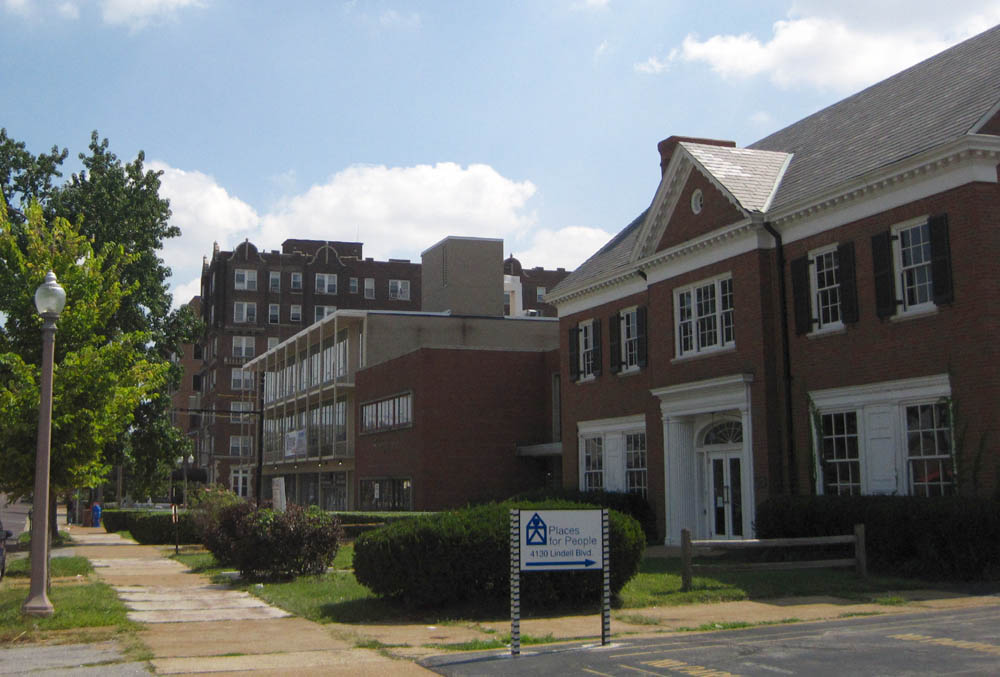
The final building, located at 4120 Lindell Boulevard, is a two-story Colonial Revival office building from 1937 much larger than its front elevation suggests. The setback may not meet the urbanist formula, but the density of site use is pretty solid. However elegant, the Colonial Revival buildings on Lindell are admittedly not as architecturally significant as their modern brethren.

The modern buildings form an architectural context recently demonstrated in the successful listing in the National Register of Historic Places nomination of the at 4630 Lindell. Not all of the modern buildings on Lindell can be listed individually. Clearly, however, the modern buildings on Lindell as a group have sufficient significance to be listed in the National Register of Historic Places under a multiple-property cover. That action would make it easier for interested owners to list their buildings and be eligible for historic rehabilitation tax credits. Then, the market might be more than a momentary ally in preservation efforts.

Categories
Downtown Green Space JNEM

Duffy: Design Competition Promises to Be Bold

by Michael R. Allen

Bob Duffy has an insightful commentary in the St. Louis Beacon entitled “The competition to improve Arch grounds promises to be bold, creative”. I recommend a full read. However, Duffy’s recap of yesterday’s briefing for potential competitors in the design competition includes some hopeful signs that the competition process will be fruitful for visionary thinking.

For one thing, the competitors will be forbidden contact with the sponsors and jurors. Writes Duffy:

Competitors are forbidden contact with competition sponsors and jurors, and if this rule is broken, the offending team will be disqualified. There is to be no corporate or personal lobbying. Strict communications protocols have been established, and all information must be requested through competition management.

Competition manager Don Stastny also reiterates that the process and short timeline is meant to guarantee, not stifle, visionary solution-making. From Bob Duffy:

The guidelines and timelines for the competition are meant not to put obstacles in the paths of designers, architects and artists who may compete, but to create an environment in which the teams might do their best work.

Sounds good to me.

Categories
Infrastructure Rivers South St. Louis

Getting Creative with the River Des Peres

by Michael R. Allen

Yesterday, after successfully keeping the project under wraps for some time, Thomas Crone launched his new website Creative St. Louis: A Conversation on Creativity.

The site is “dedicated to celebrating the creative people, places, things, history and traditions that make St. Louis a great place to live and work.” I can’t wait to see what Thomas does with the site.

Meantime, I have the first Tuesday “Creative Places” spot with a history of the River Des Peres that examines the creativity of engineers as well as what a new future for the channelized river-sewer could look like.

Categories
Architects Downtown Green Space JNEM

The Design Competition’s Jury, and Its Grand Jury

by Michael R. Allen

This morning, the CityArchRiver 2015 Foundation announced the jury that ultimately will select the winning entry in the International Gateway Arch Design Competition. The eight jurors are:

Robert Campbell, architecture critic at The Boston Globe and contributing editor for Architectural Record;

Gerald Early, Merle Kling Professor of Modern Letters and Director of the African and Afro-American Studies at Washington University in St. Louis;

Denis P. Galvin, former Deputy Director of the National Park Service;

Alex Krieger, founding principal of Chan Krieger Sieniewicz, architecture and urban design firm and professor at the Harvard School of Design, Cambridge, Mass.;

David C. Leland, an urban strategist and managing director of the Leland Consulting Group, Portland, Ore.;

Cara McCarty, curator of the Smithsonian’s Cooper-Hewitt National Design Museum, New York City;

Laurie D. Olin, partner and landscape architect of the OLIN Studio, Philadelphia;

Carol Ross Barney, founder and Principal of Ross Barney Architects, Chicago.

Notably, there is only one St. Louis resident on the panel, Gerald Early. However, the fact that the local juror is a scholar of cultural history and not someone deeply tied to the local architectural community is refreshing. Cara McCarty is also a scholar with a local connection; she used to serve as a curator at the St. Louis Art Museum.

Some wonder why there is not more local representation on the jury, and that is a valid question. Certainly there are local architectural critics, professors of architectural history, architects and designers whose credentials match or trump those found in this jury. There has been rumbling from local architects that the program requirements for the competition is out of reach for local firms, and jury spots could have provided consolation.

However, the jury would not do well for St. Louis if it were fraught with the politics of representing local talent or special interests. The jury must be able to independently evaluate the submissions free from the wires of local politics. That goal has been accomplished. We now will have a rare opportunity to watch architectural heavyweights from other places examine St. Louis, which should be a welcome breath of fresh air.

The jury’s composition, however, should not consign local critics to passivity. In fact, having St. Louis’ leading critics and designers outside of the official process allows them the free reign of critical engagement that only those with deep local understanding can offer. All of us concerned with the competition should step up to demand excellence, praise good decisions, call out bad decisions and work to guarantee that the design competition is truly a great moment for our city.

The decision to have a competition, after all, is political. Politics can water down great ideas. The ambitious deadline for completing the winning design is a political threat to realizing a transformative change in connections between downtown and the riverfront. The jury can’t tackle that problem — that’s up to the rest of us. Citizens remain the grand jury.