Categories
Churches Fire Fountain Park

New Bethlehem Missionary Baptist Church Suffers Christmas Fire

by Michael R. Allen

On Christmas, terrible tragedy struck the New Bethlehem Missionary Baptist Church in Fountain Park: the church caught fire and was severely damaged after the morning service. The Fire Department considers the four-alarm fire suspicious.

Pastor Hosea Gales told the St. Louis Globe-Democrat that the church found a home for its Sunday service and that it will rebuild. What is uncertain is the fate of the historic church building at 1260 N. Euclid Avenue, built in the late 1890s as the Euclid Avenue Baptist Church. The preservation community should offer all possible assistance to the congregation.

Categories
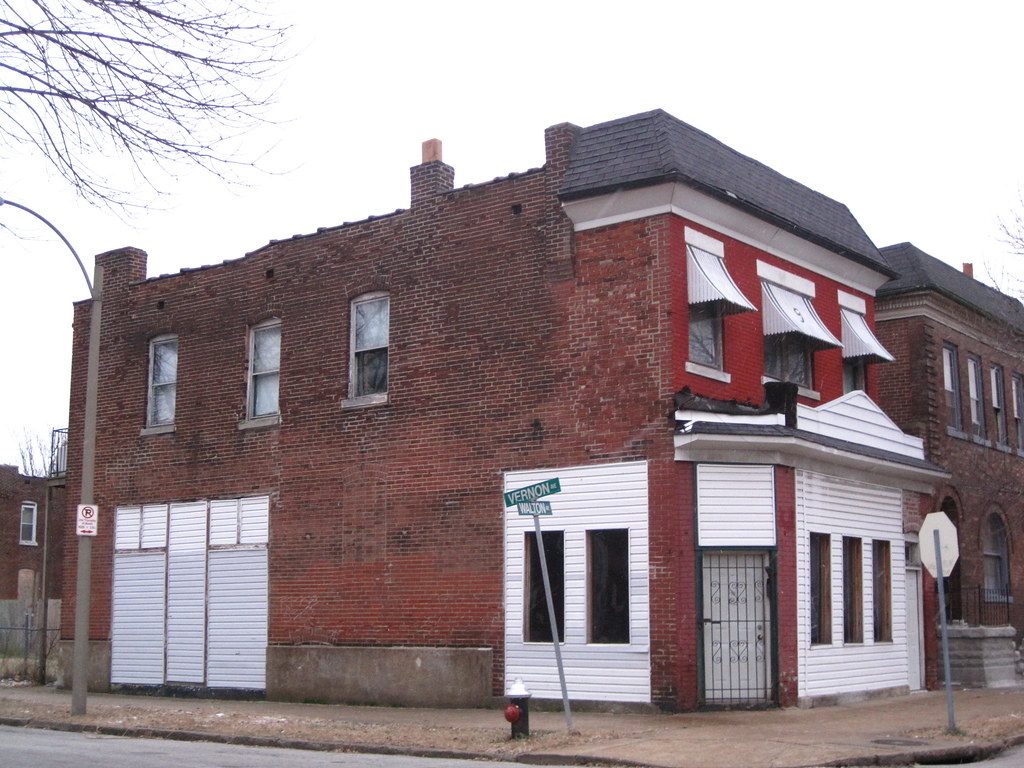
Fountain Park North St. Louis Storefront Addition

Small Storefront Addition

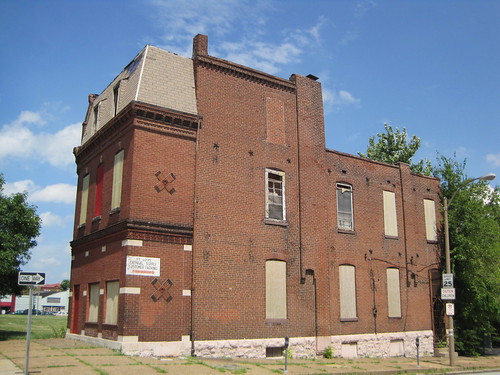
Southeast corner of Vernon and Walton Avenues, Fountain Park.

Categories
Adaptive Reuse Illinois

Old KFCs Are Buildings Too

by Michael R. Allen

My wish for the New Year is simple: Let no vital structure go vacant or get demolished.

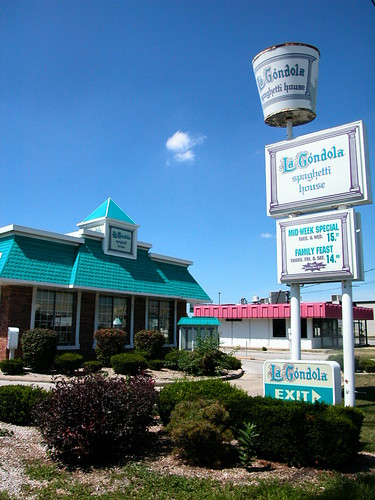
Shown above is one of the countless road side examples of the infinite adaptability of even the ugliest American buildings. The La Gondola Restaurant at 2855 North Water Street in Decatur, Illinois is located in a former Kentucky Fried Chicken restaurant. La Gondola’s rehab of the iconic fast food building consisted of new signage and repainting. Removal of the bucket of chicken was not on the agenda, and thus La Gondola has what may be the nation’s only bucket of spaghetti sign.

I write “may” because the excellent website Not Fooling Anybody shows us that La Gondola’s rehab of an old KFC is in the middle of fast food conversions, which range from inconspicuous total cover-up to oddities like the chiropractic office that retains a KFC bucket sign.

La Gondola is no stranger to converting fast food buildings: the La Gondola Restaurant in Galesburg is located in a converted Mr. Quick Hamburgers restaurant. La Gondola is a central Illinois chain that makes use of the cast-offs of another chain. That practice makes perfect sense, since smaller chains don’t have the capital that a mega-chain like KFC does. La Gondola saves money, an old KFC doesn’t sit vacant or get torn down and hungry Illinoisans still have a place to get a quick bite right where they used to.

The simple model of reuse practiced by La Gondola is not glamorous, but it works economically as well as ecologically. While an old KFC is not architecturally or urbanistically high-style, it’s still a building made of shaped and processed natural resources. When reused, those resources are saved.

Categories
I-70 Removal Mass Transit Mid-Century Modern Streets

Vintage Streetcar Photographs Show Mid-Century St. Louis

This week St. Louisan extraordinaire Jeff Vines discovered an online cache of 120 photographs of St. Louis Public Service Company trolley cars taken between 1954 and 1961. A few photographs from the 1980s are included.

The images of the cars in their vintage red, white and tan color scheme are fabulous. Yet the photographs also capture views of the city long lost, change or, in a few cases, preserved. The old Grand Avenue viaduct, its replacement soon to be replaced, features in many of the photographs in use adn under demolition. Other locations include the South Broadway car barn (now site of Carnahan Middle School), the Midtown skyline (remarkably unchanged), Maplewood, University City and Flynn Park, Washington Avenue from the Eads Bridge street car turn-around to 15th Street, rural Creve Couer, downtown St. Charles, and McKnight Road.

The photographs of the vicinity of the Eads Bridge and Washington Avenue include shots of the piers for the modern elevated lanes of I-70, now seen as likely to be removed in most of our life times.

Categories
Mid-Century Modern St. Louis County

Mid-Century Modern in the Hanley Industrial Court

by Michael R. Allen

I found myself in a situation that I normally avoid during the month of December (or any month, really): I had to go shopping at a store on Brentwood Boulevard. Coming from the southeast of my destination, I headed north on Hanley Road and decided to slip through the reliable Hanley Industrial Court short-cut.

Am I glad that I did! What I found brightened my day and made the otherwise excruciating experience worthwhile.

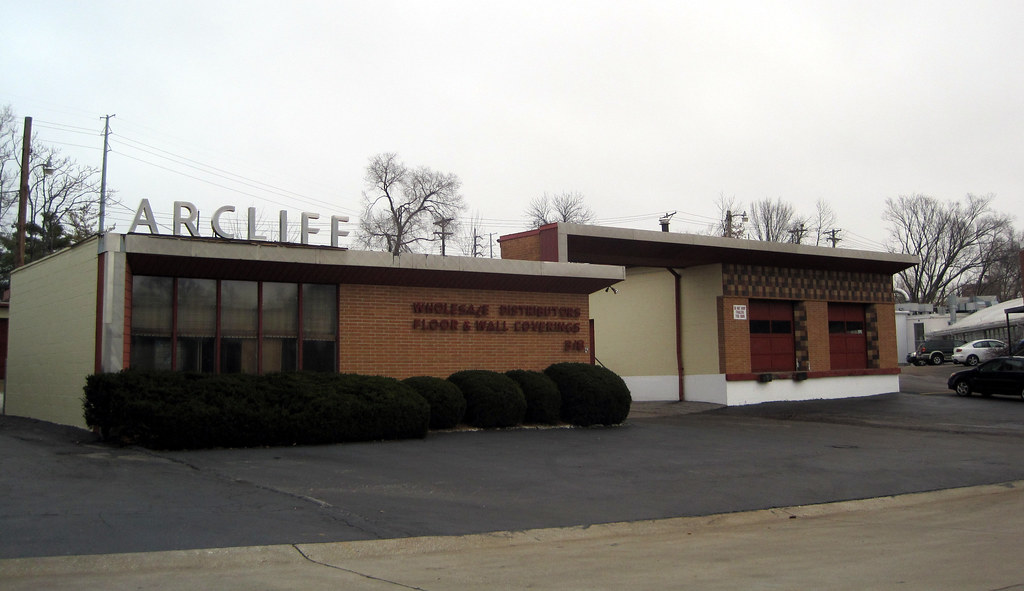
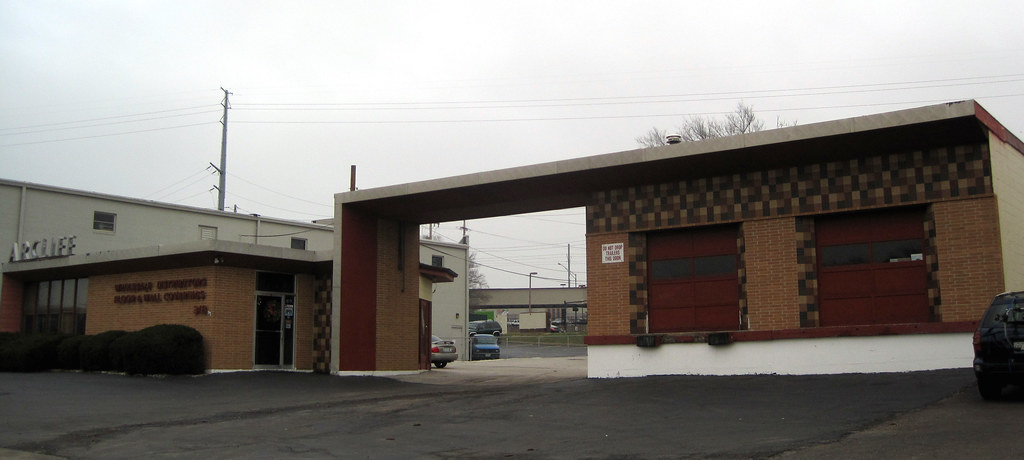
Voila, at 318 Hanely Industrial Court stands the home of Arcliff Wholesale Distributors. The mod building dates to 1960, and is in pristine condition down to the swanky metal letters above the roof life. The center is cut away, opening to an employee parking area that separates the showroom from the storeroom. The building’s roofline changes to underscore the separation, creating welcome variation and presenting an almost Potemkin-like front to what is actually two very small sections and a lot of parking.

The storeroom section is accented with brown tile tapestry that underscores the tile sold wholesale by Arcliff. What a gem! Few of the other Hanley Industrial Court buildings demonstrate this much care in their design, so I was quite surprised to see this. I took a wrong turn to get there, so perhaps the serendipity was inevitable.

Categories
National Register North St. Louis Old North Wells-Goodfellow

Year Ends for the Better in Two North St. Louis Commercial Districts

by Michael R. Allen

St. Louis Public Radio aired my latest commentary this morning. Listen to it here. The extended script follows.

This year ends with positive changes for two of north St. Louis’ most distressed neighborhood commercial districts – the 14th Street district in Old North St. Louis and a section of Martin Luther King Drive in the Wellston Loop area.

In Old North, the $35 million Crown Square redevelopment project has transformed two blocks that once were the commercial center of the neighborhood. In 1977, using federal funds, the city of St. Louis closed the street to create a pedestrian mall. Eventually that mall killed the foot and vehicle traffic necessary to sustain the businesses.

Thankfully and improbably, most of the buildings fronting 14th Street on the two blocks between St. Louis and Warren streets survived abandonment. Now, these buildings have been beautifully rehabilitated into residential and commercial spaces. 14th Street is set to reopen to traffic early next year. Old North will regain a vital center.

The good news in the Martin Luther King Drive in the Wellston Loop area comes from an earlier chapter in the renewal story than the news from Old North. In November, a state review council approved a National Register of Historic Places nomination for 65 buildings on or around the north side thoroughfare from Clara Avenue west to the city limits.

The designation honors the cultural and architectural significance of what was in the late 1940s the city’s busiest shopping district. However, the designation also makes available rehabilitation tax credits long sought by building owners in the area. Such credits were crucial in rebuilding Crown Square.

Commercial districts are barometers of neighborhood health. Once they die, a neighborhood may be gone forever. By all indications, Old North and the Wellston Loop have a lot of life left in them.

Categories
Demolition Fox Park Marine Villa Preservation Board South St. Louis

At the Preservation Board Yesterday

by Michael R. Allen

Carnival Supply Building to be Demolished

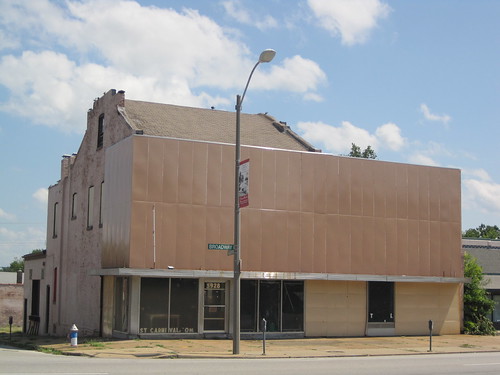
Yesterday, the St. Louis Preservation Board voted unanimously to permit demolition of the old St. Louis Carnival Supply Company building at 3928 S. Broadway (see “Old Carnival Supply Buildings Return to the Preservation Board”, December 18. The motion to permit demolition made by David Richardson is conditional; owner KOBA LP must first obtain a building permit for facade improvements to the building at 3924 S. Broadway.

Alderman Ken Ortmann (D-9th) and the Chippewa-Broadway Business Association had previously opposed demolition of both buildings. At the meeting yesterday, Cultural Resources Office (CRO) Director Kate Shea announced that she had received letters of support for demolition of 3928 S. Broadway from both parties and that CRO was changing its position as well. Five residents of the Marine Villa neighborhood sent letters of opposition. I was the only person to testify against the demolition, following KOBA LP owner Ken Nuernberger (ordinarily a preservation-minded developer). As I told the Preservation Board, no matter what cladding covered 3928 S. Broadway and no matter what happens to the other building, the decision still was one between a historic corner commercial building and a surface parking lot.

A Row House By Any Other Standard…

Another matter before the Preservation Board was also of great interest. The owner of the house at 2248 Nebraska in the Fox Park Local Historic District wants to install aluminum windows on her home. CRO staff said they would have approved the windows, except that the house is part of an adjoined row of houses and that the windows would alter the character of the row. CRO recommended denial, but the Board voted unanimously to allow use of the windows. Richardson and Mary Johnson both stated that they believed that the local district standards applied to fee-simple houses and contained no language that enabled CRO to take into consideration neighboring buildings — even if connected — in making a decision about an individual permit.

Categories
North St. Louis Schools SLPS The Ville

Marshall School Awaits New Use

by Michael R. Allen

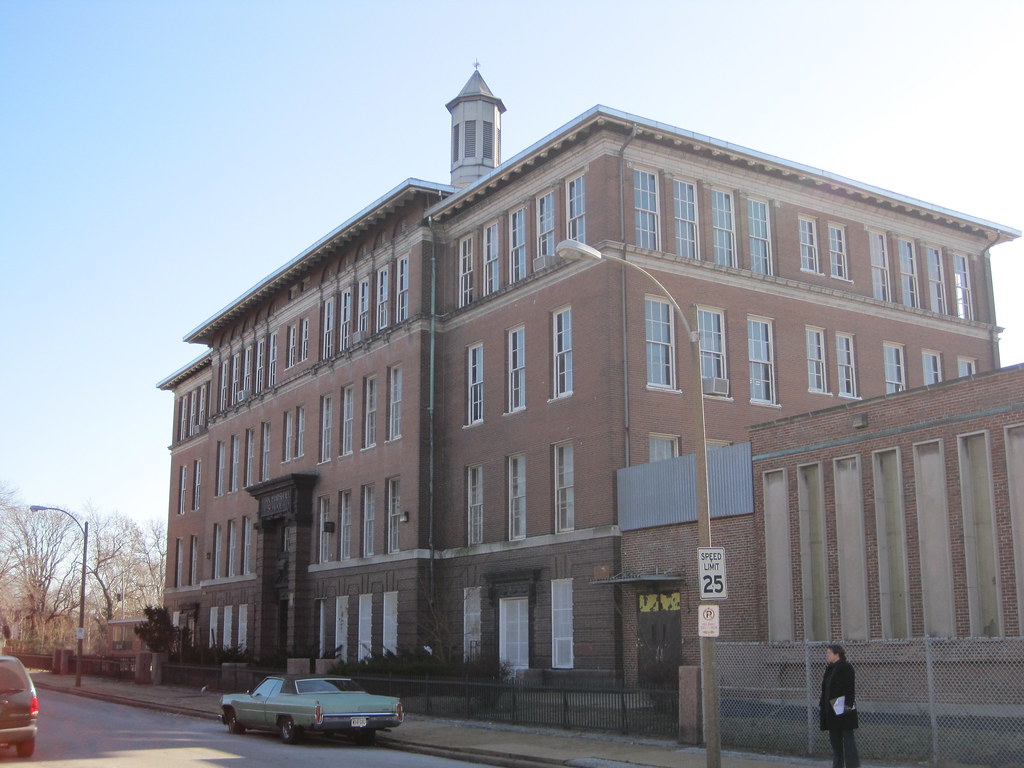
This week’s news of a reprieve for Sumner High School brought relief to the Ville neighborhood, where another public school remains vacant after closing this summer. Stately John Marshall School stands at 4342 Aldine Avenue between Newstead and Pendleton avenues. The three-story building in the Classical Revival style dates to 1900 and is one of architect William B. Ittner’s first uses of the E-Plan layout.

The entrance is imposing and formed by brick piers supporting a massing terra cotta entablature. Brown terra cotta is used there and surrounding the doorway, over which a bust of John Marshall watches.

Like Sumner, Marshall School is a crucial part of the cultural legacy of the Ville. During segregation, the school became an African-American intermediate school in 1918 and an elementary school in 1927. Many students who would pass through the doors of mighty Sumner High School, also designed by Ittner, would first pass through Marshall School.

What future may be in store for the shuttered Marshall School is uncertain. With deed restrictions against charter school purchase lifted by the St. Louis Public Schools, educational use is possible. For now, however, all that is certain is that the Ville does not need another vacant school building.

Categories
Historic Preservation Housing North St. Louis Visitation Park

Winston Churchill Apartments

by Michael R. Allen

One of the best preservation stories to come out of north St. Louis this year was the rehabilitation of the Winston Churchill Apartments at 5435-75 Cabanne Avenue in Visitation Park. The apartment building had long been the scourge of a changing neighborhood — and not because it was a vacant eyesore. The Winston Churchill was fully occupied and generating as many as 300 calls to the police from neighbors before the apartments closed in 2005. In some cases, shutting down a nuisance property is only a trade between an occupied nuisance and a vacant one.

Because of the Friedman Group, Ltd. and Dublin Capital, the Winston Churchill instead was rejuvenated through a $12 million rehabilitation designed by Klitzing Welsh Architects and built out by E.M. Harris Construction Company. The building reopened with 101 affordable housing units. Many new houses have been built to the west of the Winston Churchill on Cabanne Avenue. Reopening the apartments ensures that the neighborhood offers housing to residents who are not in the market for owning a brand-new house or a large old home.
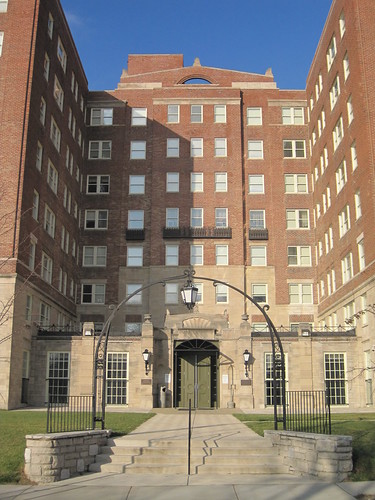
Built in 1927, the eight-story, concrete-framed Winston Churchill is an imposing, somewhat austere building. The brick architrave at the top is often mistaken for patchwork that replaced the original cornice, but the building never had any such cornice. The stark termination of the building is original (see two historic photographs here. The first two floors provide a softer neoclassical base clad in native Missouri limestone. The firm Avis, Hall and Proetz designed the apartment building, which is named for the once-renowned St. Louis novelist whose fame preceded that of the British statesman.
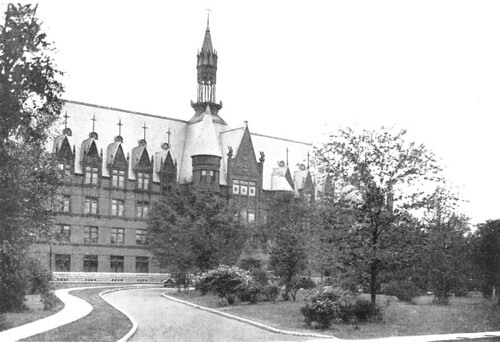
At the time of construction, the Winston Churchill stood in the shadow of a more imposing building, the Visitation Academy by Barnett, Haynes and Barnett (1891) across the street. The eclectic French Renaissance Revival academy was the second St. Louis home of the school and convent of the Sisters of the Visitation, who had migrated to the city in 1844 following a devastating flood that destroyed their building in Kaskaskia, Illinois. The Sisters’ tenure at Cabanne and Belt would last through 1962, when the order opened a new school and convent on Ballas Road in St. Louis County.

The building on Cabanne was demolished one year later, and the site donated to the City of St. Louis. The park is now known as Ivory Perry Park, well-known for its summer concert series. The Winston Churchill Apartments is now the architectural anchor of the corner of Cabanne and Belt avenues, providing necessary housing as well as visual interest.

Categories
Marine Villa Preservation Board South St. Louis

Old Carnival Supply Buildings Return to the Preservation Board

by Michael R. Allen

The two buildings at 3924 and 3928 South Broadway may look like a contrasting pair. One makes a robust display of unpainted, unaltered brick work that includes many patterns. The other building’s front wall is covered in metal paneling, and its side elevation is caked in old paint. Separated by Alberta Avenue, these two buildings were the long-time home of St. Louis Carnival Supply.

Now, these corner anchors sit vacant. This summer, the present owner, KOBA LP, tried to persuade the city’s Preservation Board to permit demolition of both buildings so that the owner could expand the parking lot of an adjacent strip mall where a Grace Hill clinic is located. In August, the Preservation Board voted to deny both demolitions on a preliminary basis. Now, KOBA LP returns with a proposal to demolish the metal-clad building and retain the other.

The city’s Cultural Resources Office (CRO) does not accept the compromise. In a report to the Preservation Board for the Monday, December 21 meeting, the CRO recommends denial of both permits. CRO maintains that the metal-clad building is likely intact under the siding and its appearance could be restored. Furthermore, loss of the building would alter the nearly-intact Alberta Avenue street scape.


CRO is right. The building at 3924 S. Broadway is obviously worth rehabilitation, and the owner’s earlier attempt to demolish it made no sense. However, the other building may be just as obvious a candidate for preservation once the metal siding is removed (an easy preliminary step). Perhaps KOBA LP will have evidence to dispel CRO’s recommendation, but without removing the siding any argument merely will be a good guess.

The Preservation Board meets Monday, December 21 at 4:00 p.m. in the 12th floor conference room at 1015 Locust Street downtown. Testimony may be submitted via e-mail to Adona Buford at BufordA@stlouiscity.com.