Categories
Historic Preservation Public Policy

Legal Standing and Preservation in Pennsylvania

by Michael R. Allen

Today’s Preservation Online includes an article that illustrates the importance of legal standing to historic preservation advocacy:

A last-ditch effort to save America’s first Lithuanian Catholic church, located in Shenandoah, Pa., failed this week. Schuylkill County Judge Cyrus Palmer Dolbin ruled Dec. 1 that parishioners of St. George Catholic Church have “no standing,” or no legal right, to file a lawsuit to halt the current demolition of the historic 1891 sanctuary.

There are familiar elements in the story: an unbending Catholic diocese, an inflated estimate of repair costs and wide support inside and outside of the Church for preservation. The plaintiffs are contemplating appeal, but demolition now has a green light to proceed no matter what the outcome of the appeal.

Of course, unlike the local effort of the Friends of the San Luis, the Shenandoah effort hinges on the basis that parishioners have standing to sue their own Diocese. What is clear is that having legally-defensible standing to bring forth lawsuits to halt demolition is crucial to preservation efforts. When the eleventh hour comes — and it often does — the courts provide recourse.

Categories
Brick Theft North St. Louis Vandeventer

Depletion, West Evans Avenue

by Michael R. Allen

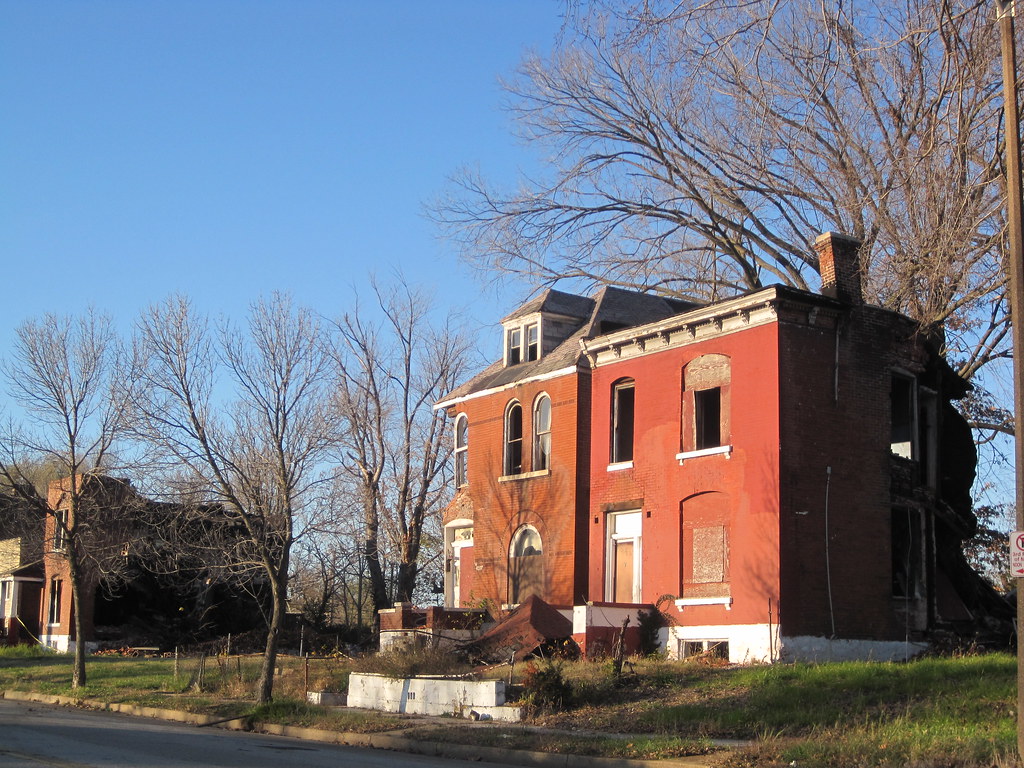
This summer and fall, brick thieves have destroyed four houses on the 4200 block of West Evans Avenue in the Vandeventer neighborhood. Shown above are three of the houses, the privately-owned 4219 W. Evans (left) and the Land Reutilization Authority-owned 4207 (center) and 4203 (right) W. Evans Avenue. Across the street are the remains of the privately-owned house at 4202 W. Evans Avenue.


This block is located in the city’s Fourth Ward, which is represented by Alderman Sam Moore (Democrat). Moore has been vigilant in trying to keep brick thieves out of his ward, as he explains in a 2007 video produced for Pub Def by Antonio French.

Categories
Events

Raise a Cup for Preservation

Next Friday, unwind with your fellow preservationists over a pint of fresh keg beer — while helping to raise money for your right to stand up to senseless demolition!


On Friday, December 11, local preservationists will host another Anti-Wrecking Ball to raise funds for ongoing legal efforts. Darren Snow, host of KDHX’s “Rocket 88” program, is the DJ for the party. All who attend will be entered into a raffle for prizes from STL Style, St. Louis Cinemas and other local businesses. The venue will be a new community gallery in Old North St. Louis in the heart of the nearly-completed 14th Street redevelopment project.

When: Friday, December 11 from 8:00 p.m. – midnight.

Where: Old North St. Louis Community Gallery, 2700 N. 14th Street

Cost: $10 (includes beer)

The Anti-Wrecking Ball will raise funds for the ongoing appeal of this year’s ruling by St. Louis Circuit Court Judge Robert Dierker that citizens have no standing under city preservation law.

When the Preservation Board approved — by a close 3-2 vote — demolition of the modern San Luis Apartments in June, the Friends of the San Luis filed an injunction in court. Under city preservation law, the citizens who make up Friends of the San Luis have a right to appeal – but only after a demolition permit has been issued! The Friends sued to stop demolition so we could appeal the Preservation Board ruling.

However, Judge Dierker ruled against the Friends, and not because he thought their argument was wrong, but because he thinks that citizens who are not owners of property threatened with demolition should have no right to protest or appeal. The San Luis Apartments were demolished this summer, but the ruling left a bigger issue that affects all citizens regardless of what they think about that one particular building.

Unchallenged, Dierker’s ruling could impede citizen efforts to save community landmarks across the city. The Friends of the San Luis filed an appeal to the Missouri Court of Appeals in September to stand up for future preservation efforts. The Friends of the San Luis believe that citizen rights should not be demolished along with the San Luis Apartments.

Consequently, the Friends of the San Luis and other preservationists have organized the Anti-Wrecking Ball to raise funds to cover attorney’s fees. After the Friends wins its appeal, the Anti-Wrecking Ball movement will continue to raise money for legal costs associated with citizen preservation action.

Categories
North St. Louis Northside Regeneration

A City Guarantee for Northside Regeneration

by Michael R. Allen

At the November 13 ceremonial signing of the first ordinances related to the Northside Regeneration redevelopment concept, Mayor Francis Slay made statements to St. Louis Post-Dispatch reporter Tim Logan that indicated his former hard line against a public guarantee of any of the $390 million in tax increment financing bonds authorized by one of the ordinances. Northside Regeneration’s developer, Paul J. McKee, Jr., has told the press on numerous occasions that the project won’t work without a public guarantee of some kind. Slay and Deputy Mayor Barbara Geisman have assured the public that City Hall was not eager to support such a guarantee.

Yet on November 13, Slay told Logan that there “may be some limited participation” from city government. He followed that statement up with an ambiguous one: “To what extent, if any, the city is going to do that hasn’t been determined.”

It should be determined in one word: No.

At least, the City of St. Louis should not pledge its full faith and credit to cover any of the bonds for the Northside Regeneration TIF. For one thing, the city simply cannot afford the liability. In the last two weeks, the press has reported several stories about a $20 million city budget shortfall and mandatory city employee furloughs. It’s not fair to ask city employees to take a hit and then be open to handing a private developer the right to bankrupt the city. Even a $1 million guarantee is too much risk for a city government trying to avoid a giant deficit.

Precedent for city guarantee shows high risk and poor development outcomes. Our first foray was backing the bonds for Midland Group’s $53 million St. Louis Marketplace on Manchester Road, completed in 1991. The developers sold the city on the promise that reclaiming the old Scullin Steel site — a true brownfield — for the sort of retail center found all over St. Louis County would lead to a sales tax boon. That promise rang hollow, and revenue fell short of the projection used to sell the TIF. The city has paid $3 million toward the TIF for the Marketplace, and will pay another $1,3 million before the TIF expires in 2011. The St. Louis Marketplace has high vacancy and low demand for its spaces.

Next, in 2003 the city backed bonds issued for the Renaissance Grand Hotel & Suites on Washington Avenue downtown. This time, developers Historic Restoration, Inc. and a subsidiary of Kimberly-Clark Corporation didn’t sell the vision to the city, but capitalized on the mythic promise that St. Louis desperately needed a giant convention hotel to compete for major conventions. The hotel has never met revenue and occupancy projections, and $13.6 million from federal block grants to St. Louis have been used to cover shortfalls.
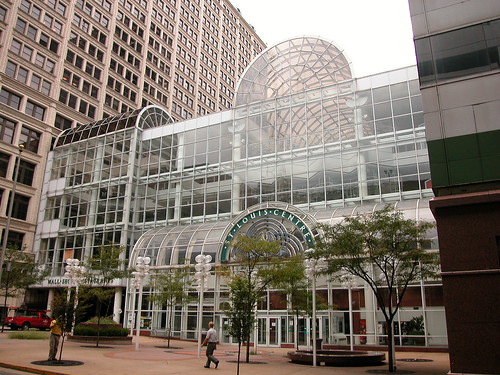
Most recent and most irresponsible was the city’s decision to guarantee bonds for Pyramid’s $26 million purchase of One City Centre in 2006. Time will tell how bad the damage to city coffers will be. Currently, the city is trying to work out a plan to keep the office tower profitable by converting the surrounding St. Louis Centre mall into parking to serve tenants. With the prospect of being on the hook for the bonds, the city has no time to wait to consider more creative ideas for reusing the old mall.

Some might argue that Northside Regeneration is too different from past city-guaranteed projects to be compared. However, fundamentally, the project shares a lot in common with the three other projects: the “last great hope” myth surrounding the project, the unrealistic revenue projections and the developer using public process to lure private capital to the project. The truth is that the Northside Regeneration project is so malleable and undefined that any revenue projections created right now are just fancy guesstimates. I write this with some hope, because the malleability of the project makes it more possible to reconcile McKee’s vision with community needs.

The reconciliation of McKee’s private aims and the civic life of north St. Louis is exactly where some help from city government would come in handy. If City Hall and the Board of Aldermen want to commit resources to speed along redevelopment, there are appropriate ways of doing so that are fairly noncontroversial: roads, streets, sidewalks and parks. There are service needs in the footprint of McKee’s Northside project that should be addressed now — especially in those parts of the project McKee has phased as the last areas to get development.

One project that the city could try to fund early on are stabilization and marketing of Land Reutilization Authority buildings in the project area, so that historic buildings are preserved and ready-to-rehab buildings are available for microdevelopers and rehabbers. Another project that would be of great benefit to all citizens is restoration and enhancement of St. Louis Place Park. DeSoto Park and others need improvements as well. And the area’s sidewalk network is badly damaged. These are all improvements that have been needed for a long time, and are promised in the Northside Regeneration presentation. Why not start them now?

Public sector expenditure can be used to make the near north side a better place for current residents. McKee will realize benefits too, of course, but not at the expense of the people his plan is supposed to help. The city guarantee that needs to be on the table is a guarantee that residents of the near north side will benefit from the redevelopment project, enjoy an improved quality of life and have their tax dollars used for true public benefit.

Categories
Adaptive Reuse Demolition Forest Park Southeast North St. Louis St. Louis County

Some Thoughts on Our Gasometer(s)

by Michael R. Allen

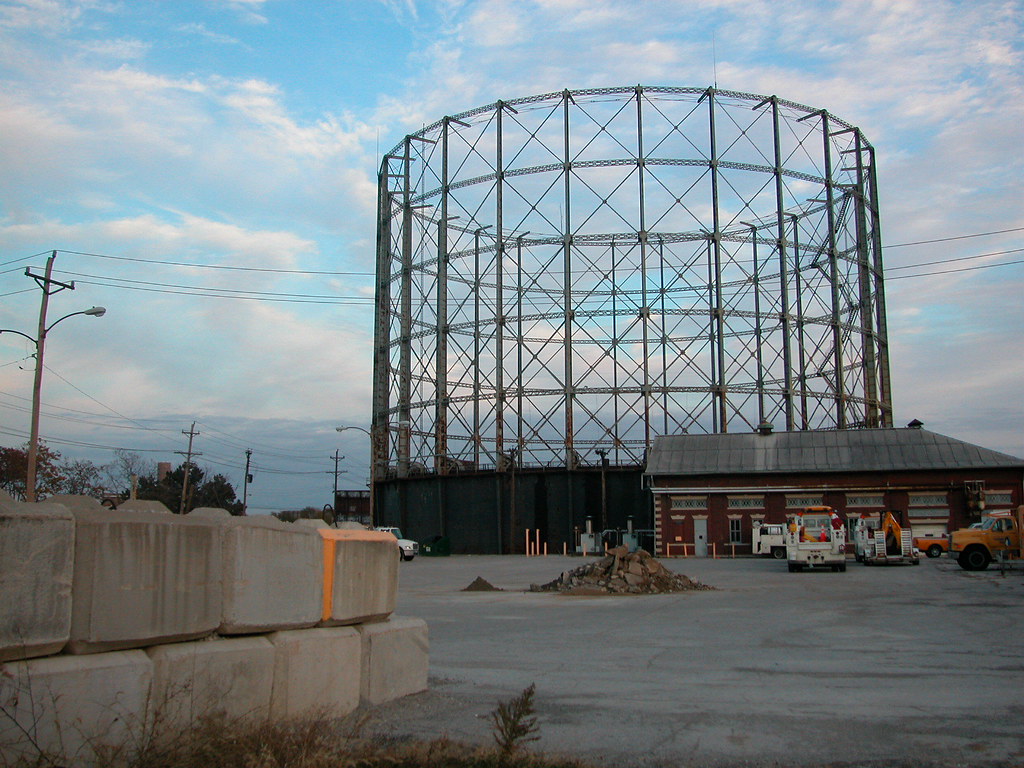
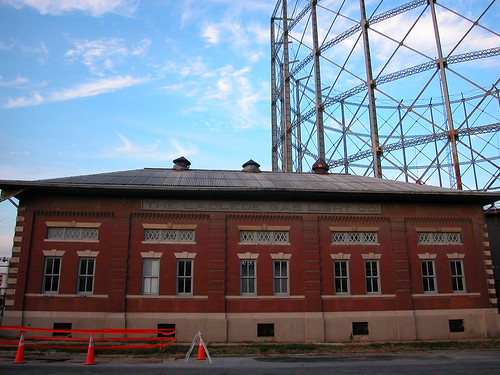
The impending demolition of the two gasometers in Shrewsbury draws me back to the demolition of the gasometer in Forest Park Southeast. Once one of two gasometers at Laclede Gas Company’s Pumping Station G and built in 1901 (rebuilt in 1942), the Forest Park Southeast gasometer was a landmark for over a century. When Highway 40 was first built, the gasometer’s prominence greatly increased, and it was one of several iconic structures — the St. Louis Science Center’s McDonnell Planetarium, the grain elevator at Sarah and Duncan, Barnes Hospital — that gave a magically urban character to an otherwise dull trip down the highway. Within Forest Park Southeast, the gasometer’s web of steel served as a backdrop to views from backyards, bedrooms and sidewalks. The gasometer was a strange remnant that had outlived its purpose — regulating the supply of the city’s gas system — but not its industrial charm and connection to the past.

In 2006, developers successfully listed Pumping Station G in the National Register of Historic Places (read the nomination by Susan Sheppard and Doug Johnson here). The State Historic Preservation Office insisted that the gasometer be included, and the gasometer was listed as a contributing structure. However, the official landmark status provided no protection. The developers had never intended to try to save the structure.

An eloquent plea for preservation from historian and then-St. Louis University professor Joseph Heathcott, “Getting creative with the region’s exceptional industrial heritage”, appeared in the February 8, 2007 issue of the St Louis Post-Dispatch, but there was no strong effort to preserve the gasometer. There was plenty of discussion, however, among architects, Forest Park Southeast residents and preservationists. The alternative ends for the gasometer were obvious. Several European cities, including London and Vienna, have converted iconic gasometers into equally iconic apartment and office buildings. Others have maintained the structures as urban artifacts. Heathcott’s article alluded to the imaginative possibilities.

Photograph of Viennese gasometer reuse project from Wikipedia.

Alas, imagination did not win out. Neither did National Register protection; the city’s Cultural Resources Office approved demolition of the gasometer without bringing the matter to a public hearing at the Preservation Board. Demolition of the gasometer was completed in the middle of 2007.


Today, the Pumping Station G site is largely vacant. The pumping house (1911) still stands, vacant but slated for rehabilitation. The developers who wrecked the gasometer sold the site to different developers, who have yet to devise plans for the site. In the end, the gasometer could have remained standing as a resource for its neighborhood and a icon for the city. Perhaps a new owner would have been interested in the challenge of finding a new use for the structure. Now, the gasometer is gone, and two of its three sisters soon also will be gone.

That leaves St. Louis only one chance to reclaim a gasometer: the gasometer at the vacant Pumping Station N, located just south of Natural Bridge Road on Chevrolet Avenue in north St. Louis. Can we rise to the challenge of retaining an endangered structural type, or will we let it fall too?

Categories
Chicago Demolition Mid-Century Modern

Chicago Still Destroying Gropius’ Work

by Michael R. Allen

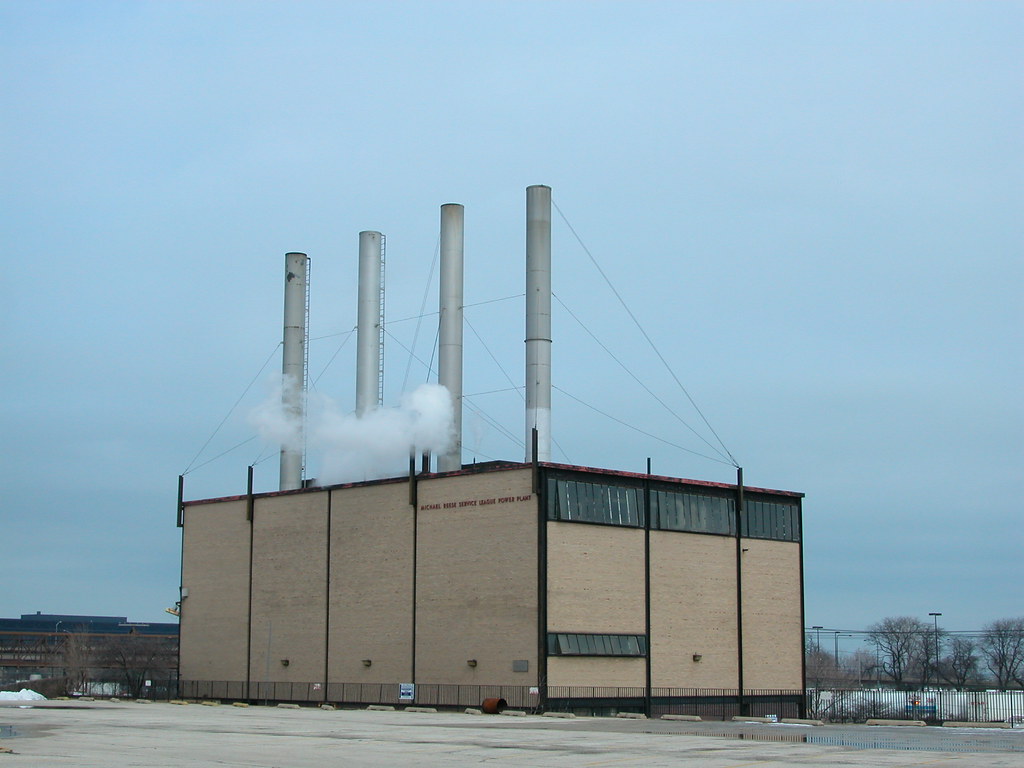
St. Louis has a long way to go to catch up to Chicago. While our Archdiocese senselessly demolished a motel by Charles Colbert this year, Chicago city government has been working to demolish the Michael Reese Hospital campus planned and co-designed by Walter Gropius. This week, the city’s wreckers demolished the power plant shown above, which was completed in 1953 and designed by Gropius’ The Architects Collaborative. Only five buildings associated with Gropius remain out of the eight that stood earlier this year, and the landscape is ruined.

The Michael Reese campus was Gropius’ only work in Chicago. In Chicago during the twentieth century, American eyes gazed upon some of the finest modern architecture in the history of the world, from Louis Sullivan to Frank Lloyd Wright to Mies van der Rohe to Walter Gropius. As we know, the Windy City’s regard for the work of Sullivan has been spotty at best. Gropius’ work at least enjoys good company in its flagrant disregard.

While the city of Chicago is now bound by its contract with the demolition company, one wonders why the city even rushed to get into such an arrangement not knowing the outcome of its Olympics bid. Why did Alderwoman Toni Preckwinkle deign to play architectural historian and dispute the well-documented role of Gropius? Why did Chicago Mayor Richard Daley, the supposed “Green Mayor,” rush to throw away irreplaceable, internationally significant modern architecture and already-built building stock? Don’t ask. Irrational acts of destruction lack any rational explanation.

Categories
Demolition Downtown

Aerial View of Downtown, 1926

by Michael R. Allen

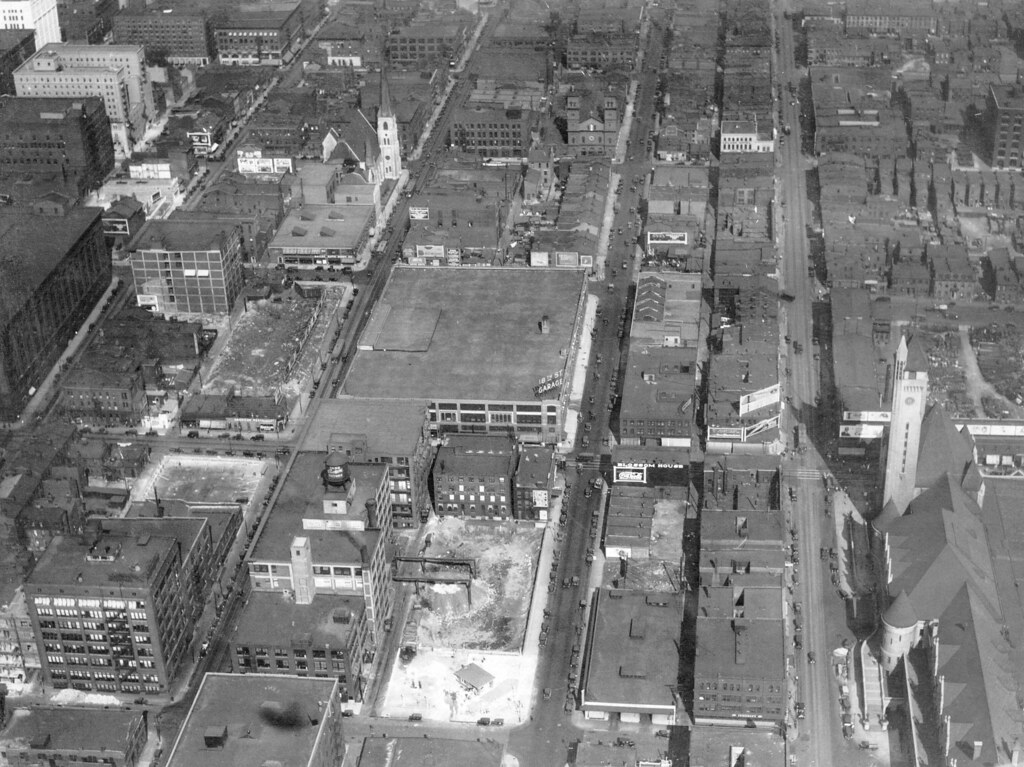
Following up on Monday’s article about the Railton Residence, here is an aerial photograph of the area of downtown around the Railton site from 1926. This photograph is from the collection of the City Plan Commission. At right, one sees the tower of Union Station. At center is the full-block-sized 18th Street Garage, designed by Klipstein & Rathmann and completed in 1924. The cleared site for the Robert E. Lee Hotel (now the Railton) is just diagonally down to the left of the large parking garage. (A larger cleared site is on the block east, or up from this perspective.)

Beside Union Station, the 18th Street Garage and a few wholesale buildings, most of the buildings in this image are two to three stories and more typical of St. Louis’ neighborhood vernacular forms than our modern downtown architecture. This area was an eastern extension of Mill Creek Valley, with a largely African-American and exclusively poor and working-class population. City leaders took aim at this “slum” as early as the 1890s. Starting in 1928, using money from the $87 million raised in a 1923 multi-part bond issue, the city would clear the block across the street from Union Station for a large plaza (now Aloe Plaza). The new post office and Municipal (later Kiel) Auditorium east of Union Station would claim more of the western downtown area’s small buildings. By 1961, the city would have obliterated over 75% of the building stock seen in this view.

Categories
Historic Preservation Public Policy

More Federal Money for Historic Preservation Exists, Needs to be Appropriated

by Michael R. Allen

In 1976, the U.S. Congress created the Historic Preservation Fund (HPF). Funded by offshore oil leases, the $150 million fund is supposed to be available for matching grants to state and territorial historic preservation offices, tribal historic preservation offices, historically black colleges and universities and the National Trust for Historic Preservation. Recipients must provide a 40% match for preservation planning, bricks and mortar projects, resources and neighborhood surveys and educational programs.

Furthermore, 10% of each state’s allocation must be passed through to certified local governments (CLGs). In the St. Louis area, CLGs include the City of St. Louis, Chesterfield, Cottleville, Ferguson, Florissant, Kirkwood, Manchester, Oakland, Pasadena Hills, St. Charles, University City, Webster Groves and Wildwood. Imagine what a source of new funding for surveys and education could do for preservation efforts in these cities.

In 1980, Congress authorized deposit of the full $150 million annual revenue amount into the fund. However, since then, Congress has never appropriated more than one-third of the fund for its intended use. In this Congress, we have a chance to change that.

Over 40 organizations and companies in 26 states have joined the Coalition for Full Permanent Funding of the Historic Preservation Fund. (The Preservation Research Office, the St. Louis Building Arts Foundation and the Friends of the San Luis from St. Louis have signed on.) The Coalition is seeking more support to show Congress that there is wide support for full appropriate; contact the Coalition at infor@fullyfundhpf.org to sign on.

The bill that could cut through 29 years of Congressional neglect is the Consolidated Land, Energy, and Aquatic Resources (CLEAR) Act of 2009 (H.R. 3534). The bill was introduced into the House Natural Resources Committee by Democratic Congressman Nick Rahall from West Virginia. Currently, it includes full funding for the Land and Water Conservation Fund, which draws from the same off-shore oil revenues and has traditionally been appropriated at the same time as the Historic Preservation Fund. The Coalition hopes to add a provision for full funding of the Historic Preservation Fund.

Congressman Rahall is friendly to the Coalition, but needs support to bring forward the necessary amendment to fully fund the HPF. Contact Rahall online, by phone at (202) 225-3452 or by postal mail at:

Hon. Nick Rahall
2307 Rayburn HOB
Washington, DC 20515

Categories
Downtown Historic Preservation Housing

The Railton Residence Reopens

by Michael R. Allen

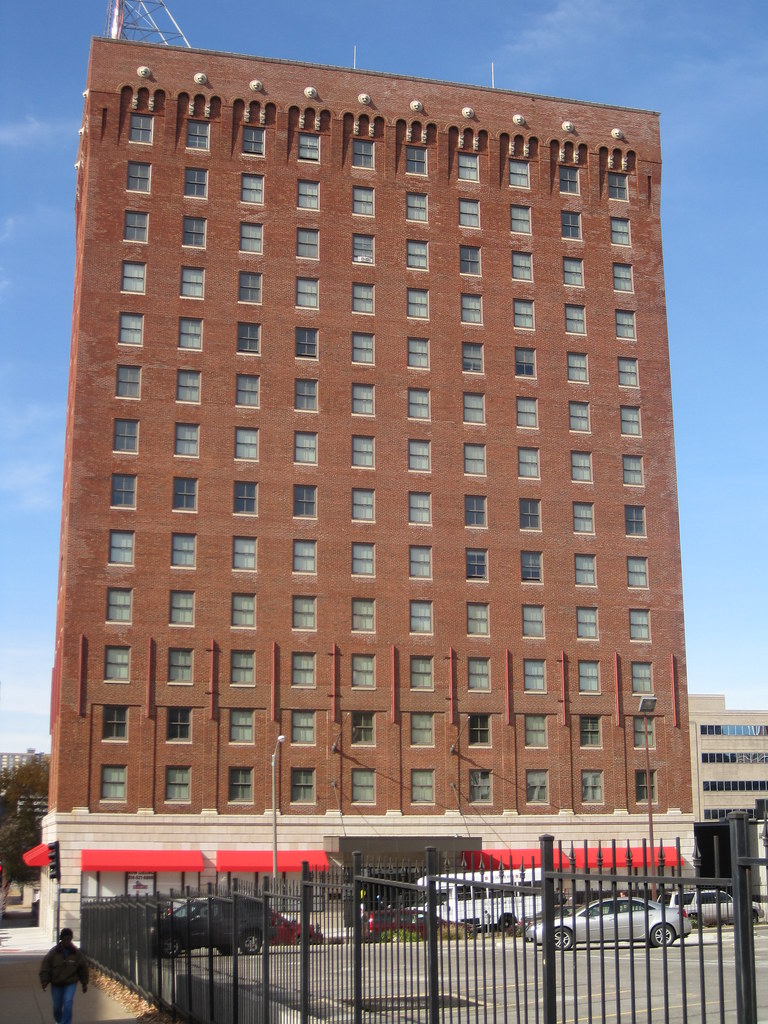
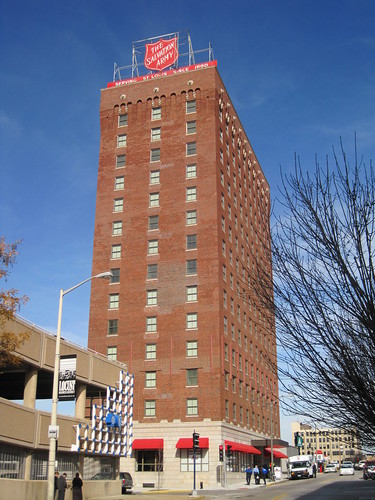
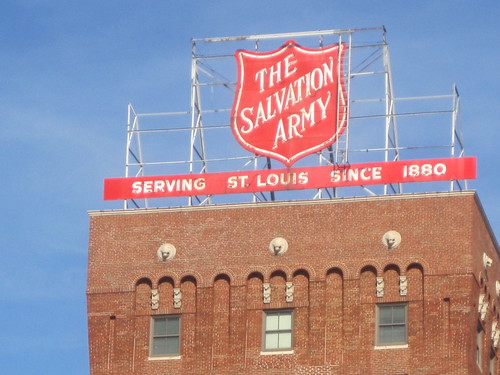
On November 12, Salvation Army officials cut the ribbon on the beautifully rehabilitated Railton Residence at 205 N. 18th Street downtown. The project cost $14 million and produces 102 workforce housing units in the heart of downtown. Major assistance came from the St. Louis Equity Fund, and the project would not have happened without the use of state historic rehabilitation tax credits and the state low income housing tax credit.

The Salvation Army has owned the Railton since 1939, when it acquired the former hotel for use as one of the Army’s Evangeline residences. Named for Evangeline Booth, first female “general” of the Salvation Army, the residences provided single-room-occupancy lodging for single women working jobs downtown. In 1974, the Salvation Army removed restrictions on male occupants and renamed the building the Railton Residence. In recent years, the Railton’s future has been important in a downtown housing market lacking adequate workforce housing. The Salvation Army is doing a good thing in keeping the Railton reserved for people priced out of most recent downtown development. We just need more units like these.

As the author of the National Register of Historic Places nomination for the Railton, I could elaborate at length on the history of the building. Instead I’ll offer a nutshell and recommend reading Section 8 of the nomination. The 14-story Railton started as the Robert E. Lee Hotel, completed in 1928 and designed by Kansas City architect Alonzo H. Gentry. Originally, the Renaissance Revival hotel had 221 rooms. Nearby Union Station fueled a district of hotels along 18th Street — there were ten operating between Market and Washington in 1928 — of which the old Lee Hotel is the sole survivor. (The Marquette Hotel was the northern anchor, and fell in 1988).

The Lee was marketed to traveling businessmen who arrived by train and had business in the wholesale business. Unlike other more lavish or plain seedy lodgings, the Lee was envisioned by its developers as a moderately-priced, economical hotel — a precursor of the motel. In fact, the Lee was part of a chain that capitalized on the St. Louis-Texas trade route by operating hotels in St. Louis, Kansas City, Laredo and San Antonio. In 1935, the Lee became the Auditorium Hotel.

In 1958, the terra cotta belt course between the third and fourth floors was removed. The current rehabilitation could not cover the cost of replicating the lost cornice, but it did change out later aluminum windows for new ones that replicate the original two-over-two pattern. Overall, the Railton is a fairly austere building, but the next time you are nearby look up to the top — those round terra cotta medallions are lion’s heads!

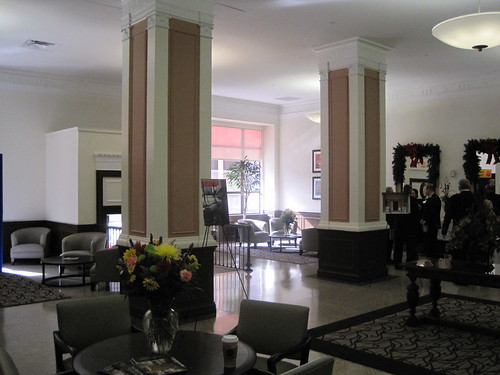
The lobby of the Railton is not highly ornamented, but it has fine terrazzo floors, millwork and plaster moldings. Two years ago, a drop ceiling concealed the plasterwork and old carpets covered the terrazo. The lobby has been restored. Meeting rooms and a small gym are among the amenities offered.

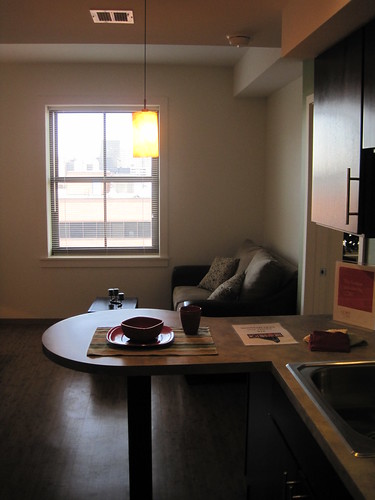
The Salvation Army did decide to abandon the SRO model and expand the suites, so that 221 rooms became 102 apartments. This was a wise move because the original rooms were crowded with low-ceilings and no kitchens. The new rooms have kitchens and bathrooms as well as wonderful views of downtown.

Of course, the signature sign on the roof was retained. The sign structure was put up in the early 1930s and the sign itself in 1946.

The Salvation Army is discussing following up the Railton rehabilitation with a similar project at the Harbor Light in Midtown. Hopefully, that project gets underway in the near future. Affordable housing in the heart of the city needs to be retained and expanded. Historic buildings, especially those like the Railton that have not seen great deterioration, reduce construction costs and thus reduce the cost of housing units.

Categories
Hyde Park LRA Old North Preservation Board The Hill

Today’s Preservation Board Meeting: Old North and Hyde Park Buildings, But No Southwest Avenue

by Michael R. Allen

UPDATE 12:09 p.m.: The Old North item has been pulled from the agenda.

The final agenda of today’s Preservation Board meeting is online.

The two buildings on Southwest Avenue that this blog covered on November 14 are no longer on the agenda.

However, one of the several city-proposed demolitions in Old North St. Louis remains on the agenda on preliminary review: demolition of the building at 1942-44 Hebert Street. Typically, requests from the Building Division to demolish city-owned buildings appear on the preliminary agendas of the Preservation Board but get denied by the staff of the Cultural Resources Office prior to Board meetings.

On this building, the staff is seeking direction from the Preservation Board rather than making a recommendation. The direction needs to be denial. Last month, a contributing building in the Murphy-Blair Historic District collapsed. Others are vulnerable. In light of the ongoing near north building depletion and possible wave of demolitions for the NorthSide project, preservation in Old North has become very important. The condition of 1942-44 Hebert Street is rough, but certainly not fatal. Perhaps the city can apply the $25,000 paid by the Haven of Grace to demolish building at 2619-21 Hadley Street in Old North toward the stabilization of this fine building on Hebert.

Another item on today’s agenda is the appeal of CRO denial of a demolition permit for the building at 3959 N. 11th Street in Hyde Park. The Preservation Board heard this item in October, and upheld denial. Not sure why the item is back.

As usual, the meeting begins today at 4:00 p.m. on the 12th floor of the building at 105 Locust Street. Citizens may send comments to Preservation Board Secretary Adona Buford at BufordA@stlouiscity.com. Note that in a preliminary review, the Board is not required to review e-mailed comments before making a decision.