Categories
Benton Park Historic Preservation South St. Louis

Good News from the Chatillon-DeMenil House: Roof Replacement on the Way

by Michael R. Allen

Tonight, the Chatillon-DeMenil House Foundation hosted its Holiday Party and Annual meeting. The customary good cheer and fellowship always accompanies a short business meeting during which members of the Board of Directors are elected and news is shared. I was overjoyed to hear Board President Ted Atwood announce that the board is poised to sign a contract for roof replacement as soon as next week, and that restoration of the portico columns facing DeMenil Place will follow that project.

For the last few years, the condition of the roof and columns has caused concern among the many supporters of the house. Of course, the columns can’t be repaired until the roof stops leaking. Next year, a new metal roof should be in place and column work underway.

If you have not been to the gift shop at the DeMenil, you will be in for a surprise. The shop has been overhauled. There is a strong new array of items for sale, and the room itself has been redecorated. It’s much better!

The Chatillon-DeMenil House, located at 3352 DeMenil Place, is open Tuesday through Saturday, 10 a.m. – 4:00 p.m. One of the local preservation community’s early success stories, the DeMenil was rescued in 1964 from the path of interstate highway 55 by Landmarks Association of St. Louis using a generous gift from Union Electric Company. If you go for a tour during the week, there is a great chance that Facilities Director Kevin O’Neill will give you the tour. Kevin’s knowledge and stewardship are amazing, and one of the reasons the DeMenil is no ordinary house museum.

Categories
Academy Neighborhood Demolition North St. Louis Preservation Board Schools SLPS

Good News and Bad News on Page Boulevard

by Michael R. Allen

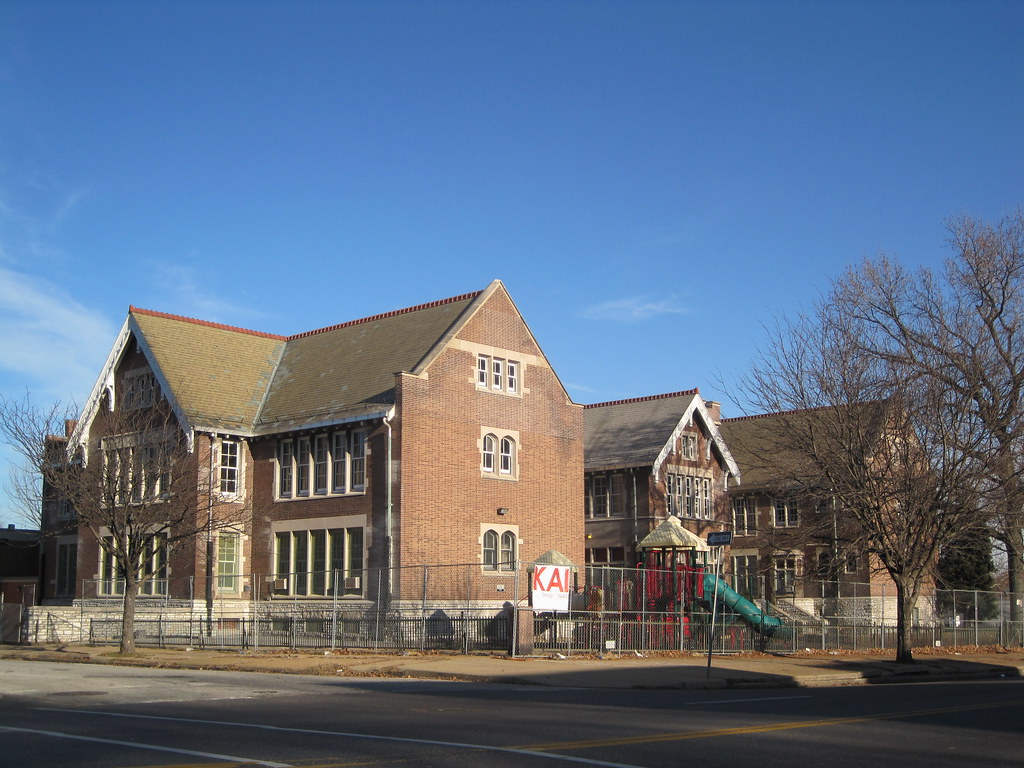
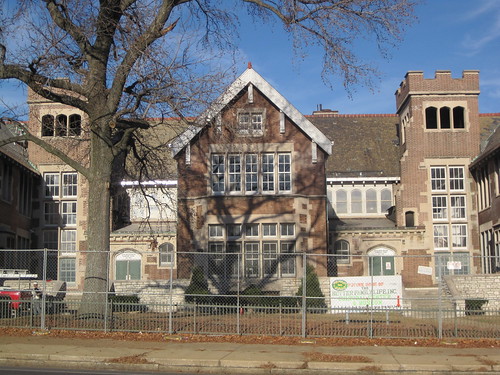
Preservationists should send their thanks to Better Family Life, a cultural and educational organization that is uplifting African-American St. Louis while rehabilitating one of our city’s irreplaceable historic schools. In 2005, Better Family Life purchased the shuttered Ralph Waldo Emerson School at 5415 Page Boulevard. This year, the organization began a $4.5 million rehabilitation that will convert the school into an educational and cultural center.

Currently, a construction fence surrounds the school. Workers are on site most days, and a lift was in front today. The daily activity at Emerson School has not been this high since the school’s last day of classes in June 2003. When the school closed, few predicted that any serious buyer would step forward so soon. The landmark could have become an abandoned wreck.

Designed by William B. Ittner and completed in 1901, the brick school is one of the earliest of Ittner’s schools in the hybrid “Jacobethan” style that he helped popularize. Ittner began working for the St. Louis Board of Education in 1898, and did not turn to the Renaissance styles until a few years into his tenure. Emerson School is a handsome early work utilizing the architect’s open floor plan. The grace of the landmark shall be with us for generations, thanks to Better Family Life.

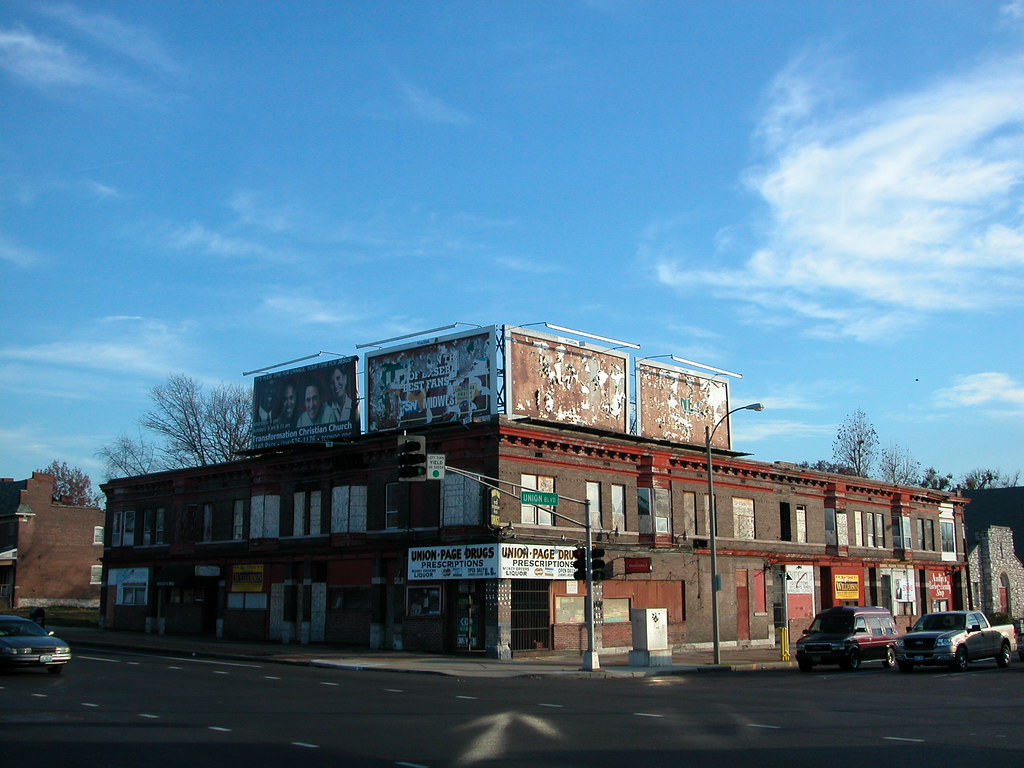
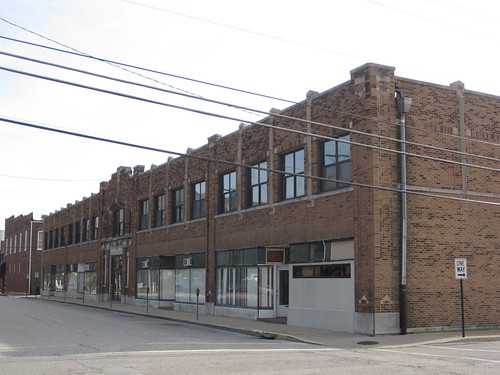
If only all good news from St. Louis’ built environment did not have to be counterbalanced by bad news. Just two blocks east of Emerson on the south side of mighty Page Boulevard at Union Boulevards, another north side landmark is meeting a sad end. The corner commercial block at 5986-98 Page Boulevard, written about on this blog several times before, is finally falling to the wreckers. I offer here an image of the building in better days, and will spare readers yet another demolition photograph.

The corner building is a younger building than Emerson School, with a completion date at 1905. The two-story building is part of the Mount Cabanne-Raymond Place Historic District and could have been reused utilizing historic tax credit programs. Surely, commercial storefronts and apartments enjoy far more demand in the city than cultural centers. However, the building had the wrong owner, the Berean Seventh Day Adventist Church, which will be building a parking lot on the site.

In February 2008, the city’s Preservation Board voted 5-2 to deny a demolition permit for this building. Then, in June 2009, the city’s Planning Commission arbitrarily overturned the Preservation Board decision.

The story got stranger after that when the church failed to meet the requirements of the Planning Commission decision but began demolition this summer without a permit. City officials called a halt to the wrecking, but the wreckers had already delivered fatal damage by removing most of the roof. Now the rest of the building will be removed legally. Page Boulevard will have a completely disjointed, unhinged intersection with Union Boulevard. Two prominent thoroughfares shall meet at an intersection as full of character as any generic suburban intersection anywhere in the United States. This city, it should be stated, deserves better. It deserves what it had before.

Categories
Historic Preservation Public Policy

Cash for Caulkers: What About Cash for Weatherstrippers?

by Michael R. Allen

Today President Barack Obama spoke in favor of an energy efficiency program dubbed “Cash for Caulkers.”

Where did this speech take place? Outside of a Home Depot store in Virginia. Not a good sign. Where does the program leave the millions of Americans who resident in historic houses?

We aren’t sure yet. The Climate Change bills that stalled in the House and Senate actually included a bikk called Retrofit for Energy and Environmental Performance (REEP) that provided specific incentives for achieving energy efficiency in historic buildings.

The new administration program should carry over language that allows historic building owners to get incentives for making more sensitive and effective repairs to their buildings. Home Depot is a fine place to buy caulk, but it is also fairly useless to someone who wants to retain and repair a wooden window made from 125-year-old virgin growth timber.

If the new incentive would reward someone for removing a window that could be as old as a century and replace it with a window that probably won’t last 20 years, but won’t reward someone for retaining and repairing existing windows, then it should be called “Cash for Home Depot.” Removal of existing building material that can be saved is a waste of natural resources. Replacement of that material with materials designed to last less than two decades increases one’s carbon footprint in the long run.

Historic windows are often the first things to be removed in a rehabilitation project. They almost never get replaced with anything that will have the same durability or longevity. A wooden window can be maintained for well over a century, and can be kept weather-tight with proper glazing, weatherstripping and the presence of an interior or exterior storm window. The thermal properties of wood are actually quite good, especially when that wood has the dense grains found in the old-growth wood available to builders in the 19th and early 20th century. Your windows are second-nature natural resources, and their destruction has an environmental impact no matter how “energy efficient” contemporary windows’ manufacturers claim they can be.

Scratching your head at my logic? I offer a Energy Efficiency Tips for Historic Homeowners, a document published by the City of Albany, New York. There is also a short article by architect Curtis Drake entitled “Making Your Historic Home More Energy Efficient” that appeared in Save Our Heritage Organisation Magazine.

Hopefully President Obama will support an energy efficiency program that makes sense for all buildings and all remedies — even those that can’t be purchased at the Big Orange Box.

Categories
Fountain Park North St. Louis Urban Assets LLC

Board Up Award

by Michael R. Allen

And the award for boarding up almost every window on a front elevation of an abandoned north St. Louis house surrounded by occupied houses goes to: Urban Assets LLC, for 1414 N. Euclid Avenue in Fountain Park!

Categories
Historic Preservation North St. Louis Rehabbing West End

West Cabanne Place Living

by Michael R. Allen

Photograph courtesy of Landmarks Association of St. Louis.

The city’s West Cabanne Place opened in 1888 as a semi-rural private street, located away from the urban core of St. Louis. Many prominent businessmen and a few architects — including Charles Ramsey and Theodore Link — purchased lots and built large homes on West Cabanne. Built in 1889 for E.O. Pope of the Jones-Pope Produce Company, the house at 5927 West Cabanne was one of the earliest residences on the street. The designer of the eclectic home remains unknown. Jane Porter, author of the National Register of Historic Places nomination for West Cabanne Place, suggests that a contractor rather than an architect designed the Italianate-influenced house, which mixes elements rather freely.

In the 1990s, 5927 West Cabanne Place appeared to be at risk of being lost. Landmarks Association of St. Louis included in the house in its annual Eleven Most Endangered Places list for several years. Eventually, however, the home fell into the hands of an owner who gave the house needed rehabilitation work. The exterior was restored by removing asphalt siding and repairing and replacing wooden elements. Now the spacious residence is for sale for the unbelievable price of $119,000. This truly must be a buyer’s market, for a rehabilitated home on West Cabanne Place to be offered at that price!

Categories
Events Historic Preservation North St. Louis Old North

Second Anti-Wrecking Ball: Success

by Michael R. Allen

Toby Weiss has already posted an excellent recap of last night’s Anti-Wrecking Ball, but here’s another. In short, we raised more money than we thought that we could, had more people attend than we expected and had a lot more dancing than usually seen at preservation fundraisers!


Video by Toby Weiss.

Dozens of people came to Old North St. Louis to support the cause of citizen preservation action and to enjoy a party inside of the spacious, lovely new Old North St. Louis Community Gallery. The venue was perfect, and not simply spatially. While the event’s focus was raising money for the Friends of the San Luis‘ appeal of a circuit court ruling against citizen standing in preservation battles, it was also a celebration of all that we can do together. The gallery is smack dab in the middle of the revitalized 14th Street commercial district, until recently a horrid pedestrian mall. The rebirth of the mall and Old North have come through the dedication of scores of people working against tough odds. Citizens, acting on the belief that we can make our neighborhoods better places and save our irreplaceable landmarks.

The attendance was a great example of the wide support for preservation. There were north side residents, young urbanists, veteran preservationists, architects, artists, anti-eminent domain activists, and even a Preservation Board member. Up the street at the Urban Studio Cafe there was an art opening, and crowds migrated back and forth throughout the evening.

DJ Darren Snow kept a wonderful flow of music going. Emily Beck created a powerful slide show that weaved together the past year of Friends of the San Luis events, architectural images and photographs of people across the city celebrating the historic architecture of our neighborhoods. The Chase Park Plaza Cinemas, STL Style and Toby and I provided raffle items. Volunteers too numerous to mention pitched in, and the party went well past the advertised midnight close. Bravo!

Categories
Belleville, Illinois Historic Preservation

More Time Needed to Market Belleville YMCA Building

by Michael R. Allen

On December 5, the Belleville News Democrat carried an article with the title “Reality check for old YMCA building: ‘Unless money is found, nothing’s going to happen'”. The article contains disturbing news from Belleville’s effort to market the historic downtown YMCA building, originally the Belleville Turner Hall (see ““Old Belleville Turner Hall Could Be Yours”, August 7, 2009). From the article:

Jack LeChien, alderman in Ward 7 and the chairman of the YMCA committee, has favored using the building rather than tearing it down; after all, he’s a member of the Belleville Historic Preservation Commission. But he thinks anyone with a strong proposal and adequate financial backing likely would have stepped forward by now.

Alderman LeChien had had a tough job, and has done it well. LeChien reached out to historic preservation blogs, magazines and other publications to carry the Request for Proposals issued by the city. However, the timing of Belleville’s quest to sell the YMCA building has been a problem. Belleville picked the worst possible time for developers to get financing for a large project like the YMCA building. As I wrote to Alderman LeChien in June: “One thing to consider is that the lending climate is still emerging from stagnation and many developers who might be interested could need time to close on financing.”

The fact is that the market is still slow and recovery is not complete. Belleville needs more time to sell the YMCA building, and its leaders should not rush to any conclusions about lack of responses to the RFP.

Also, the RFP posted on Belleville’s website this year was not very strong. The document consisted of a short cover statement and a lengthy report on asbestos issues — not a great marketing package. All old buildings have some asbestos, but not all old buildings have the reuse potential, location and cool interior spaces that the Bellevilel YMCA has. More time and a better RFP are needed.

Categories
Downtown Green Space JNEM

International Design Competition to Invigorate the Gateway Arch Starts Today

Goal is to “Frame a Modern Masterpiece” and Connect the Gateway Arch with the Mississippi River and the St. Louis Region by 2015

FOR RELEASE: December 8, 2009

Contact: Tom Bradley, Superintendent
Jefferson National Expansion Memorial
(314) 655-1600

Jeff Rainford
Office of St. Louis Mayor Francis G. Slay
(314) 622-3201

ST. LOUIS, Mo. – The National Park Service and St. Louis Mayor Francis Slay today launched an international design competition to invigorate the park and city areas surrounding of one of the world’s most iconic monuments, the Gateway Arch in St. Louis.

“The competition begins today,” said Tom Bradley, Superintendent of the Jefferson National Expansion Memorial, which includes the Gateway Arch. “This competition is a unique and important opportunity to integrate the Arch and the park surrounding it into the fabric of the city and region and embrace the Mississippi River and its east bank. It’s an opportunity to energize the park with new amenities and attractions. By achieving these objectives, we will design people into the area – and establish a national model for urban parks.”

The winning design will be announced in October 2010, with the resulting work completed by October 28, 2015 – the 50th anniversary of the completion of the Arch.

“Critical stakeholders are engaged and the architectural and design communities are excited to get started,” said Slay, who, with Bradley, is a member of the CityArchRiver2015 Foundation, a nonprofit organization created to drive the effort. Also represented in that group are regional business and university leaders, national park advocates and architects.

“We’re very lucky to now have Tom Bradley as a partner in this initiative,” said Slay. “He has worked diligently to drive federal action, solicit community input, and engage and reassure the park advocacy community, all of which have been absolutely essential to launching this competition.”

The competition – “Framing a Modern Masterpiece: The City + The Arch + The River 2015” – is called for in the National Park Service’s new General Management Plan, which was developed with extensive public input over an 18-month period, and approved on November 23, 2009.

“Engaging the wider community, including and extending far beyond the St. Louis region, has been and will continue to be an important element in this process,” said Slay.

The competition will invite teams to create a new design for the Arch grounds and surrounding areas with 10 goals in mind:

* Create an iconic place for the international icon, the Gateway Arch.
* Catalyze increased vitality in the St. Louis region.
* Honor the character-defining elements of the National Historic Landmark.
* Weave connections and transitions from the city and the Arch grounds to the Mississippi River.
* Embrace the Mississippi River and the east bank in Illinois as an integral part of the national park.
* Mitigate the impact of transportation systems.
* Reinvigorate the mission to tell the story of St. Louis as the gateway to national expansion.
* Create attractors to promote extended visitation to the Arch, the city and the river.
* Develop a sustainable future for the Jefferson National Expansion Memorial.
* Enhance the visitor experience and create a welcoming and accessible environment.

The competition is being organized and managed by Donald Stastny, one of the nation’s most experienced design managers. Stastny is the chief executive officer of StastnyBrun Architects in Portland, Ore., and has served as professional advisor for more than 35 design competitions. Among them are the recent Flight 93 National Memorial in Stonycreek Township, Pa., the Oklahoma City National Memorial, the new U.S. embassy in London and Disney Concert Hall in Los Angeles.

Stastny will instruct and assist an eight-person jury. The names of jury members – from design, architecture, landscape architecture and related fields – will be announced in early January 2010, closer to the deadline for initial registration for the competition.

“The challenge is great – to take one of America’s first urban parks and weave it into the fabric of the region,” Stastny said. “I’m confident that this competition will foster an environment in which leading and emerging design professionals can do their best work and walk in Eero Saarinen’s footsteps. It’s a once-in-a-lifetime opportunity for the participants – and I’m proud to be involved.”

“This competition will honor the character-defining elements of the National Historic Landmark, which includes the Gateway Arch and its grounds,” said Lynn McClure, Regional Director for the National Parks Conservation Association, America’s leading voice for our national parks.

“The national park, downtown St. Louis, the riverfront and the Illinois side will finally be brought together as a vibrant and exciting destination,” said McClure, who is also a member of CityArchRiver2015 Foundation.

Dr. Robert Archibald, President and CEO of the Missouri Historical Society, praised the competition plan, stating, “This park symbolizes the American spirit, the sense of optimism and energy. The Gateway Arch is truly stunning; as magnificent today as it was the day it was completed. We need now to free it of its isolation and connect it to the region and the river on whose banks it sits.”

Archibald was among a small group of civic leaders tapped two years ago by Mayor Slay to explore new options to connect the city, the Gateway Arch and the river, and to bring new vitality to the riverfront.

This new competition honors the spirit of the 1947 national challenge that inspired architect Eero Saarinen’s Gateway Arch design. In the effort to produce a memorial to Thomas Jefferson’s Louisiana Purchase and the era of American Westward expansion, the jury chose the most audacious entry – a gleaming 630-foot stainless steel arch. It was the first of several masterpieces by the gifted but short-lived Saarinen.

Completed in 1965, the Gateway Arch instantly became an international destination and won immediate recognition as one of the world’s premier works of public art. The grounds immediately surrounding it, designed by the late Dan Kiley, are also widely recognized as a landscape masterpiece. However, those grounds, and the city streetscape, highways, and the Mississippi riverfront which they abut, lack the “buzz” of constant activity associated with a vibrant urban park – one of the issues the competition is meant to address.

In addition to Superintendent Bradley, Mayor Slay and Lynn McClure, CityArchRiver2015 Foundation also includes: Bruce Lindsey, Dean of the College of Architecture and Graduate School of Architecture and Urban Design at Washington University in St. Louis; Walter Metcalfe Jr., an attorney with Bryan Cave LLP and another of Mayor Slay’s original team of civic leaders; Deborah Patterson, President of the Monsanto Fund and director of social responsibility for the Monsanto Company; and, Dr. Vaughn Vandegrift, Chancellor of Southern Illinois University Edwardsville. This volunteer group has coalesced over the last six months as the National Park Service’s General Management Plan took shape.

Financial contributions are being handled by the Greater St. Louis Community Foundation, a public charity with more than $140 million in charitable assets and representing more than 350 individual funds.

Contributors to the design competition include: Emerson, Gateway Center of Metropolitan St. Louis (Malcolm W. Martin Memorial Park), Peter Fischer, Emily Rauh Pulitzer, Civic Progress, Wachovia Wells Fargo Foundation, Danforth Foundation, Bryan Cave LLP, Greater St. Louis Community Foundation, National Park Foundation, Monsanto, Alison and John Ferring, Bank of America and donors who choose to remain anonymous.

Additional information can be found at www.cityarchrivercompetition.org.

###

Categories
Forest Park Southeast Housing Streets

Thoughts on the Proposed Adams Grove Infill Project

by Michael R. Allen

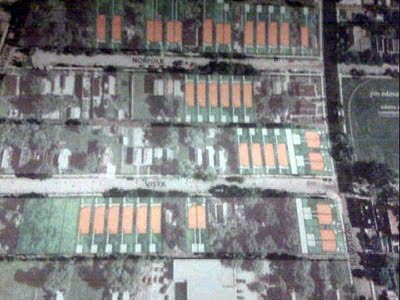
Alex Ihnen has reported the his St. Louis Urban Workshop blog that a substantial new scattered-site infill housing project is in the works for part of Forest Park Southeast. Specifically, the Regional Housing and Community Development Alliance hopes to build 40 new houses on and around Norfolk and Vista avenues west of Newstead. These are some the neighborhood’s roughest blocks in its most neglected portion, the area south of Manchester Avenue known as Adams Grove. Adams Grove was platted in 1875 and is the oldest part of Forest Park Southeast, but long has lagged behind the northern section of the neighborhood in development efforts.

Readers may recall that in 2006, these blocks were targeted by the Forest Park Southeast Development Corporation during a wide round of demolition that took down over 30 buildings across the neighborhood. The Preservation Board approved demolition permits for one building on Norfolk and eight buildings on Vista.

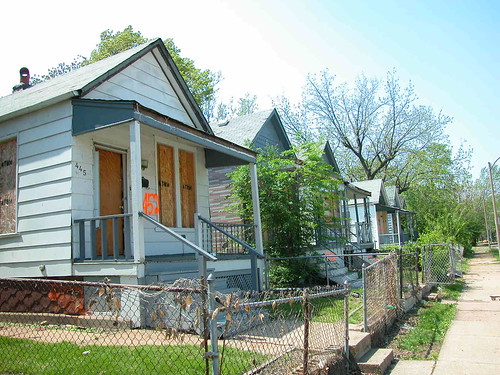
One of the worst aspects of this round of demolition was the wholesale removal of vacant frame houses like the row shown here. These six houses stood from 4452-4462 Vista Avenue. Proponents of demolition argued that the houses were too small for people’s demands, and that wide clearance would allow for a large-scale new housing effort.

While the large-scale infill project is welcome fulfillment of the promises that the Development Corporation made in support of demolition, there remains some bittersweet irony that the houses now proposed for construction are small, one-story homes like those rejected as unfit for housing needs. Make no mistake, though — the size of the proposed infill is perfect for the area and the housing needs. That’s why some of us opposed demolishing the frame shotgun houses that also could have served those needs.

The wide demolition in 2006 could lead to two other losses, one of which is the prominent two-story brick corner building at Newstead and Vista that recent was being rehabilitated. Getting remaining buildings listed in the National Register of Historic Places to attain historic rehab tax credits might be difficult, although certainly not impossible. The demolitions are tentative, though, and could be avoidable.

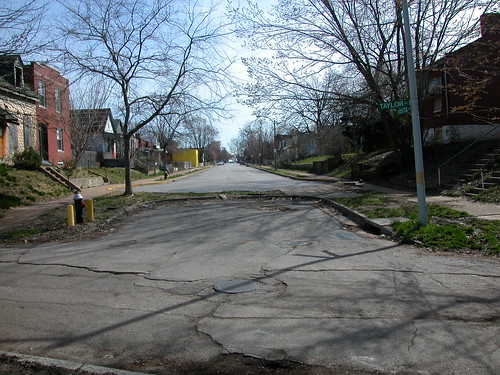
One problem for these specific block of Adams Grove are the cul-de-sac street closures on the western end. These closures are partly responsible for the decline of the building stock in this area. Placement of the closures at an unsightly and moribund stretch of Taylor Avenue has compounded the ill effects. The “dead ends” on Swan, Norfolk and Vista avenues attract enough criminal activity to deserve the term.

Here’s the closure on Norfolk:

And this is Vista:

The Vista closure even has large evergreen trees that close off the sight lines of the street. To make these blocks safe and desirable places to live, the closures must be removed and Taylor must be improved. I want very much for the infill project to succeed, because Adams Grove needs major development. That development must address the circulation problem to succeed.

Categories
Downtown Historic Preservation

Good News Coming for Kiel Opera House?

by Michael R. Allen

I found this 1950s postcard view of the Kiel Auditorium in my files today, and thought that I would share. The caption on the back of the postcard reads:

The auditorium, outstanding among convention halls in the country, represents an investment of nearly $7,000,000. This beautiful structure contains an opera house; spacious exhibition hall; numerous smaller halls and committee rooms; and an extensive arena.
St. Louis, “The City of a Thousand Sights”

Of course, in 1992 the city began demolition of the Auditorium section, leaving the opera house, four auditoriums and part of the basement exhibition hall. However, what remains of the people’s palace is still undeniably grand.

Last month, Dave Checketts told reporters that reopening the Kiel Opera House would be pushed off again, this time to spring 2011. Checketts and development partner McEagle Properties have had difficulty selling the $29 million in bonds issued by the city of St. Louis toward the projected $74 million renovation cost. There are rumors that bond sales may close by the end of this year.

Hopefully we’ll get good news by year’s end. Maybe soon there will be a new postcard celebrating the triumphant return of one of the city’s finest landmarks of architecture and democratic accomplishment.