Categories
Media North St. Louis Northside Regeneration

NorthSide Media

by Michael R. Allen

I am not surprised that one of the first things to come out of last night’s public meeting on the McEagle NorthSide project is a new blog on the project. Rick Bonasch was at the meeting and took it on himself to launch NorthSide Blog for citizen discussion of the project. This probably won’t be the last. Paul J. McKee, Jr. promises that a YouTube video and interactive website sponsored by McEagle are in the works for the next few weeks. Certainly others who attended the meeting will take to and create new media to broadcast their thoughts and concerns. The more discussion, the better!

Categories
JeffVanderLou North St. Louis Northside Regeneration

One Block Times One Hundred

by Michael R. Allen

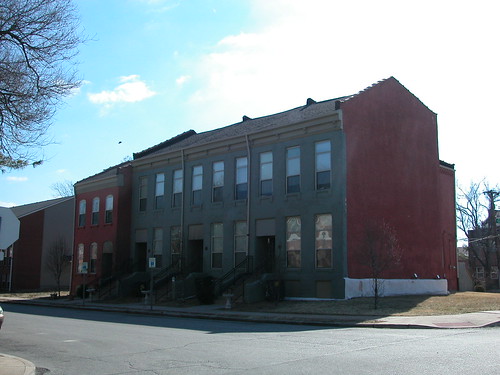
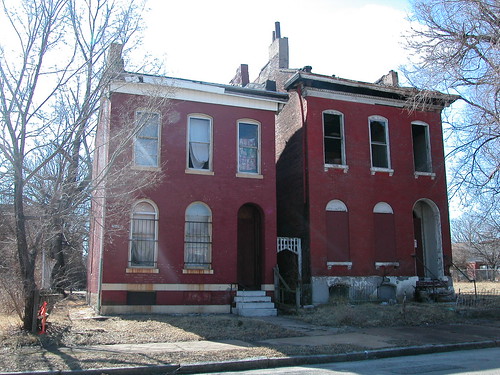
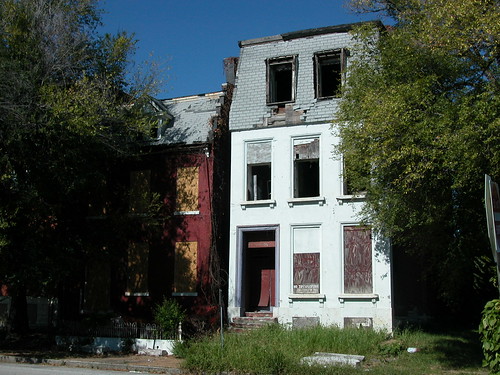
2611 Howard and 2615 Howard (McEagle-owned)

2621 Howard Street.

2625 Howard Street (McEagle-owned) and 2623 Howard Street (privately-owned vacant building).
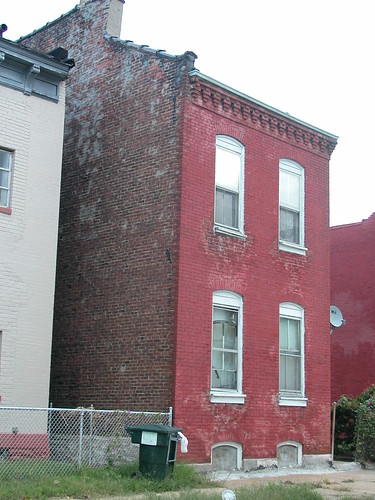
Here is one side of the 2600 block of Howard Street in JeffVanderLou. The block face is missing a few buildings (one fell in 2006) but is still retains five solid, sound historic buildings. As you can see, this is not an easy block to overlay within a large new development. This block needs strategy for resident retention and home repair, historic preservation and building stabilization awaiting eventual development of the vacant properties.

Take this block times one hundred and one sees the difficulty of trying to make development sense of St. Louis Place and JeffVanderLou — and how much potential there is if the existing neighborhood is enhanced rather than supplanted. This is a huge challenge requiring smart planning. The starting point is a redevelopment ordinance that makes as much sense for blocks like this as it does for the wide expanses of Pruitt-Igoe. Is that ordinance possible?

Categories
Historic Preservation Missouri Missouri Legislature Public Policy

Historic Tax Credit Compromise Celebrated

by Michael R. Allen

Yesterday the Missouri Coalition for Historic Preservation and Economic Development sent a press release celebrating the legislative compromise reached in the Missouri Senate at the end of the session. The compromise language is included in an economic development omnibus bill awaiting signature by Governor Jay Nixon.

Here’s a summary of the compromise:

* A per-project residential cap of $1,000,000 in qualified rehabilitation expenditures (QREs) for owner occupied single family homes.

* A small project exemption for projects with $1.1 million in qualified rehabilitation expenditures (QREs) (these do not count toward a cap).

* $140 million cap on historic tax credits (existing projects do not fall under the cap).

* An effective date of January 1, 2010.

Categories
Historic Preservation North St. Louis Northside Regeneration O'Fallon Public Policy The Ville Urban Assets LLC Wells-Goodfellow

Private LRA in the Works Across North St. Louis?

by Michael R. Allen


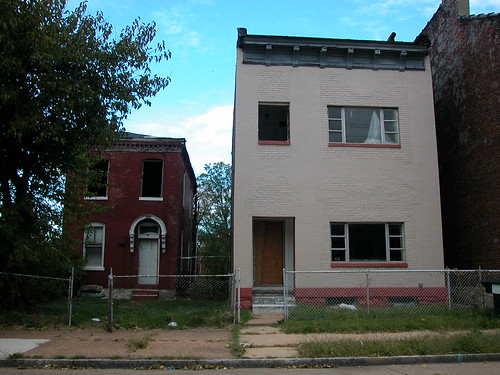
The house shown here, located at 4448 Athlone Avenue in the O’Fallon neighborhood, is just one of the 225 vacant properties purchased by a holding company named Urban Assets LLC in the last six months. The spending spree has attracted the notice of neighborhood leaders and elected officials across north St. Louis. Urban Assets has purchased across a wide swath of north St. Louis, mostly between Delmar Boulevard on the south and Natural Bridge Avenue on the north — all of the way from Grand Avenue on the east to the city limits on the west.

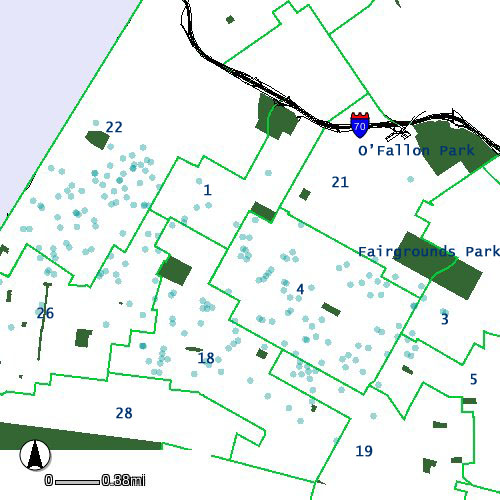
Here is a crude map of the holdings made by this writer using Geo St. Louis:

The holdings are spread across nine wards and include 120 vacant lots and 85 buildings, mostly historic. The wards and number of properties are as follows: Ward 1 (7), Ward 3 (4), Ward 4 (64), Ward 5 (5), Ward 18 (39), Ward 19 (11), Ward 21 (4), Ward 22 (64) and Ward 26 (27).

There are distinct concentrations in the Ville and Greater Ville neighborhoods as well as the Wells-Goodfellow and Hamilton Heights neighborhoods. There are a handful, like 4448 Athlone, standing alone far from other holdings. Urban Assets began aggressively purchasing properties at Sheriff’s tax sales in September 2008. Most of the holdings come from tax sale purchasing, with prices often less than $2,000 at auctions with no other bidders.

This purchase pattern is reminiscent of the start of purchasing by McEagle holding companies like the infamous Blairmont Associates LC — and the same real estate broker is making the purchases for the parties behind the holding company.

On June 6, 2008, real estate broker Harvey Noble of Eagle Realty incorporated Urban Assets LLC online. The incorporation filing and the registered agent listing on the Secretary of State’s website misspell Noble’s name as “Nobel” and incorrectly state that the zip code for Noble’s office is 63102.

On the record with KWMU and the St. Louis Post-Dispatch, Paul J. McKee, Jr. denies any involvement with Urban Assets. Examining the acquisition patterns of Urban Assets, one sees that there is no overlap with the McEagle project and a few intense concentrations that suggest efforts to buy out other areas. Whoever is behind Urban Assets could very well soon be in competition with McEagle for the Distressed Areas Land Assemblage Tax Credit Act.

While Urban Assets seems to be buying whatever it can acquire in certain small areas, generally the company seems interested in vacant property in as much of north St. Louis as possible. The acquisitions almost seem like a private land bank like the city’s Land Reutilization Authority.

The only apparent incentive to this type of far-flung land banking, however, is the Distressed Areas Land Assemblage Tax Credit. In order to receive that credit, a developer must be appointed redeveloper by the Board of Aldermen. Redevelopment rights don’t necessarily mean that a developer will clear-cut a redevelopment area. Those rights fundamentally mean that a developer acts as gatekeeper for all investment within a redevelopment area — allowing some in and keeping others out.

Is Urban Assets seeking to become a gatekeeper for north St. Louis, or is their acquisition simply a land-banking scheme?

Categories
Historic Preservation JeffVanderLou North St. Louis Northside Regeneration Pruitt Igoe

The Urban Character of Eastern JeffVanderLou

by Michael R. Allen

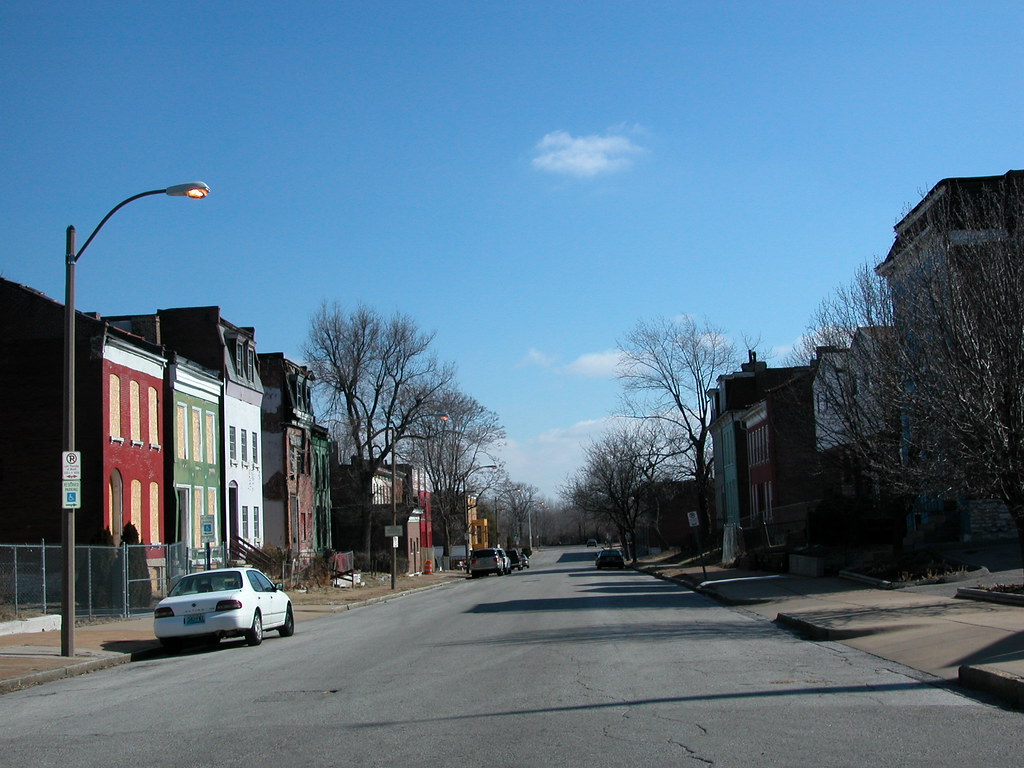
Looking east toward the Pruitt-Igoe site on James Cool Papa Bell Avenue.

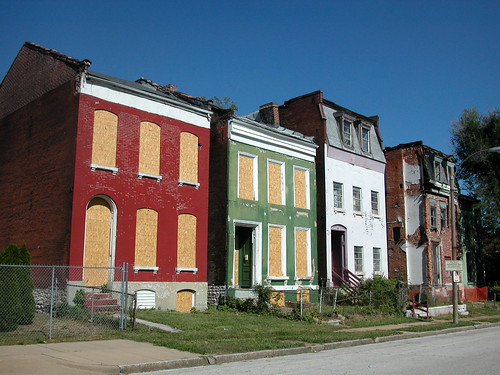
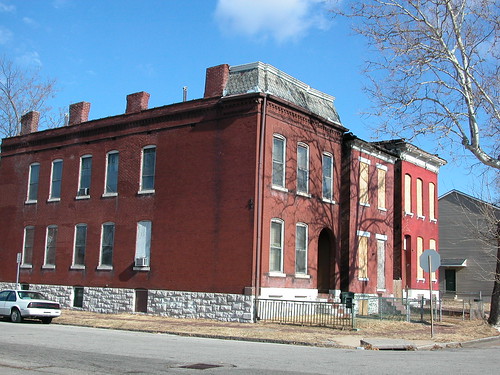
One of the characterizations often raised about the area of north St. Louis included in the McEagle project is that it is “urban prairie” where few houses remain. The area is marked by only a handful of historic buildings, vacant land, and people who are unseemly and whose eviction will only benefit the area. There are many vacant lots and houses (too many) and a few bad apples, but by and large the persistence of these neighborhoods is contrary to the word on the street. The worst parts happen to be very photogenic examples of disinvestment, but the best parts show resilience and an urban character impossible to recreate.

St. Louis Place and JeffVanderLou are amazingly rich with fine architecture, caring residents and many efforts at neighborhood improvement. These neighborhoods could use a boost — the bigger the better. However, that boost must complement what is already there.

Here are photographs of the rich architectural character of the part of JeffVanderLou just west of an admitted urban forest, the site of the Pruitt-Igoe housing project. These photographs show that historic preservation and sensitivity to existing residents must be part of the McEagle plan — there is critical mass here.

2713 and 2715 Mills Street

2834-42 Gamble Street


2820-34 Thomas Street

2700 Block of James Cool Papa Bell Avenue

2623 James Cool Papa Bell Avenue

2627-31 Madison Street

2626-28 Howard Street

2946 & 2950 Thomas Street

2703 and 2707 Stoddard Street

These houses date from 1870 through 1910, and span a wide stylistic range. There has not yet been a comprehensive architectural survey of the area, but a cursory examination shows much remaining building stock with strong significance. The building density in JeffVanderLou is higher than that of Old North St. Louis — there is tremendous opportunity for preservation-oriented development. Many individuals and the St. Louis Equity Fund have invested in historic buildings, but a lot of work remains. Listing as much of the neighborhood as possible on the National Register of Historic Places would help bring economic development incentives and recognition of the unique architecture that remains.

Of course, photographs only tell part of the story. In JeffVanderLou, one also can find the photographs that would prove an “urban prairie” theory. The truth is complex, and best experienced in person away from the manipulations of photographs and aerial plans. One will find a neighborhood — flawed, deprived, lively and urban. New investment must face this reality and work with it.

Categories
Historic Preservation Industrial Buildings North St. Louis

Old Chair Factory Stands in Path of New Bridge

by Michael R. Allen

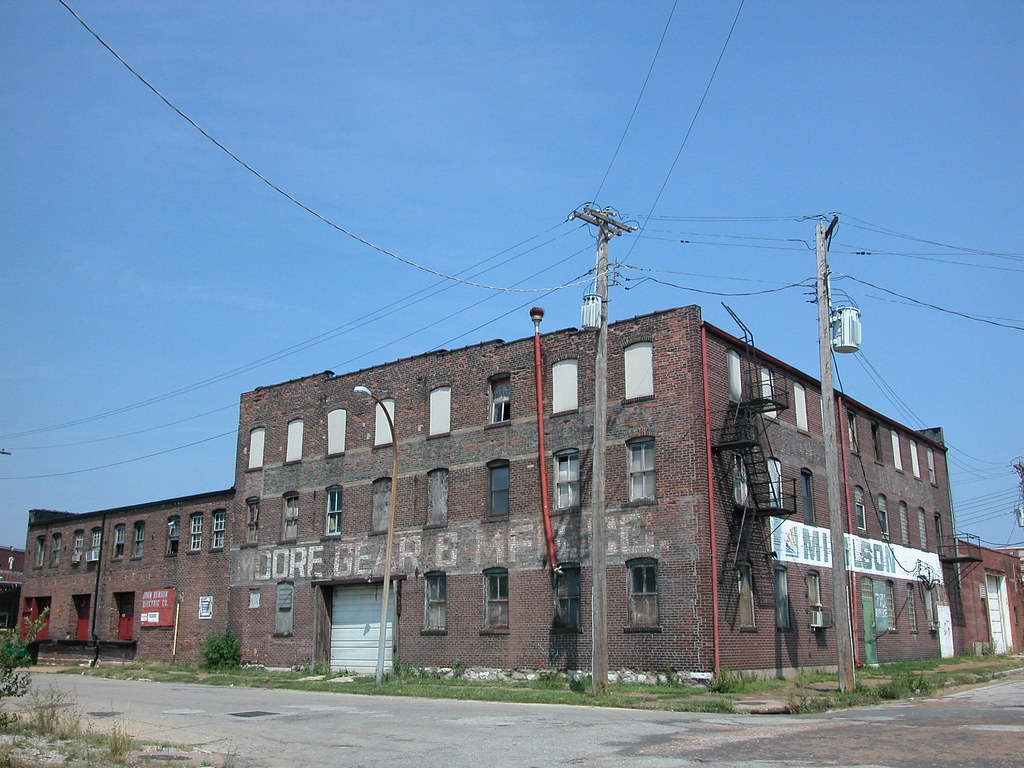
The old Heller & Hoffman Chair Companies factory at the northeast corner of Howard and 8th streets will be demolished for the new Mississippi River Bridge. The bridge will claim these buildings and a few others, as well as the site of the “big mound.” Believe it or not, the bridge path has been significantly changed to make the path less invasive to the built environment. The Missouri and Illinois Departments of Transportation made these changes to keep costs down, not to save buildings, but the result is a net benefit to the North Broadway industrial corridor. Still, we will be losing a few solid historic buildings.

The city issued a building permit to Heller & Hoffmann Chair Company on September 14, 1881 for the purpose of building a four-story factory at 715 Howard Street. The company estimated the cost as $10,000. At the time, the neighborhood was a patchwork of tenements, corner saloons and growing industrial operations. One of the largest companies in the vicinity was the Luedinghaus wagon company located to the immediate north. The chair factory fit in well. Its mill method construction, plain brick walls and bays of wooden windows set in segmental arch openings were traits of many contemporary industrial buildings in the North Broadway area.

Heller & Hoffmann manufactured everything from stock dining room chairs to fancy upholstered parlor chairs, and their ware enjoyed some popularity at north side furniture stores. On October 3, 1894, the city issued another permit for “repair of a four story brick factory” with a cost estimate of $3,000. This permit apparently accounts for the interconnected northern building that is now two stories tall. The 1909 Sanborn fire insurance map indicates that both sections were four stories tall and in use by the Mound City Chair Company. The original corner building is labeled “putting together” and the northern building is labeled “varnishing and polishing.”

When the buildings lost their upper floors is uncertain. However, such alterations are very common in St. Louis industrial architecture, especially with mill method buildings. Many extant 19th century warehouses and factories along North Broadway has lost upper floors to fires in the days before our modern fire code.

Intact or not, the factory buildings stand right where the overhead ramps connecting the bridge to I-70 will be built. The neighbor to the north, M & L Frozen Foods, is already scouting sites for relocation. The old Heller & Hoffmann buildings are still in use, doing just fine with their current users, but their survival seems improbable. Could the bridge coexist with these buildings? Probably, but that takes a level of preservation planning (and small business promotion) that we don’t have in St. Louis.

Categories
Events North St. Louis Northside Regeneration

Meeting on McEagle North City/Downtown Project Tomorrow Night

by Michael R. Allen

Tomorrow night, there will be the big truly public meeting on the McEagle north side/downtown project. Here are the details:

Time: 7:00 p.m. Thursday, May 21
Place: Central Baptist Church Educational Center, 2837 Washington Avenue (across from the church)

While open to the public and the press, Tim Logan of the Post-Dispatch reports that organizers (it’s unclear is that means McEagle or elected officials) have aimed this meeting toward 5th and 19th ward residents. Apparently, every 5th and 19th ward registered voter was supposed to receive a mailer about the meeting, but as of mail time yesterday residents whom I know had not received any such thing.

Realtor Myrtle Bailey is serving as “public engagement coordinator” for the “North City Development Project” (for whom she works is unclear) and told Logan that 5th and 19th ward residents will be given the first crack at asking questions.

I understand the aim at the 5th and 19th ward residents, but according to McEagle this project will include a large section of the 6th ward as well as parts of the 3rd and 7th. Outreach ought to be aimed ward-wide, and all elected officials who represent those wards engaged in the first and last public meeting before McEagle plans to submit a blighting study to the Land Clearance for Redevelopment Authority on May 26.

Realistically, the project transcends ward boundaries. The project will be one of the largest in the city’s history, may include unprecedented tax increment financing and sale of hundreds of acres of city-owned land. If this were a simple matter of a private developer developing land that he owned on his own or with moderate incentive use, the aldermanic system could handle the deal. However, this project falls outside of the aldermanic system — or severely overloads it. Every city resident and alderman has the right to be part of the process.

Categories
Architecture North St. Louis Northside Regeneration Pruitt Igoe St. Louis Place

Corner Storefronts Are Important to Building Community

by Michael R. Allen

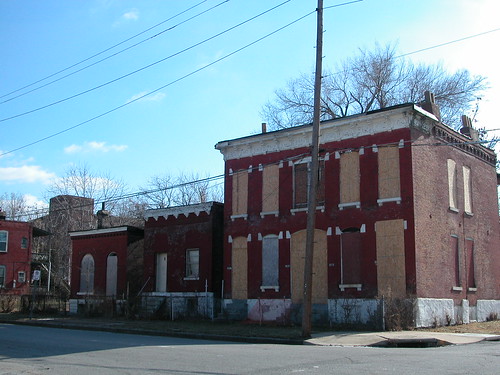
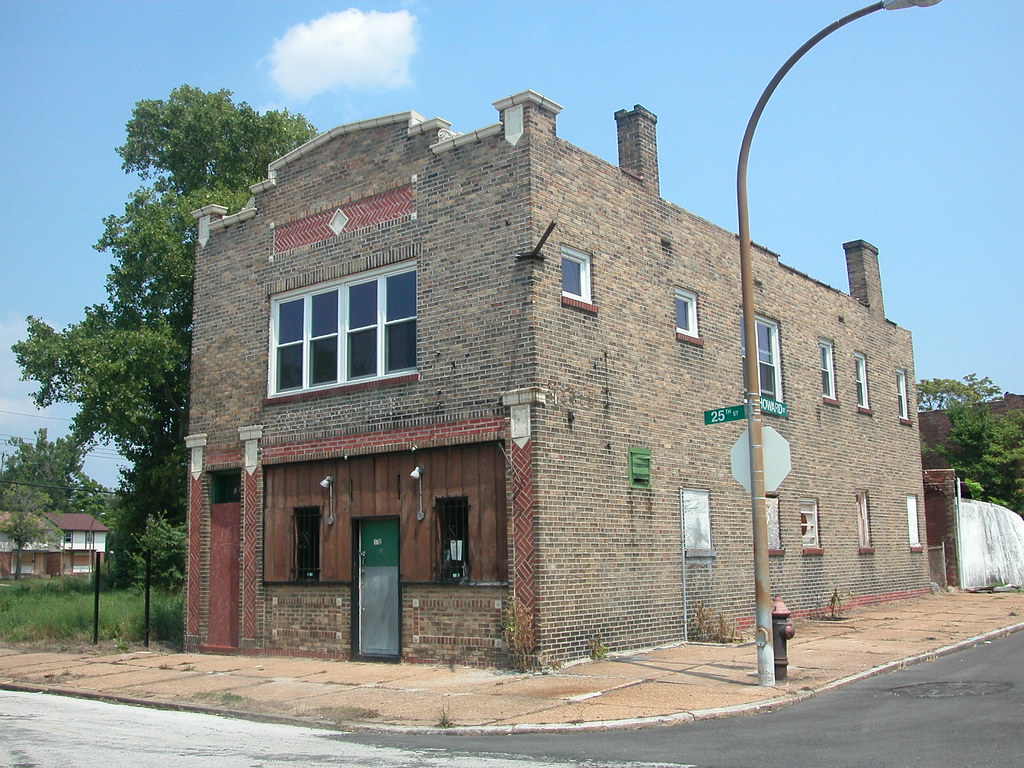
The corner storefront at the northeast corner of 25th and Howard streets dates to 1920.

What’s a neighborhood without a corner commercial storefront?

What’s a corner commercial storefront without a neighborhood?

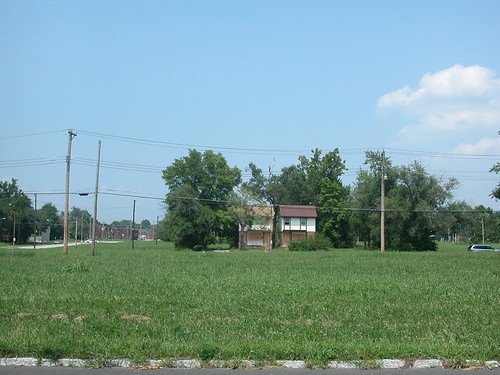
These questions are pertinent to the fate of the building pictured above, located at the northeast corner of 25th and Howard streets in the southwest end of St. Louis Place. This lonely building is one of three remaining on its block, which is surrounded by blocks of similar low density.

Many do not realize that the forlorn appearance of this “urban prairie” is the result of city policy. In 1973, under Mayor John Poelker, the city identified this six-block area north of the Pruitt Igoe site bounded by Cass on the south, 22nd on the east, Madison on the north and 25th on the west as ripe for industrial expansion. In fact, the Planned Industrial Expansion Authority began buying up land there, while the Planning Commission urged clearance of these blocks. Speculators moved in, arsons were common, and people were pushed out. With Pruitt-Igoe gone, city planners figured that large vacant site and these emptying blocks were a perfect area for a large-scale industrial park.
Looking north from Howard Street just east of 23rd Street

Yet, thankfully the industrial park project never happened. The city wasn’t able to push out all of the residents — nor were city government or the area’s alderman willing to invest in rebuilding the area. In 1996, Mayor Freeman Bosley, Jr. revived the idea of using this area for something big. Bosley’s administration created the ridiculous Gateway Village golf course subdivision plan, which was shelved by Mayor Clarence Harmon during his first week on the job.

The urban prairie was left behind, with residents, businesses and churches spread out across a quiet pocket of the neighborhood. Many people love living in that area and hope to stay for the rest of their lives. When developer Paul McKee Jr. began purchasing land, many speculated that his intention was to combine this area with Pruitt-Igoe for a massive commercial development. However, the plan that his representatives showed residents last week showed commercial development confined to the Pruitt-Igoe site and the six blocks platted with high-density residential development much like what was once there.

What that means for remaining buildings and residents is unclear. The plans unveiled last week are not detailed enough for further assumption. How the corner commercial building at 25th and Howard, built in 1920, managed to survive is pure luck — and solid construction. This building is in great condition, and was occupied by a tavern only a few years ago before McKee’s holding company Sheridan Place LC purchased it in 2006.

Sure, there might be retail at Pruitt Igoe, but great urban neighborhoods do not cluster retail into centers. Neighborhoods like St. Louis Place have always had their main streets and their corner bars and stores. The less concentrated commercial activity is located in a neighborhood, the more people will be able to walk to buy a carton of milk or meet friends for dinner.

Preservation is not simply a matter of saving pretty buildings (which this one is) or keeping buildings from the landfill (which is important if we want “green” to be more than a catch phrase). Preservation fundamentally is about maintenance of the relationships between people and place that foster a high quality of life. Having a corner storefront increases a neighborhood quality of life, provides a place for social interaction and gathering and encourages people to experience their neighborhood on foot — where they will meet more people doing the same.

Architecture is fundamental to building and sustaining community, although other factors are also fundamental — some more so. If McEagle is serious about building community in north St. Louis, its principals will do more than just calculate the future of a building like the corner storefront in dollars and sense. The project must build up from what is already in place — buildings and people. The intrinsic connection between architecture and community comes from daily human action. After all, the corner bar stayed open even after the loss of most of the rest of the block and the industrial park never got built!

If this storefront is lost in the development to come, that will be a shame. However, if the neighborhood mode of life is lost, that will be a tragedy. Architecture should never come at the expense of community.

Categories
Central West End Events Mid-Century Modern

Lindell Boulevard Mid-Century Modern Tour Tomorrow

Landmarks Association of St. Louis concludes Preservation Week with:

This was the Future: Mid-Century Modern Architecture on Lindell Boulevard

Sunday, May 17, 2009 — 10:00 a.m.

Begin inside the Chase Park Plaza Cinema, 212 N. Kingshighway

Have a mid-century modern morning in May! A screening of a new version of the new short documentary San Luis: This Was the Future tells the story of the threatened San Luis Apartments. After the 10 minute film, Toby Weiss of beltstl.com and Michael Allen will lead a walking tour of the many mid-century treasurers along Lindell Boulevard, where modern design flourished between World War II and the 1970s. The walk will run from the Chase Park Plaza Hotel to Vandeventer and back, so be prepared for serious walking.

Categories
JeffVanderLou North St. Louis Old North St. Louis Place

Aldermen Talk About McEagle "Concept"

by Michael R. Allen

Yesterday the Beacon published an interesting article on the McEagle project by reporter Dale Singer. The article is relevant because it includes the most substantial remarks by aldermen April Ford-Griffin (D-5th) and Marlene Davis (D-19th) on the plan that I have read. Oddly, the article makes no mention of Alderman Kacie Starr Triplett (D-6th), whose ward includes a substantial part of the project’s southern end, where development will likely begin.

The article also mentions the date and time of the next meeting on the plans, but does not indicate that the meeting will be open to the public or the press — just a “wider audience.”

That meeting will take place at 7 p.m. on Thursday, May 21 at Central Baptist Church (2842 Washington Avenue).