Categories
CORTEX Storefront Addition

Storefront Addition With Grain Elevator

by Michael R. Allen

To me, the contrast between the house with storefront addition at 4052 Forest Park Boulevard (house, c. 1890; addition, 1917) and the towering grain elevator is beautiful. Both buildings are testament to the results of flexible zoning and the spirit of commerce. No subsidy or master plan could produce any architectural contrast like this — this is the work of people shaping the built environment to their needs.

Categories
Historic Preservation Missouri Missouri Legislature Public Policy

Missouri Senate Passes Economic Development Bill That Includes Historic Tax Credit Cap

by Michael R. Allen

Last night, after a long impasse, the Missouri Senate passed a Senate substitute to economic development bill HB 191. The bill reflects a legislative compromise reached on historic tax credits: the state’s first cap on the program.

HB 191 places a $140 million cap on the annual issuance of historic tax credits, but exempts projects with qualified rehabilitation costs of $1.1 million or less — the majority of projects — from counting toward the cap. The figures will not be indexed to rise with inflation. The new rules won’t go into effect until January 1, 2010. Honestly, I don’t think that these changes will make much of an impact on the program.

The compromise was made possible when Senator Jason Crowell (R-Cape Girardeau), a staunch opponent of the program in the past, switched his position and began speaking in favor of the program on the Senate floor. Crowell and Senator Jeff Smith (D-St. Louis) worked with leadership and erstwhile historic tax credit foe Senator Brad Lager (R-Savannah) to forge an acceptable compromise. Without Crowell’s switch, a compromise may have been impossible.

The bill now heads to the House for final approval.

Categories
North St. Louis Old North

Go, Urban Studio Cafe, Go!

by Michael R. Allen

This video from the St. Louis Beacon makes my head spin at the potential for community-building across the city. Person after person here declares their support for opening a coffee shop in Old North St. Louis, the Urban Studio Cafe. We have residents, their children, their alderwoman, their friends, the people who work in their neighborhood businesses and their fellow city residents from across the city. Each person in displaying faith that an old city neighborhood that has experienced massive population loss and disinvestment can and should support a gathering place.

Read the accompanying article to see what the cafe project is all about. This is a project that comes from the social roots of the neighborhood — roots that extend deep and wide, intertwined with roots of other neighborhoods. The Urban Studio Cafe is the sort of project that really makes a difference in sustaining a community. The storefront itself is well-suited to the cafe, and the location adjacent to Crown Candy Kitchen generates enough foot traffic that chance encounters occur frequently here. The space is cool, but people make it come to life.

Categories
Mayor Slay

$5.3 Million in Block Grants Coming

A blog entry on MayorSlay.com reports that the city of St. Louis expects to receive $5.3 million in additional Community Development Block Grant funding through the American Recovery and Reinvestment Act, and that there is a May 22 deadline for applications. Apparently, the city received a notice from the Department of Housing and Urban Development on May 6. The funds are prioritized for “hard development costs” associated with infrastructure activities that provide basic services to residents or activities that promote energy efficiency through rehabilitation or retrofitting of existing buildings.

The link to the application forms is here.

These funds can do a lot of good for the city, especially because they are expressly available for existing buildings. Hopefully neighborhood organizations are ready to jump at this chance!

Categories
Media North St. Louis Northside Regeneration

What’s in the McEagle Plan?

KMOX reporter Kevin Killeen has some information in this story.

Categories
Historic Preservation Housing North St. Louis Northside Regeneration St. Louis Place

Front-Addition Houses Part of the St. Louis Place Legacy

by Michael R. Allen

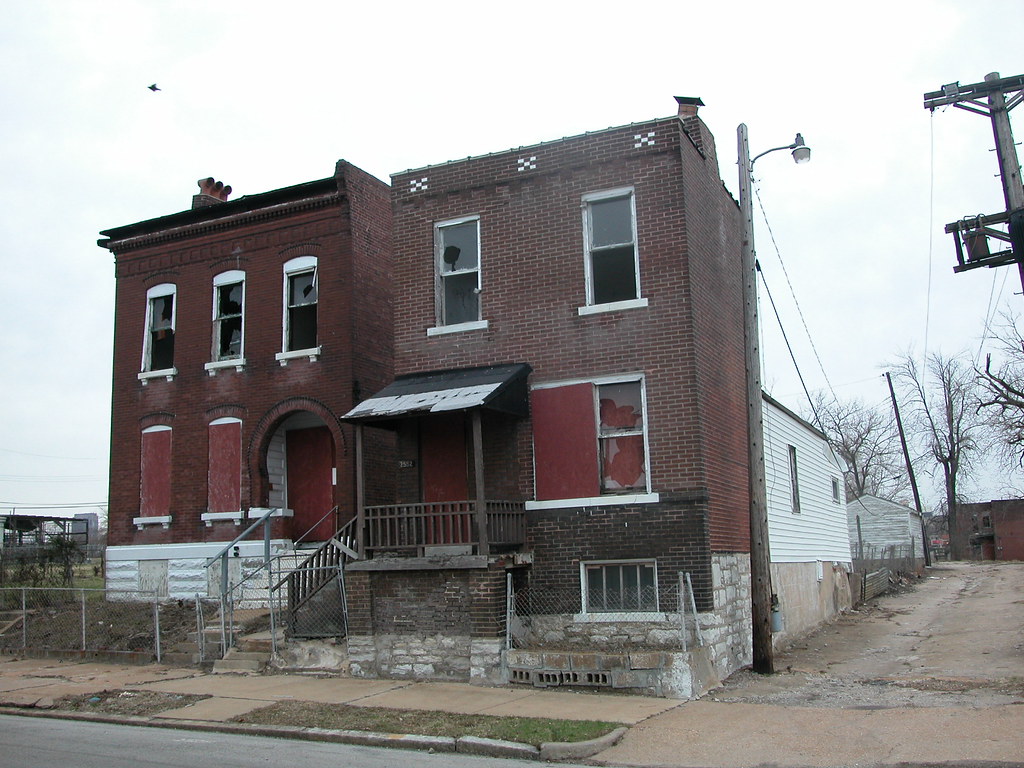
Planner Mark Johnson from Civitas has had a major hand in developing McEagle’s plan for north St. Louis and western downtown. On Monday night at Central Baptist Church, Johnson used the phrase “legacy properties” to describe the historic buildings that McEagle is contemplating including in the project. I have no idea what criteria Johnson or McEagle has use to define “legacy property,” but when I heard that phrase I started thinking about houses like the one showed above at right, located at 2552 North Market Street in St. Louis Place. (The house at left, at 2548 North Market, is quite a looker itself — check out that entrance arch!)

Readers might recall last week’s post “Brick Thieves Return to St. Louis Place” that showed how a house at 2543 Maiden Lane was damaged by criminals earlier this month. That house is just east and south of the ones shown above. All are highly visible from Jefferson Avenue.

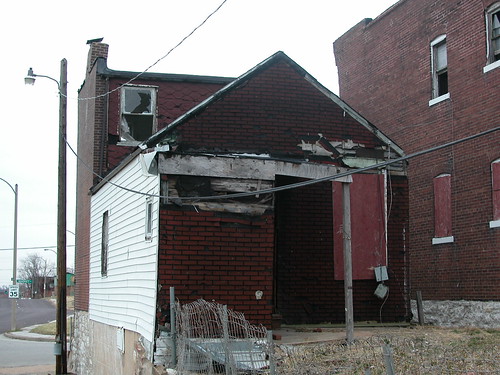
Why do I think that the modest house at 2552 North Market is so interesting? Well, the house is one of a few remaining frame houses that have brick front additions. If that doesn’t make sense, take a look at the rear of the house.

The rear is a one-story gabled frame home, with one room in front and a small addition at the back. This house dates to the 19th century. The front brick section, with one room on each of two floors, dates to a building permit issued on May 22, 1915. The cost of the addition was $500 to owner William Duerdick and his builder J. Scaumel. The result of the addition was a handsome, two-story brick front to match those of neighboring houses.

As St. Louis Place developed into a high-density, middle-class enclave, many early frame houses were absorbed into the emerging urban (brick) fabric through front additions. Simple frame houses could be concealed behind fronts as refined as those of any neighbors’ houses. A new look and more space arrived, while the usable original house was retained instead of being wrecked. What great architectural economy for growing families on a budget!

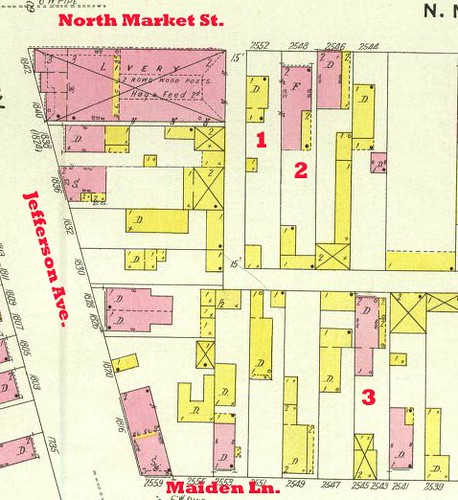
The 1909 Sanborn fire insurance map shows the footprint of the little frame house before expansion. That house is numbered 1, while the brick two-story house at 2548 North Market is numbered 2 and the flounder house at 2543 Maiden Lane is numbered 3. Frame is colored yellow, and brick is pink.

One can see that this area was not typified by any one form of house or method of construction. There are even a few vacant lots. Architectural diversity like this as historically common as the more regular patterns found in other parts of the city.

Lest I throw out my appreciation without offering any idea for how a developer like McEagle could reuse a quirky “legacy property,” I have a great example from another block in St. Louis Place. Here is the house at 1871 Madison Avenue, built first in the mid-19th century and given the brick front treatment in 1890. The style is different, but the form is the same.

The owners purchased this house from the Land Reutilization Authority, spent their own time and money on rehabilitation and ended up with a cozy homestead. The frame addition was in shambles, so they rebuilt it and finished it in earthen stucco. The roof on the frame section is a long-lasting metal roof, while the windows and doors are mostly recycled elements purchased at the ReStore and other places. A solar collector is on top of the flat roof of the brick front. Inside, the house makes great use of its small size with an open layout and a sleeping loft. The house uses stove heat in the winter, made possible by the small size.

While not historically accurate, the rehab of the house on Madison is inventive and green. The front-addition form is versatile and adds small-house options to the neighborhood for those who want to own a house but keep costs and house size down. the home on North Market Street is ripe for rehabilitation. The mansions of St. Louis Avenue tell one part of the St. Louis Place story, but that story is incomplete without the other parts. We can’t preserve everything that is left, but we should ensure that we preserve an architectural cross-section of a living, economically diverse neighborhood — so that we encourage that diversity to be part of the future as well as the past.

Categories
DALATC North St. Louis Northside Regeneration Public Policy

DALATC and the McEagle Project

by Michael R. Allen

Now that McEagle Properties has started to reveal its plan for north St. Louis and downtown, let’s review the Distressed Areas Land Assemblage Tax Credit Act. Last night at a meeting, Bill Laskowsky from McEagle and planner Mark Johnson from Civitas revealed that McEagle hopes to submit a financial proposal to the city of St. Louis’ Land Clearance for Redevelopment Authority by May 26. That proposal will accompany a request for redevelopment rights and tax increment financing. Various government entities will consider the proposal and make recommendations to the Board of Aldermen.

According to Laskowsky and Johnson, a redevelopment ordinance ideally would be in place by the end of the year so that an application for the Distressed Areas Land Assemblage Tax Credit (DALATC) can be made. The DALATC will allow McEagle reimbursement for 50% of land acquisition costs and 100% of maintenance

While the redevelopment agreement with the city will have its own rules, the DALATC brings its own rules.

Here are a few key provisions to keep in mind:

The DALATC will reimburse McEagle for 100% of demolition costs.

Under DALTAC, “acquisition costs” are defined as the purchase price for the eligible parcel, costs of environmental assessments, closing costs, real estate brokerage fees, reasonable demolition costs of vacant structures, and reasonable maintenance costs incurred to maintain an acquired eligible parcel for a period of five years after the acquisition of such eligible parcel. Acquisition costs shall not include costs for title insurance and survey, attorney’s fees, relocation costs, fines, or bills from a municipality.

The DALATC will reimburse McEagle for half of the cost of mowing lawns and boarding up windows.

“Maintenance costs” are defined in DALATC as the costs of boarding up and securing vacant structures, costs of removing trash, and costs of cutting grass and weeds.

The DALATC is authorized under Chapter 99 of Missouri law.

Under Chapter 99, a redeveloper must follow a certain process to have an area declared blighted by municipal authority; that process is detailed online here. Eminent domain power will reside with the city’s Land Clearance for Redevelopment Authority, not McEagle.

Less than five percent of the acreage within the boundaries of the eligible project area shall consist of owner-occupied residences which the applicant has identified for acquisition under the urban renewal plan or the redevelopment plan.

Let’s make it clear: eminent domain can be used by McEagle in this project. There just happens to be a reasonable limit to its use, and parcels acquired by eminent domain can’t get the DALATC.

No city-owned property is eligible for the DALATC.

McEagle won’t be able to get DALATC for purchase of the hundreds of city-owned parcels it requires for this project. Does that mean that the city will convey the land for a token amount to help the deal move along? Or will the cash-strapped city hold McEagle to the same standards as anyone else who seeks to purchase city-owned land, and charge the typical “full price” for each parcel?

No more than seventy-five percent of the urban renewal area identified in the urban renewal plan or the redevelopment area identified in the redevelopment plan may be redeveloped by the applicant. The remainder of the urban renewal area or the redevelopment area shall be redeveloped by co-redevelopers or redevelopers to whom the applicant has assigned its redevelopment rights and obligations under the urban renewal plan or the redevelopment plan.

McEagle will be working with co-developers. Who are these partners? What area non-profit development organizations are likely to get on board?

The redevelopment agreement shall include a time line for redevelopment of the eligible project area.

The DALATC requires a redevelopment time line be submitted to the city. What is unclear is whether that time line is binding, and what enforcement mechanisms the city or state can implement to ensure completion of the project.

The DALATC sunsets in 2013.

Any attempt to receive all $95 million has to start soon to beat the sunset.

Categories
JeffVanderLou North St. Louis Northside Regeneration St. Louis Place

McEagle Shows the Plan

by Michael R. Allen

Yesterday evening at Central Baptist Church, Aldermen Marlene Davis (D-19th) and April Ford-Griffin (D-5th) held a meeting on McEagle Properties’ large-scale redevelopment project centered around St. Louis Place and JeffVanderLou. McEagle’s representatives made a presentation, including slides showing proposed land uses, before taking spirited questions from the crowd.

The bombshell dropped was that McEagle plans to submit a financial plan and tax increment financing plan to the city by May 26, and hopes to have a redevelopment ordinance approved by the Board of Aldermen by the end of the year. This project is on a fast track all of a sudden.

The St. Louis Post-Dispatch has an account here: “Residents get briefing on developer’s long-awaited plan”

I’m going to withhold comment now and turn this post over to readers and people who attended last night’s meeting.

What are your thoughts about the McEagle project, the proposed timeline and the forthcoming request for more public incentives?

Categories
Architecture Events Housing James Clemens House Missouri

Tonight: Lecture and Book Signing on the Houses of Missouri

This evening, learn about the houses of Missouri at one of Missouri’s most important historic homes:


Lecture and Book Signing: Houses of Missouri, 1870-1940
Monday, May 11, 2009
7:00-9:00 P.M.

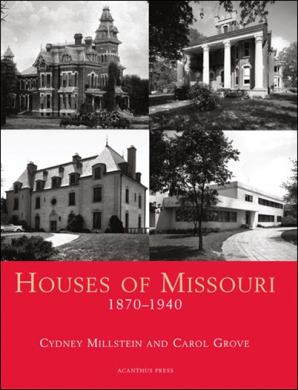
Carol Grove and Cydney Millstein’s Houses of Missouri, 1870-1940 is the first comprehensive account of the development of residential architecture in the state. With nearly 300 archival photographs, drawings, and original floor plans, the book offers an intimate tour behind the facades of 45 purely American houses ranging from pastoral retreats to mid-century modern mansions. The authors will discuss the book project at the historic Chatillon-DeMenil House, with a reception and signing to follow. Copies of the book (retail price $65) will be on sale, but the reception is complimentary.

The Chatillon-Demenil House is located at 3352 DeMenil Place.

This event is part of Preservation Week, a whirlwind of exciting events offered by Landmarks Association of St. Louis. Come out this week to learn and celebrate our region’s great architecture!

Speaking of historic houses, my talk yesterday at Architecture St. Louis on the James Clemens, Jr. House drew a spirited crowd of people who learned about the history of the house, its namesake, and the current threat to the house and its attached buildings. This was a great kick-off to Preservation Week! Hopefully one year from now I can report back with good news about the Clemens House. Meantime, expect an update based on the talk here.

Categories
Adaptive Reuse East St. Louis, Illinois Events Metro East Old North

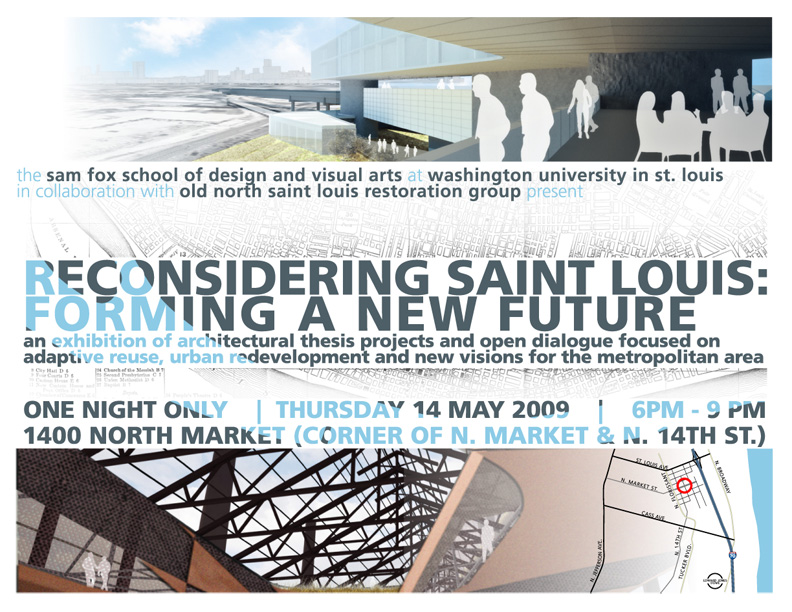
Reconsidering St. Louis: Forming a New Future

This event showcases the work of this year’s graduating master’s degree candidates from Washington University School of Architecture. This year is special because students were allowed to choose existing buildings for projects, and a fair number of students did just that. One of the sites chosen is the National City Stockyards in East St. Louis, for which Andrew Faulkner envisioned the ruins of the pens and packing plants returning to life to be part of the 21st century food chain. Come out and see that project and more.