Categories
Brick Theft North St. Louis St. Louis Building Division

How Brick Thieves Do It

This Pub Def video features Alderman Sam Moore (D-4th) explaining how brick thieves do their work. This first appeared in August 2007, but it is relevant this summer as the streets of north St. Louis gear up against this wave of criminal activity.


Moore’s comment that “somebody is doing it from the inside” of the Building Division still rings loud and clear. Has the Building Division ever investigated links between thieves and its demolition staff? If not, Alderman Moore and his colleagues on the Board of Aldermen should.

Categories
DALATC Historic Preservation Missouri Legislature Northside Regeneration Public Policy

Tax Credit Action in the State Legislature

by Michael R. Allen

Yesterday the Missouri House of Representatives passed the House Committee Substitute (HCS) to Senate Bill 377. Now included in the bill is a $150 million cap on the historic tax credit with a $250,000 (in credits issued) exemption and a $250,000 (in credits issued) per-project cap on residential rehabs. The $150 million cap might not have much impact with healthy “micro” exemptions like these. The question: Is this a good enough micro exemption to keep present level of tax credit activity going?

Meanwhile, Representative Tim Flook (R-Liberty) offered an amendment to the HCS for SB 377 that, among other things, changed the language of the Distressed Areas Land Assemblage Tax Credit (DALATC) to allow issuance of up to $20 million per year instead of the current $10 million. On the House floor, Rep. Flook stated that a group of representatives had met with developer Paul J. McKee, Jr. to see his plans for north St. Louis, and that those plans needed an extra boost during this session. Of course, McKee still has to be designated redeveloper by the St. Louis Board of Aldermen in order to apply for the DALATC. Since the DALATC credits must be spent on development within the project area, the higher issuance could mean more immediate development activity after McKee receives the credits.

Flook’s amendment passed.

Categories
Mass Transit Missouri Legislature Transportation

Legislature Gives Metro $12 Million

by Michael R. Allen

The St. Louis Beacon reports that the legislature passed a stimulus bill that contains $12 million for Metro (actually still named the Bi-State Development Agency but doing business as Metro). This is a one-time payment, of course, and short of the $20 million that Metro estimates it needs to restore all service cuts made in March.

Governor Jay Nixon, often silent on state-funded programs that support St. Louis, actually has expressed support for Metro. However, the $12 million request came from Lt. Governor Peter Kinder, not Nixon. If the governor signs the bill, Metro will be able to restore Call-a-Ride and some bus routes — for one year.

Realistically, the stimulus money is a small stop-gap. What is needed is a regional taxing district. Senator Robin Wright-Jones introduced a bill in this legislative session to allow such a district to be created, but the bill remains on the Senate’s informal calender.

No matter what the fate of the stimulus funding or Wright-Jones’ bill, Metro has a lot of work to do right now to build a strong case for its support. The longer the agency waits to start building public support, the longer people are stuck without transportation — and the longer cities that have regional investment in transportation will surpass our ability to attract new residents and jobs. We can’t have a hand-to-mouth transit system if St. Louis is going to be a competitive American city.

Categories
Events Historic Preservation James Clemens House North St. Louis Northside Regeneration St. Louis Place

Lecture: The James Clemens House: Past, Present, Future

Volunteers for the Landmarks Association of St. Louis standing on the porch of the James Clemens, Jr. House in 1960.

“The James Clemens House, Past, Present and Future”
When: Sunday, May 10, 2009 at 2:00 p.m.
Where: Architecture St. Louis, 911 Washington Avenue #170

Join Michael Allen, Assistant Director of Landmarks Association, as he offers a look at one of the most significant endangered houses in St. Louis. Built in 1858 for James Clemens, Jr., the house at 1849 Cass Avenue is one of the few remaining antebellum mansions in the city. Later life included expansion of the house and use as a convent and several ministries. For the last decade, the fate of the vacant complex has been uncertain. Collapse of a chapel wall last year sent shock waves throughout the preservation community. Explore the fascinating history of this St. Louis landmark and discover what hope remains.

Lecture is free and open to the public, but reservations are requested, please call 421-6474.

The lecture is part of Preservation Week, a week-long series of events centered on historic preservation. The full schedule is online here.

Categories
Architecture Media

St. Louis Chapter of the Society of Architectural Historians Unveils Website

by Michael R. Allen

Courtesy of Michelle Kodner, the St. Louis Chapter of the Society of Architectural Historians has a lovely new website. One of the best features of the site is that most chapter newsletters back to Fall 2004 are fully published in PDF format.

Those familiar with the plethora of online content on St. Louis architecture may not be familiar with the chapter’s outstanding newsletter of original research, edited by Esley Hamilton. Read through some of the newsletters and you’ll see why I look forward to seeing the newsletter in the mail every quarter. Chapter membership includes a newsletter subscription and is an astounding $10 a year!

Categories
Chicago Historic Preservation Illinois Southern Illinois

Illinois’ Ten Most Endangered — And the Chicago Landmark Ordinance

by Michael R. Allen

Landmarks Illinois has released its ten most endangered places list for 2009; the list and information about each site is online here. There are no sites in southwestern Illinois near St. Louis, although a few southern Illinois sites are included.

Here’s the full list:

1. Arcade Building (Riverside)
2. Archer House (Marshall)
3. Aurora Masonic Temple (Aurora)
4. Chautauqua Auditorium (Shelbyville)
5. Davenport, Rock Island and Northwestern Depot (Moline)
6. Lewis Pharmacy Interior (Canton)
7. Michael Reese Hospital Campus (Chicago)
8. Porthole Barns of Greene County
9. Prentice Women’s Hospital (Chicago)
10. Shawneetown Bank (Old Shawneetown)

A special eleventh spot is included for the Chicago Landmark Ordinance. On January 31, an appellate court ruled that the criteria for landmark designation under the ordinance was vague and sent the ordinance to trial court for review. The outcome of that review could nullify the ordinance, removing legal protection for 277 landmark sites and 51 historic districts designated under the powers of that ordinance.

Categories
Brick Theft Flounder House North St. Louis Northside Regeneration St. Louis Place

Brick Thieves Return to St. Louis Place

by Michael R. Allen

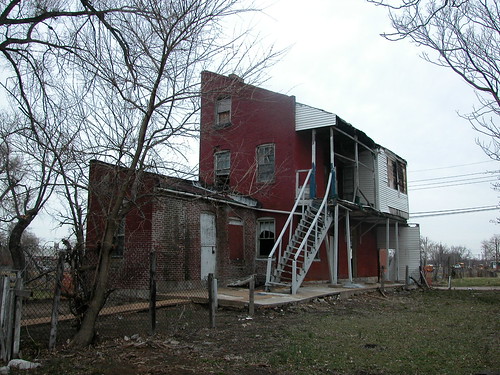
By March 2009, things were not good for the unusual two-and-half-story flounder house located at 2543 Maiden Lane in St. Louis Place. The house was sporting a small hole at the base of its west wall as well as a major stress crack. The hole was strange because there was no apparent structural problem causing it. Urban Solutions, the consulting firm performing maintenance on behalf of owner McEagle Properties, placed one of its orange construction fences around the building in response to the conditions. Then the building just sat, with most window and door openings unsecured.

On April 2, the Building Division condemned the house for demolition, but so far has not placed the demolition out to bid.

The house stands out not only for a height rare for a flounder house, but also because it actually faced out toward Maiden Lane, an east-west street that is almost alley-like. The flounder sits on the north end of its lot, directly on the alley between Maiden Lane and North Market. The one-story flounder addition in front is a unique feature as well. The east side contains a gallery porch with access to the two flats inside of the building.

The north face shows the full height of the house, as well as some original six-over-six wooden window sash.

Last week, I noticed that the hole had grown bigger, with a pile of bricks at the base covered in lime mortar dust. I wondered if recent windy days had taken their toll until today, when I realized that a more common culprit is at work here.

That’s right, the brick thieves are back in action. They have made short work of the one story addition, and have made the hole in the main house bigger (although their clumsy methods have broken many bricks).

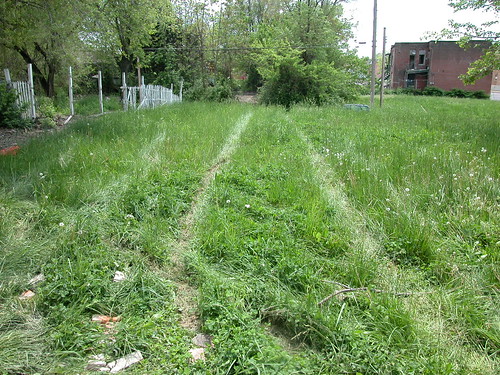
The tire tracks running through the high grass on the vacant lot next door provide clear evidence of thievery.


Strange that the thieves have evaded detection here — the west wall faces out at busy Jefferson Avenue, not far from the police station. I’m also perplexed by the fact that of all of the brick buildings with wall damage in this vicinity, the thieves have struck this one. Is the recent condemnation for demolition a prompt? Perhaps the thieves saw the building on a demolition bid list.

In the middle of a flagging economy, brick theft could be elevated this summer. It’s time for all of us to get tough — city government, police and neighbors. If you see people removing bricks from a building and there is any suspicion of theft, call 911. If you have the constitution, take photographs of the activity and wait for police to arrive. Unfortunately, police will not always respond seriously to a brick theft call. A legitimate wrecker with demolition rights will be able to show police a demolition permit.

Let’s hope this summer does not see a wave of destruction like the ones that hit the north side in the past two years.

Categories
Mid-Century Modern Midtown Rehabbing

Mid-Century Modern Preservation in Grand Center

by Michael R. Allen

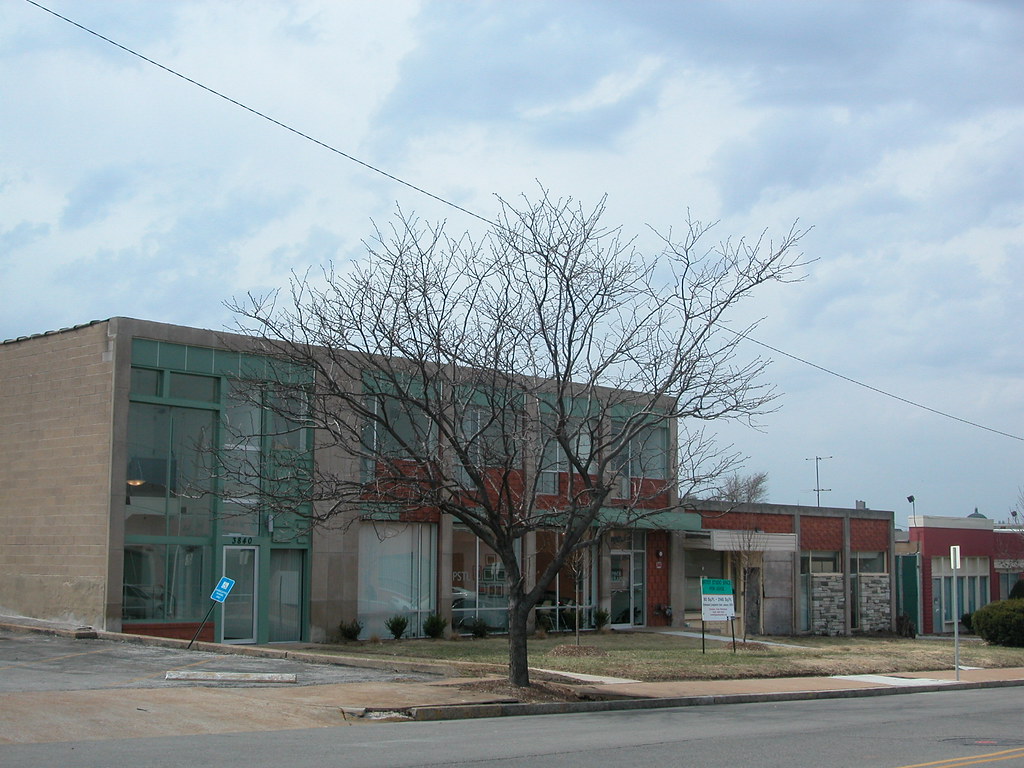
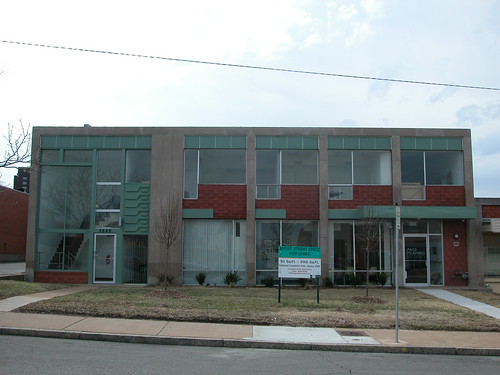
Grand Center, Inc., deserves recognition for a small but important step toward preservation of our mid-century modern architecture. Earlier this year, Grand Center completed renovation of the Loyola Building at 3840 Washington Boulevard just west of Vandeventer. This playfully articulated two-story building and a one-story wing to the west were designed by architect Isadore Shank and completed in 1958. Built as offices, Loyola Academy across the street once used the two-story section for classrooms. The one-story section was owned by a church group. The building is part of a row of modern buildings all enjoying the same setback; see Toby Weiss’ post “Mid-Town Washington Boulevard” on B.E.L.T for more information.

The crisp modern lines are drawn here through smooth limestone. However, there is textural depth added through the patterned brick spandrels and what seems to be a painted wooden spandrel at the main entrance (at left) that reminds me of a patterned fir applique on Shank’s Miller House (1963).

The detailing here is not as extensive as on Shank’s elaborate DeBalieviere Building (1927) at Delmar and DeBaliviere, but it has similarities. The introduction of wall texture through patterns is similar, as is the breakdown of the potential monotony of repeated patterns through the articulation of the fenestration. This is a cool little building, and not well known among Shank’s work.

Grand Center has recycled this office building as artists’ studios and the home of the Pace framing company. The redevelopment organization could have done no better — the Loyola Building did not need a lavish rehab. A little repair and painting renewed the mid-century strut, and all is well in the world.

Categories
Art Events South St. Louis

Second Night of Chautauqua Art Lab

by Michael R. Allen

Tonight is the second night of the Chautauqua Art Lab, of which I am proud to be a part. Check out the details:

CHAUTAUQUA ART LAB

Map the multi-verse with controversial artists/speakers, pots and pans music makers, and film bricoleurs constellating for the temporary art and technology project co-organized by Eric Repice, Sarah Paulsen, and Emily Hemeyer. The series of nightly collaborative educational gatherings is inspired by the historical Chautauqua adult education movement in the US and features participatory panels, music soundscapes, and video screenings .

When: May 3-7th each night, 6:30 PM -10:00 PM

Where: Fort Gondo, 3151 Cherokee Street, St. Louis, MO, USA

Why: Learn, Include, Collaborate, Constellate (L.I.C.C.). “Chautauqua is the most American thing about America”– Theodore Roosevelt

Monday, May 4: “Local Go-getters and How I Started My Space.” Public Forum Q & A with Matt Strauss (White Flag), BJ Vogt (MAPS), Juan William Chavez (Boots Contemporary), Nita Turnage and Hap Phillips (Artica), David Wolk (Cranky Yellow& Crammed Organisms), Stephen Brien (All Along Press), Firecracker Press, Open Lot, Luminary Center, and APOP.

Tuesday, May 5: “Personal and Collective Practices that Investigate Notions of Space, History, and Public Goods.” Demonstrations and discussion highlighting mapping, tagging, blogging, virtual studios, and YouTube as art spaces. Featuring Eric and Michelle DeLair Repice (Wash U), Michael Allen (Ecology of Absence), Ben West (WASABINET), Jordan Hicks (Open Lot), live animation by Sarah Paulsen and music by Macro Meltdown

Wednesday, May 6 : “Artist Viewpoints: Innovations and Boundaries in Community Art Practice.” Works and commentary by Cindy Tower, Lyndsey Scott, Keith Bucholdz, Peat Wollager, and Maya Escobar.

Thursday, May 7:“Exploratory Film Night:Time based art/video shorts exploring the use of found/appropriated images, collage and archives.” Including films by Jodie Mack (Chicago) Yard Work is Hard Work, Ken Brown and Tom Bussmann (Germany and Stl) Beyond the Crisis in Art, Emily Foster (San Francisco) Snowfakes, Mike Pagano (Stl), Jeremy Kannappell (Stl), Emily Hemeyer and more. Music by Kevin Butterfield. Opening Music, Flowers. All donated proceeds benefit CAMP (Community Arts and Media Project).

Contact : Press- Emily Hemeyer ghostsihavebeen@gmail.com

Sarah Paulsen pintorasp@hotmail.com

Eric Repice erepice@gmail.com

Categories
Abandonment North St. Louis Northside Regeneration Public Policy St. Louis Place

Where Ed Box and Peter Kinder Meet

by Michael R. Allen

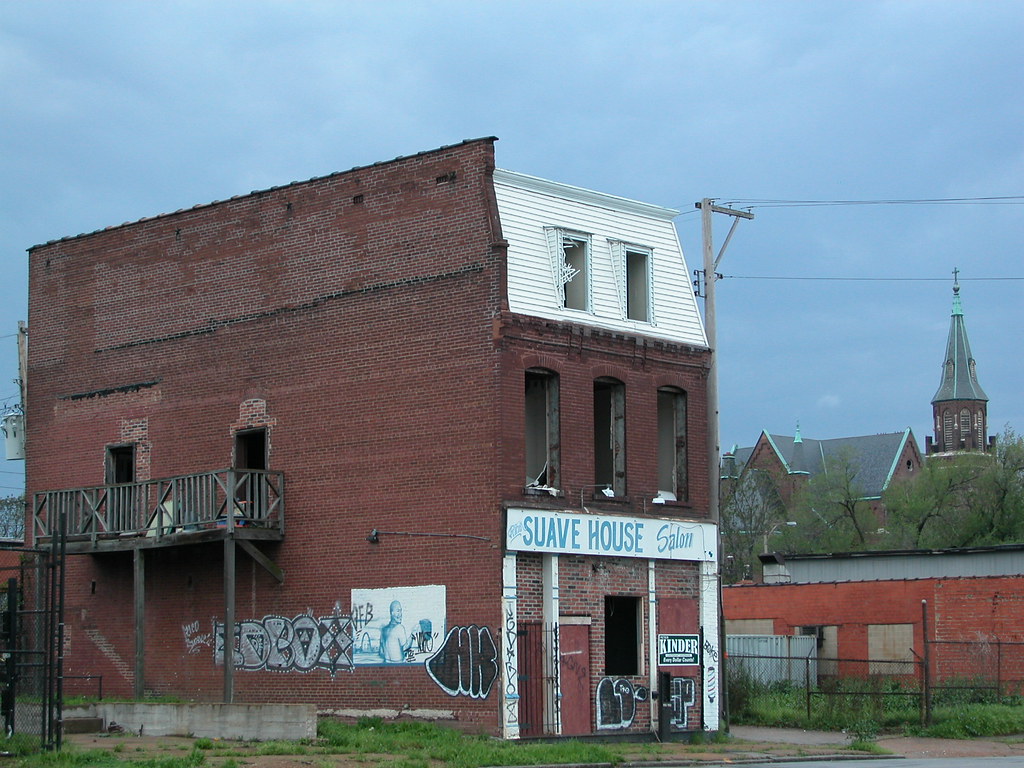
The Suave House at 2512 Palm Street in St. Louis Place has been adorned by both the graffiti artistry of Ed Box and the political signage of Peter Kinder. The fact that’s it is owned by a Paul McKee, Jr.-controlled holding company (N & G Ventures) creates a strange political triangle of sorts. McKee owns many of the vacant buildings of St. Louis Place, Box tags them and Kinder posed himself as a gatekeeper of north St. Louis’ future by championing a tax credit that could help McKee make sense of his holdings.

Someday MetroLink may run down Palm, which merges into Natural Bridge. There are pockets of storefronts like this one on Natural Bridge west to the city limits. Unlike Martin Luther King Drive, Natural Bridge largely passes through areas of high population density, making it a natural commercial thoroughfare for north St. Louis. In fact, on the block just west of the Suave House there already are popular small businesses in sidewalk-fronting buildings. The area already functions as a commercial gathering spot, but it needs enhancement. Of course, commercial districts on public transportation corridors don’t work well if they are not densely built out, and buildings like the Suave House indicate the density and building form that is needed to build up Natural Bridge in the future.

McKee would be wise to think about this northern edge of St. Louis Place, where Palm meets Natural Bridge, and its relationship to other neighborhoods west of here and the future presence of light rail. This is a seam, not an edge. This eastern end could be the gateway to a renewed Natural Bridge Avenue commercial district. The Suave House is a welcoming building that defines this block not as a marked boundary but as the face of one side of a street that laterally connects the entire city.

Of course, MetroLink itself could be a boundary of sorts if Metro insists on building out a light rail line like the ones it currently operates. The drawings for the north extension show many streets crossing Florissant Avenue, Palm and Natural Bridge that would not go through due to the placement of contained tracks in the middle of those major thoroughfares. That could hurt the tremendous potential of these streets to sprout more pedestrian-oriented commercial areas. A less invasive light rail system would be better — how about a street car? Meantime, let’s protect future building blocks like the Suave House.