Categories
Demolition Gate District Historic Preservation South St. Louis

Two for One on Lafayette Avenue

by Michael R. Allen

In September, I wrote about the storm-damaged collapsing eastern house in a row of three historic houses on the 2800 block of Lafayette Avenue (see “Rowhouse on Lafayette Avenue Slated for Demolition”, September 10). The Building Division quickly condemned for demolition the 19th century house as an emergency public safety hazard, and demolition commenced last month.

The result shows the pitfalls of our current policy for abandoned buildings.

There is no mistake that the wreckers hired by the Building Division did their job, but that job itself is not all that needed to be done. What is left behind by the crew an adjacent row house now weakened to a point where it too may start suffering structural problems.  The first problem is that the side wall, of soft brick never meant to be exposed to weather, is now uncovered.

On the front elevation, as I predicted, the wreckers could not easily deal with the fact that the front wall of the row was laid as a continuous bond with no easy seams. The wrecking job led to loss of face brick and of part of the wooden cornice of the neighboring house. The loss of the cornice is inexcusable since a simple straight saw cut could have been used.

Again, I am not insinuating that the wreckers did anything wrong. Trouble is, they did what the city hired them to do. The city did not hire them to make sure the neighboring building was stabilized, or to do anything beyond removing 2804 Lafayette Avenue.

That task seems particularly short-sighted when one views the newly-exposed east elevation to find a gaping hole in the foundation wall.  I have no clue how this hole was created, but I do know that it leaves wooden joists unsupported.  Without support, those joists will eventually fall, and pull the walls downward with them.  This hole should be patched in with masonry of either stone or concrete masonry units, but if anyone complains the most likely result will be that a city crew will cover it with plywood.

Clearly, the Building Division’s demolition policy leaves unresolved issues when one building in a row — and despite perceptions there are many row houses in the city — gets wrecked but the row stands. The neighboring house now has been destabilized and joist collapse, front wall spalling and other maladies will set in. Hopefully if it gets demolished, the occupied house next door will be protected from careless damage.

Photograph by Jane Porter of Landmarks Association of St. Louis from the National Register nomination of the Barr Branch Library Historic District, 1981.

Before the demolition, the potential of this fine row of houses on Lafayette reminded me of another row, also on the south side of Lafayette between Jefferson and Compton avenues. The photograph of Barr’s Block above shows its deteriorated condition in 1981. The seven-house row built in 1875 by merchant William Barr (of Famous-Barr fame) was in dire condition when it was listed in the National Register of Historic Places as part of the Barr Branch Library Historic District in 1982. That designation made the row eligible for the federal historic rehabilitation tax credit and led to the row’s rehabilitation.  (One building was later demolished.)

Today Barr’s Block has been rehabilitated again, reverting to town houses from its previous incarnation as rental housing. While Lafayette Avenue in the Gate District may have lost building density and be marred by much vacant land, there remain many historic buildings and the potential for urban infill. The location is amazing. Why the row to the west — not part of any historic district — has been left to die is incomprehensible.

Categories
Events Historic Preservation Mid-Century Modern

Modern STL Blasts Off Next Thursday


Lindell Terrace (left; Hellmuth, Obata, Kassabaum) and the DeVille Motor Hotel (right; Colbert, Lowery, Hess & Boudreaux) rise on Lindell Boulevard in 1962. The newly-completed Optimists Club Building (Russell, Mullgardt, Schwarz & Van Hoefen) is at left.

Almost forty years ago, when the city was on a modern architecture building spree, the staunchest advocates for modern architecture in St. Louis were developers, civic leaders and architects.

Today, the advocates are going to have to be us. Care to join?

Modern STL makes its public debut on November 18th from 5-8 PM at Atomic Cowboy.  We will be accepting our founding members ($20 individual / $30 family annual dues) at this event.  You can be among the first to stand up for our mid-century modern architecture by joining next week.

If joining the cause of modern architecture preservation and attending a fun party aren’t enough enticement, try this: The first 25 people to become a Modern STL member (and here’s why you should join) get a gift bag stuffed with MCM souvenirs personally hand-picked by thrift-shopping board members. There will also be raffle tickets that give you the chance to win two ultra-modern watches.

See you there!

Categories
Events Louis Sullivan

Louis Sullivan Documentary at the Film Festival

The St. Louis International Film Festival includes the return of Mark Richard’s Smith’s Louis Sullivan: The Struggle for American Architecture, a lushly-filmed exposition on the architect’s work that first screened here this summer. The screening takes place Sunday, Nov 14th at 2:00 PM at the Hi-Pointe.

From Cinema St. Louis:

This compelling documentary examines the life and work of the great American architect Louis H. Sullivan (1856-1924), one of the original practitioners of the Prairie School of design and a key influence on Frank Lloyd Wright. Sullivan’s legacy is especially visible in his adopted home of Chicago, but his work is found throughout the U.S. and includes St. Louis’ Wainwright Building — one of the world’s first skyscrapers — and Union Trust Building. Playfully describing the film as “design porn,” the Kansas City Star says that “the genius of this movie lies in its almost sensual appreciation of Sullivan’s buildings, which formed an elegant yet utilitarian bridge between the solid formality of the late Victorian era and the lush ornamentation of art nouveau while planting the seeds for art deco. So you’ll learn about an important artist from this film, but you’ll also leave feeling a bit ravished.” With director Smith. Sponsored by Tjaden Interiors.

Tickets are $12 on the day of show. More ticketing information here.

Categories
Events Housing North St. Louis St. Louis Place

Groundbreaking for Modular Homes in St. Louis Place

Categories
Demolition Downtown Terra Cotta

Locust Street Breathes Again

by Michael R. Allen

Our landmark Railway Exchange Building, home of Macy’s Department Store, breathed a sigh of relief last week as the last bit of the monstrous St. Louis Centre sky bridge over Locust Street came down. The wide, tall bridge connected the second through fifth floors of the department store space to the mall, and blocked views of the building’s north elevation.

Completed in 1913 and designed by Mauran, Russell & Crowell, the Railway Exchange occupies the entire city block between Olive, 6th, Locust and 7th streets. The 21-story mass is adorned with 183,000 white-glazed terra cotta tiles by St. Louis’ Winkle Terra Cotta Company. The tiles display a wealth of original work and Italian Renaissance-derived patterns. For the past 25 years, only three sides of the building have been fully displayed.

Removal shows that the sky bridge construction in 1984-1985 did entail grinding away of the faces of many tiles, but the damage is not as extensive as it could have been. Most of the area was simply coated with fire-proofing spray.

As with the former Stix-Baer and Fuller department store building to the south (coincidentally designed by the same firm), some replication of terra cotta is ahead. The Railway Exchange’s north elevation will again shine, perhaps with a substitute material (hopefully not a plastic-based one!) or perhaps with the real thing. Recent replacement work on the Orpheum Theater used actual new clay terra cotta pieces. Terra cotta is still manufactured in Italy, but there may be fewer than a half-dozen American makers. When the Railway Exchange was built, there were many makers domestically but none finer than our own Winkle Company.

The Railway Exchange has repair work ahead, but already Locust Street is a restored place. With both of St. Louis Centre’s sky bridges demolished, we have reversed one of the worst atrocities of the 1980’s urban renewal era in St. Louis. At an event Sunday, someone asked me if the Gateway One of the Mall building’s demolition could be far behind.

I won’t bet on that event happening soon, and I would certainly prioritize projects that reclaim the public space of the street eroded in the post-modern era.  (Also, with the mass of the bridge gone, the loss of density through demolition on Locust between 7th and 9th is terribly evident.)  The sky bridges may not have precluded pedestrian and vehicle passage, but they cast a psychological shadow that devastated the east end of downtown.  No more.

Categories
Housing Mid-Century Modern St. Louis County University City

The Joseph and Ann Murphy Residence

by Michael R. Allen

Published as “Joseph Murphy’s Own Residence Now Listed on National Register” in the Fall 2010 NewsLetter of the Society of Architectural Historians, St. Louis Chapter. The essay is based on text from my National Register of Historic Places nomination for the Joseph and Ann Murphy House (listed May 10, 2010).

The Murphy house as it appeared in Architectural Forum, April 1941.

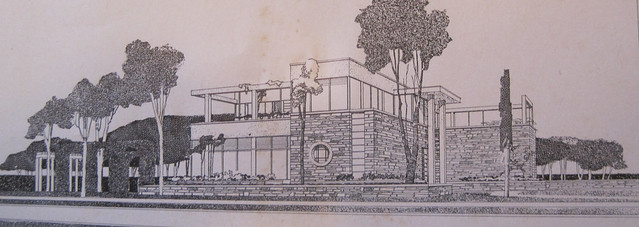
Designed by prominent St. Louis architect and educator Joseph Denis Murphy (1907-1995) for his own residence, the Joseph and Ann Murphy Residence at 7901 Stanford Avenue in University City was built in 1938-1939 but expanded in 1950 and 1962. Built in the same year that Frank Lloyd Wright published his vision for the Usonian house in Architectural Forum, the Murphy Residence demonstrates Murphy’s contemporary and unique vision of residential architecture. While Murphy’s residential program has clear parallels to Wright’s, Murphy developed it simultaneously rather than subsequently. In 1938, few Modern Movement Houses had been built in the St. Louis area, although within twenty years Modern styles would dominate suburban residential construction. Newly arrived in St. Louis and serving on the faculty of the Washington University School of Architecture, Joseph D. Murphy’s career was at its start when he designed his own home. The house was one of the first small Modern Movement houses to attain national publication, and it contributed to wide interest in Modern houses in the St. Louis area.

Joseph Murphy’s submission to the 1934 Flat Glass Industry Architectural Competition. Courtesy of Mary Brunstrom.

In the 1930s, many American architects were working on developing ideas about Modern houses. With modernism on the rise in America amid the Great Depression, many American architects endeavored to create affordable small house designs that would advance Modern design principles. Joseph Murphy delved into the national architectural discussion on houses early, and published his first Modern house prototype ahead of Frank Lloyd Wright’s widely influential publication of his “Usonian” house. Frank Lloyd Wright’s Usonian House would become the American standard for the small, affordable Modern house, but Murphy had already provided his own prototype when Wright first published his ideal.

Categories
Events

This Weekend: Lucas Place, Modern Churches

Two events this weekend are worth your attendance:

Walking Tour of Lucas Place
Saturday, November 6 at 2:00 p.m.
Meet at the Campbell House Museum, 15th and Locust

Cambell House Museum Executive Director Andy Hahn leads a free walking tour of Lucas Place, now Locust Street, St. Louis’ most elite address in the middle 19th century.

Lecture: Faith’s Modern Forms: The 1950s Churches of Murphy and Mackey
Sunday, November 7 at 3:00 p.m.
Architecture St. Louis, 911 Washington #170

Mary Reid Brunstrom, Doctoral candidate in Art History and Archaeology at Washington University, will lecture on the architectural innovations in three churches designed for the Catholic Archdiocese by Murphy and Mackey. This lecture discusses significant architectural innovations in three churches built for the Catholic Archdiocese of St. Louis by Murphy and Mackey, Architects namely St. Ann Church in Normandy, St. Peter Catholic Church in Kirkwood and the Church of the Resurrection of Our Lord in South St. Louis. At the time of building, all three were recognized nationally and internationally for their imaginative new forms as well as the architects’ integration of art and architecture.

The Lecture will begin at 3:00 PM int he classroom at Architecture St. Louis at 911 Washington Avenue, Suite 170. Seating is limited to 50 people. We strongly encourage reservations as we cannot guarantee seating without one. To reserve a seat, please call 314.421.6474 or email: landmark@stlouis.missouri.org.

Categories
Clearance Downtown Mill Creek Valley PRO Collection

Parade in a Lost Neighborhood

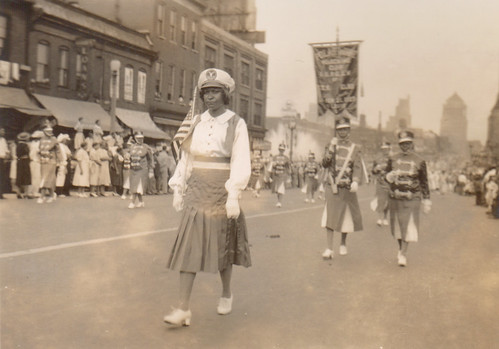
This parade shot was taken just west of Aloe Plaza near 21st and Market streets. The view is looking east toward the Civil Courts Building (at right in the background), and shows some of the Mill Creek Valley commercial district on Market Street.  The parade’s forward march follows the path of clearance that totally eradicated the African-American enclave around Union Station between 1928 and 1960.

Given the photographer’s other subjects, the date is likely after 1940.

From the Preservation Research Office Collection.

Categories
Alton, Illinois Historic Preservation

Alton City Council Reverses Grand Theater Landmark Designation

by Michael R. Allen

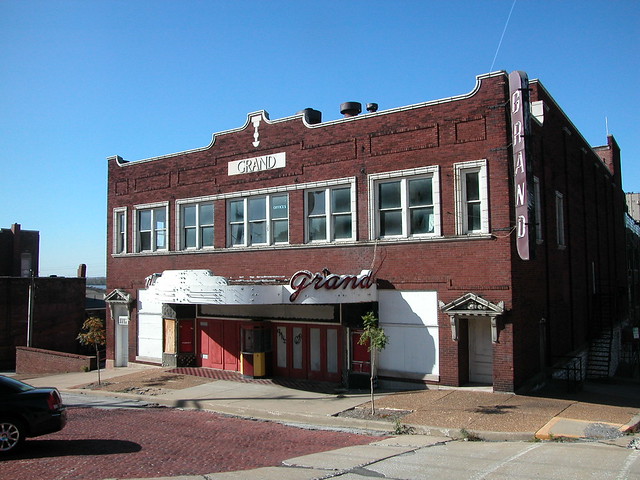
Yesterday, the Alton City Council voted 6-1 to overturn the city landmark designation recently conferred by the Historical Commission upon the Grand Theater. The theater, at the corner of Third and Market streets, has been owned by businessman Ed McPike since 1990. There is one tenant in a basement storefront on Third Street. McPike opposed the landmark nomination prepared by citizen Bill McKenzie.

After the Historical Commission voted 4-2 to confer designation, McPike appealed. Under Alton’s preservation ordinance, that appeal went to the City Council, which was then allowed to consider new evidence. Apparently, given yesterday’s decision, the council also has the authority to not only consider new evidence but also to impose a new standard of review.

Many concerned citizens, including McKenzie and Alton Area Landmarks Association President Terry Sharp, spoke in favor of upholding the Historical Commission’s brave decision. I spoke to clarify several points, including how — based on my St. Louis experience — landmark designation does not preclude reasonable alteration or even, if justified, demolition. In fact, the Alton Historical Commission recently granted demolition for the city’s oldest house, the Mansion House, after a devastating fire. Preservationists thought that the Mansion House could be saved, but the Historical Commission did not. Landmark designation simply ensures that the decision to demolish a historic building receives deliberation; it does not compel preservation in every case.

Alderman Mike Velloff, the lone dissenter, made the point that the level of review brought by the designation was no more arduous than what the Council would put in place for anyone seeking an official redevelopment plan. McPike’s attorney Jim Sinclair had called the landmark status a “taking” of the property.

While the Council overturned the landmark designation, the strong advocacy campaign for the Grand Theater has drawn a lot of attention to the long-vacant building. Hopefully that will lead McPike or a future owner to consider preservation.

Categories
Belleville, Illinois Demolition Fire Historic Preservation Mid-Century Modern

Opportunity Lost in Belleville

by Michael R. Allen

Photograph by Chad Briesacher.

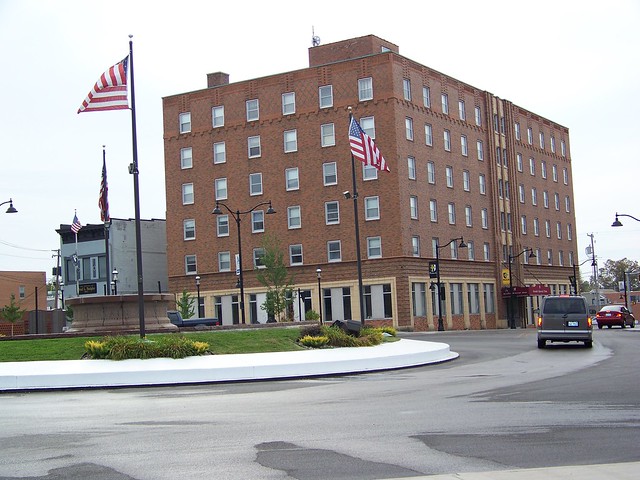
In a strange move, on October 19 the Belleville (Illinois) City Council voted 14-1 to approve a plan that would replace the former Meredith Home with a park. The Meredith Home is the six-story former Hotel Belleville at the southeast corner of Illinois and Main streets at the fountain circle. Built in 1931, the hotel has art deco stylistic elements expressed through brick and terra cotta. Between 1962 and earlier this year, the hotel served as retirement home operated by the Roman Catholic Diocese of Belleville.

How the City Council came to vote away the sales and property tax revenues the building might generate in the future is uncertain. Using a loan, the city purchased the occupied building for $487,500 in February when the Diocese placed the building for sale. The sale generated some raised eyebrows in light of how the city of Belleville has cited lack of funds as a reason for not assisting the effort to save the former Belleville Turner Hall.

Photograph by Chad Briesacher.

After discussing redevelopment with a boutique hotel developer from St. Louis, Belleville officials abruptly changed course. Suddenly, attorney Bruce Cook stepped forward with an offer to pay off the loan on the property if the old hotel were demolished and the site became a park memorial for his late daughter. The park plan — a noble purpose best suited for a site whose development would cost less — lacks funding for demolition and construction. Belleville Mayor Mark Eckert has stated that the city might help with the cost, even though it has steadfastly refused to help the citizens trying to turn the Turner Hall into an arts center.


Photograph by Chad Briesacher.

Downtown Belleville has many vacant lots and surface parking lots well suited for a small memorial park. The city could easily have helped Cook find another site, and just as easily not purchased a large building that private developers may have purchased. The city does not have another building like the Meredith Home, which has not generated revenues in nearly 40 years. Beyond the preservation issue, it is odd that the city — with its revenues strained like every city’s — would not have jumped at the chance to move a prominent downtown parcel from tax-exempt status to a taxable piece of land. Cities thrive when private initiative, not government control, is the driving force in commercial districts. Belleville has missed a big opportunity with the Meredith Home.


Photograph by Chad Briesacher.

Another Belleville opportunity that hopefully won’t be squandered is a few blocks east at the northeast corner of Main and Jackson streets. In May, a corner building and part of the slipcover-clad former Fellner’s Department Store were destroyed by fire. The taller, more stylized section of the Fellner’s building survives, to the delight of the region’s mid-century modern aficionados.  Hopefully the city of Belleville will support new urban infill on this prime corner.