Categories
Demolition Housing Mid-Century Modern St. Louis County

Olivette Tear-Down

by Michael R. Allen

Last week I spotted this tear-down on Dielman Road at Engel Lane just south of Olive Boulevard. Another fine postwar ranch house, built sturdy of brick and concrete, will meet its death. Oh, recession, you were supposed to bring calm to the troubled waters of suburban real estate!

Categories
Schools SLPS The Ville Tower Grove South

Adams Recommends Closing Six School Buildings

by Michael R. Allen

At last night’s meeting of the Special Administrative Board of the St. Louis Public Schools, Superintendent Kelvin Adams recommended closing the following six school buildings:

Gallaudet School for the Hearing Impaired, 1616 S. Grand; built in 1925; Rockwell Milligan, architect.

Alternative South at Lyon School; 7417 Vermont; built in 1909; William B. Ittner, architect.

Ford Branch School; 1383 Clara Avenue; built around 1960.

Fresh Start at Turner Middle School; 2615 Billups Avenue; built in 1939; George Sanger, architect.

Bunche at Madison School, 1118 S. Seventh; built in 1910; William B. Ittner, architect.

Pruitt Middle School (Cleveland Junior Naval Academy), 1212 N. 22nd; built in 1954.

Lyon School And Turner Middle School (formerly Stowe Teachers College) are already listed in the National Register of Historic Places. Gallaudet, Madison and Pruitt are eligible for such designation. Ford Branch might contribute to a historic district listing.

Six schools that Adams once suggested closing, including Mann Elementary School at 4047 Juniata Avenue in Tower Grove South (built in 1901-16 and designed by William B. Ittner; listed in the National Register), will be placed on a new “turnaround model” with new principals and at least 50% new teaching staff.

Four schools are going to be placed on “restart” — closed as public schools and reopened as chartered schools. One of these is the venerable — but academically failing — Sumner High School at 4248 Cottage Avenue in the Ville (built in 1908-9 and designed by William B. Ittner; listed in the National Register).

Categories
Historic Preservation Schools SLPS

More St. Louis Public Schools to Close

by Michael R. Allen

On Tuesday, the St. Louis Beacon published an article by Dale Singer covering a presentation by Superintendent Kelvin Adams on the state of the troubled St. Louis Public Schools. Not surprising, perhaps, is the prediction by Adams that more school closings are ahead. Singer writes:

Of the district’s buildings — 74 currently in use, 39 decommissioned — the average age is 75 years, he said, ranging from six years to 132. Last year more than a dozen schools were closed, down from the 29 closings that a consulting firm had recommended, but more are certain to be on the closing list this time around.

Mann School in Tower Grove South, previously considered for demolition and replacement or closure, likely will again be threatened with closure. Given the district’s financial state, however, demolition and construction of new school buildings seems unlikely.

That the average age of a city school building is 75 years means that the average city school student attends class in a historic neighborhood school. While that fact alone does not produce desired educational outcome, it is reassuring. Our students are interacting with their city’s heritage and most are attending class in humane buildings with ample natural light, ventilation and classroom space. Imagine if the troubled district was mostly housed in the bleak, low-ceiling, fluorescent-lit educational hot-houses being built today. Performance could be much worse.

Categories
Benton Park Events

DeMenil Mansion Hosts Fourth Annual Book Sale

by Michael R. Allen

Books and Crannies: our fourth annual used book sale
Benefits the Chatillon-DeMenil House Foundation
Located at the Chatillon-DeMenil Mansion, 3352 DeMenil Place, Saint Louis, 63118
10 a.m. – 4 p.m. on Saturday, May 15 (preview: 8 a. m. – 10 a. m., $5)
Noon – 4 p.m. on Sunday, May 16

DeMenil Place (April 14, 2010) – The Chatillon-DeMenil House Foundation will hold its fourth annual Used Book Sale at the House on May 15 – 16, 2010. This year’s theme will be “Books and Crannies.” Bigger and better than ever, the sale has outgrown our gift shop: for one weekend, patrons will have access to parts of the house usually off-limits to visitors, including our staff-only kitchen (for cookbooks, of course!) and the basement “tunnel.”

Free tours will be offered throughout the sale weekend.

The Used Book Sale is one of the year’s biggest fundraisers, providing capital for ongoing operations and restoration projects. Books are accepted at the House from 10 AM – 3PM, Wednesday through Saturday until May.

The Chatillon-DeMenil House was saved from the path of Interstate 55 construction by concerned citizens. A remarkable community effort resulted in its careful restoration. In 1966 the House opened as a museum interpreting the lives of the French-American families who lived there from the 1840s into the 1920s, and as a rare survivor interpreting the tastes and architectural preferences of the Victorian upper class. For more information on the Chatillon-DeMenil House, please visit www.demenil.org or call (314) 771-5828.

Categories
Adaptive Reuse Chicago Historic Preservation

"Saving" a Chicago Church

by Michael R. Allen

Over at ArchitectureChicago PLUS, Lynn Becker has posted renderings of a bizarre plan to “save” Chicago’s St. Boniface Church by retaining the front elevation and the street face of the crossing, demolishing the rest and constructing a massive six-story apartment building for senior citizens. This has to be one of the ugliest designs that I’ve seen lately.

There is some grace in retaining parts of a neighborhood landmark on site where those whose lives connected with the church can still have a physical connection. that could be better than total demolition or relocation. The Buffalo, New York archdiocese is preparing to relocate an entire historic church to suburban Atlanta — another form of preservation that robs the church of a meaningful historic site. Many Buffalo residents oppose the move. The plan for St. Boniface in Chicago seems to be an odd compromise, and one that mocks the parts of the church that will remain.

Who do you think?

Categories
Demolition Downtown Historic Preservation

It’s Just One Building…Right?


The 2002 short video …it’s just one building created by Alan Brunettin and produced by Margie Newman is now available on YouTube. …it’s just one building remains a powerful and moving piece, and the downtown focus is relevant in light of renewed interest in the riverfront. (Not to mention the fact that we still have threatened downtown buildings.) The haunting score by Dan Rubright and the images selected by Lynn Josse from the archive of Landmarks Association of St. Louis are as a poignant a combination now as they were eight years ago in the thick of the battle to save the Century Building.

Categories
Historic Preservation Missouri Public Policy

Historic Tax Credits at Work Near the Missouri Capitol

by Michael R. Allen

This is how the building at 105-7 East High Street in downtown Jefferson City looked in 2006.


Here’s what it looked like on a recent visit. While mid-century slipcovers should not always be removed, here the half-covering was ugly and covered operable windows. Windows allow for light and ventilation and significantly reduce the energy usage of a building — not to mention the spirits of the people who work or live inside. Underneath, the ornate cast iron lintels are intact. The facade will be restored gracing a block very near our state Capitol.

This project is utilizing Missouri’s state historic rehabilitation tax credit, a national model that returns up to 25% of qualified rehabilitation costs back to an owner in transferable credits. This building was in sound condition before, but its street face was not becoming a location right by the seat of state government. Without the tax credit, the owner might have left well enough alone — and visitors to our capital might have found this block a bit unbecoming.

Categories
North St. Louis South St. Louis St. Louis Place Tower Grove East

Operation Brightside Blitz Days

by Michael R. Allen

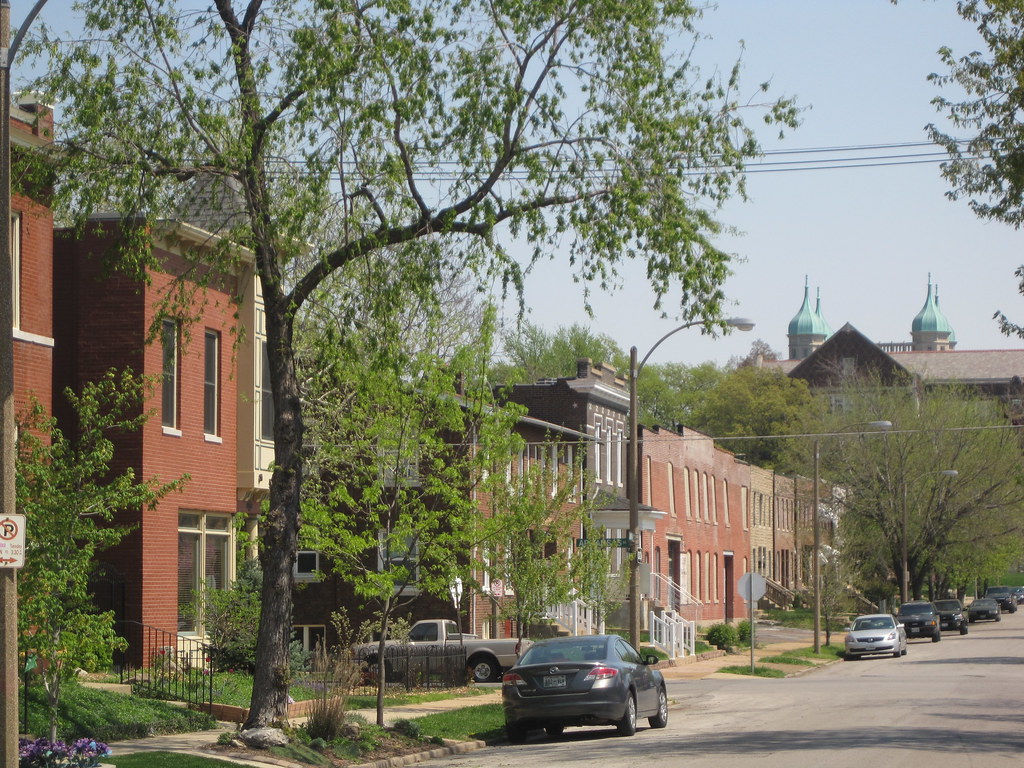
Juniata Street looking east toward Roosevelt High School in Tower Grove East.


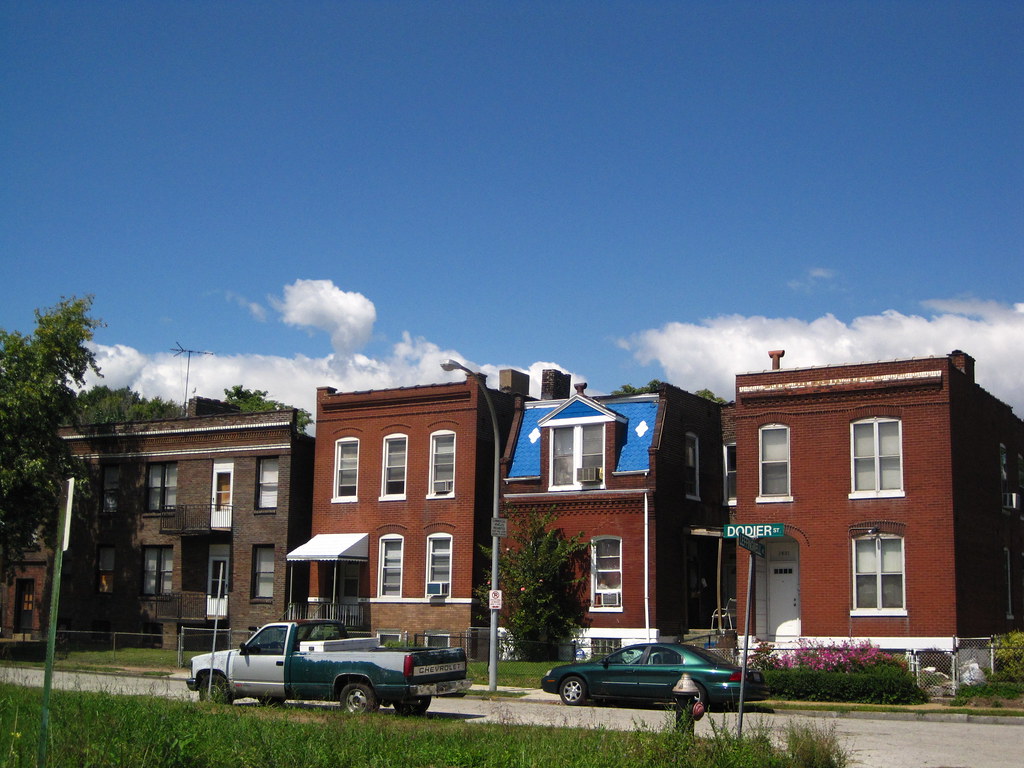
Dodier Street west of Leffingwell Avenue in St. Louis Place.

 
The two blocks pictured here both were part of today’s Operation Brightside Blitz Day. My neighbors and I were out working on our block this morning. Since there is no such thing as a self-cleaning city, citizen cleaning is essential to keeping blocks looking lovely. Government provides the basic services, but citizens create quality of life. We have to be active stewards of our houses and our blocks. No one is going to clean our alleys and sidewalks for us, even in the most ideal world. There are Blitz days coming up in other areas of the city and you should do your part. There’s nothing more rewarding than working with neighbors to make St. Louis look beautiful!

Categories
Historic Preservation Public Policy

Minnesota Passes Historic Tax Credit as Stimulus

by Michael R. Allen

From Preservation Action

Last week, on April 1, Governor Tim Pawlenty signed into law the Minnesota Jobs Stimulus Bill which, of note to preservationists, includes a State Historic Rehabilitation Tax Credit designed to stimulate green job growth, increase local tax bases, and revitalize urban and main street communities through reinvestment in historic properties. Approximately 1,500 to 3,000 construction jobs are projected to be added annually because of the measure.

The new state historic preservation tax credit, like the federal rehabilitation tax credit, will make available a state income tax credit equal to 20 percent of the cost of rehabilitating a qualifying income-producing historic property. Projects are eligible to claim the state credit if they qualify for the federal credit, which requires properties to be listed in the National Register of Historic Places. Minnesota currently has 1,600 listings in the National Register representing almost 7,000 individual properties.

An innovative component of the tax credit allows developers to choose either a certificated, refundable credit or a grant, which will stimulate nonprofit use of the incentive, and also can be used against the insurance premium tax widening the investor pool. There is no cap for the program.

Minnesota joins thirty other states that have similar tax credit programs.

Categories
Historic Preservation Mullanphy Emigrant Home Old North

Mullanphy Emigrant Home, Four Years Later

by Michael R. Allen

The fact that this city still has the Mullanphy Emigrant Home is testament to the amazing mobilization of dedicated Old North St. Louis residents, preservationists and civic leaders across the city. This week’s victory for Proposition A in St. Louis County brought much jubilation to advocates for sustainable urban development, and its close coincidence with the anniversaries of the dates that the venerable north side landmark was struck by storms crossed my mind.

The tale of the Mullanphy Emigrant Home, located at 1609 N. 14th Street at the south end of Old North, is no less remarkable than the overwhelming passage of Proposition A. In the dark days after the storm wrecked the south wall in April 2006, many observers conceded its loss. The Building Division pushed for emergency demolition, the owner was not certain that he wanted to preserve it or even sell it and the neighborhood had so many other pressing needs that taking on a possible lost cause seemed unlikely. Yet residents of Old North rallied around the battered landmark, which defines the south entrance to the neighborhood and has great historic significance. While only used as a transitional home for westward-moving immigrants for ten years after its 1867 construction date, the Emigrant Home was pivotal in that period. Its Italianate masonry design, by celebrated architects George I. Barnett and Alfred Piquenard, is one of the city’s finest surviving 19th century examples of the style.

Cultural Resources Office Director Kathleen Shea helped fend off demolition to buy time. Swift mobilization of the Old North St. Louis Restoration Group allowed for a building sale. Then the hard part: raising money for stabilization and repair. Of course, things would get worse before getting better when a storm inflicted more damage almost one year later in 2007. Still, the preservation effort proceeded against daunting odds and with the generosity of E.M. Harris Construction Company and the Masonry Contractors Association, not to mention countless individual donors. Now, the building is effectively mothballed awaiting reuse as a hostel planned by the Hostelling International Gateway Council.

Here’s a look back at the building’s plight.

On March 31, 2007, the Mullanphy Emigrant Home suffered a second collapse due to heavy winds. The south wall already had a gaping hole, but then the east side and north wall were also partly collapsed. Bracing installed after the first damage held the building together although the open southern end created a wind tunnel effect that probably caused the blow-out damage.
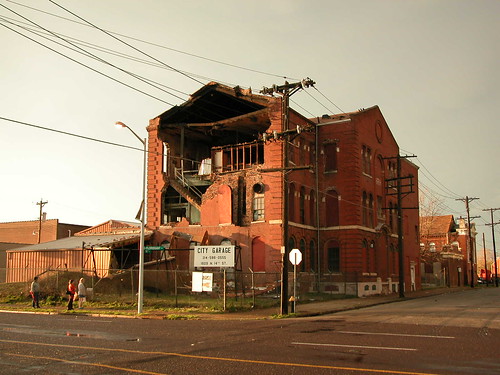
The building was already in rough shape following the south end collapse on April 2, 2006.
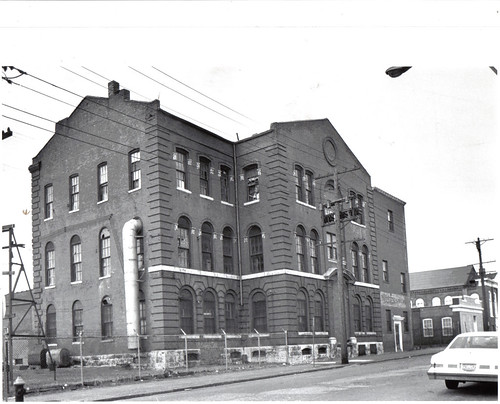
From 1900 through the 1980s, the Absorene Company occupied the building and used it to manufacture wallpaper adhesives, cleaners and removers. Absorene altered the building considerable, adding the bump-out stairwell in 1927, removing the cupola and main entrance, and changing the original profile of the front gable. The photograph above was taken by Landmarks Association of St. Louis in 1982 as part of the documentation for the Mullanphy Historic District, a National Register of Historic Places district.

Artist Pat Baer’s drawing presents the original appearance of the Mullanphy Emigrant Home. The outpouring of civic good will and hard work that saved the building — twice, no less — will hopefully restore this appearance some day.