Categories
Historic Preservation Illinois

Blagojevich Cuts Historic Sites Out of Restored Funding

by Michael R. Allen

Rod Blagojevich, America’s least popular governor with approval ratings consistently lower than President George W. Bush, has again taken aim at Illinois’ state historic sites. Yesterday, Blagojevich signed part of a $230 million state budget passed by the legislature that restored funding cuts made to state parks and historic sites. The part that Blagojevich vetoed, however, included all of the funding needed to prevent closure of 13 state historic sites. The governor claimed that the funds that the legislature allocated for historic sites is federally prohibited from being used that way — and he may be right. Still, there are other sources of funding, including revenues the governor approved being used to spare the 11 state parks that had been slated for closure.

Blagojevich’s move seems extraordinarily petty and intended to marginalize the struggle to keep the state historic sites open. By removing that struggle from the struggle to reopen the state parks, the governor is trying to divide the army of advocates fighting both sites of closures.

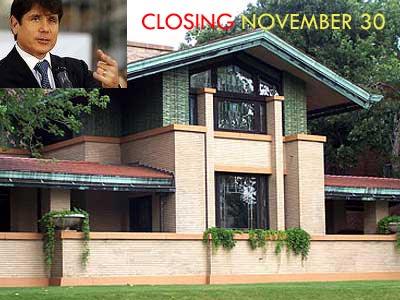
Once again, though, Blagojevich has made a huge mistake. Citizens across the state — and, really, the nation — will not back down in efforts to keep the sites open. From the Dana Thomas House in Springfield (pictured above), an internationally-revered work of Frank Lloyd Wright, to Fort de Chartres in Prairie du Rocher, the oldest building in the state, the historic sites are the lifeblood of historians and towns whose economies benefit from the tourist economy. Expect an outcry that will grow as strong as the importance of the 13 sites — one that will not be silenced by reactionary politicking in Springfield.

A Randolph County where the Fort and the Pierre Menard Home are closed is a frightening prospect to area residents. The Vandalia Statehouse, Carl Sandburg birthplace and Dana Thomas House are as ingrained in the hearts of Illinoisans as the Sears Tower and the capitol, and people are not going to let them meet uncertain fates. This matter will be brought back to the budget or to the ballot box. The legislature is now on board. The governor may be the only person in the state on the other side.

Categories
Missouri SHPO

Missouri State Historic Preservation Office Turns 40

by Michael R. Allen

Among Missourians celebrating 40th birthdays this year is the Missouri State Historic Preservation Office (SHPO). Believe it or not, Missouri’s SHPO was first in the nation to be officially recognized by the Department of the Interior after passage of the federal Historic Preservation Act in 1966. While other states followed soon after, it’s reassuring that Missouri was at the head of the pack on preservation. That is no surprise to those who know that today Missouri leads the nation is use of state and federal historic rehabilitation programs. The “Show Me” state has seen the economic benefits and cultural importance of historic preservation for a long time now.

The full story of last week’s 40th anniversary celebration is on Landmarks Association of St. Louis’ website.

Categories
Historic Preservation Illinois

Re-Enactors Rally in Springfield Against Historic Site Closings

by Michael R. Allen

KSDK reports on yesterday’s spirited demonstration at the Illinois state capital against closures of 13 historic sites. Over 50 re-enactors and their supporters came to the Illinois capital, many in historical costume, to urge Illinois Governor Rod Blagojevich to sign the bill on his desk to reinstate funding for the sites that otherwise close on November 30.

While the intractable governor is sticking to his penny unwise, pound very foolish stance, the most encouraging part of the rally is that those assembled have formed a new coalition called Save Illinois History to concentrate lobbying efforts. That’s a smart move, as the struggle seems to be a long one. In January, when the legislature reconvenes, there will be much work to do to try to ensure that the state budget provides full funding again, and that the governor’s stance changes.

Categories
Historic Boats Historic Preservation Mississippi River Riverfront

Pinnacle Chief: S.S. Admiral Has "A Few Years Left"

by Michael R. Allen

Yesterday’s article in the St. Louis Post-Dispatch on the fate of the S.S. Admiral (“Boat my move north” by Gail Appleson) reported on both the short-term and long-term fates of the Art Moderne vessel. Pinnacle Entertainment, owner of the boat, plans to move the Admiral to a site just north of the Chain of Rocks Bridge. This move could take place in 2009, if the Missouri Gaming Commission approves.

The more troubling news comes in a quote from Pinnacle Chief Executive Office Dan Lee. According to Lee, the Admiral is close to needing its 100-year-old-hull (the Art Moderne section was built atop an existing 1907 hull) rebuilt, and Pinnacle has no interest in making that repair. Lee told the Post that re-hulling “wouldn’t be economical” but he thinks that “there are a few more years left on that hull.” How long the S.S. Admiral can survive remains uncertain.

Categories
Demolition Hyde Park JNEM North St. Louis Riverfront

Long Lost: First Home of Bremen Bank

by Michael R. Allen

The following scanned clipping comes from the January 9, 1949 edition of the St. Louis Post-Dispatch:
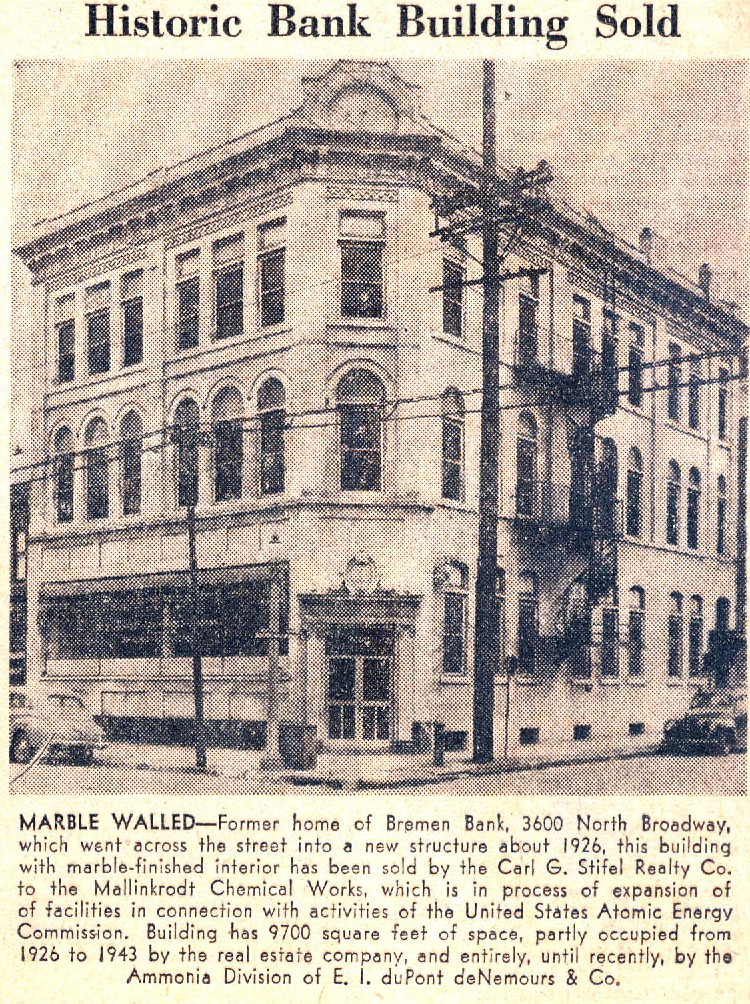
Some readers know of the 1927 Bremen Bank building diagonally across the intersection of Broadway and Mallinckrodt streets; that lovely historic building remains the home of the Bremen Bank.

This clipping is interesting because its caption tells the story of what has happened to large buildings built for specific large tenants when the original tenant moves out. First another large user might come along, with a less prominent use of the space (her, a real estate office). Then comes a second wave of office use, and further depreciation of value. Finally, the property is eyed for a larger development. The story here ends a few months after this blurb appeared in the newspaper. After Mallinckrodt purchased the lovely old bank building, it wrecked it. While the blurb mentions federally-subsidized atomic energy activity, Mallinckrodt actually wrecked the Bremen Bank for a worker parking lot. To this day, the site remains vacant save a small building built on the east end if the parcel in 1994.

In 1949, such industrial expansion along Broadway north and south of downtown was not uncommon. Such expansion came on the heels of the 1947 city Comprehensive Plan, which streamlined land uses to industrial in formerly mixed-use areas along the riverfront while calling for a zoning plan that would allow such anti-urban uses as surface parking on a major thoroughfare. Alas, that zoning plan remains in place, while the land use plan finally changed in 2005. Also remaining is the notion that industrial sites need to spread outward, surrounded by parking and open land, and not be more integrated into city neighborhoods. A clipping like this demonstrates that there are formidable constants in historic preservation and urban design. Nearly sixty years later, a lot remains the same.

North Broadway around Bremen Bank, however, does not remain the same. Mallinckrodt’s expansion — much of it for parking — erased most of the pedestrian quality of that street scape. Besides the bank, only a few other small businesses are open there. Interstate 70 forms a barrier between this area and the populated section of the Hyde Park Park neighborhood to the west. The city government officially draws the Old North and Hyde Park boundaries at I-70, further enforcing the separation. Had things progressed differently, the old Bremen Bank could have been retained along with other buildings on Broadway, with Hyde Park connected to its major employer and to the riverfront.

What is puzzling is that at the same time the 1947 Comprehensive Plan’s call for creating an industrial wall along the river was being drafted, civic leaders were also plotting the construction of the Jefferson National Expansion Memorial downtown in order to improve the central riverfront. Did no one see the conflict between the policies? There was already an organic urban connection to the river, and it could have been enhanced as the city began its loss of industry. Industrial expansion policies — and, I should point out, the Memorial itself — decimated the street grids, neighborhoods and buildings that bound the city to the Mississippi. The long-term consequences of the old policies are haunting us today. And we don’t have as many resources like the Bremen Bank building around to help reconnect us to the riverfront as we started with.

Categories
Downtown Green Space JNEM Riverfront

Clay: Arch Grounds Bill "Technical Placeholder" for Next Congress

by Michael R. Allen

Today’s Riverfront Times carries an article by Kristin Hinman, “Shaky Grounds: Congress may consider putting the Arch’s riverfront park in private hands”, in which Congressman William Clay states on the record the intention behind HR 7252, the bill that he introduced in October to cede control of the Jefferson National Expansion Memorial to a private group.

Clay’s statement is encouraging:

In a written statement to Riverfront Times, he describes the bill as a “technical placeholder” for the 111th Congress, which begins in January.

“The potential loss of a portion of a national park, even for a worthy public purpose, is a very serious matter,” Clay writes. “And it will require extensive public input and community engagement before anything happens.”

The congressman is correct. I am glad that Clay put his intentions on the record and supports a public process for considering changes. Hopefully, when the next Congress convenes, Clay refrains from introducing any bill until the National Park Service draft management plan is reviewed by the public and formally adopted in the spring.

Categories
Academy Neighborhood Demolition Lafayette Square North St. Louis Preservation Board Shaw South St. Louis St. Louis Place

Preservation Board to Consider Five Demolition Proposals on Monday

by Michael R. Allen

The preliminary agenda for the St. Louis Preservation Board’s regular monthly meeting on Monday, November 24 is now available. The agenda contains five demolition proposals.

Three proposals are preliminary reviews requested by the Department of Public Safety, seeking condemnation for demolition on private properties located at 1824 Warren Street in the Clemens House-Columbia Brewery Historic District (St. Louis Place), 5115 Cates Avenue in the Mount Cabanne-Raymond Place Historic District (Academy) and 3927-29 Shenandoah Avenue in the Shaw Historic District. The fourth preliminary review is requested by a homeowner for a historic garage at 1106 Dolman Street in the Lafayette Square Historic District.

Then there is a staff denial of a demolition permit for the frame 19th century house at 4722 Tennessee Avenue in Dutchtown South. A different owner went through the same motions last year, and in June 2007 the Preservation Board upheld staff denial of the demolition permit. The current owner, New Life Evangelistic Center, is a tenacious organization, so this may be the most contentious item on the agenda.

Categories
Demolition Historic Preservation Housing LRA North St. Louis

Lost: 4405 & 4409 Evans Avenue

by Michael R. Allen

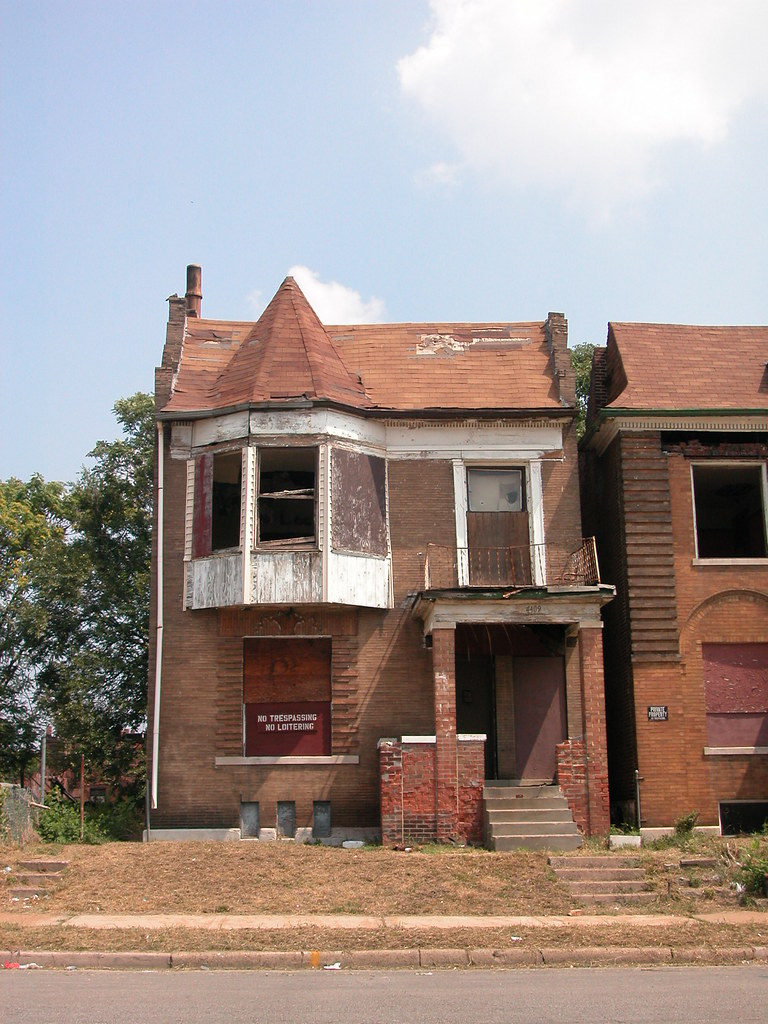
I have taken so many photographs of north St. Louis buildings that I often fall behind in tracking the subjects. The buildings shown above are a good example, since this photograph dates to August 2005, their demolition took place in 2006 and I noticed their loss in 2008.

When I stumbled upon this pair on Evans Avenue in Lewis Place I was struck by the versatility of the pyramidal turret. At left, the house at 4409 Evans Avenue uses the turret to punctuate the top of a projecting bay window.

The otherwise plain house stood out with the addition of that striking but basic architectural form. Next door, the flats at 4405 Evans use the turret in a different way.

Brick quoins and terra cotta panels adorned the Classical Revival building, but that center-placed turret was the crown. Rising above the flared gable’s peak, the turret drew the eye toward the sky, balancing the view of the building with a strong sense of the natural world around it. The architect’s skyward aspirations were immodest but also inspiring. Here, as in so many other instances in St. Louis, a building for the common person was addressing the street with architectural finery and any power above with a tall turret.

The vacant lot now on this site draws the eye downward, at ragged grass and the droppings of careless pedestrians and motorists. There is nothing transformational about the vacant lot, and no hint of any aspiration — even toward reuse of the site.

Categories
Downtown Green Space JNEM Riverfront

More Time Needed for Jefferson National Expansion Memorial Planning

by Michael R. Allen

I was out of town Friday when KWMU aired my most recent guest commentary:

More Time Needed for Jefferson National Expansion Memorial Planning

Categories
Architecture Demolition Housing LRA North St. Louis O'Fallon

Lost: Tudor Revival Apartment Building on Warne Avenue

by Michael R. Allen

The other day, I passed the southwest corner of Warne and Greelea avenues in the O’Fallon neighborhood and noticed that the apartment building once on the site was gone. The photograph above shows that building, whose address was 4225 Warne, in August 2005. The Land Reutilization Authority wrecked the building in August 2007. Vacant since 1991, the building deteriorated badly under the ownership of Jourdan and Jo Ann Jordan who finally defaulted on taxes, although the couple took out small building permits for work in 2004. Once LRA obtained the property, the roof was missing over half of the building, with massive water damage inside.

So went one of the city’s most picturesque multi-family buildings. The Tudor Revival building had a sense of whimsy, as evidenced by the irresistible small turret and the crenellation. The differentiation of setbacks also showed a smart sensibility on the part of the architect. From among a cluster of modest frame buildings arose this masonry jewel on Warne Avenue. Just west, on the opposite side of the street, is Harrison School. Just north is the commercial strip on Florissant Avenue with its southern dip down Warne. This building clearly intended to line up alongside the fancy commercial buildings and hold its own architecturally. For many years, it did.