 Looking southeast from the corner of 13th and Mullanphy Streets in St. Louis yesterday evening.
Categories
 Preservation Research Office
Looking southeast from the corner of 13th and Mullanphy Streets in St. Louis yesterday evening.
Fire gutted the building housing the St. Gemme Beauvais bed and breakfast, built in 1848. Read more here. (Thanks to Andrew Weil for the tip.)
by Michael R. Allen
City of Destiny offers insightful commentary on the failure of Chicago preservation groups to reach their logical audiences and actually spotlight endangered buildings. Katherine, author of the blog, takes as her starting point the annual endangered buildings lists of Preservation Chicago and Landmarks Illinois:
I feel I should join both these preservation groups because I support their goals, but I’m so frustrated at how little opportunity there seems to be for interaction, for publicizing other buildings that deserve attention, for getting updates on the status of buildings they’ve put on the lists.
Read all of it here: “Watching the watch lists”
by Michael R. Allen
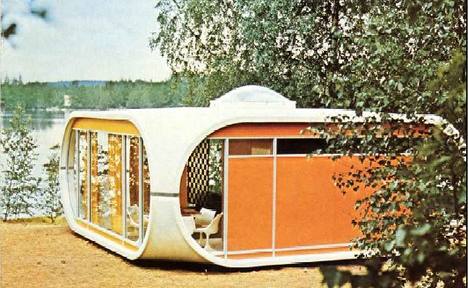
Rumors are circulating that the Danforth Foundation has arrived at a surprising plan for the Arch grounds: resurrect the 1970s Venturo House by Finnish architect Matti Suuronen by placing a line of one hundred of the houses on the western perimeter of the grounds. Apparently, the Foundation’s planners realized that without strong connections to a residential population, any plan to develop the grounds would fail. The Venturo House has appeal due to the shared nationality and similar last name of Suuronen and Arch architect Eero Saarinen. (In this vein, the Foundation could ask band Rilo Kiley to perform on Dan Kiley’s historic modernist landscape.)
If successful, city leaders have discussed the potential for building steel frames with elevators on several blocks of the Gateway Mall. Venturo homes could be hooked up to utilities that would run to each level of these towers. When a resident moved, that person could take their home with them and make way for a new resident.
Accompanying zoning and code changes would allow downtown building owners to place Venturo homes or similar modular homes on roofs — or adjacent surface parking lots. The changes would allow parking garages to be preserved and their historic architectural features left intact should they fall vacant. Venturo homes — arranged on special steel shims to adjust for the typical garage floor slope — will allow preservation-minded garage owners to avoid demolition.
If true, exciting news!
Toby Weiss, whose day job is marketing coordinator for Mosby Building Arts, points out that Mosby has complete a whirlwind rehabilitation of the Kirkwood City Council chambers, damaged in last week’s shooting. Follow along a in a day-by-day account of the project here.
by Michael R. Allen
 This work by prolific graffiti creator Ed Boxx can be found down near the eastern terminus of Espenschied Street, by the former Carondelet Coke plant. Who can disagree with the message? Admittedly, few will see it but perhaps those who do need the instruction more than those who won’t. Such work raises questions: What does one make of positive messages inscribed on private property not being used and not likely to be reused? This “graf” graces the side of a damaged box trailer on the old St. Louis Ship property, which no doubt will be scrapped if its owner ever does anything more than let it sit and rust. Why not let one person’s scrap become another’s momentary canvas?
by Michael R. Allen
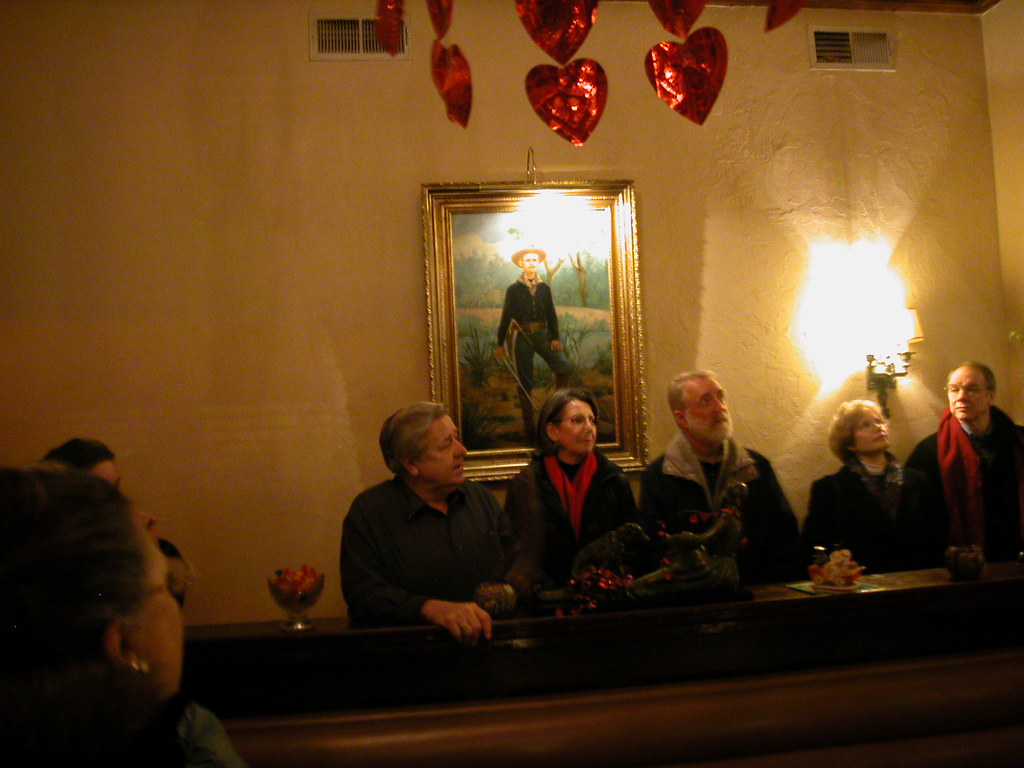 Marty Luepker recounts the rehabilitation of the Feasting Fox.
On Sunday February 10, our local Missouri Valley Chapter of the Society of Architectural Historians convened their annual gathering at the Feasting Fox restaurant in south St. Louis. Many people attended the gathering — and joined the chapter — for the first time. NiNi Harris opened the gathering with an account of the long battle to preserve the Feasting Fox, a historic tavern and restaurant built in 1913 and designed by Klipstein and Rathmann for Anheuser-Busch. Owners Marty and Sue Luepker then led a tour of the restaurant before attendees returned to the Gretchen’s Inn building next door for dinner and the annual slide show.
Attendees enjoyed fine food and drink, including scrumptious chocolate cake, before the customary slide show by chapter members. The slide show always features a wide variety of architectural topics and locations. This year’s was no exception, including presentations on endangered buildings in Gary, Indiana, a Greek Revival farm house in Missouri, Theodore Link’s Monticello Female Seminary campus in Godfrey, Illinois, frame homes in Tower Grove South, the Cathedral of Trash in Austin, Texas and others. In fact, the show went longer than allotted time and will be continued next year!
The chapter is a very welcoming group and publishes a splendid newsletter filled with members’ research and timely event listings; for membership details, contact Esley Hamilton at EHamilton@stlouisco.com.
by Michael R. Allen
Would you believe that there could be an attractive row of contemporary townhouses within a short walk of Grand Avenue in Midtown?
Behold the Art House, proposed for construction on Grandel just west of the perpetually-under-rehabilitation Merriwether House. Sage Homebuilders is the pioneering company daring to build actual housing in “Grand Center.” Forum Studio designed the townhouses.
So far, you can only see it in a Flash animation on your computer. Hopefully soon you will be able to walk through the completed buildings themselves and enjoy the smart views their generous windows will create.
Despite many visible failings in historic preservation and urban planning, somehow Midtown has attained two of the finest contemporary buildings in the city, the Pulitzer Foundation for the Arts and the Contemporary Art Museum buildings. Art House would add one more unique contemporary building to the confused Midtown landscape. Amid parking lots and surviving historic buildings, perhaps we will find a crop of thoughtful, elegant, humanely-scaled residential architecture. If Art House can prove its own success by selling quickly, Grand Center’s longtime refusal to seriously consider the need for residents might start to wither as other developers get in line.
As we have seen downtown, a healthy market cuts through bureaucracy pretty quickly — and solidly on the side of more people, more buildings and more life.
by Michael R. Allen
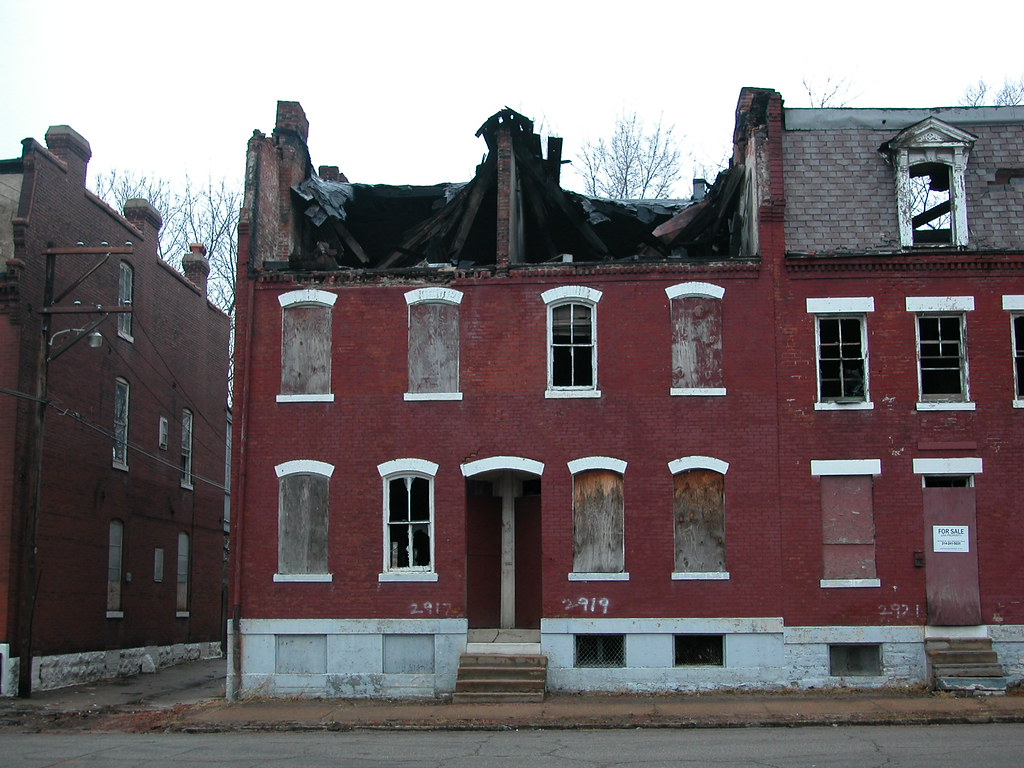
Above is the grim scene that I encountered two weeks ago after a blustery winter storm: the vacant city-owned building at 2917-21 N. 13th Street in Old North St. Louis had suffered a roof collapse. The building, built around 1880, stands one block north from my house in the densest section of a neighborhood famed for its loss of building density. Mt neighbors and I were aghast to see what misfortune had struck a vacant building already beset by misfortune.
The building and an adjacent building to the north form a graceful row that hugs the sidewalk line. Before, the buildings’ back walls had fallen. Loose bricks on the parapet of the alley side elevation had caused the Land Reutilization Authority to consider emergency demolition, but LRA backed off after the Old North St. Louis Restoration Group reminded LRA that they were trying to market the poor buildings for historic rehabilitation.
Now, the mansard roof with its two dormers had completely collapsed outward and the flat roof above had fallen inside of this part of the row. But again the Restoration Group acted quickly. Development Coordinator Karen Heet fended off the Building Division and managed to get the debris out of the public right-of-way (a favorite demolition excuse) within 24 hours of the collapse.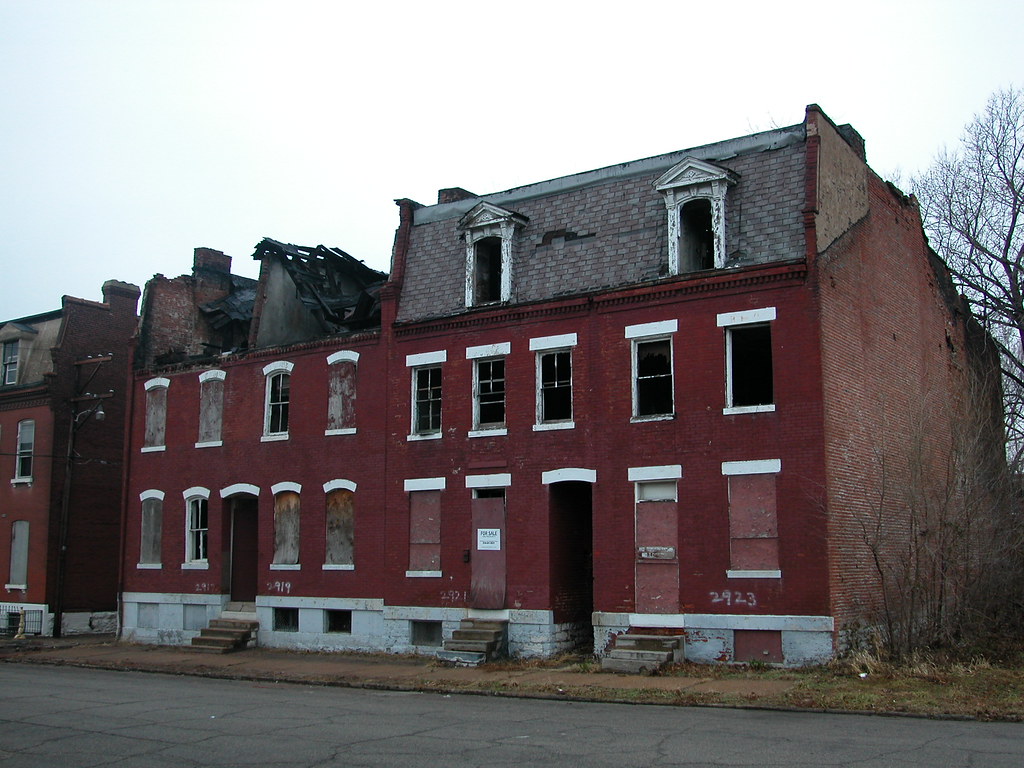
Karen has posed a very interesting idea for reusing the buildings. A look at the rear of the row helps underscore her logic.
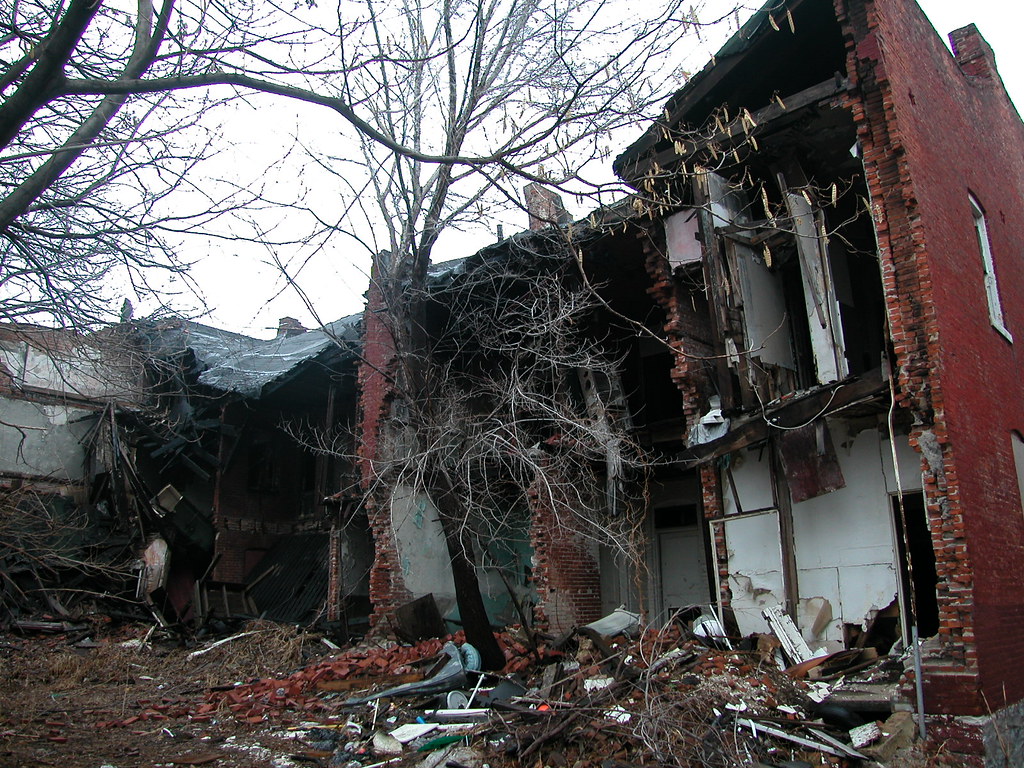
Rather than try to rebuild the buildings, which have lost significant building material, Karen would like to try something else. She suggests demolishing the interiors and retaining only the front and side elevations. Inside, a developer could build a new building on the old foundations using the existing brick walls as facades. The new building could be modular and modern, allowing Old North to offer a different housing unit while retaining the impressive street face of this row. I think that idea is worth attempting.
There are many historic buildings in the city with severe damage that are ineligible for historic rehabilitation tax credits. Some of these buildings are located outside of historic districts and are never going to eligible for such designation. Others are buildings that once were contributing to historic districts but have had so many sections collapse their rebuilding would count as “reconstruction” and not “rehabilitation” and thus would be ineligible for both state and federal historic rehab credits. Still others are badly remuddled old buildings that don’t count as contributing resources in districts.
In such cases, a straightforward attempt at replicating the old building fabric may be cost-prohibitive or simply limiting. The old Archigram concept of using masonry walls as armaments for modular housing offers an intriguing solution to situations where we have a pretty wall and little else. In other cases, more of the original building may be retained than in others. The important thing is that we don’t commit to a dichotomy in which the only common form of rehab is the tax-credit project and the only alternative is demolition for new construction. There is a full spectrum of architectural options, and saving any of the embodied energy in an old building at all is far more green than starting completely fresh.
Anyone interested in purchasing and rebuilding the buildings on 13th Street can call Karen at 314-241-5031.
More information on the row, including earlier photographs, can be found here.
by Michael R. Allen
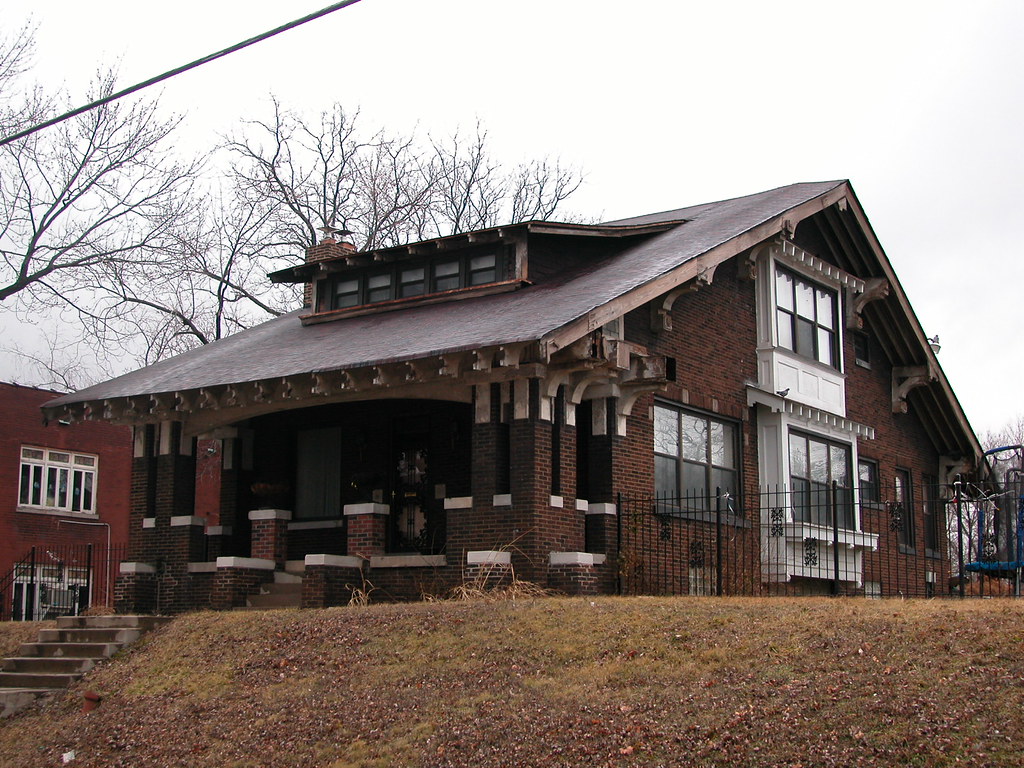
While photographing a building across the street for work, I stumbled across this Craftsman gem on Ridge Avenue (just west of Hamilton Avenue) in Wells-Goodfellow. The size of the brackets on the porch end of the roof is incredible. Brackets, half-timbering and wide gable roofs were hallmarks of the Craftsman style, which was part of the revival style craze that dominated American residential architecture between 1890 and 1930. The Craftsman style drew upon the Arts & Crafts movement as well as historic rural European vernacular styles. St. Louis has great examples in north and south city, especially west of O’Fallon Park and in Tower Grove South.
Coincidentally, this home is only a few blocks from one of the city’s most prominent Craftsman landmarks, the Wellston Station at 6111 Martin Luther King Drive.

Under its wide roof, the Wellston Station provided covered boarding, and a shelter with waiting rooms and toilets, for the first fixed-track streetcars on Easton Avenue (now MLK). Wellston Station was the destination for the last streetcar run in the city’s history: the run of the Hodiamont street car in 1966. For years after that, the building served as a bus shelter, but the grandeur was out of scale with cash-strapped Bi-State. Bi-State aimed to convert the building to a farmers’ market, but in 2006 abruptly turned it over to the Land Reutilization Authority. In May 2007, the National Park Service placed the Wellston Station on the National Register. That designation has not yet led to redevelopment, although a burger joint still rents the front end of the waiting room area. (The waiting room has always had a storefront at the street side.)
Two Craftsman gabled buildings in Wells-Goodfellow — one a domestic building, the other a remnant of a once-robust public sector economy. May they both be part of the city’s future.