Categories
Dutchtown Events People South St. Louis

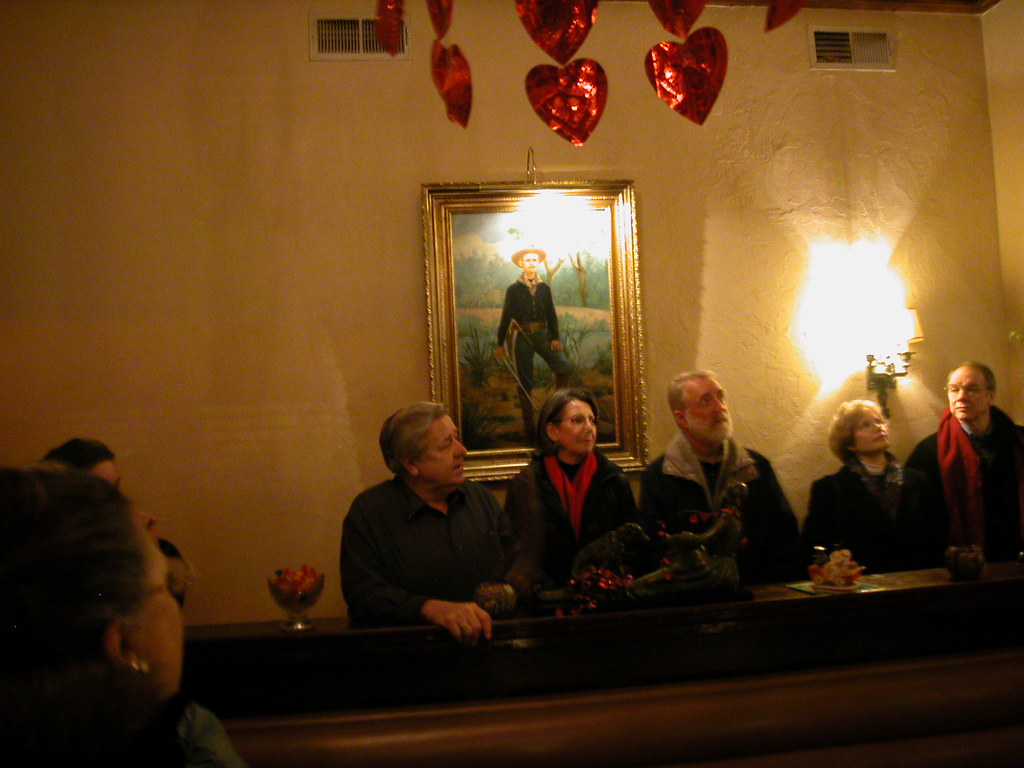
Feasting Fox Hosted SAH Chapter Gathering

by Michael R. Allen

Marty Luepker recounts the rehabilitation of the Feasting Fox.

 
On Sunday February 10, our local Missouri Valley Chapter of the Society of Architectural Historians convened their annual gathering at the Feasting Fox restaurant in south St. Louis. Many people attended the gathering — and joined the chapter — for the first time. NiNi Harris opened the gathering with an account of the long battle to preserve the Feasting Fox, a historic tavern and restaurant built in 1913 and designed by Klipstein and Rathmann for Anheuser-Busch. Owners Marty and Sue Luepker then led a tour of the restaurant before attendees returned to the Gretchen’s Inn building next door for dinner and the annual slide show.

Attendees enjoyed fine food and drink, including scrumptious chocolate cake, before the customary slide show by chapter members. The slide show always features a wide variety of architectural topics and locations. This year’s was no exception, including presentations on endangered buildings in Gary, Indiana, a Greek Revival farm house in Missouri, Theodore Link’s Monticello Female Seminary campus in Godfrey, Illinois, frame homes in Tower Grove South, the Cathedral of Trash in Austin, Texas and others. In fact, the show went longer than allotted time and will be continued next year!

The chapter is a very welcoming group and publishes a splendid newsletter filled with members’ research and timely event listings; for membership details, contact Esley Hamilton at EHamilton@stlouisco.com.

Categories
Architecture Housing Midtown

Art House Could Help Grand Center Come to Life

by Michael R. Allen

Would you believe that there could be an attractive row of contemporary townhouses within a short walk of Grand Avenue in Midtown?

Behold the Art House, proposed for construction on Grandel just west of the perpetually-under-rehabilitation Merriwether House. Sage Homebuilders is the pioneering company daring to build actual housing in “Grand Center.” Forum Studio designed the townhouses.

So far, you can only see it in a Flash animation on your computer. Hopefully soon you will be able to walk through the completed buildings themselves and enjoy the smart views their generous windows will create.

Despite many visible failings in historic preservation and urban planning, somehow Midtown has attained two of the finest contemporary buildings in the city, the Pulitzer Foundation for the Arts and the Contemporary Art Museum buildings. Art House would add one more unique contemporary building to the confused Midtown landscape. Amid parking lots and surviving historic buildings, perhaps we will find a crop of thoughtful, elegant, humanely-scaled residential architecture. If Art House can prove its own success by selling quickly, Grand Center’s longtime refusal to seriously consider the need for residents might start to wither as other developers get in line.

As we have seen downtown, a healthy market cuts through bureaucracy pretty quickly — and solidly on the side of more people, more buildings and more life.

Categories
Architecture Historic Preservation LRA North St. Louis Old North

A Middle Path?

by Michael R. Allen


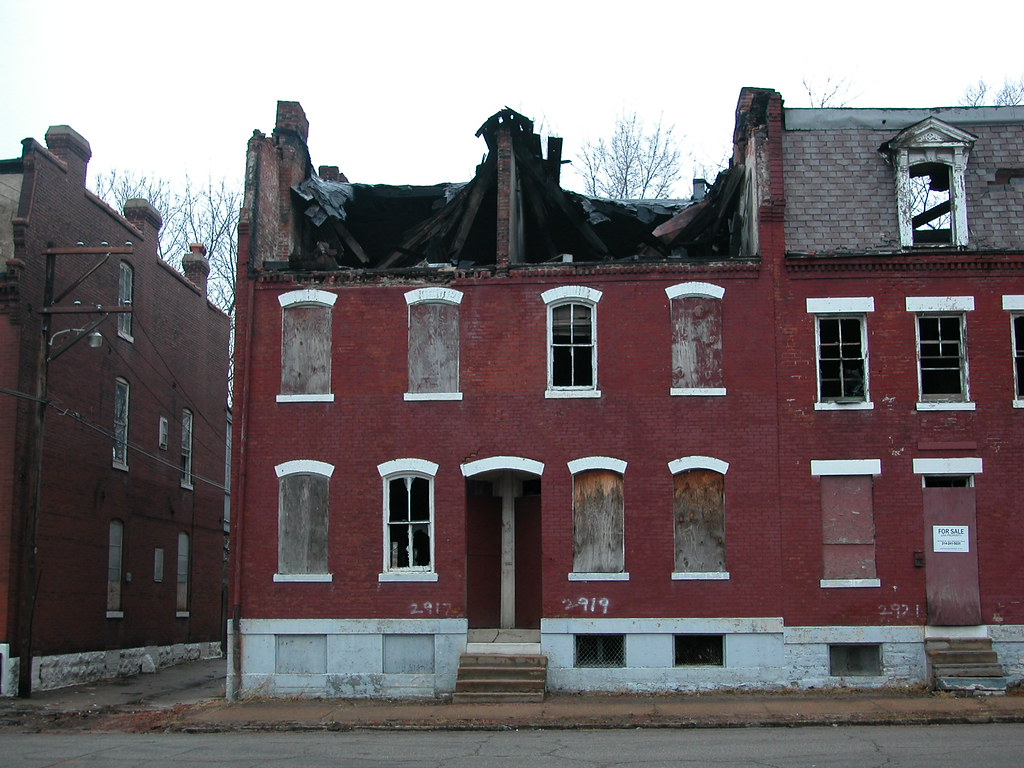
Above is the grim scene that I encountered two weeks ago after a blustery winter storm: the vacant city-owned building at 2917-21 N. 13th Street in Old North St. Louis had suffered a roof collapse. The building, built around 1880, stands one block north from my house in the densest section of a neighborhood famed for its loss of building density. Mt neighbors and I were aghast to see what misfortune had struck a vacant building already beset by misfortune.

The building and an adjacent building to the north form a graceful row that hugs the sidewalk line. Before, the buildings’ back walls had fallen. Loose bricks on the parapet of the alley side elevation had caused the Land Reutilization Authority to consider emergency demolition, but LRA backed off after the Old North St. Louis Restoration Group reminded LRA that they were trying to market the poor buildings for historic rehabilitation.

Now, the mansard roof with its two dormers had completely collapsed outward and the flat roof above had fallen inside of this part of the row. But again the Restoration Group acted quickly. Development Coordinator Karen Heet fended off the Building Division and managed to get the debris out of the public right-of-way (a favorite demolition excuse) within 24 hours of the collapse.
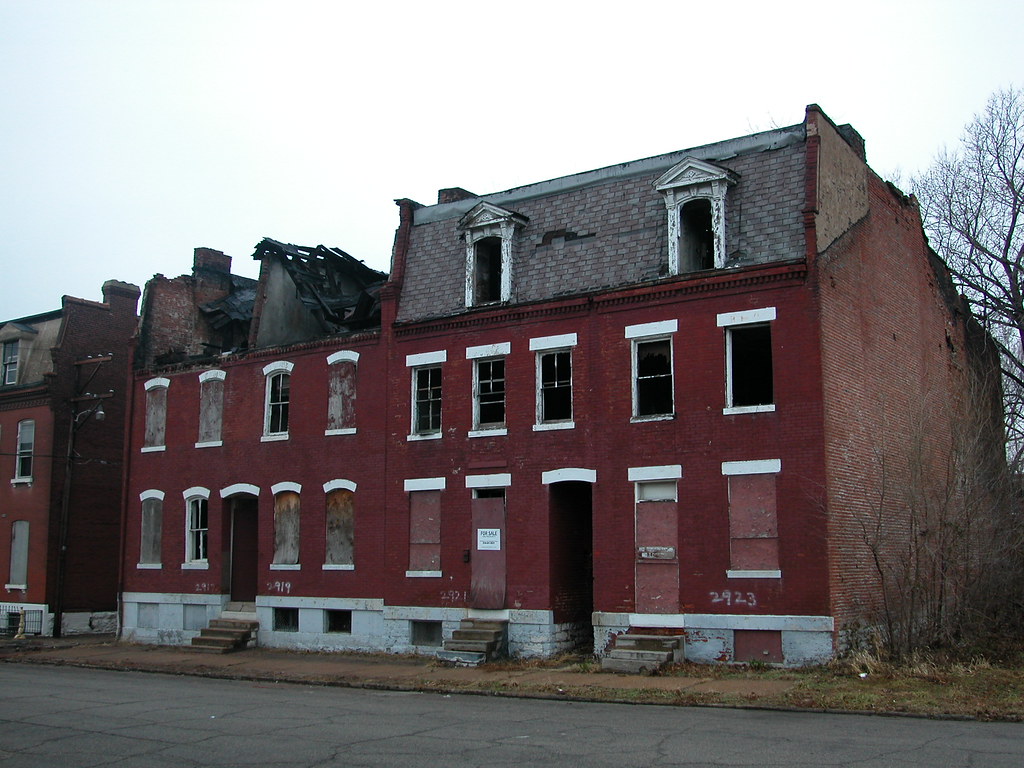
Karen has posed a very interesting idea for reusing the buildings. A look at the rear of the row helps underscore her logic.
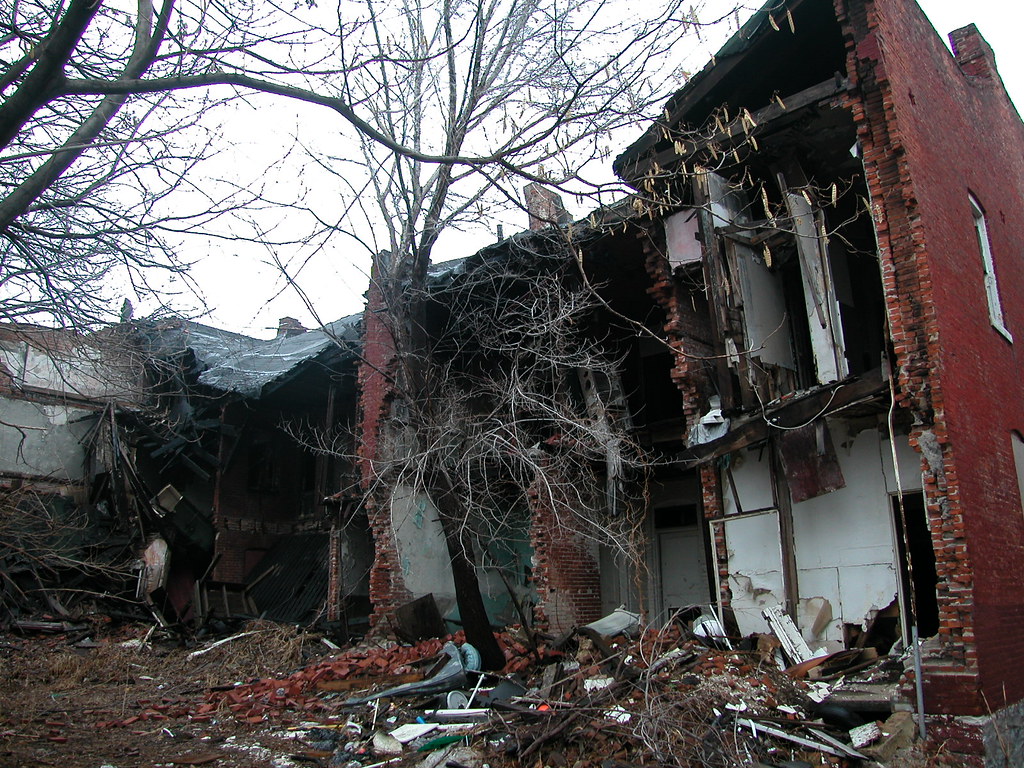

Rather than try to rebuild the buildings, which have lost significant building material, Karen would like to try something else. She suggests demolishing the interiors and retaining only the front and side elevations. Inside, a developer could build a new building on the old foundations using the existing brick walls as facades. The new building could be modular and modern, allowing Old North to offer a different housing unit while retaining the impressive street face of this row. I think that idea is worth attempting.

There are many historic buildings in the city with severe damage that are ineligible for historic rehabilitation tax credits. Some of these buildings are located outside of historic districts and are never going to eligible for such designation. Others are buildings that once were contributing to historic districts but have had so many sections collapse their rebuilding would count as “reconstruction” and not “rehabilitation” and thus would be ineligible for both state and federal historic rehab credits. Still others are badly remuddled old buildings that don’t count as contributing resources in districts.

In such cases, a straightforward attempt at replicating the old building fabric may be cost-prohibitive or simply limiting. The old Archigram concept of using masonry walls as armaments for modular housing offers an intriguing solution to situations where we have a pretty wall and little else. In other cases, more of the original building may be retained than in others. The important thing is that we don’t commit to a dichotomy in which the only common form of rehab is the tax-credit project and the only alternative is demolition for new construction. There is a full spectrum of architectural options, and saving any of the embodied energy in an old building at all is far more green than starting completely fresh.

Anyone interested in purchasing and rebuilding the buildings on 13th Street can call Karen at 314-241-5031.

More information on the row, including earlier photographs, can be found here.

Categories
Architecture Historic Preservation LRA National Register North St. Louis Wells-Goodfellow

Two Craftsman Buildings in Wells-Goodfellow

by Michael R. Allen


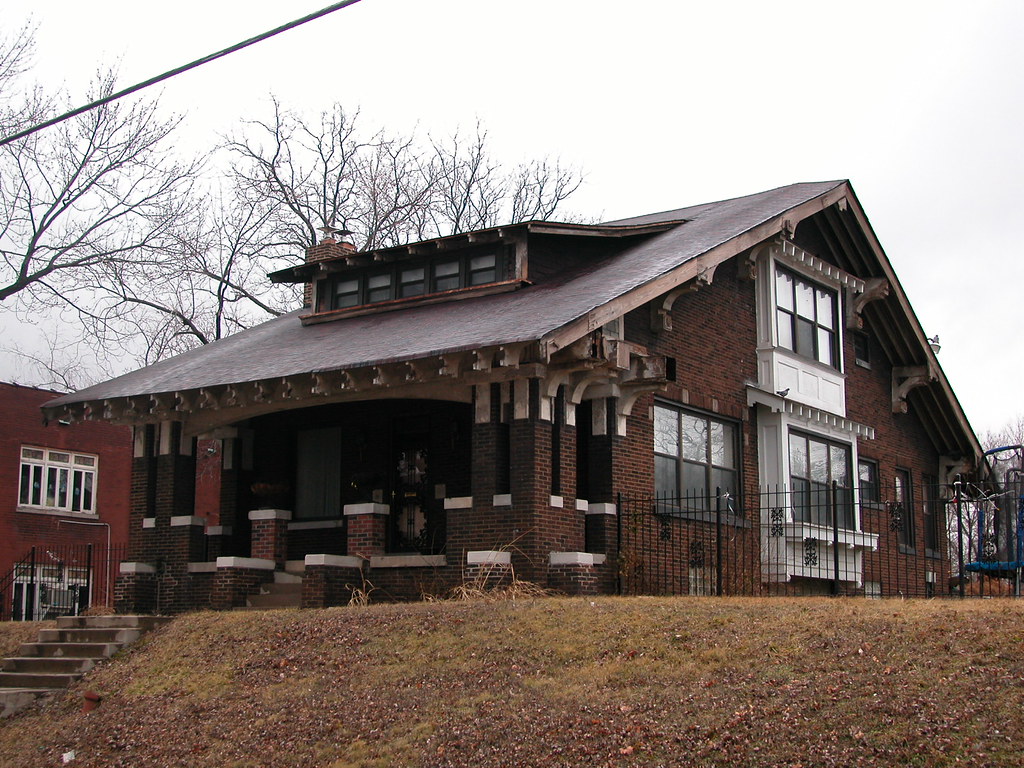
While photographing a building across the street for work, I stumbled across this Craftsman gem on Ridge Avenue (just west of Hamilton Avenue) in Wells-Goodfellow. The size of the brackets on the porch end of the roof is incredible. Brackets, half-timbering and wide gable roofs were hallmarks of the Craftsman style, which was part of the revival style craze that dominated American residential architecture between 1890 and 1930. The Craftsman style drew upon the Arts & Crafts movement as well as historic rural European vernacular styles. St. Louis has great examples in north and south city, especially west of O’Fallon Park and in Tower Grove South.

Coincidentally, this home is only a few blocks from one of the city’s most prominent Craftsman landmarks, the Wellston Station at 6111 Martin Luther King Drive.


Photo by Rob Powers for Built St. Louis

I don’t know much about the house on Ridge, but I co-wrote the National Register of Historic Places nomination for the Wellston Station. The Station was built in 1911 and designed by Martin Arhelger for the St. Louis Transit Company, the streetcar arm of United Railways. United Railways held the monopoly on mass transit in the city until 1963 when it was subsumed into the Bi-State Development Agency.

Under its wide roof, the Wellston Station provided covered boarding, and a shelter with waiting rooms and toilets, for the first fixed-track streetcars on Easton Avenue (now MLK). Wellston Station was the destination for the last streetcar run in the city’s history: the run of the Hodiamont street car in 1966. For years after that, the building served as a bus shelter, but the grandeur was out of scale with cash-strapped Bi-State. Bi-State aimed to convert the building to a farmers’ market, but in 2006 abruptly turned it over to the Land Reutilization Authority. In May 2007, the National Park Service placed the Wellston Station on the National Register. That designation has not yet led to redevelopment, although a burger joint still rents the front end of the waiting room area. (The waiting room has always had a storefront at the street side.)

Two Craftsman gabled buildings in Wells-Goodfellow — one a domestic building, the other a remnant of a once-robust public sector economy. May they both be part of the city’s future.

Categories
Academy Neighborhood Demolition Historic Preservation North St. Louis

Another Fine Building on Page Boulevard

by Michael R. Allen


The original version of the agenda for the January 28, 2008 meeting of the St. Louis Preservation Board included an appeal of staff denial of demolition of the commercial building at 5100 Page Boulevard. This building stands just east of another building whose fate on the same agenda, 5286-98 Page. The final agenda did not include the appeal. Whether or not it returns is up to the owner of the building, Rosie Love.

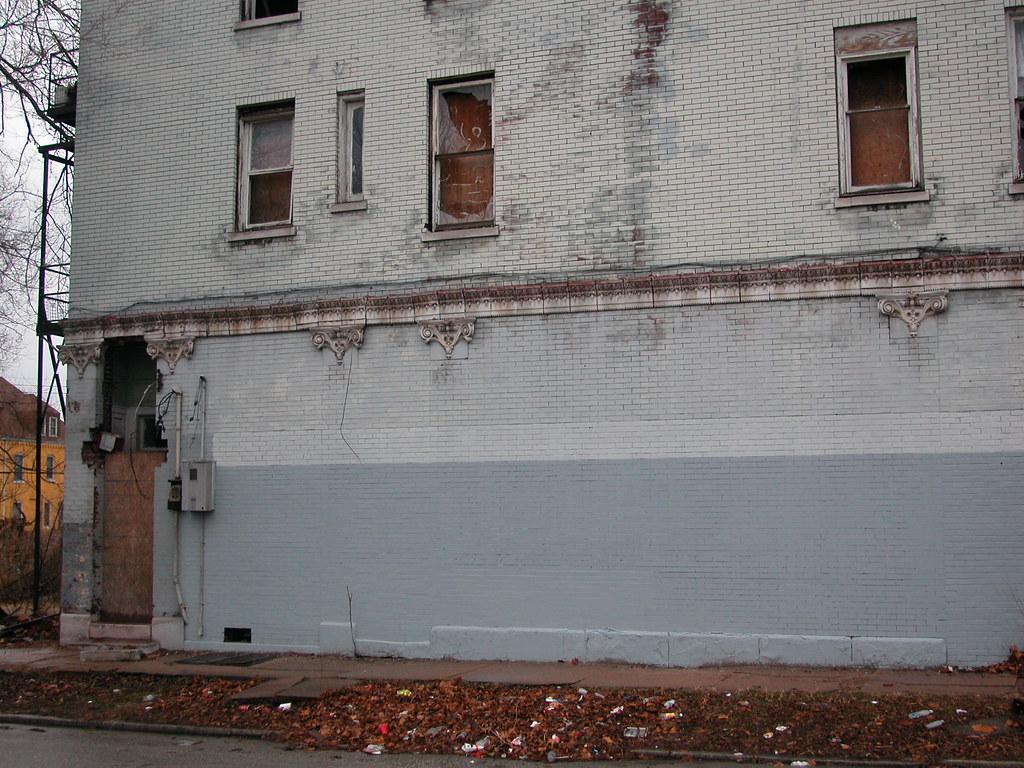
Curiosity sent me to look at the building. I was pleasantly surprised to find a sturdy three-story building with a mansard-style roof and lovely masonry details. The stepped-down parapet alongside the mansard gives the corner some pizazz, while a terra cotta cornice below the mansard has an eye-catching swag garland motif. The brick cornice on the secondary east elevation adds a less formal vertical line.


What is perhaps most intriguing is the bricked-in storefront configuration on the east wall. Under a continuous cornice with an egg-and-dart pattern are some strange capitals; these top brick false pilasters that run vertically between the storefront opening. Looking at the painted wall closely, one can see the distinct vertical lines between the pilasters and the infill. How wonderful it must have been to have the storefront opened up to both the main and side streets!

The building is, of course, vacant and deteriorating. It’s been empty for some time. Geo St. Louis shows records of an occupancy permit for a convenience store in 1995 and a permit for a “grandfathered pay phone” in 1998.

The front wall has some damage at the cornice line, while missing downspouts on the rear elevation has caused severe mortar erosion. Still, there are no collapsed wall sections yet. Numerous buildings in worse condition have been spared demolition by the Cultural Resources Office and the Preservation Board.

The Academy neighborhood (and the Mount Cabanne-Raymond Place National Historic District that encompasses much of the neighborhood) needs its commercial edges to remain strong. Delmar on the south has become a lost cause, but Page retains many corner commercial buildings like this one and the one at 5286-98 Page, which bookend rows of historic residences. With its proximity to the Central West End and its largely intact building stock, this area is bound to be an emergent rehabbing neighborhood. We need to keep the neighborhood’s buildings around for the new day ahead.

Categories
Illinois Metro East Southern Illinois Theaters

Edwardsville Plans to Restore The Wildey

by Michael R. Allen

The St. Louis Post-Dispatch reports that Alderman Rich Walker of Edwardsville, Illinois, has launched both a campaign to restore The Wildey theater and a public history project on the theater. The City of Edwardsville purchased the theater in 1999 and plans to raise an estimated $3 million for restoration work. It’s admirable to see a city government willing to invest in its cultural resources.

Categories
People

Bettis In, Stanley Out

by Michael R. Allen

The Cultural Resources Office of the City of St. Louis hired Robert J. Bettis to the newly-created Preservation Planner position. Most recently working for the Commercial Development Department of the St. Louis Development Corporation, Bob worked for several years as the Certified Local Government Coordinator for the Kansas State Historic Preservation Office. I’m gratified to see Bob’s experience and talent matched with CRO. Bob joins an office of experienced — and overworked — professionals comprised of Director Kathleen Shea, Preservation Administrator Jan Cameron, Preservation Planner Andrea Gagen and Administrative Assistant Adonna Buford. CRO once had additional full-time positions, but lost them during downsizing in 2002. It’s great to have CRO regain its capacity.

Meanwhile at 1015 Locust, Planning and Urban Design Director Rollin Stanley celebrated his last day on January 31. Stanley is off to head planning operations for Montgomery County, Maryland. No word yet on when Planning and Urban Design will begin the search for Rollin’s replacement. The agency actively seeks a Community Development Research Analyst, though.

Categories
Architecture CORTEX Historic Preservation

Old Printing Building Slated for Demolition as Part of CORTEX

by Michael R. Allen

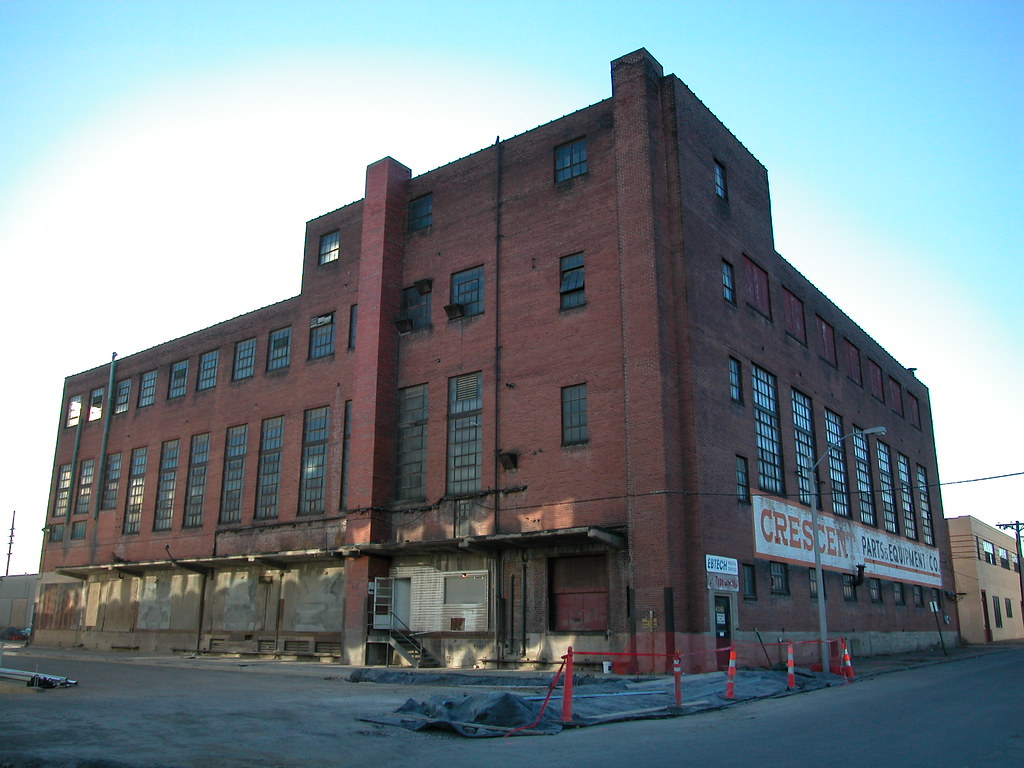
Washington University recently purchased this building, located at 4340 Duncan Avenue in the central corridor. The university’s master plan for the Medical Center calls for demolition as part of the CORTEX redevelopment project. Although unadorned, and perhaps a bit sepulchral, the brick industrial building possesses several unique architectural features. Built in 1936 for a printing company, the building is the work of the noted firm Mauran, Russell and Crowell. The firm employed its characteristic genius here. While the concrete-framed fireproof building appears as a four story building, the second and third floors are actually a second floor and mezzanine. This arrangement allowed for production using machinery with overhead components on the second floor and distribution on the first floor, with loading bays lining the east wall (see the photo above). The floor arrangement allowed for the building to have a smaller footprint, saving room and creating a more urban form. The mezzanine arrangement is reflected in tall exterior windows that call to mind the same firm’s earlier Federal Reserve Bank Building (1924) at Broadway and Locust downtown.

In 1946, the St. Louis Post-Dispatch acquired the building and put it to use printing its popular Sunday lifestyle magazines. The Post expanded the building in 1959. In recent years, the building housed Crescent Electrical Supply. The former owner recently began clearing the building in preparation of its impending demolition. The loss is a shame. The lack of lavish ornament no doubt seals the fate, but that same quality gives the building an appearance consistent with its original use. While not a masterpiece, the building is a handsome modern industrial composition that is an important part of the character of Duncan Avenue. Besides, the building is almost built with adaptation in mind. All we need is a little imagination — the sort of big thinking that led our leaders to envision CORTEX in the first place.

Categories
Downtown Events

Gateway Mall Lecture on Sunday

Michael Allen will be giving the opening lecture in this year’s Friends of Tower Grove Park lecture series.

What: “Making Parks in the Central City: The Challenges of the Last 100 Years”: I will discuss the history of various plans for introducing the Gateway Mall into downtown St. Louis, from the early City Beautiful-era Comprehensive Plan in 1907 to the current Master Plan. There will be many slide illustrations.

When: Sunday, February 3 at 3:00 p.m.

Where: Stupp Center, Tower Grove Park

FREE. Lecture will be around one hour in length.

Categories
Architecture Historic Preservation Midtown Storefront Addition

Thoughts on Storefront Additions

by Michael R. Allen

Sometimes I wonder if the mid-twentieth century practice of adding storefront sections to the front of historic homes is a St. Louis phenomenon. Certainly, we have many interesting examples here on major east-west streets like Delmar, Natural Bridge, Cherokee and Forest Park. These are symptoms of explosive population growth and changing land uses.

The example shown here is located at 3808 Olive Street, between Spring and Vandeventer, in Midtown. (The Central Apartments stood across the street.) Here we have a limestone-faced Queen Anne home dating to the 1890s. The architect may be Jerome Bibb Legg, a prolific residential architect who designed the other home remaining on this desolate block; Legg’s name appears as owner or architect on several building permits on this block.

In front we have a pressed-brick storefront from the middle part of the twentieth century. A door at right leads to the original entrance of the home. This photo does not show the quirky gesture in which the builder reused stone from the porch to build a side wall that connects the house to the storefront.

Weird? Yes. Useful? Also, yes. While not a candidate for listing on the National Register of Historic Places as a 19th century house, the hybrid building offers some interesting potential for reuse. Perhaps the alteration of the house itself could make it eligible for National Register listing. What is needed is a local survey of such storefront-bearing houses, followed by national comparison. This strange building could be a treasure!