Categories
Historic Preservation

“St. Louis Labor History Tour” Online

by Michael R. Allen


Searching for a copy of the difficult-to-find St. Louis Labor History Tour this week, we should have known where we would find it: on the Internet, and on the editor’s own website! Rosemary Feurer’s excellent website Labor History Links has the booklet online in PDF format. St. Louis Labor History Tour was edited by Feurer with contributions by Dave Roediger, Marilyn Slaughter, Lon Smith and Diana Young. The 27-page booklet was published in 1994 and 1996 by one St. Louis Bread and Roses, Inc.

St. Louis Labor History Tour tells, among others, the stories of the “Washington Avenue Massacre,” a 1900 incident in which three striking streetcar workers were killed by an upper-class posse; the telephone operators’ efforts to unionize Southwestern Bell between 1913 and 1919; and, one of the biggest forgotten tales, the unemployed marches on City Hall in the 1930s.

Categories
Adaptive Reuse Historic Preservation Mid-Century Modern Midtown New York City

New York Project Suggests Direction for Hotel on Forest Park

by Michael R. Allen

Today The Architect’s Newspaper carried a story that poses a suggestion to St. Louis, by way of New York. In “Tower Twists and Preservationists Shout”, Alan G. Brake tells the tale of a proposed design by architect Morris Adjmi in the Gansevoort Market Historic District on Manhattan.
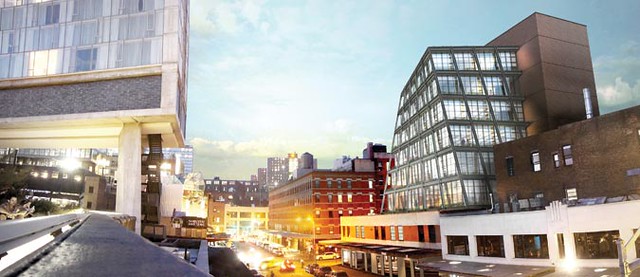
Taconic Investments hired Adjmi to design a seven-story condominium-and-retail structure placed on top of an art moderne market building. The building, dating to 1938 and enjoying no singular official distinction, is at 13th and Washington inside of a local historic district. Hence, Adjmi’s plan for a slightly twisted tower with sloped grid walls had to be approved by the Landmark Preservation Commission last month. The Commission debated the proposal but failed to find a majority for or against the plan.
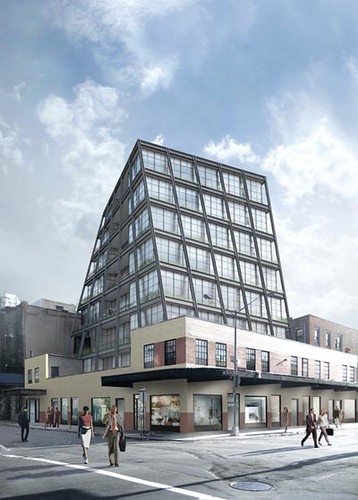
What was reassuring was that the Commission spent time debating how appropriate the tower was to the area, which is a former meat market district with mostly low-rise buildings (except for the tower straddling the High Line across the street, outside of the historic district boundary). This is why I thought about St. Louis as I read the article.
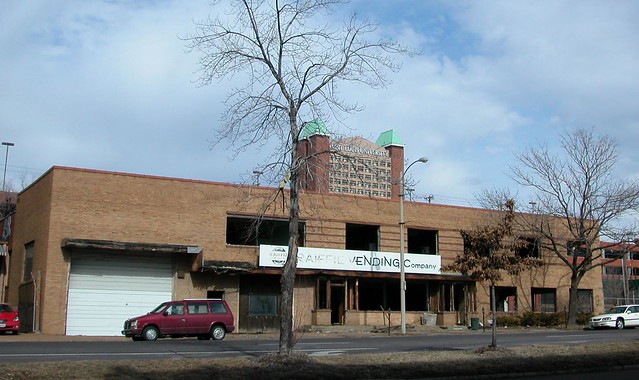
Twice in the last two years, our Preservation Board considered the demolition of a simple two-story art moderne building, the old Raiffie Vending Building at 3663 Forest Park Boulevard in Midtown. The two-story building dates to 1948 and has a handsome, plain buff brick face. The building is a fine contributing player in the industrial district of Forest Park Boulevard west of Grand, but it has little individual historic or architectural distinction.

The Sask Corporation has owned the building for several years and bought it to build a chain motel on the site. In August 2009, the Sasak Corporation proposed the design shown above to the Preservation Board ( see “More Urban Is Not Always Better”, August 11, 2009). The Board denied demolition on a preliminary basis. While the Raiffie building is not in any historic districts, it is in a Preservation Review area, the 17th Ward.
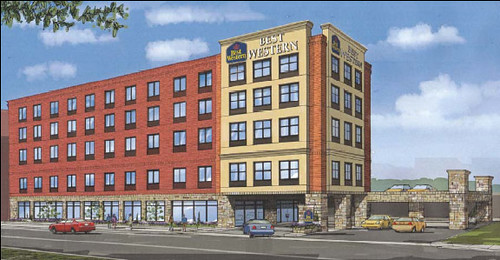
In September 2010, Sasak Corporation came back to the Preservation Board with an even less inspired plan, shown above. The Best Western had “better” materials than the 2009 plan, although its red brick panels, stucco corner and strange stone base were a regression from the previous rendering.  The Preservation Board approved demolition contingent on Sasak securing a building permit for the Best Western.  That has not happened, although Sasak applied for a demolition permit on November 15th.

Morris Adjmi may have to tone down his Manhattan design, but he would be welcome to try it at 3663 Forest Park in St. Louis. Here we have a building without singular significance outside of a local historic district that has already been approved for demolition. What a great candidate it would be for a thoughtful, provocative building rising from its center or rear. Midtown has a small skyline of tall buildings in which a new high-rise would not be inappropriate. In the case of the Best Western, the most elegant and expensive-looking front — cost of the hotel has been a concern among Midtown players — is the building that is already there. The hotel developers could very well use it, and do something imaginative above.
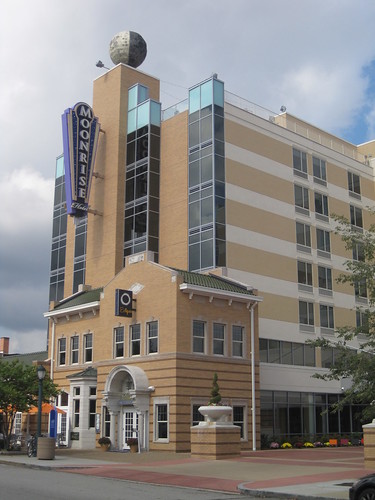
A parting thought on the subject: The Moonrise Hotel on Delmar already attempted to use an existing facade to hide a rather programmatic hotel high-rise from a smaller-scaled business district. This was not a very successful endeavor. The hotel and the old Ronald L. Jones Funeral Home building have little real relationship, and besides, the funeral home itself was actually demolished and imprecisely reconstructed. The reconstruction shows, and something modern would have been better.

On Forest Park, a modern high-rise addition to the old Raiffie Vending building could avoid the mistakes of the Moonrise by leaving whatever part of the building to be retained in place, to keep its historic character as best as possible. If New York turns down Morris Adjmi, maybe St. Louis would welcome his work here — or elsewhere.

Categories
Historic Boats

Goldenrod Showboat Video Released

Tyler LaVite has produced the short video The Goldenrod Showboat: A Short History, now posted on YouTube. Take a look:

Categories
North St. Louis Northside Regeneration St. Louis Place

Northside Regeneration Still Buying

by Michael R. Allen

Make no mistake about the fact that Northside Regeneration LLC continues to buy property. On October 27, the Recorder of Deeds recorded seven purchases by Northside Regeneration (and signed by Eagle Realty’s Harvey Noble) at a Sheriff’s land tax sale held on October 8. All of these properties are vacant lots.

The properties and sales prices are:

  • 1822 N. 22nd Street ($707)
  • 3510 N. Jefferson Avenue ($5,000)
  • 2714 Madison Avenue ($1,456)
  • 2331 Hebert Street ($783)
  • 2323-25 Hebert Street ($717)
  • 2301 Hebert Street ($688)
  • 2329 Hebert Street ($717)
  •  
    The amounts paid are whatever bid was needed to win the property. In most cases at the Sheriff’s sale, there is only one bid. In that case, the amount paid is the minimum price equal to the amount of unpaid land tax. Purchasing property at a Sheriff’s sale is much easier for a private citizen than going through the Land Reutilization Authority (LRA). All a winning bidder needs to do to secure the property is to have cash on hand to pay on the same day. No aldermanic approval or redevelopment plans are needed.

    The properties on Hebert were owned by the Pyramid Companies for their development of single-family homes east of Sullivan Place. Some of the houses were built. While other Pyramid properties passed to creditors or investors, these simply sat without their taxes paid for three consecutive years. Pyramid had partnered with McEagle Properties to develop housing at WingHaven in O’Fallon, Missouri before the two companies abruptly parted ways.

    Categories
    Historic Preservation Public Policy

    Next Year’s Federal Preservation Funding Uncertain

    From Preservation Action

    With still no FY 2011 spending bills passed, and the federal government operating on a continuing resolution that was set to expire today, late last night Congress passed yet another resolution extending FY 2010 funding levels until December 18th.

    A permanent path for FY 2011 funding levels is still unclear. Between now and the 18th, Congress will continue to argue over several possible scenarios:

  • A year-long Continuing Resolution that would fund the entirety of FY 2011 at FY 2010 levels. (Could be good for preservationists because it would rescue the Save America’s Treasures (SAT) and Preserve America (PA) programs as well as restore funding to National Heritage Areas – all of which were gutted in the Administration’s proposed budget. This would, however, face opposition from legislators who seek spending cuts. There is also a chance that the CR might include some specific cuts.)
     
  • An Omnibus spending bill that would include all 12 individual appropriations bills. (A wild-card for preservationists because individual spending bills have yet to be passed and, in many cases have yet to even have Committee action. This means we don’t know how well our programs will fair. Over the summer, the House Subcommittee on Interior Appropriations stated that they “restored” funding for SAT, PA and Heritage Areas, but specific numbers have not been shared.
     
  • A Continuing Resolution funding the government through February or March at FY 2010 levels. (Another wild-card not only for preservationists but for any program uncertain of how it will be treated in the 112th Congress, which is expected to be focused upon spending cuts.) Some legislators have threatened that if this comes to pass, they would fight for a final FY 2011 spending bill that would include cuts back to 2008 budget levels. This would mean an approximate 15% cut to SHPO funding and a 20% decrease in THPO funding, but would provide level funding for SAT and an approximate 63% increase for PA.
  • Categories
    Downtown

    Railway Exchange Building Idea Bounce

    From RCGA:

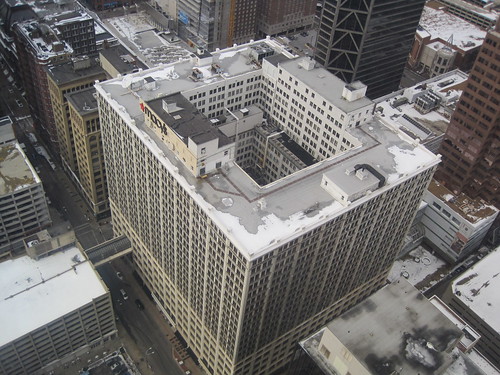
    The St Louis design community has a unique opportunity to brainstorm and collaborate. Macy’s downtown location is downsizing its footprint in the Railway Exchange Building, the 1,000,000 square foot former HQ for May Co./Famous Barr. Current owners RKMerlyn Development and Bruce Development are seeking ideas to develop several floors of the building, a space of 100,000 square feet! St Louis has a rich history in creative entrepreneurship, and we are seeking ideas on how this space may be utilized to create a dynamic, collaborative incubator for design ideas. The core may be an incubator for fashion designers, but who do you think could be included in that space to create a rich environment of creativity and collaboration?

    The RCGA and Partnership for Downtown will host an “open house” in the space on Wednesday, December 1, from 5 – 8PM so you can get a feel for the history and possibilities of the space. Then on Wednesday, December 8, the Skandalaris Center will host a “Design in St Louis” IdeaBounce®. We invite you to post ideas for the space on www.ideabounce.com. When you do, check off “Design Entrepreneurship” in the industry box, and we will invite you to bounce your idea on December 8. All are welcome to both the open house and IdeaBounce®. On December 8 we will include an “open mic” period for people who may not have posted their idea on www.ideabounce.com, but we encourage you to post to start to connect with the innovators and entrepreneurs who can help you get started.

    No need to register for the Open House on December 1, but please do register for the December 8 IdeaBounce® at http://www.ideabounce.com/contact/events.php.

    Categories
    Columbus Square North St. Louis Northside Regeneration Signs

    Cass Bank Sign Missing

    by Michael R. Allen

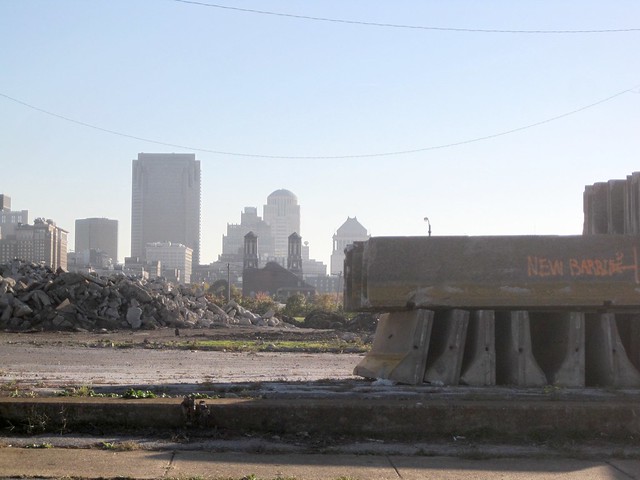
    There have been more than a few changes around the intersection of North Florissant Avenue, 13th Street and Cass Avenue lately. In the past, I have lamented the destruction of the Crunden Library at 14th and Cass and the Brecht Butcher Supply Company buildings on Cass, noted (with a degree of lament) the fiery loss of an old bus maintenance garage on 14th and recently observed the National Register of Historic Places nomination for the old Cass Bank and Trust Company Building at 13th and Cass. Once upon a time, before a change in plans in 2007, I protested the proposed ramp system feeding the Mississippi River Bridge that would have cut right across the intersection and severed downtown from Old North forever.

    Oh, and then there is the whole matter of Northside Regeneration! A lot can change a small area in five years’ time.  Northside Regeneration, then known as Allston Alliance LC, purchased the old Schnucks store on Cass Avenue and eventually persuaded the Missouri Department of Transportation to route the bridge landing across that site to connect with Tucker Boulevard.  Tucker is now being rebuilt by the removal and infill of the Illinois Traction System cut upon which it was built in 1932.

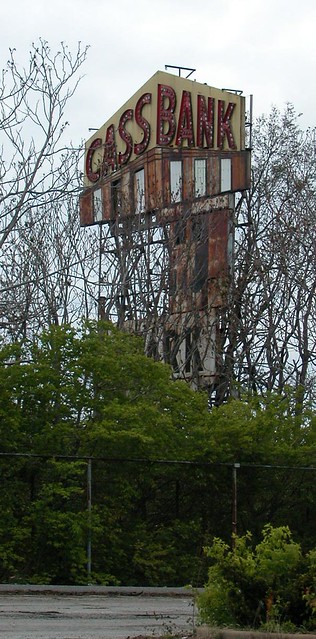
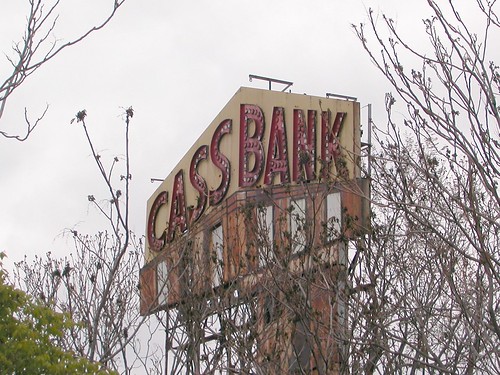
    All of those big changes entailed removal of a very small thing, the once-shining Cass Bank sign that faced the northbound interurban trains of the Illinois Traction System.  The sign was incandescent, with bulbs placed in channels spelling the bank’s name.

    Deposit with us, the sign beckoned to all those yearning for a place to put their hard-earned money. All others could enjoy its bright lights which would have shone in the fall-winter dusk on their ride home from downtown.

    The lights went out years ago, after the trains stopped running in 1956, but the Cass Bank sign stood amid the jungle growing from the cut.

    Standing behind the current Cass Bank home on North 13th Street, the sign was in the way of the new bridge-to-Tucker connection. And it disappeared earlier this year. Does anyone know what happened to it? Could its pointed wedge have been spared as a reminder of part of the history of a site now flattened into the future?

    Categories
    Forest Park Infrastructure South St. Louis

    The Harnessed Channel: How the River Des Peres Became a Sewer

    by Michael R. Allen

    Versions of this article were published in Common Ground, Spring 2003 and the already-missed Creative St. Louis, March 2010.

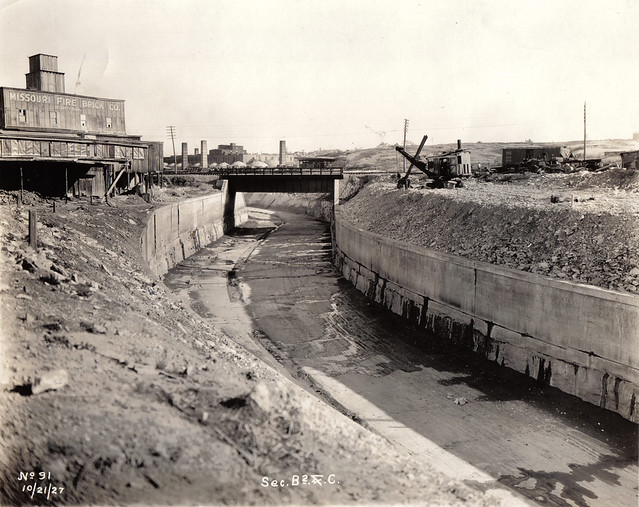
    The River Des Peres channel in the Cheltenham area of the city, 1927. Source: File softhe City Plan Commission.

    Along the southwest edge of the city of St. Louis, Missouri runs a six-mile curve of what appears to be a river with paved banks. This river is usually dry and rarely filled to even half its capacity. Covered in rip-rap and white stones along this six miles, the banks form a visual boundary of the city limits — although the actual city line is several hundred yards west. Still, the moat-like river creates an effective border between the middle-class parts of the county and city that occupy either side of it. Yet this river actually unites them, because it carries away all of their wasted water and, deep below its channel, their sewage. The river is the River Des Peres, a harnessed channel that was transformed from a natural waterway into a massive civil engineering project in the early twentieth century.

    Of course, the River Des Peres is not simply a deep gorge that carries away waste water from the city and its inner suburbs. In fact, it now lies almost completely underground and is not visible at all. In a 1988 booklet published by the Metropolitan Sewer District (MSD), the quasi-governmental agency that has controlled the river since 1956, an anonymous author writes that “the rocky banks of the River Des Peres form a landmark which nearly every St. Louisan recognizes, but few understand.” Few Saint Louisans realize that its 18 miles extend along over half of the city’s western edge, covering a drainage area of 115 square miles and serving a population of over 535,000 people. It enters the city at Skinker Boulevard and Vernon Avenue at the University City limits and then winds its way through Forest Park and into the familiar open section that drains into the Mississippi River. Along the way, it carries both storm water and sewage in separate pipes with connections to most major city and inner-suburban trunk sewers. It is the backbone of the St. Louis sewer system.

    Very few residents recognize that the River Des Peres became the backbone of the St. Louis sewer system by having its natural state completely rebuilt so that none of its original features remain. No living person likely remembers the days when all of it was an open and wild, albeit polluted, waterway that St. Louisans happened to dump sewage into. And few accounts describe its earlier incarnation as a pure waterway far from the French settlements on the Mississippi River. In those days, the idea of the River Des Peres becoming one of the largest regional civil engineering projects in the Midwest would have seemed strange. Yet St. Louisans slowly converted the small river into their largest sewer over the course of more than a hundred years, so most of the changes were hardly noticed until the river was already irreversibly controlled by engineers looking to drain unwanted materials from the young city of St. Louis.

    Categories
    Mid-Century Modern St. Louis County

    Lambert Airport Main Terminal, 1968

    by Michael R. Allen

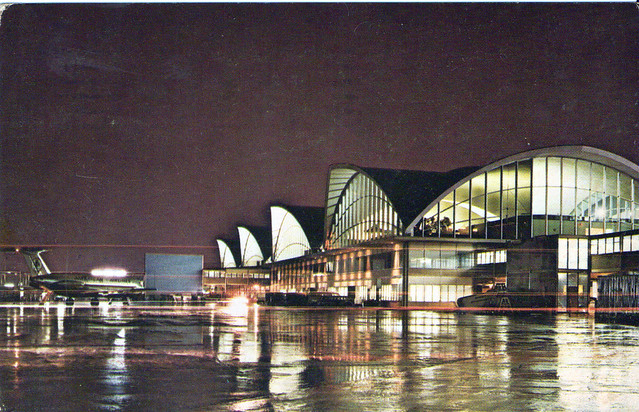
    One can almost smell the jet fuel exhaust in this vivid night time postcard view of the Lambert Airport Main Terminal Building from 1968. Streaks of red record the passage of jets on their way to and from what was then a hub for passenger travel. Behind all of the hustle and bustle, then as now, was modern architecture’s first American airport terminal masterpiece.

    Completed in 1956, Lambert’s terminal and its thin-shell concrete domes designed by Minoru Yamasaki of Hellmuth Yamasaki and Leinweber became the forerunner of jet-set terminal style. At John F. Kennedy and Dulles, Eero Saarinen would carry this high standard forward.  Other architects joined the pursuit to create enobling, structurally progressive modern terminals until the drama — and peculiar bliss — of airline travel would be mushed into a middling realm of tepid architecture, placeless chain-shop concourses, discount carriers and clumsy, invasive security procedures. But in St. Louis, at least we still come and go at Lambert, where the sublime remains part of the spatial experience.  Happy travels this weekend!

    Categories
    Forest Park Southeast Preservation Board

    Preservation Board Approves Split on Arco Avenue; Denies SLU High Appeal

    by Michael R. Allen

    From left: 4225 Arco, 4223 Arco, 4221 Arco and 4217 Arco.

    Yesterday, the Preservation Board voted unanimously to accept the Cultural Resources Office (CRO) staff recommendation to approve demolition of the one-story brick houses at 4223 and 4225 Arco Avenue and deny demolition of those at 4217 and 4221 Arco. CRO Preservation Administrator Jan Cameron testified that the structural failures of the side and rear walls of 4223 and 4225 Arco justified their demolition, but that the other houses are sound. Jim Morrison from Restoration St. Louis, the owner, argued for demolition of all four — a position endorsed by Alderman Joe Roddy (D-17th) and Park Central Development Corporation. Landmarks Association of St. Louis Assistant Director Andrew Weil stood against Restoration St. Louis’ proposal and spoke in favor of the CRO staff recommendation.

    The group of houses is almost intact, save the sister house at 4219 Arco pushed to an early death without a building permit recently.  All of the houses on this block are contributing resources to the Forest Park Southeast Historic District, listed in the National Register of Historic Places in 2001.  According to the nomination, 4217, 4221 and 4223 are presumed to date to 1908 but 4225 dates to 1903.  The nomination’s authors did not locate builders or architects for the houses.