Categories
Art

S.P.O.R.E. Projects Call for Collaborators

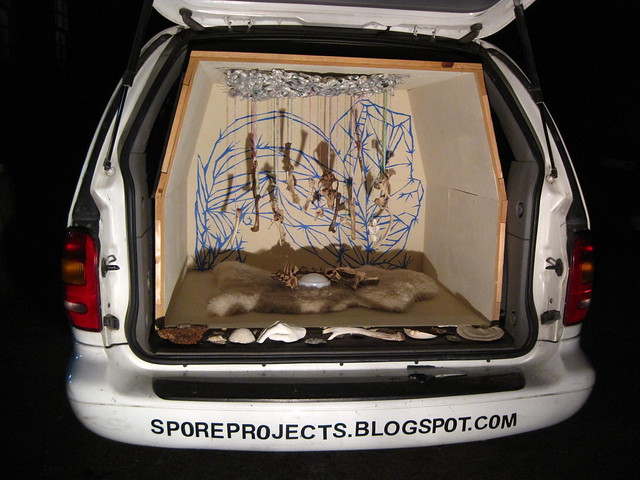
S.P.O.R.E. Projects, sponsor of the mobile gallery pictured above, is the brainchild of the amazing and talented Emily Hemeyer. Emily is one of those people who makes things happen anywhere she goes, and the mobile gallery — a repurposed white minivan — potentially has extended her reach across the entire nation.  The thought of Emily reaching the entire nation is intriguing.  There are so many connections to make in St. Louis, between St. Louis and other places, and between people in other places –  and it seems that Emily is going to make as many of these happen as possible.   –Michael R. Allen

Send proposal to Emily at ghostsihavebeen@gmail.com

Include in your proposal:
1. 3-5 jpegs of past work or website link
2. Concept outline. Including writing, drawings, video, and/or images.
3. List materials. These should be found, constructed or recycled.
4. Q- How the project will engage the community?

LOCATION: SPORE is presently located in St Louis, Missouri.

GALLERY MONTHS: Aug, Sept, Oct, Nov, Feb, March, April, May (off months- Dec, Jan, June, and July).

ARTIST RESIDENCY: We offer a communal 1-week residency w/ an “opening”, community share and/or performance for out-of-town artists and musicians. This includes studio access, housing, general materials, and use of a bike. Sliding scale donation of $50-$100 covers food, studio and housing costs.

MOBILE COLLABORATION: SPORE relishes collaborations in other communities. Exchanges can range from a weekend to short residencies.

NEEDS: Always accepting gifts of gas, maintenance, money, materials, and art for the archive. Currently looking for a projector and amplifier.

Categories
Belleville, Illinois Best Practices Chicago Illinois

Two Wayfinding Ideas from Illinois

by Michael R. Allen

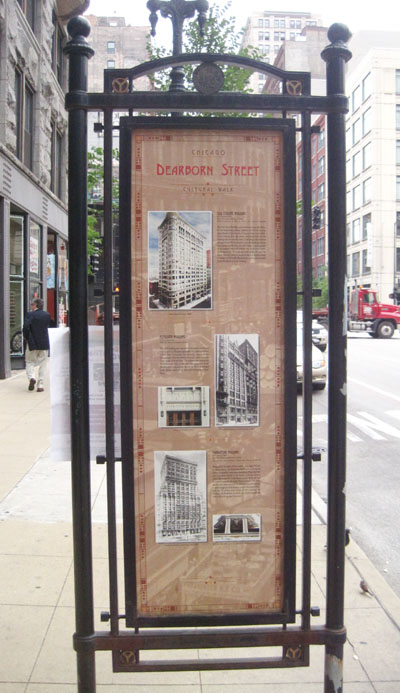
On a recent trip to Chicago, I came across the wonderful “Dearborn Avenue Cultural Walk.”  The “walk” is a self-guided architectural and cultural tour with information placed on illustrated signs along Dearborn.

Each sign contains information and historic photographs about the architecture and history of buildings on that block. Dearborn is one of Chicago’s most storied streets, so there is plenty of information. The photographs make it clear which building is which and what buildings looked like at other times (or what lost buildings looked like).

The elaborate sign boards could not have been cheap, but they are an excellent amenity. They are as easy to use for those seeking to take the whole “tour” as for someone just walking to work. The signs bring out more color from a very colorful street. St. Louis could stand to implement something similar. Downtown’s Olive Street would be a good test, because it is largely intact and still very densely built up. Washington Avenue would also be a good choice. Of course, both (and more) would be a good first choice, but cost certainly is a factor. Anyone interested?

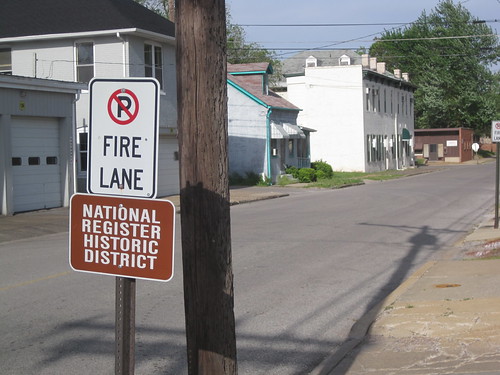
Closer to home, Belleville, Illinois has placed steel signs at the boundaries of the downtown area historic districts that read simply “National Register Historic District.”  The brown signs are placed near other road signs and thus underscore their recognition of what is an official status.

The Belleville signs do not include the historic district name or any other information, but they are a relatively economical, easy way of marking the special status of the city’s historic districts. These signs won’t guide tourists, but they do impress upon passers-by that there is something special about the neighborhood. Perhaps the signs instill some neighborhood pride in the status, too. Again, St. Louis might do well to grab this idea in some way. Anything that draws attention to our rich architectural heritage is good for cultural tourism and economic development — and we could use more of both.

Categories
North St. Louis Northside Regeneration

Hearing on Northside Regeneration Retrial Motion on September 24

Judge Robert Dierker, Jr. has set a hearing on Northside Regeneration’s motion for a new trial in Bonzella Smith et al. v. City of St. Louis et. al. for 9:00 a.m. on Friday, September 24 in Division 1.  Dierker issued his ruling in the case on July 2.  The ruling invalidated Ordinances 68484 and 68485 that gave Northside Regeneration LLC redevelopment rights and authorized issuance of tax increment financing for the company’ s proposed project.

Categories
Mid-Century Modern Missouri

Tan-Tar-A Turns 50

July 4th marked the 50th anniversary of the opening of Missouri’s Tan-Tar-A resort. The resort was the dream of St. Louis builder Burton Duenke, who was one of the pioneer builders of mid-century modern subdivision homes around St. Louis.

This summer The Lake Today published an article about the 50th anniversary that includes the story of Tan-Tar-A’s development: “Resorting to celebration”.

Thanks to Nathan Wilber for sharing.

Categories
Abandonment Collapse Gate District South St. Louis

Row House on Lafayette Avenue Slated for Demolition

by Michael R. Allen

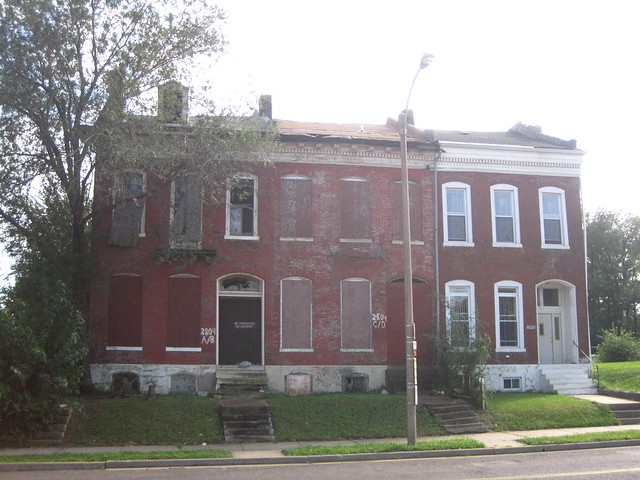
Only one of these three row houses at the southwest corner of Lafayette and California avenues in the Gate District is occupied. The photograph makes that obvious.  Built circa 1883, the row is one of the remaining historic buildings that provides architectural character to Lafayette Avenue west of Jefferson — character that, although diminished through substantial demolition, connects this section of the south side street to its eastern and western parts.  Lafayette Avenue has its gaps, but never on its entire run through the city does it lack any part of our city’s built heritage.

Yet all is not well with this row.

Last month, during heavy rain, a large crack developed in the eastern wall of the row’s easternmost house. Then the back section of the wall collapsed, leaving a gaping hole and the house without needed structural support. The wooden joists in brick row houses almost always run perpendicular to the side walls, so damage to these walls can be fatal.

Located at 2804 Lafayette Avenue, city records show that the house is owned by Mark S. Phillips care of Edward Wandrick. The Building Division has listed the house as vacant since 1998, and its adjacent neighbor as vacant from 1989-1991 and again since 2007. Yet given the rough condition and length of abandonment, one would be excused for mistaking it for a Land Reutilization Authority (LRA) building.

On September 7, Building Commissioner Frank Oswald approved an emergency demolition for the damaged eastern house. Of course, the house could be salvaged even now. After all, the side wall is only half-gone — a condition that means, of course, that it is half intact. And the other walls of the house are sound. A problematic factor for demolition is the connected middle house. Not only do the buildings share a common party wall, but the front elevation of all three houses is laid continuously. There is no straight seam between the row. Removal of part of it could destabilize the rest without masonry repair, and emergency demolitions don’t have masonry repair budgets.

Of course, the fate of the building has been under the control of its owners, and they have let the building quietly ride its course. If the building were owned by the LRA, perhaps other options would exist right now should the Gate District neighbors and the area’s alderwoman, Kacie Starr Triplett (D-6th), wish to pursue them. Perhaps the building would be rehabilitated instead of facing its death knell, or perhaps it would have been wrecked years ago. The only certainty is that preservation of long-vacant city buildings is far from scientific. Fortune, in the forms of passionate buyers or harsh sudden winds, make or break St. Louis’ fragile buildings.
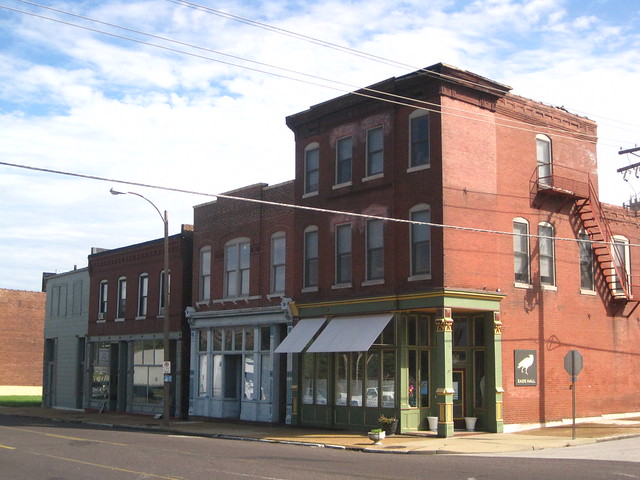
Although fortune has often cast a frown on the immediate area around the row on Lafayette, there is significant urban fabric remaining. Although the corner parcel next to 2804 Lafayette has long lost another dwelling and a corner store, across California to the east is a line of commercial buildings in good repair.  South on California are a few residential buildings and then Interstate 44.
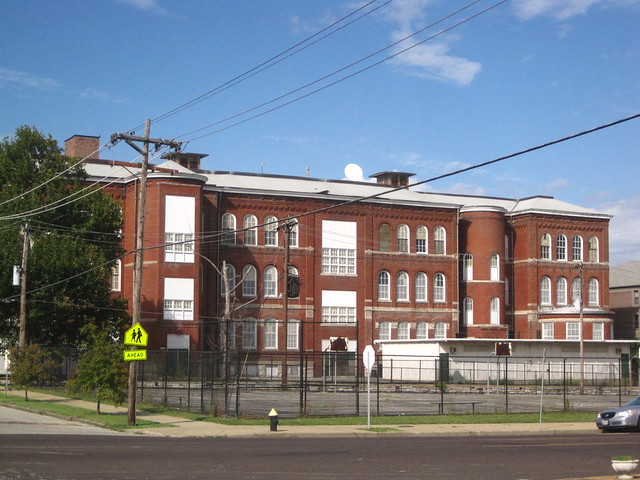
Across the street from those buildings is the imposing red-brick, Romanesque Revival Hodgen School of 1884. Designed by Otto J. Wilhelmi, the school may very well have educated young people who were raised at 2804 Lafayette. The closed school building awaits reuse.  Hodgen’s large school yard was created by razing a line of commercial buildings, an action which created a gap in the Lafayette Avenue street line.  One more gap is on the way.

Categories
Housing Mid-Century Modern National Register St. Louis County

Fenton House by Wright Associate Listed in National Register

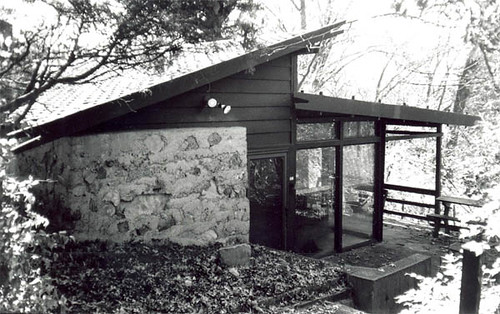
Photograph from the National Register of Historic Places nomination.

by Michael R. Allen

On July 8, the National Park Service placed the Carney-Keightley House near Fenton in the National Register of Historic Places. Located on Hawkins Road on the boundary line between St. Louis and Jefferson counties, the Carney-Keightley House is a unique local connection to the legacy of Frank Lloyd Wright. Completed in 1948, the house is the only known architectural work solely attributed to Richard Edgar Carney. Carney was a fellow at Taliesin, Wright’s school for architects, and served as Wright’s personal aide from 1952 through 1959.

Jill O’Neal, owner of the Carney-Keightley House, prepared the National Register nomination. O’Neal describes the house as “unpretentious, modest, natural, economical, unassuming, authentic and totally American.” This is not surprising given that Carney designed the house in accordance with Wright’s Usonian principles for house design.  Those principles included compact layout with open living area, placement of the house on a concrete slab, respect for and harmony with the contours of the house site, use of sloped or flat roofs, use of affordable, often mass-produced materials and attention to energy efficiency through careful fenestration. The Carney-Keightley House is only 1,000 square feet and sits on a slab on a wooded site. The house is clad in local stone and redwood and has large windows, screened by the overhangs of the sloped roofs, that emphasize natural light. Carney’s work is a delightfully compact Usonian home that is a totally original work of architecture.

Read the nomination here.

Categories
Metro East Mid-Century Modern Neon Theaters

Traces of Route 66 on Chain of Rocks Road

by Michael R. Allen

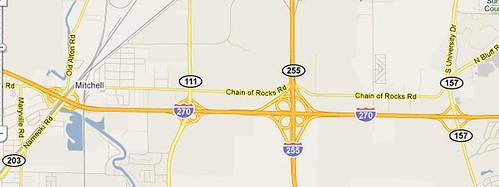
One of the St. Louis sections of the historic Route 66 is the two-lane Chain of Rocks Road in Madison County, Illinois.  Between Highway 157 at the west and Highway 203 at the east, passing through Mitchell, the modest road has a surprising number of remaining signs and buildings from the Route 66 heyday.  Chain of Rocks Road was part of Route 66 from the start in 1926 until 1929, when the river crossing was shifted from the Chain of Rocks Bridge to the Municipal Free (later MacArthur) Bridge and then again from 1936 until 1955 when the crossing was moved to the new Veterans’ Memorial (later Martin Luther King) Bridg

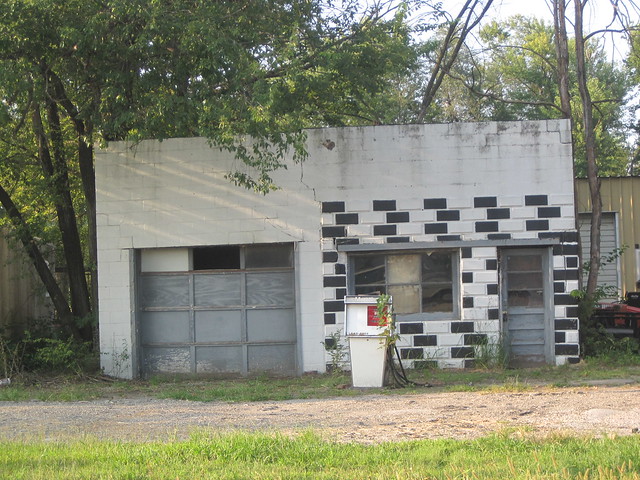
Starting at the east and moving west, one of the first Route 66 era landmarks is this concrete block gas station on the north side of the road.  The black and white paint checkerboard marks the earliest section of a building that was later expanded.

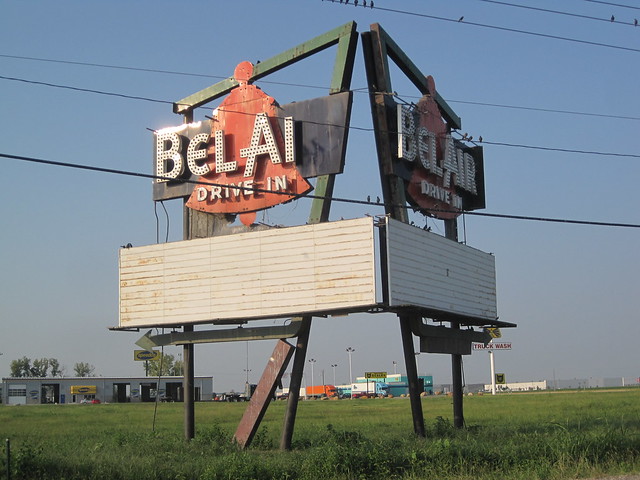
One of most impressive signs on Chain of Rocks Road is the old Bel Air Drive In sign, which faces an uncertain future.  One of the large letters is already missing, but the sign’s bell still rings out with a swanky mid-century design.  One of the metro east’s largest, the Bel Air Drive In opened in 1953 and could accommodate 700 cars.  Mid-America Theatres built the Bel Air.  The drive-in was so successful that the owners added a second screen in 1979, but times changed rapidly before the theater’s closure in 1986.  Wreckers took down the theater buildings in 1991, and the site is now partly built out as an industrial park. The owner of the land has expressed interest in either retaining the sign on site or selling it, according to a 2007 Belleville News-Democrat article.  Originally, the sign had a channel silhouette on each bell and then incandescent bulbs spelling out the Bel Air name.

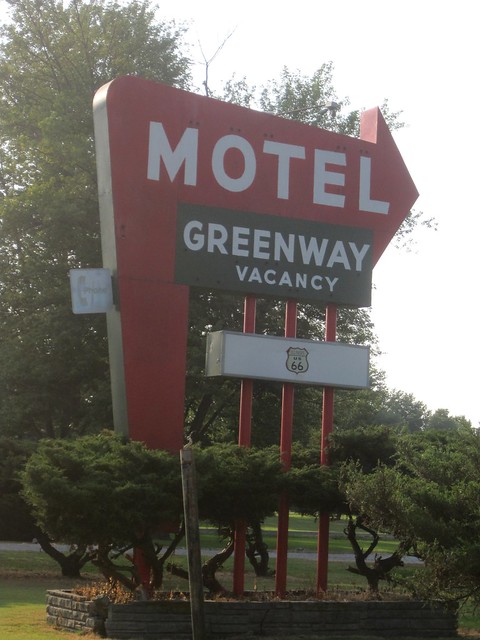
The Greenway Motel and the Apple Valley Motel remain in operation despite less traffic on the old Route 66. The Greenway sign is now bereft of its channel-letter neon tubing, but it is well-maintained and retains its historic two-tone paint scheme.


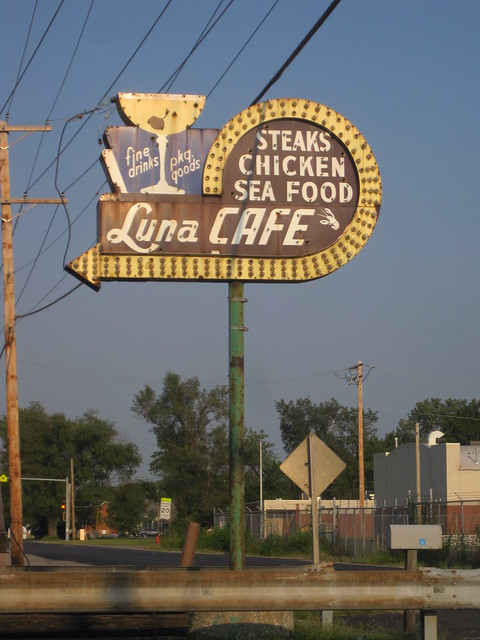
The Luna Cafe to the east pre-dates Route 66, and is located in a sprawling frame building from the 1920s. The sign went up later.  The martini glass takes the eye on a swirling journey along an arrow pointing at the cafe.  Time to pull over for refreshment!

Categories
Illinois Peoria Public Policy

Illinois Tries a Pilot Historic Rehab Tax Credit, for One Project

by Michael R. Allen

Although last year’s effort to pass an Illinois state historic rehabilitation tax credit did not pass the legislature, a very specific pilot program did pass and receive Governor Pat Quinn’s signature. Senate Bill 2534 created a one-time 25% tax credit against the income of the owners of the historic Pere Marquette Hotel in Peoria (1927). The $40 million rehabilitation project that the owners have started must follow the Secretary of the Interior’s Standards for Historic Rehabilitation in order to receive credits.

Yesterday the Peoria Journal Star published the article “Preservationists watching hotel pilot project in Peoria”, a good analysis of the pilot program and the larger effort to pass a statewide tax credit. There are obvious questions. Is the tax credit “pilot” really a pilot if the legislature does not pass the statewide credit? Why choose one $40 million project in a larger city instead of several smaller projects totaling $40 million across the state? Did the owners of the hotel make political headway that other owners will never make?

The “pilot” project is a good one, but there are so many others across the state equally worthy of the state’s consideration. All will create jobs and generate local sales and income tax revenues. The legislature should pass a credit open to all. If Illinois cannot afford a 25% credit, the legislature should look at a different figure that the state can. Missouri’s tax credit program is the model used by Illinois legislatures that crafted last year’s bill. One of the reasons the tax credit is a model is because it is open to all who qualify and the application process is not subject to approval by or the influence of elected officials. Illinois’ first attempt to create a historic tax credit greatly underscores that fact.

Categories
Historic Preservation Public Policy

White House States Support for CLEAR Act and Historic Preservation Fund

From Preservation Action

At the end of July, a statement from from the White House was quietly released (in fact so quiet, most of us completely missed it) in which the the President expressed his support for the CLEAR Act, H.R. 3534. In his “Statement of Administration Policy,” which includes support for several oil spill prevention and off-shore drilling measures, the very last paragraph states that “The Administration strongly supports funding for land and water conservation and historic preservation projects that prioritize the needs of the Nation based on competitive process.”

While it is still unclear just how much of a priority historic preservation is to the Administration, this is a good starting point, and one we can use to bolster our arguments to the Senate for inclusion in their version of the CLEAR Act. For the president to understand the economic benefits of historic preservation that speak directly to “the needs of the Nation” during this difficult time is a huge boon to our campaign for full funding of the HPF.

The administration has not previously shown open support of historic preservation; demonstrated most clearly by the FY 2011 budget cuts to eliminate funding for Save America’s Treasures and Preserve America, and greatly reduce funding for National Heritage Areas. Preservation Action and our members need to continue working hard to make sure our voice is heard and kept on the executive radar. The best ways to act are continuing to provide feedback to the America’s Great Outdoors initiative, contact your Senators and ask them to support HPF in the energy bill, S. 3663, and to help broaden our network by reaching out and finding new members for Preservation Action.

Categories
McRee Town South St. Louis

4343 McRee Avenue Offered for $1

by Michael R. Allen

Tom Pickel, Executive Director of the Garden District Commission is offering the unique house at 4343 McRee Avenue for $1:

The Garden District Commission, a community-based non-profit, owns a unique historic house at 4343 McRee Avenue in the Botanical Heights neighborhood that is threatened with demolition. The GDC would very much like to see the building preserved and rehabbed and is prepared to deed it for $1 to a capable rehabber. Must have the skills, experience and funding to undertake a substantial project. The building is located within the Liggett & Myers National Register Historic District and 10-year tax abatement is available. The re-use of the property could be either residential or commercial.

You will be hearing much more about development in Botanical Heights in the coming months and this is a great opportunity to be part of some exciting things.

Interested buyers can contact Tom Pickel at Thomas.Pickel@desaleshousing.com.

The house enjoys one of the most unique sites in the neighborhood.  It sits on the south side of the intersection of east-west McRee Avenue and an alley that runs parallel to diagonal Vandeventer Avenue.  Consequently, the house has a wedge-shaped profile with a delightful rounded corner.

According to Lynn Josse, who wrote the National Register of Historic Places nomination for the Liggett and Myers Historic District, the house dates to 1892 and is one of the most peculiar examples of the Queen Anne style in the district.

However, the house at 4343 McRee Avenue is part of a group of three Queen Anne-influenced eclectic houses on the south face of a lovely block.  The house is just down the block from the building at Tower Grove Avenue and McRee recently rehabilitated to house Urban Improvement Construction and Central Design Office, firms operated by Brent Crittenden and Sarah Gibson.  Just one block east onthe 4200 block of McRee, UIC and CDO are working on a redevelopment plan to construct 12 new houses and rehabilitate 16 others.  That momentum makes 4343 McRee Avenue a great investment.