Categories
Chicago Downtown

Blair Kamin in St. Louis

by Michael R. Allen

Chicago Tribune architecture critic Blair Kamin turns his Cityscapes blog toward St. Louis. Today’s introductory post includes this provocative assessment of Busch Stadium: “a retro ballpark that is too competent and context-driven to hate, but too bloated to love.” Stay tuned for more.

Categories
North St. Louis Old North

Help Transform an Old North Yard in Ten Seconds

by Michael R. Allen

This lot at 13th & North Market is the site of the house of the twenty-fourth mayor of St. Louis, Henry Overstoltz (term, 1876-1881). Since Graham and Viveca Lane started rehabbing the building next door, it has become the couple’s future side yard. Geothermal excavation made the long-time vacant lot even less yard-like, but Graham and Viveca have a shot at turning the situation around right quick.

This yard is a contestant in KSHE’s Great Green Yard contest. The station is picking the top five this week, so our Old North rehabbing friends need you support. Take ten seconds to vote for their project here.

Categories
Historic Preservation Public Policy

U.S. House Fully Funds Historic Preservation Fund

by Michael R. Allen

Yesterday by a vote of 209-193 the United States House of Representatives passed the Consolidated Land, Energy, and Aquatic Resources (CLEAR) Act of 2010 (H.R. 3534), sponsored by Representative Nick Rahall (D-WV). The CLEAR Act is important to historic preservation efforts because it included the first-ever full annual appropriation of $150 million to the federal Historic Preservation Fund (HPF), one of the conservation funds funded by offshore oil lease revenues. The HPF and the Land and Water Conservation Fund (LWCF) have been funded through lease revenues since the 1980s.

The HPF provides federal money available to state and tribal historic preservation offices through matching grants for preservation planning, architectural survey, educational programs and other activities authorized in the Historic Preservation Act of 1966. Certified Local Governments — like St. Louis, Kirkwood and Chesterfield to name a few locals — can apply for funds through state historic preservation offices. The HPF, created in 1976, allows local budgets to stretch.

The U.S. Treasury Department estimated that the balance in funds that can only be appropriated to the HPF at $2.7 billion in Fiscal Year 2009. Previous Congresses have authorized anywhere from one-third to two-thirds of the $150 million annual appropriation that Congress authorized in 1974.

Categories
Downtown North St. Louis Northside Regeneration

Northside Regeneration and City Museum Now Neighbors

by Michael R. Allen

The big story this week is that Paul J. McKee Jr.’s Northside Regenation LLC filed a post-trial (well, post-ruling) request for a new trial to Judge Robert Dierker, Jr. The City of St. Louis apparently is joining the request. On July 2nd, Dierker invalidated the two city ordinances that constituted Northside Regeneration’s redevelopment agreement with the City of St. Louis.

Not mentioned in recent news reports is the fact that Northside Regeneration is still buying property for its project.  The most recent purchase brings Northside Regeneration’s holdings directly into downtown. On June 4, the company closed on a nearly $2 million purchase of a large parcel containing a warehouse building located at 1424 Dr. Martin Luther King Drive. (The parcel is highlighted on a Geo St. Louis map below.)

If that address is not familiar, its surroundings will be: the parcel is one block north of the City Museum, and for the last few years its parking lot has been home to a changing assortment of fire engines, school buses and even the original cupola of the City Hospital’s Administration Building.

Categories
Adaptive Reuse North St. Louis Old North

14th Street Mall in 1991

by Michael R. Allen

On Thursday, July 29th, the Old North St. Louis Restoration Group and the Regional Housing and Community Development Alliance will cut the ribbon on Crown Square, the new name for the former 14th Street Mall. The public is invited to the celebratory event, which runs as a street party until 8:00 p.m. Indeed, there will be an actual paved street on the two blocks of 14th and Montgomery streets for the first time since 1976.

Not much time passed after the 14th Street Mall grand opening on March 21, 1977 before the street closure started having negative impacts on the businesses of the dense commercial district. Storefronts devolved to lesser uses and ultimately entire buildings went vacant. Within ten years, the 14th Street Mall was a failure, and by the early 1990s was a symbol of the decay of the near north side. No longer.

A look back at photographs taken in 1991 by Cindi Longwisch, then Assistant Director of Landmarks Association of St. Louis, shows dire conditions. That we are celebrating rebirth of the collection of historic buildings 19 years later is nothing short of miraculous. A few of the buildings on 14th Street in the two blocks did not survive the mall years, but most did.
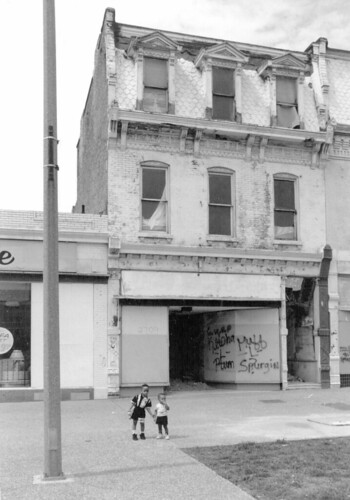
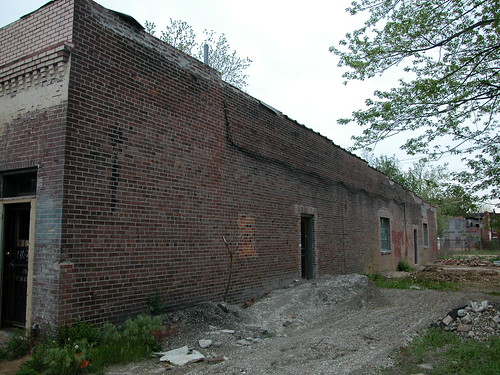
The building at2709 N. 14th Street, shown above, was one that did not survive. However, the buildings to either side have been fully rehabilitated as part of Crown Square.
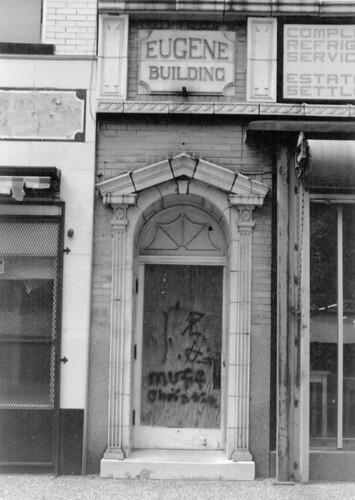
The Eugene Building at the southwest corner of 14th and Monthgomery has an ornate entrance and extensive colorful catalog terra cotta ornament. The building is now fully rehabilitated as part of Crown Square.
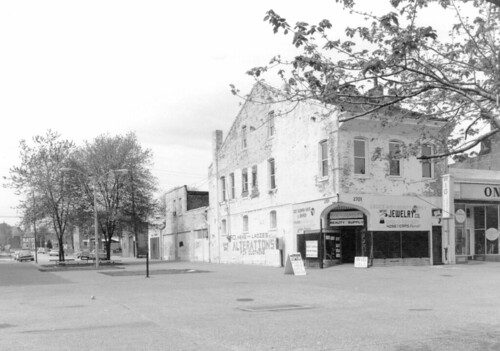
The building across the street from the Eugene Building, at the northwest corner of the intersection, as been extensively rehabilitated by owner Peter Sparks. Work is not yet complete, but the transformation is beautiful.
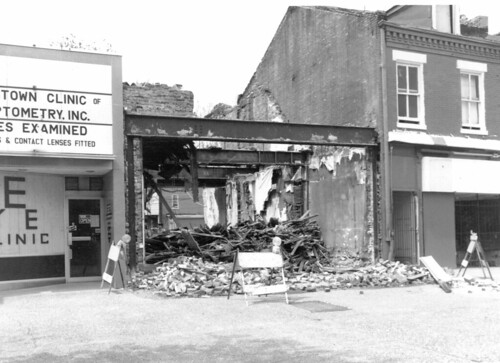
Demolition of the building at 2715 N. 14th Street was underway with Cindi Longwisch took this shot. The heavily altered one-story building at left, 2713 N. 14th Street, was demolished as part of the Crown Square project.

Categories
Central West End Hospitals Preservation Board

BJC Seeking Demolition of Jewish Hospital Nursing School Building

by Michael R. Allen

UPDATE: The Preservation Board unanimously voted to deny the demolition on a preliminary basis.  Board Member David Richardson made the motion to deny, and Melanie Fathman provided the second.  Anthony Robinson voted “aye” and Chairman Richard Callow abstained from voting.  Mary Johnson arrived after the vote.

At the meeting of the Preservation Board today (Monday, July 26), the board will consider preliminary approval of demolition of the College of Nursing Building at the Washington University Medical Center. BJC Healthcare is requesting preliminary approval so that it can demolish the building for open space until it is ready to build a new building on the site.

Built in 1926, the College of Nursing Building is a sturdy, attractive flat-roofed building with a limestone base and red brick body. The building is fine, but not very significant, as a work of architecture. What makes the building significant is its original use as the Training School for Nurses for Jewish Hospital. The building is sound and human-scaled on a campus suffering from undistinguished giantism in recent construction. Besides, BJC has no immediate plan for redevelopment. By ordinance, presence of a redevelopment plan is a key consideration in Preservation Board determination of whether preliminary approval of any demolition is appropriate.

The city’s Cultural Resources Office rightly is recommending that the Preservation Board withhold preliminary approval at this time. The Preservation Board meeting is at 4:00 p.m. at 1015 Locust Street, 12th Floor. Written testimony may be submitted to the board via Secretary Adona Buford, BufordA@stlouiscity.com.

Categories
Historic Preservation Public Policy

House Interior Appropriations Subcommittee Restores SAT, PA and Heritage Area Funding

From Preservation Action:

On Thursday of this week, the House Appropriations Subcommittee on the Interior and Environment held a mark-up of the FY2011 spending bill. Despite a difficult budgetary climate, Chairman Jim Moran (D-VA) said in his opening statement, “We have restored many grant programs that have for years been Congressional Priorities, including Save America’s Treasures, Heritage Area Partnerships, [and] Preserve America…”

Earlier this year, the Administration proposed eliminating all funding for the Save America’s Treasure and Preserve America programs, and cut National Heritage Area spending by one half. Popular with members of Congress, there was a great deal of speculation that the funding would be restored in the House and Senate budgets. Nevertheless, a wholesale grassroots push for restoring funding for these programs was undertaken by PA, the National Trust and several other national partners.

The overall Interior/Environment spending cap set by the full Appropriations Committee allows for $32.24 billion in discretionary spending compared to $32.33 billion in the Senate and $32.37 requested by the President. The exact funding levels for State and Tribal Historic Preservation Offices, Save America’s Treasures, Preserve America and Heritage Areas have not yet been released.

Categories
East St. Louis, Illinois

Monroe Manual Training Center

by Michael R. Allen

Few 1910’s buildings in the St. Louis area anticipate the Art Deco style as much as the Monroe Manual Training Center at 1620 Martin Luther King Drive in East St. Louis. The building’s symmetrical form, flat roof, angular lines, large expanses of windows and mostly-abstract terra cotta ornament are extremely precocious for this 1916 building. The building’s purpose — serving as home for a progressive school aimed at training young people in the industrial and mechanical arts — only heightens its machine-age aura. The central pediment proclaims “Learning and Labor,” a proud summary of the values of the inter-war period, when modernist ideas were being refined to seeming perfection. Yet the Monroe Manual Training Center building is not an early Art Deco palace. There is a hint of Beaux Arts classicism in its small doorway pediment, which displays garlands and a keystone. The Greek-key frieze, running along the entire cornice and also above the doorway opening, is more classical than modern. The building’s architecture is forward-looking but not quite avant-garde.

Still, the building’s stylistic refinement — although not its modest scale — is on par with educational buildings being built in Chicago at that time, such as those of Dwight Perkins, Richard Schmidt and Arthur Hussander (see Jacob Riis School). These buildings embodied a fascination with the intersection of machine age and education as well as the influence of nascent European modernism and the Prairie School philosophy on architects trained in classicism. In 1916, both East St. Louis and Chicago were bustling industrial centers whose leaders saw no limits to their cities’ growth. Civic leaders pushed for strong and progressive public education, including innovations like manual training, as well as for grand civic architecture worthy of budding metropolises.

Today, the Monroe Manual Training Center stands empty, diagonally across the street from the now-demolished Gateway Community Hospital. The old dreams of East St. Louis are dormant, and new dreams have yet to include this building.

Categories
Fox Park Housing South St. Louis

Look Next Door

by Michael R. Allen

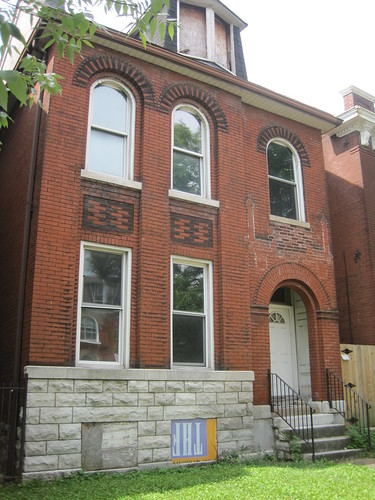
This house on the 2800 block of Victor Street in Fox Park is a lovely house that uses the American Foursquare form.  (The American Foursquare is typified by a rectangular shape, hipped or sometimes gabled roof with central dormer and four-room plan on each floor.)  The use of the rock-faced dark brick is particularly striking.  Yet something clearly is missing!

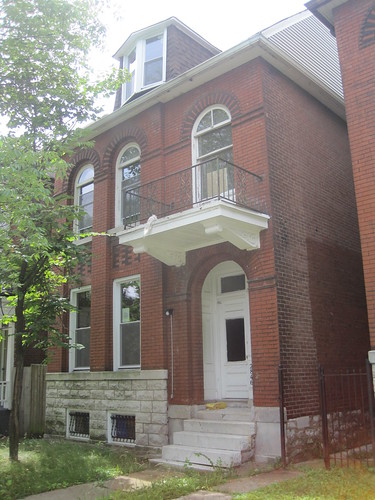
Look above the entrance — there is a shade of the old balcony.  The outline suggests that the balcony was cantilevered over the entrance, maybe with ornate brackets underneath.

Aha! Indeed, the balcony did have ornate brackets and was cantilevered over the entrance. We know this because the near-twin house next door retains its original balcony.  The next-door house is only a near-twin because it employs paired string courses that connect with the arches of the windows and entrance.  The balconies were probably the same, but the brick work was not made exact.  Such a slight variation is typical in St. Louis vernacular masonry architecture, which produced many near-twins but few exact copies.

Categories
Missouri Public Policy

Governor Nixon’s Tax Credit Commission Criticized

From the Coalition for Historic Preservation and Economic Development:

Governor Nixon’s tax credit commission criticized as lacking enough representation of people who know economic benefits of Historic Tax Credits

For Immediate Release

Contact: Deb Sheals, 573-874-3379
Coalition for Historic Preservation and Economic Development

Columbia, MO – July 22, 2010 – Governor Jay Nixon released his plans for creating a commission to perform a review of the state tax credit programs yesterday. The Missouri Coalition for Historic Preservation and Economic Development (MCHPED) spokesperson Deb Sheals, stated, “We are concerned that the Governor’s commission does not appear to have enough representation from people and organizations that are familiar with the dramatic impact the Historic Tax Credit has had in the production of jobs and economic development across Missouri. There are, for example, no representatives from small main street organizations, community development organizations, or historic preservation organizations, all of whom have firsthand experience in how well the program works for the average citizen. Missouri leads the nation in economic development from the historic tax credit, and any commission that is looking at this issue should include more members that are familiar with how it works.”

It also appears that the members chosen for the commission mirror a previous effort taken midway through the 2010 legislative session to pit education vs. development and redevelopment in communities throughout the state. This is not an either-or situation; economic development through historic preservation creates a stronger tax base and is therefore a benefit to education.

The State Historic Tax Program is a proven economic engine. Historic Tax Credits create jobs, encourage environmentally sensitive redevelopment, and long term revenue sustainability for the state of Missouri. Since 2000, historic tax credits have generated more than $669 million dollars in revenue for the state and local governments while creating 43,150 new and retained jobs with an average salary of $42,732. (See the attached executive summary of a recent study of the impact of this program.) The Governor’s attacks are creating industry-wide uncertainty and have crippled the effectiveness of the program as an economic stimulus.

MCHPED looks forward to once again demonstrating the tremendous state and community benefits generated by the Historic Tax Credit Program.