Categories
Missouri Public Policy

Say What, Mr. Governor?

by Michael R. Allen

Tim Logan at the Post-Dispatch reports that Governor Jay Nixon (Democrat) is ready to put tax credit programs under the budget axe. That’s not all bad, of course, but here’s the shocker:

When pressed on what programs he might go after, the governor mentioned historic and low income housing tax credits, both of which are widely used to fund development in the City of St. Louis and its older suburbs. But any specifics would likely need to be negotiated with lawmakers, some of whom have been targeting the historic tax credits program for years.

Of all of the tax credit programs in Missouri, Governor Nixon singles out the two most used in urban areas and one — the historic rehab tax credit — that average people can actually use. Hello?

Categories
LRA North St. Louis

21st Ward Real Estate

by Michael R. Allen

Citizens often complain that St. Louis aldermen are in impediment to selling Land Reutilization Authority (LRA), but Alderman Antonio French (D-21st) is actually trying to help. French has launched a 21st Ward Real Estate website with information about available LRA-owned property in his ward.

Why do people complain? LRA requires a letter of aldermanic support before selling a parcel to an interested buyer, and aldermen often have parcels removed from the sale list when they are needed for community development corporation or private development projects.

LRA also has maintained a rather old-fashioned website with only a handful of properties having photographs. With no dedicated funding for marketing, LRA cannot do more.

That’s fine. Alderman French is showing us that LRA marketing is possible without additional appropriation to LRA. Other aldermen or community groups can — and should — do what French is doing.

Categories
Agriculture Events Historic Preservation Missouri

Talk on Missouri Barns This Friday

Barn Again: Efforts to Document and Save Elements of the Rural Missouri Landscape

Noon, Friday, March 12 / Lecture Room / Architecture St. Louis / 911 Washington Avenue, Suite 170

Since joining Missouri Preservation as its Field Representative a little over a year ago, Bill Hart has been advocating for Missouri’s endangered historic resources. His position as Field Representative, a first for Missouri Preservation, is assisted by a Partners in the Field Challenge Grant from the National Trust for Historic Preservation. One of Bill’s outreach activities has included calling attention to the plight of the barn. Realizing that this is one of the most endangered building types not just in Missouri but throughout the nation, Bill has been photographing barns throughout the state (several hundred so far), keeping an eye toward at least providing quick photographic documentation of those that tenuously cling to the rural landscape. Bill has also been instrumental in organizing our state’s first barn alliance, which recently held its first meeting in conjunction with Missouri Preservation’s annual conference in Independence.

Categories
North St. Louis Northside Regeneration St. Louis Board of Aldermen

Next Wave of NorthSide Ordinances Delayed

by Michael R. Allen

While the thunder of a showy trial on McEagle’s NorthSide project has marched along, the next round of redevelopment ordinances specific to the four phases of the project apparently have not. The Board of Aldermen was supposed to consider those ordinances before April 1, but they may not come for some time longer. At least, that’s what Jerry Berger tells us:

Most City Hall observers expect McKee and his partners will let the date slip by while the McEagle team continues to acquire properties and wait for answers to his requests for federal and state assistance.

Dale Singer has a sold analysis of the trial in the Beacon. Read it here.

On the matter of federal and state assistance, the city lost its bid for a federal TIGER grant to reconfigure the Jefferson/22nd Street exits downtown. McEagle needs that reconfiguration and a land swap with the Missouri Department of Transportation to start one of the first-phase components of the project.

Categories
Brick Theft Public Policy St. Louis Board of Aldermen

Brick Thieves and Brick Dealers

by Michael R. Allen

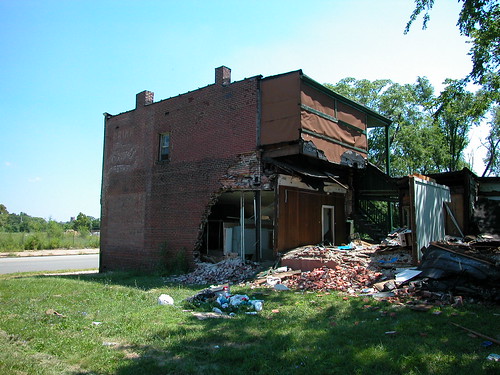
After this week’s spate of fires in JeffVanderLou, Alderman Sam Moore (D-4th) proposes changing city ordinances to force brick thieves to pay back the amount of damage that they cause, instead of the current maximum of $500. Moore’s proposal makes sense.

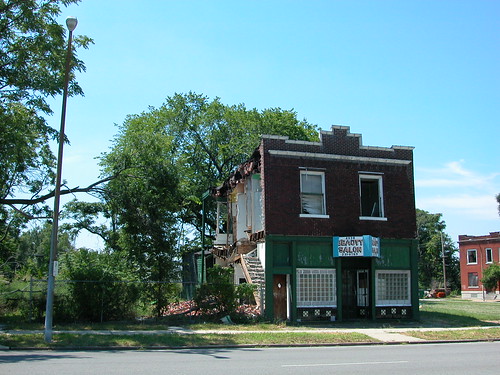
The commercial building at 2538 St. Louis Avenue in St. Louis Place, destroyed by brick thieves in August 2007.

Yet a new ordinance should go further. The thieves are only the first — and least compensated — beneficiaries of the money generated by the stolen brick. Penalties for dealers who buy stolen brick are the same as for the thieves. Those should be increased too.

The commercial building at 2538 St. Louis Avenue in St. Louis Place, destroyed by brick thieves in August 2007.

What if dealers caught buying stolen brick permanently lost their business licenses?

Categories
Fire JeffVanderLou North St. Louis Northside Regeneration

Fires Plague JeffVanderLou

by Michael R. Allen

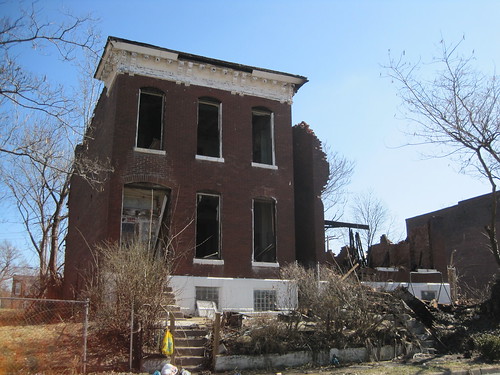
Last week, on the way to a meeting in JeffVanderLou, I noticed a recently — judging by scent — fire-ravaged house on Bacon Street, shown here.

Then, early this week, I learned of a two-night wave of four fires. These fires hit vacant buildings in a small area. The buildings lost to the firebug share two characteristics: all were historic buildings in decent repair and all were vacant and unboarded. Since the location of all but one of these houses is within the footprint of McEagle’s NorthSide project, the press has been quick to report these fires, and the loose tongues of conspiracy have been wagging.

The sad fact is that arson claims vacant buildings across north St. Louis every month, and mostly the St. Louis Post-Dispatch and its cloaked comments-section pundits take no notice. The culprits in many of these cases are never caught, let alone charged. Neighborhood residents, who know best, generally suspect brick thieves.

Arson on the near north side also is an old problem. In the 1960s, some white property owners fleeing the near north side torched their own homes to collect insurance money. As time moved on, and buildings went vacant, assorted firebugs, vandals, bored teenagers, firework-launching revelers and brick thieves have done more damage. In 1997, Old North St. Louis suffered a rash of arsons that included a massive fire at the five-story former Peters Shoe Company factory just south of Jackson Park (since demolished).
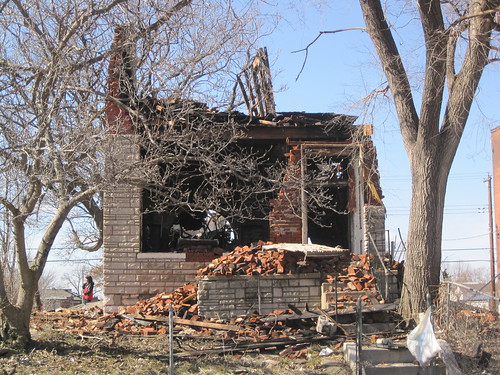
A building on the 1800 block of Bacon Street lost this week. I could not find a pre-fire photograph.

Then there are the fires that never happened. Neighborhood patrols, starting in the evening and sometimes going to the early morning, have kept many buildings standing. Rarely do neighborhoods get the assistance of owners of the vacant buildings, or the busy police department. Still, many people have taken action to prevent senseless destruction of their neighborhood fabric.

What gets lost through arson are indelible parts of city neighborhoods. The brick piles and half-collapsed buildings are easy picking for brick thieves, and not enticing enough to those who enjoy arson. Most targets are buildings in sound condition, that are stores of community wealth. Negligent ownership is definitely a root cause that must be addressed systematically, but the arsonists aren’t going to be affected by scorn heaped upon McEagle or the Land Reutilization Authority.

Robbing neighborhoods of community wealth is a base crime. The police and the circuit attorney need to step up efforts to send neighborhood arsonists away for as long as statues allow.

Two houses on the 1900 block of Bacon Street before last week.
Two houses on the 1900 block of Bacon Street this week.
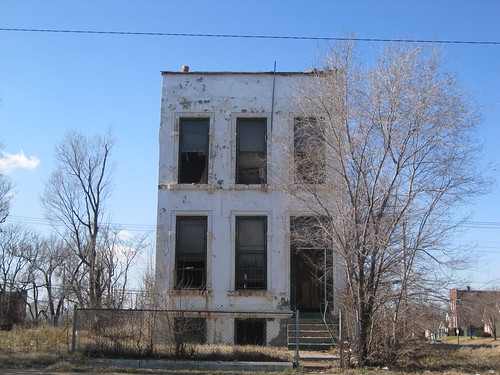
The house at 1721 N. Grand Avenue last week.
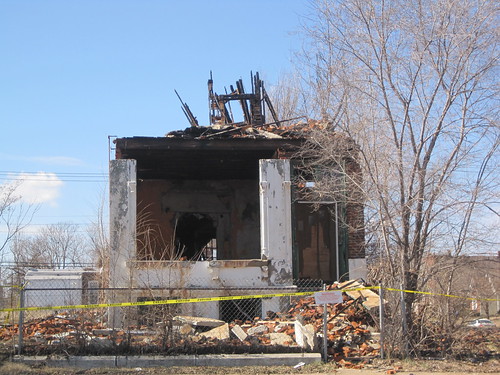
The house at 1721 N. Grand Avenue this week.
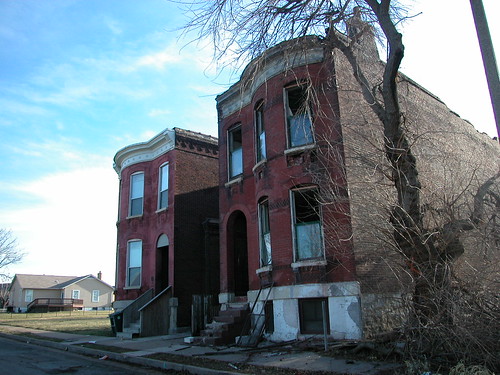
Two row houses at 3508-10 Cozens Avenue in 2007. The configuration is unique — the two houses adjoin at the back with a center gangway leading to secondary entrances.

The two row houses this week. The house hit by fire is owned by McEagle.

Categories
Downtown Historic Preservation

Kiel Opera House Looks Good Inside

by Michael R. Allen

Landmarks Association of St. Louis sponsored a tour of Kiel Opera House on February 27. This rare peak inside of the old opera house — which I once took without being allowed to take photographs — is captured through photographs found here. The photographs reveal the remarkable degree of integrity Kiel has maintained despite nearly two decades of vacancy.

Categories
Architects Downtown Green Space

1967, 1974 and 2010

by Michael R. Allen

Whenever the Roberts Tower on Eighth Street downtown is completed, it will have been a long time since any new residential buildings have been built downtown. There is no need to state the obvious, that no tall residential buildings have been built, because there have simply been none. The last new residential building to be built downtown was any one of the three towers of the Mansion House Center on Fourth Street, completed in 1967. Over forty years later, we await the next installment in the very limited and erratic story of downtown apartment building construction. (Our last tall building, the maligned Thomas Eagleton Federal Courthouse, arrived in 1997.)

The Roberts Tower’s architects are unheralded, and I cannot draw any name when asked who she or he is, or who they are. All I know is that the design is a suitable modern building, disgraced only slightly by the oh-too-silvery reflective glass being used to clad it. While I appreciate the break from the minimalist humdrum that inhibits contemporary architects, I am not impressed with the awkward reference to 1980s postmodern glazing trends. I’ll admit that the greenish reflective glass shown in early renderings of the Roberts Tower would have been no better. At least views of the rear elevation of the Old Post Office will be enshrined in the wall as well as — unfortunately, for the most part — any elements of Old Post Office Plaza that catch the mirrored surface.


On the matter of Old Post Office Plaza, there is no denying that the block is playing out very much like the vision shown in the 1974 Downtown Plan produced by PGAV for the Downtown Partnership. While we did not get the sunken plaza shown in the rendering, we did get a plaza and a narrow concrete tower in line with the south elevation of the Orpheum Theater. Alas, the 1974 plaza looks to be far more humane than what was built. Hopefully the Roberts Tower outshines the tepid hulk envisioned by planners back in the day. Architecture, supposedly the realm of innovation, is more often the repetition of concepts through new expression. That is, it may have been 1967 when downtown’s last high-rise residential building was completed, but forty-three years later have seem to have progressed to 1974. That’s not terrible — Mansion House is still lovely despite some recent muddling.

Categories
Events Urbanism

That "G" Word

by Michael R. Allen

This Thursday, I will moderate what should be a provocative City Affair panel discussion on the “g” word: gentrification. I volunteered to moderate because I lack a hard and fast definition of the word, and have been challenged and amazed at the wide range of connotations the word has attained. I’m eager to learn more about the cultural definition of the word, and look forward to the discussion.

Here’s the event description:

What is meant by gentrification and whether that word is a positive or negative can vary depending on who uses it. Panelists will talk about the dynamics that they perceive as contributing to gentrification: real estate purchasing, property improvement, demographic change, perception of inclusion and other forces of city life.

The panel consists of:
Steven Smith – Owner of the Royale and activist

Minerva Lopez – Past President of the Cherokee Station Business Association

Alex Ihnen – Regional Director of Development at Washington University, blogger at St. Louis Urban Workshop

Alycia Green – Advocate at The People’s Advocate St. Louis

Michael Allen will moderate the panel discussion.

Following forty five minutes of panel discussion we will open the floor to audience questions.

CITY AFFAIR XIV: GENTRIFICATION

MARCH 4, 2010
7:30-9:00 PM
STYLEhouse (STL-Style)
3155 Cherokee Street
Saint Louis, Mo. 63118

Categories
Historic Boats Riverfront

State Court Ruling on the Admiral Hull

by Michael R. Allen

The state appeals court ruled today that the Missouri Gaming Commission acted “without sufficient process” when it ruled that Pinnacle Entertainments could “neither repair nor replace” the President Casino, better known as the S.S. Admiral. After considering plans as drastic as scrapping the modernist boat, Pinnacle has explored repairing the aging hull and possibly moving the Admiral to another location.

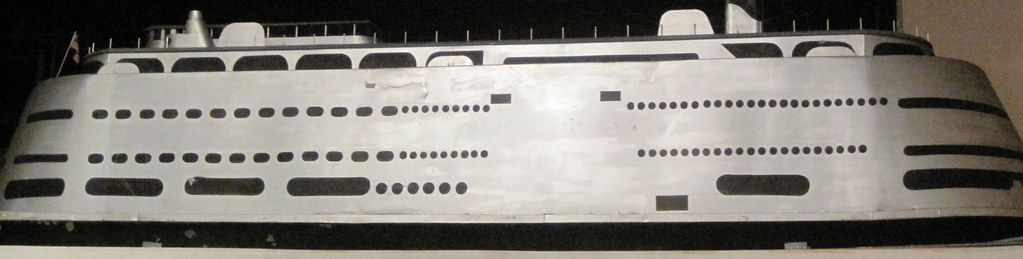
Model of the S.S. Admiral, collection of Antique Warehouse.

The Gaming Commission currently is trying to shut down the gambling boat by July — an effort not affected by today’s ruling. Still, the ruling helps Pinnacle make the case for repair. Hopefully today’s action helps keep a unique landmark afloat. Despite years of interior alteration, the exterior of the Admiral (built to current form in 1940) is as streamlined and sleek as ever. A little rehabilitation would make it shine! A new casino box built in a wetlands, after all, could not hold a candle to the swanky downtown Art Moderne riverboat.