Categories
Illinois Public Policy

Illinois Legislators Trying to Create a Historic Rehabilitation Tax Credit

by Michael R. Allen

On February 11, Illinois State Senator Dave Koehler (D-Peoria) introduced SB 2559, a bill that would create a state historic rehabilitation tax credit modeled on Missouri’s.

Since then, the bill has gained two co-sponsors, Senators Dale Risinger (D-Springfield) and Michael Noland (D-Springfield). However, the Senate Commerce Committee has postponed a hearing of the bill.

Meanwhile, a similar bill introduced last year by Representative Greg Harris (D-Chicago) in the Illinois House of Representatives (HB 586), has attained five co-sponsors but has yet to receive a committee hearing.

Categories
Historic Preservation

Preservation and Richard Moe

by Michael R. Allen

This month’s issue of Architect includes an article by Brad McKee entitled “Futures of the Past”, which chronicles the evolution of the American preservation movement during the tenure of Richard Moe as President for the National Trust for Historic Preservation. Moe will be retiring this year.

St. Louis played a role in Moe’s tenure when Moe led the Trust to support demolition of the historic Century Building in downtown St. Louis. Many here may be most familiar with that aspect of a career that also has included a welcome de-centralization of the National Trust. Moe championed grassroots preservation efforts, and helped the Trust allocate resources to its Regional Offices and, through grants, to local organizations. One of the Trust’s best initiatives under Moe is the Partners in the Field program, which provides matching funding for state and local preservation organizations to create field representatives. Missouri Preservation took advantage of that program, and created such a new position in 2008.

Categories
Abandonment East St. Louis, Illinois

Fireman’s Training Tower

by Michael R. Allen

This fireman’s training tower at the northeast corner of 18th and Broadway in East St. Louis once stood next to a station house. According to neighbors, the city government demolished the station in the 1990s but left the tower to stand. It’s a quirky vestige of the once-proud firefighting days of East St. Louis. The sturdy concrete body and relative youth — it dates to the 1950s — ensure that it won’t fall down anytime soon.

Categories
Public Policy Schools

Senate Bill Introduced For Historic Schools

by Michael R. Allen

From Preservation Action:

On January 29th, Sen. Jim Webb (D-VA) introduced S. 2970, the Rehabilitation of Historic Schools Act of 2010. A companion bill (H.R. 4133) was introduced in the House by Eric Cantor (R-VA) in November.

The bill would change a provision in the Federal Rehabilitation Tax Credit that currently restricts renovation of older public school buildings, limiting the ability of local governments to partner with private developers to rehabilitate schools.

“With municipalities across the country unable to fund school repairs and construction, this bill will provide needed assistance, partner local government with the private sector, create jobs, and give our children the facilities they need to learn and grow,” said Webb in his press release. “Good local schools and well-maintained public facilities are key indicators of where businesses may locate. This legislation strengthens our communities across the board.”

Categories
Neon Signs St. Louis County

Neon Signs at Antique Warehouse

by Michael R. Allen

On Sunday, February 21, the Antique Warehouse hosted a fundraiser for the St. Louis Sign Museum. Guests were able to see the amazing private collection at the Antique Warehouse, which includes numerous neon signs, banners, signs, vehicles, tractors, campers, sewing machines, cash registers, pinball machines and so many other things a list would fill a small book. Greg Rhomberg is the mad genius behind the Warehouse, and has been collecting for years. One of the hallmarks of Greg’s work is thorough restoration of items that require it. In the case of neon signs, that means repainting and re-tubing. Here are a few photographs suggesting the scope of the Antiques Warehouse neon sign collection.

Yes, the Lake Forest Pastry Shop sign is alive and well!


Categories
Fox Park National Register South St. Louis Tower Grove East

Historic Districts In and (Mostly) Around Tower Grove East

by Michael R. Allen

Last night’s Tower Grove East Neighborhood Association meeting included a presentation by Lynn Josse on the different types of historic districts, how they work and how they get created. Lynn distributed a flier that included the following map.

As the map shows, a large swath of Tower Grove East and the southern end of Fox Park are surrounded by districts but not included in any. All or part of 45 blocks in Tower Grove East have no historic district status, and thus no availability of rehabilitation tax credits being used all around south city.

Categories
Mass Transit Transportation

Hitchhikin’

by Michael R. Allen

I dig Citizens for Modern Transit‘s new ad.

Categories
Downtown Parking

Convenient Parking at Seventh and Locust

by Michael R. Allen

News about the conversion of St. Louis Centre into a parking garage for the “convenience” of tenants of One City Center brought to mind a page from the brochure published by the developers of Ambassador Building when the building opened in 1926. An entire page is devoted to the “convenient parking” near this building, although the definition of “convenient” allows for parking facilities over eight blocks away.

Categories
Demolition Downtown Green Space JNEM Riverfront

National Park Service Sponsors Look at Lost Riverfront Architecture

by Michael R. Allen

Photograph of St. Louis riverfront buildings from the Historic American Buildings Survey.


The nation’s only urban national park, the Jefferson National Expansion Memorial with the stunning Gateway Arch by Eero Saarinen, has long been haunted by a shadow architectural history. To make way for one of the world’s most full-realized modernist landscapes, St. Louis wrecked forty blocks of historic riverfront buildings. The significance of these buildings in American architectural history was such that in 1939, eminent architectural critic and historian Siegfried Gideon came to St. Louis to deliver a lecture on the doomed buildings. Gideon not only spoke about the unparalleled mass of cast-iron facades and storefronts found on the riverfront, he implored the city to change course and preserve the riverfront’s commercial buildings.
Gideon’s cry went unheeded, and plans to create a national memorial to westward expansion on the St. Louis riverfront progressed. Fortunately, the memorial’s architectural achievement matched what was lost. Still, the memorial site has a psychological scar tissue to any who know what was lost there. The National Park Service has had some difficulty in interpreting the pre-memorial riverfront so that both the memorial and the prior riverfront architecture are suitably honored.

Thus, the current “Faces of the Riverfront” exhibit at the Old Courthouse is a welcome endeavor, and, given current events, quite timely and inspirational. (The exhibit runs through August 22, through the unveiling of designs by finalists in the current design competition.) The National Park Service gave artist Sheila Harris access to its extensive photographic record of riverfront buildings lost to build the memorial, and she painted in watercolor renderings of the documented buildings. Harris’ paintings transform the hard, stoic documentation taken before the riverfront death knell into soft, humane snapshots of a still-living urban landscape.
Sheila Harris speaks at the exhibit’s opening reception on February 14th.

For the next few months, visitors to the Old Courthouse will be greeted by an exhibit that properly honors the life of the riverfront, in the space once occupied by the courtroom where the Dred Scott trial unfolded. Superintendent Tom Bradley, staff historian Bob Moore and exhibits manager Caitlin McQuade deserve credit for working with Harris to create the exhibit, as does Sheila Harris’s sister NiNi Harris (author of the new book Historic Photos of the Gateway Arch.)
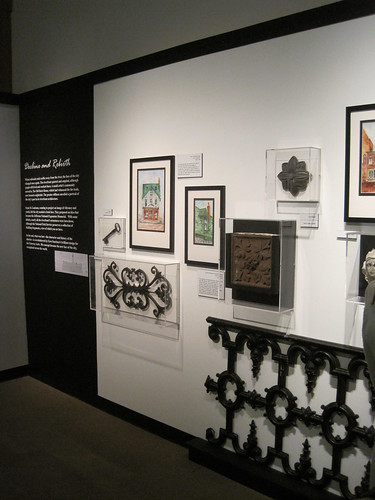
Alongside the paintings are rarely-seen items from the Memorial’s collection of salvaged portions of riverfront buildings. Those who have seen the items on permanent display in the Old Courthouse often wonder what else remains, and here are a few answers. The expected cast iron pieces are joined by a more obscure terra cotta piece. The only problem withFaces of the Riverfront is that the fragments and watercolors pique a visitor’s interest in seeing the source photographs, of which none are on display save as wall-sized backdrops. Perhaps those photographs will be made public as part of a future Memorial project.

Categories
Missouri Legislature Public Policy

Bartle’s Tax Credit Bill Didn’t Get Out of Committee

From Anna Ginsburg, Staff Coordinator of the Missouri Coalition for Historic Preservation and Economic Development:

Senator Matt Bartle’s bill (SB 584) to sunset Missouri tax credits was heard Friday 2/19/10 before the Senate Government Accountability and Fiscal Oversight Committee. The language from Senator Crowell’s bill SB 728 was attached to SB 584 as an amendment. Crowell’s bill would put 40 Missouri tax credits including Historic’s under the annual budget appropriations process. The committee voted to not send the bill to the Senate Floor by a vote of 4 -3. Senators Days, Schmitt, Schoemyer and Schaffer voted to kill the bill. Senators Purgason, Lembke and Lager voted to pass the bill out.

A second bill introduced by Senator Crowell (SB 890) was heard the Senate Jobs, Economic Development and Local Government Committee. SB 890 places a one year moratorium on low income housing tax credits and Missouri Development Finance Board tax credits. Several other economic development bills have been introduced into this committee and they could be used as vehicles for attaching Crowell’s bill SB 728 or some varation.