Categories
Architecture Downtown

Roberts Tower Rising Higher

by Michael R. Allen

The Roberts Tower on Eighth Street downtown has reached the eleven-floor mark. The last downtown structure to reach eleven floors was the Ninth Street Garage in 2006. Before that, there was the convention hotel addition (completed in 2003) and the Federal Courthouse on Tenth Street (completed in 1999). To find the most recent office building downtown that is eleven floors or higher is One Metropolitan Square (completed in 1989). The last high-rise residential buildings to meet this size were the towers of the Mansion House Center (completed in 1967 — quite awhile).

How long will it be before the next new downtown building reaches eleven stories? Soon, according to developer Kevin McGowan.

Categories
Flounder House JeffVanderLou North St. Louis Storefront Addition

Storefront Addition to Flounder House

by Michael R. Allen

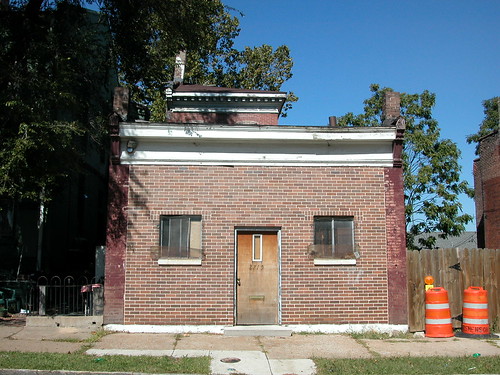
Just west of the Pruitt-Igoe Nature Reserve at 2719 James Cool Papa Bell Avenue in JeffVanderLou is this fine storefront addition dating to 1912. Now used as a residence, the structure is attached to a two-story flounder house! No attempt to match that house’s dentillated cornice was made by the builders of the addition.

Categories
Historic Preservation Hyde Park LRA North St. Louis

House on Farrar Could Be Saved

by Michael R. Allen

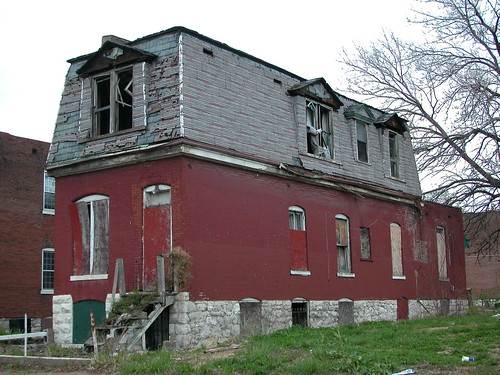
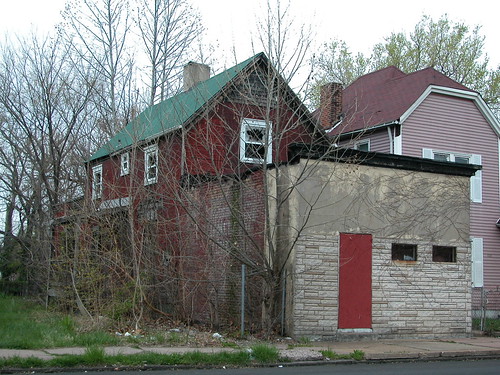
At first glance, the vacant house at 2521 Farrar Avenue in Hyde Park offers familiar signs of distress in the built environment: Boarded first floor windows. Missing glass and mangled sashes in the second floor windows. A layer of siding over the original slate roof. Missing guttering stolen for scrap value. Red paint suffocates historic masonry.

However, the house has an unmistakable charm. Details cry out from beneath decay to remind us that the beauty never left — it just got covered and distorted. Owned the city’s Land Reutilization Authority, the house has been vacant for a long time but has the potential to be transformed using state and federal historic tax credits. Houses like these — vacant, but sound by public safety law and ripe for redevelopment — have prompted Alderman Freeman Bosley (D-3rd) to repeatedly state on the record that he will no longer support demolition in Hyde Park.

Bosley, alderman for the area since 1979 save for one four-year period, has watched a lot of architectural beauty depart from the neighborhood. In many cases, he has supported demolition. However, renewed interest in the area’s historic architecture and the sheer volume of building loss have led Bosley to become a proponent of saving historic buildings and creating new historic districts within his ward.

The trouble with the house at 2521 Farrar is that there is a developer who has used historic rehab tax credits interested in the property. The Irving School Partners, led by Michelle Duffe and Ken Nuernberger, has transformed many historic houses and Irving School into showpieces. Their efforts have been as remarkable to watch as the Crown Square project in Old North. They are taking on more historic buildings this year, including Eliot School in the north end of the neighborhood.

However, the developers want to demolish the house on Farrar for new housing. They have applied for preliminary review from the Preservation Board, and the matter is on the board’s April 27 agenda. A preliminary review gives a developer a sense of what the Board will allow.

Although I will support the work of the Irving School Partners, and have even once supported a demolition for new construction that they sought, I think that the house on Farrar deserves to be spared. Perhaps if full rehabilitation is too costly, the developers might consider mothballing the building for future development. The developers wish to strengthen the Irving School project by redeveloping the rest of the block — a laudable goal. However, preservation will be the best long-term investment here.

Categories
Abandonment Missouri

Hotel Bourbon, Sitting Vacant by the Tracks

by Michael R. Allen

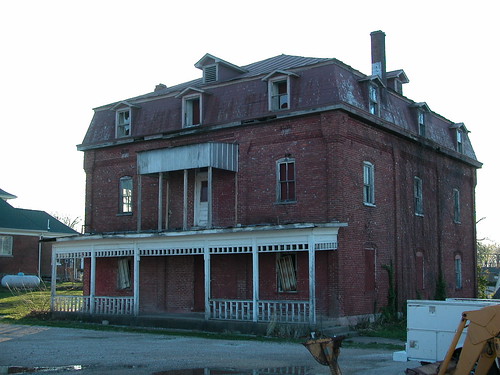
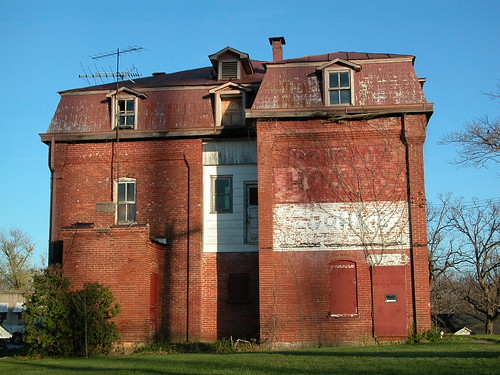
Over the weekend, I passed through Bourbon, Missouri and saw the old Bourbon Hotel. The abandoned railroad hotel apparently dates to the 1890s and served some time as a hostel before closing in the late 20th century. Many cities along the Frisco line had hotels like this one, with wide front porches facing the tracks. As passenger rail service declined, so did the economic life of these hotels.

There are no buildings in Bourbon listed in the National Register of Historic Places, and only five sites in all of Crawford County are included in the National Register. The Bourbon Hotel easily could be the sixth. My hosts did not know who owned the hotel, or what plans — if any — exist for preservation.

A short, spirited history of Bourbon (including origin of the name) can be found here. The conclusion is quite a treat: “Bourbon has never aspired to be a big city, with a cold, business-like attitude. Instead, Bourbon’s businessmen and civic leaders strive to keep the friendly, neighborly manner that has long been an Ozark tradition. Bourbon people are just plain folks, who like to make friends and make you feel at home.”

Categories
LRA North St. Louis O'Fallon Storefront Addition

Storefront Additions: 21st Ward Edition

by Michael R. Allen

In honor of Tuesday’s election of Antonio French as 21st ward alderman, here are two storefront additions found in the 21st ward. While I can’t claim that French shares my enthusiasm for these strange and often-awkward works of architecture, I have to say that his preservation-minded platform hints at great things to come in the 21st ward over the next four years.

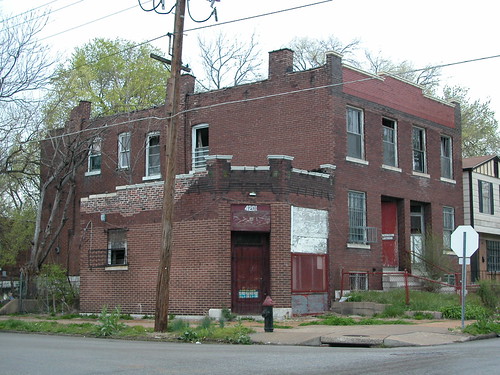
The storefront addition at 4218 Lee Avenue just west of Harris Avenue might be the ugliest one featured in this blog to date. The brick addition, built around 1920, blocks the view of a frame house dating to 1896. Later parging and permastone application don’t help matters. Still, the small commercial space created by the addition could be an office, small shop, studio or other use. The house/storefront combination could be made more attractive and the building repurposed as live/work space.

The storefront addition at the corner of Penrose and Fair is very discreet, almost blending seamlessly into the four-family dwelling to which it is attached. The storefront dates to 1920, and the parent building to just a few years before then. Thus, the architectural vernacular of the residential building — since obscured by replacement of the original parapet materials — was still in vogue when the addition went up, making a harmonious match easy.

Again, the modest scale cries out for reuse as the home of a human-scaled enterprise. Located at a fairly busy corner, this could be a sandwich shop, ice cream stand or any number of things.

Both of these buildings are owned by the Land Reutilization Authority. There is no coincidence in the fact that both Lee and Fair avenues had streetcar lines in the 20th century; these additions lie near intersections where the cars would have stopped frequently throughout the day. Perhaps these hybrid buildings will be ripe for 21st century commercial revitalization. The streetcars are gone, but the population density of the ward remains high, and the future is looking good.

Categories
Historic Preservation Missouri Legislature Public Policy

Capping the Missouri Historic Rehab Tax Credit Would Benefit Wealthy Developers

by Michael R. Allen

My latest commentary for KWMU is online here.

Categories
Historic Preservation Missouri Legislature Public Policy

After Late Night, Missouri Senate Still Hasn’t Passed Economic Development Bill

by Michael R. Allen

While debate went until well after 3:00 a.m. in the Missouri Senate this morning, the chamber did not pass an economic development bill that included a $75 million cap on the state’s historic rehabilitation tax credit program. Senator Jeff Smith (D-4th) deserves a lot of credit for his strong advocacy for the credits. Smith is a master of using an inquiry to block negative changes to the program, and his spirited efforts are helping grow support for the credit in the Senate.

Categories
Detroit Historic Preservation St. Louis Board of Aldermen

Detroit City Council Members Play Structural Engineers

by Michael R. Allen

If you think that the preservation system in St. Louis city government is screwed up, count your blessings. In Detroit, the City Council just passed a resolution calling for the emergency demolition of the landmark Michigan Central Station. The resolution comes after the council has done the following: not conduct a structural assessment of the building; not consult the building’s owner about plans for redevelopment; not implore the building owner to redevelop or sell to someone who will; and, most important, only get interested in the building’s plight after the mayor made a move.

Strange priority for a City Council that is having a hard time dealing with a $300 million municipal budget deficit.

Although the building is owned by billionaire developer Manuel Moroun, Mayor Ken Cockrel, Jr. had requested federal stimulus funds for demolition work that could cost around $3.6 million. Since Michicagn Central is listed on the National Register of Historic Places, federal funds for demolition will entail a Section 106 demolition review that could complicate the mayor’s plans. (Michigan Central Station dates to 1913 and was designed by Warren and Wetmore with Reed and Stem.)

The Council’s resolution directs the owner to pay for an emergency demolition, attempting to use a 1984 ordinance that gives the council discretionary power to take down “dangerous” structures. Council President Monica Conyers, perhaps America’s most self-serving urban politician, opines that the building should have come down years ago. Despite years of decay, Michigan Central Station is not unsound and clearly not dangerous in any legal sense. Check out Forgotten Detroit and see for yourself. The old station has great reuse potential!

The St. Louis Board of Aldermen has never passed a similar resolution, despite its many redevelopment ordinances that override preservation review. Then again, the St. Louis of today is a city where many aldermen are often the first in line defending the economic value of our landmarks. Thank goodness for the Missouri historic rehabilitation tax credit and the paradigm shift it allowed!

Categories
Housing JeffVanderLou North St. Louis Northside Regeneration

Refaced House on James Cool Papa Bell

by Michael R. Allen

This small refaced house at 2911 James Cool Papa Bell in JeffVanderLou attracts my attention. (The fact that it is owned by one of Paul McKee’s holding companies doesn’t hurt.) Although the new jack-arched window opening is a bit small, the polychrome brickwork is done well. There is even a recurring pattern in the bond found at the roof line and on each side of the window. There are many examples of historic houses being refaced with inappropriate materials, covered with paint that damages the face brick and partly relayed with new brick that doesn’t match. Then there are houses like this one, built in 1890 and refaced after World War II, where the changes add a new and interesting dimension. Perhaps my outlook reflects the fact that I read How Buildings Learn long before I read the Secretary of the Interior’s Standards for Rehabilitation. So be it.

Categories
Demolition East St. Louis, Illinois Historic Preservation Metro East

Gateway Community Hospital to be Demolished, Hope Lingers in East St. Louis

by Michael R. Allen

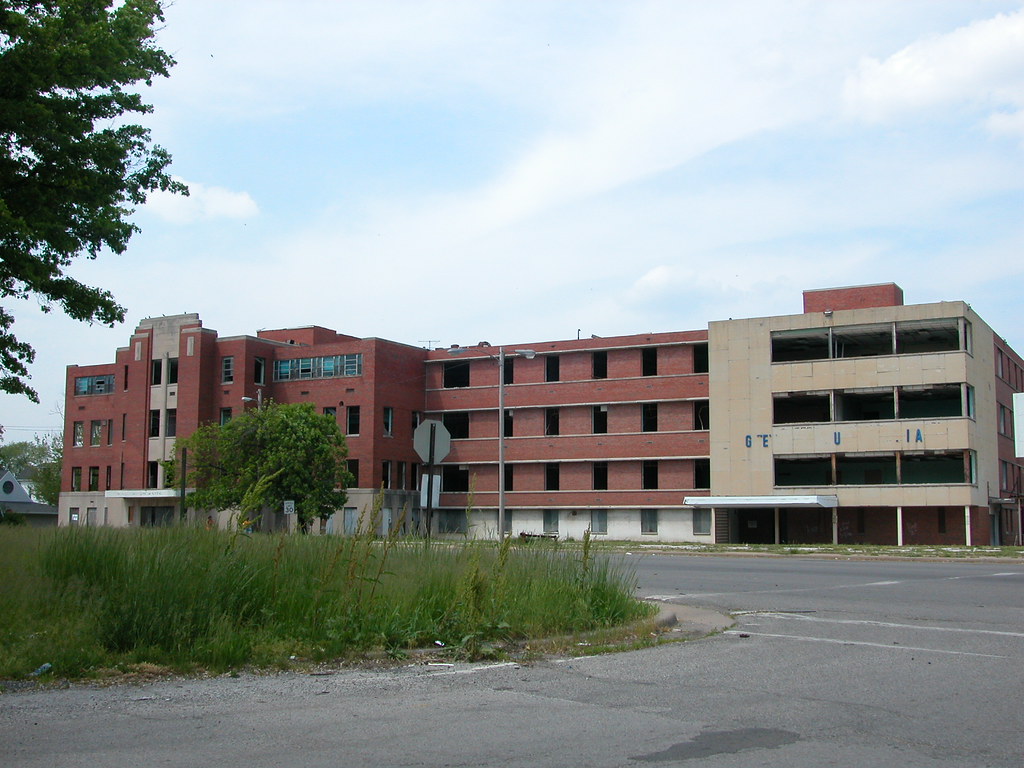
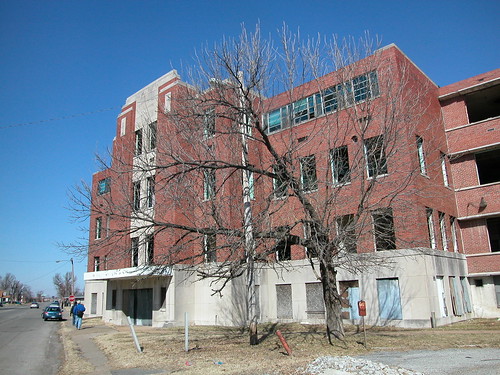
Last week, cash-rich St. Clair County hired a demolition contractor to take down Gateway Community Hospital on Martin Luther King Drive for the beleaguered city of East St. Louis. This is a sad moment for East St. Louis, although I confess that it’s impossible to count such moments. One year ago, Kenneth Hall Regional Hospital shut down all but its emergency room and some services. Now, the building that houses the city’s second hospital, which closed in 1989, will come tumbling down.

Such are the vagaries of population loss, I suppose, although that does nothing to diminish the symbolic losses or apologize for the public health problems the city faces without a full service hospital. Once upon a time, the city’s leaders were able to build two hospitals: St. Mary’s, which became Kenneth Hall, and Christian Welfare, which became Gateway Community. Christian Welfare Hospital was even able to open its privately-funded modern new facility in 1940, despite the lingering effects of the Great Depression. At the time, the city had not seen a hospital as large or as well-equipped as Gateway Community. The sad fact is that this the high point of medical service in East St. Louis. No larger or more modern facility would come, although Christian Welfare Hospital was later expanded.
The closure of Gateway Community Hospital just shy of the fiftieth anniversary of its building was not a great shock. The hospital had been ailing for awhile. The demolition is not a big surprise, either, since the buildings have been left unsecured and vandalized since closing. Few windows remain, giving the large complex a foreboding and sad presence that few people would want to live near.

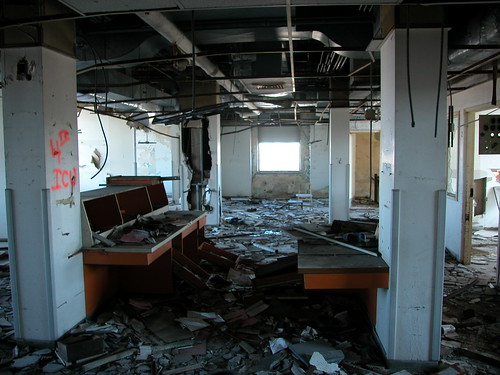
Still, the buildings have weathered 19 years of abandonment relatively well. I have toured the interior several times, including this February, and found little more amiss than falling ceiling tiles, stolen wiring and damaged walls. The structural condition is good. This complex surely could withstand another fifty years of use, at the least.
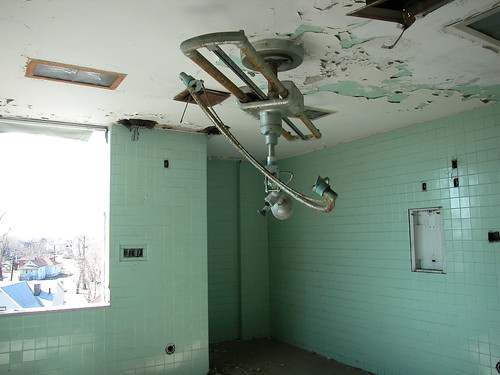
A developer did eye the complex for reuse six years ago, proposing conversion into apartments. That plan withered. No other plan has come since that time, and no one ever thought to nominate the hospital to the National Register of Historic Places. Urban explorers pass through the halls and post their photographs online. Former staff and patients, though, do have fond memories. My mother’s family includes several people born at the hospital.

However, city government is probably relieved that an end is in site for one of the city’s biggest abandoned buildings. History alone is little consolation to those charged with keeping a city livable. There must be something more — and there might be something good in store for East St. Louis if the city doesn’t rush to wreck again.

A Belleville News Democrat editorial (hat tip to the UEU 314) on the demolition is harsh in calling for the city to take down its other landmark buildings. Admittedly, many are vacant and derelict. However, the hope that these buildings will be reclaimed is greater than the hope that they will ever be replaced. To take away the hope of economic development from East St. Louis at this stage of its life seems cruel. Lofts in the Spivey Building would get the city a unique project and some attention. Demolition of the Spivey for a new drive-through bank — not so much.
With a historic rehab tax credit proposed for Illinois, the News-Democrat would do better to put its editorial efforts behind bills in the state legislature that would create a transformational incentive for East St. Louis. The suggestion that there should be no hope that a once-great city can save its beautiful landmarks is absurd. There are numerous developers who have been interested in East St. Louis’ unique, but many have walked away because of the lack of a Missouri-style incentive for tackling large buildings. Let’s work to provide an incentive before we throw our hands up in the air. The worst days for the city are long past. East St. Louis deserves a future.