Categories
North St. Louis Old North Rehabbing

Spring Rehabbing in Old North

by Michael R. Allen

Take a walk, bike ride or drive through Old North St. Louis these days and you might be tempted to ask “what recession?” The hardy north side neighborhood continues to be a construction zone, with activity all over the neighborhood.

Obviously, the Crown Square project (known to most as the “14th Street Mall” project) is moving along swiftly, with most buildings either fully rehabbed or nearing completion. Here’s a look at some of the other activity around the neighborhood.

Up at 1517 Palm Street, a mansard roof long devoid of its original dormers is being restored by a new owner. This house was once owned by the Land Reutilization Authority.

Adjacent to this house is the “three walls” house documented thoroughly by its owners on this website.

On the south end of the neighborhood, Dan Schuler is overseeing rehab of a house on the 1400 block of Monroe Street that has seen a hard life. A lot of the work is happening inside of the house, but the emerging transformation is big.

The Gallery at 1318 Hebert, a unique project involving creative reuse and new construction, is approaching completion. Watch for a post on this project soon.
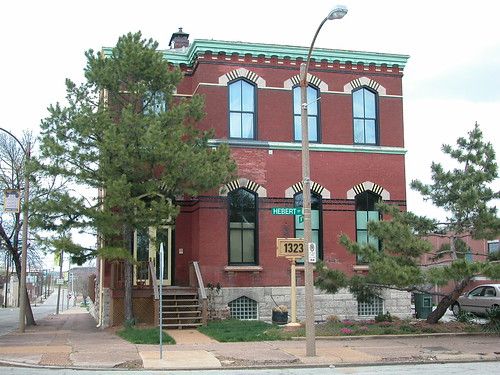
Across the street from the gallery, the former Ames Elementary School kindergarten building has received the attention of a couple who have spent the last few years doing major masonry work, cornice repair and interior rehabilitation.

See all of the progress for yourself: the Old North St. Louis House & Community Tour will take place on Saturday, May 9, from 10 a.m. to 4 p.m. Advance tickets are $10 and can be picked up in person from the ONSLRG office (2800 N. 14th Street at St. Louis Avenue) or at Crown Candy Kitchen. On the day of the tour, tickets will be available at the registration area at $12 each. As a bonus, Crown Candy once again will offer free ice cream on the day of the tour to all ticket-holders.

Categories
Schools St. Louis County University City

University City Voters Should Vote NO on Proposition U

by Lindsey Derrington

Tomorrow University City residents will have the opportunity to vote either for or against Proposition U, a $53.6 million bond issue for the University City School District. If passed, this bond issue will fund the district’s proposed facilities plan which entails the demolition of Pershing (1920) and Barbara C. Jordan (1951) Elementary schools — the former designed by Ittner himself, and the latter designed by William B. Ittner, Inc. Both of these schools currently provide healthy, functioning educational environments and both have shown the most improvement within the district in recent years. If failed, property taxes will drop in University City and the district will have a community mandate to rework its plans to improve educational achievement amongst its students, one which would focus less on facilities and more on the teachers and students themselves.

A vote for or against Proposition U is not a vote for or against the students within the UCSD, but one for or against a facilities plan which fails to address the real needs of the district.

Categories
Historic Preservation Illinois Metro East Missouri Legislature Public Policy

Illinois Legislation Would Enact Historic Tax Credit Modeled on Missouri’s

by Michael R. Allen

Rick Bonasch at STL Rising wrote a post today asking for more information on a proposed state historic rehabilitation tax credit in Illinois.

Representative Jay Hoffman (D-Collinsville) filed HB 469 on February 4, Representative Greg Harris (D-Chicago) filed HB 586 on February 6 and Senator Dan Kotoski (D-Park Ridge) filed SB 1366 on February 10. The similar bills would enact a state historic rehabilitation tax credit modeled on Missouri’s tax credit. All bills have had a first reading and remain in committee.

While Missouri inexplicably debates the future of its model tax credit, other states are looking at copying ours. What a strange reversal of regional dynamics if Illinois had an uncapped historic rehab tax credit and Missouri did not. The tax credit would be a boon to Alton, Belleville, Granite City and other east side communities that are interested in downtown revitalization.

Categories
Mortgage Fraud

Hartmann to Serve Up to 24 Months in Jail for Mortgage Fraud

by Michael R. Allen

One of Doug Hartmann’s wrists will sting — the city’s most prolific con artist has pled guilt to federal charges and heads to sentencing on June 23. At sentencing, Hartmann will face a maximum sentence on 24 months in prison and up to $1.25 million in fines. A press release from U.S. District Attorney Catherine Hanaway, who negotiated the plea bargain details more of Hartmann’s antics that were previously not publicized. The plea arrangement sounds like quite a bargain for Hartmann, who left in his wake over 100 historic buildings in various states of vacancy or incomplete rehabilitation across the city and numerous investors defrauded of their money and, in once case, a house.

One of the Hartmann properties owned under “DHP Properties” was the Nord St. Louis Turnverein in Hyde Park. After Hartmann’s ownership led to continued deterioration of the historic turner hall, the buidling suffered a severe fire in July 2006. Developer Peter George has since purcahsed the building and is trying to rebuild it.

Hanaway promises more prosecution of mortgage fraud artists like Hartmann. However, the light sentence may not send a very strong message to others. One could get more time in jail for possession of a small amount of crack.

Categories
Demolition Downtown Green Space

The Buildings that Stood on the Old Post Office Plaza Site

by Michael R. Allen

Today at 4:00 p.m. the Old Post Office Plaza will formally open. (More on the design later.) Located on the 800 block of Locust, the site was most recently occupied by surface parking. Yet there was a building standing there as recently as 2002, when demolition commenced on the building shown at right in the photograph above. The photograph, taken by Landmarks Association of St. Louis in 1980, shows that the block facing the Old Post Office was once typified by relatively narrow, short commercial buildings — exactly the kind of buildings that allowed small business to thrive downtown. The view above is looking west toward Locust’s intersection with Ninth Street.

These buildings were not celebrated like their larger, more obviously important brethren. The Old Post Office, Arcade Building and Century Building are household terms to preservationists, but few chronicle the lost small buildings that gave downtown variety in architectural style, form and scale of commerce. In 2009, we have so few left that many people can’t remember days when even streets east of Tucker had many great small buildings. These were reminders of downtown’s own rise from the heart of a small city to the center of a metropolitan region.

When I first started coming downtown as an adolescent in the early 1990s, I remember small buildings on Market, Locust, Clark, Washington and other streets, occupied by small businesses ranging from high-volume fast food restaurants to dusty bars. These gave downtown a character that unitary visions like tall office buildings and plazas have erased. While the Old Post Office Plaza takes no buildings down directly, it does take away a site where new commercial infill could have been built. Alas, we also are still taking down small downtown buildings, too, as the Hotel Indigo project one block west of the Old Post Office Plaza illustrates.


On the other end of the block, toward Eighth Street, stood the St. Nicholas Hotel. Built in 1893 and designed by Louis Sullivan, the hotel was not a small building, but it was no giant compared to later downtown hotels. The St. Nicholas met a strange fate when it was remodeled into the Victoria Building, an office building, in 1903. Eames and Young redesigned downtown’s third Sullivan masterpiece, creating a hybrid building that historian David Simmons and others have praised as a noteworthy work in its own right. Whatever one thinks about the alteration of the hotel, we all can agree that its demolition in 1974 was a senseless loss for downtown. During plaza construction, debris from the hotel’s demolition was unearthed, reminding us of the plaza site’s history.

There are merits to the Old Post Office Plaza, and the site will enter into a new life. Erasing surface parking downtown is always an improvement. Yet the plaza is another reminder of the lionization of large scale projects over preservation of the small things that make downtown a pleasant living environment.

Categories
Historic Preservation Missouri Legislature Public Policy

Missouri House Speaker Won’t Accept Historic Tax Credit Cap Under $150 Million

by Michael R. Allen

According to the Post-Dispatch, Missouri House Speaker Ron Richard (R) won’t accept a cap on the historic rehabilitation tax credits less than $150 million. That’s great news. As Democratic Governor Jay Nixon maintains his silence, we have a prominent Republican come forward with some support for one of the state’s most effective and democratically available economic development tools. Former Governor Matt Blunt (R) was a strong supporter of the historic tax credit, as is Lieutenant Governor Peter Kinder (R). While the attack on the program is coming mainly from Republicans using typical conservative anti-city rhetoric, other prominent conservative Republicans support the program (and, admittedly, some others of dubious utility).

While a $150 million cap could still cause a competitive environment in which big developers will have an advantage over homeowners, it’s a better stance than silence. State Senator Jeff Smith (D) has raised the stakes by calling for a cap no less than $170 million, the amount of credits issued in 2008, and Speaker Richard says that there is room to negotiate with his figure and Smith’s. That is an encouraging dialogue, although the need for any cap has not been adequately justified by its proponents, whose arguments are more arguments against the historic tax credit itself.

Speaker Richard told reporters that “I will have the last word on tax credits.” I wish that were true, but the last word comes at the desk of the governor when he decides whether to veto or approve an economic development bill sent to him by the legislature. What will the last word on historic tax credits be? Nixon has provided few clues.

Categories
Abandonment Academy Neighborhood North St. Louis Schools SLPS

A St. Louis Public School Not Designed by Ittner or Milligan

by Michael R. Allen

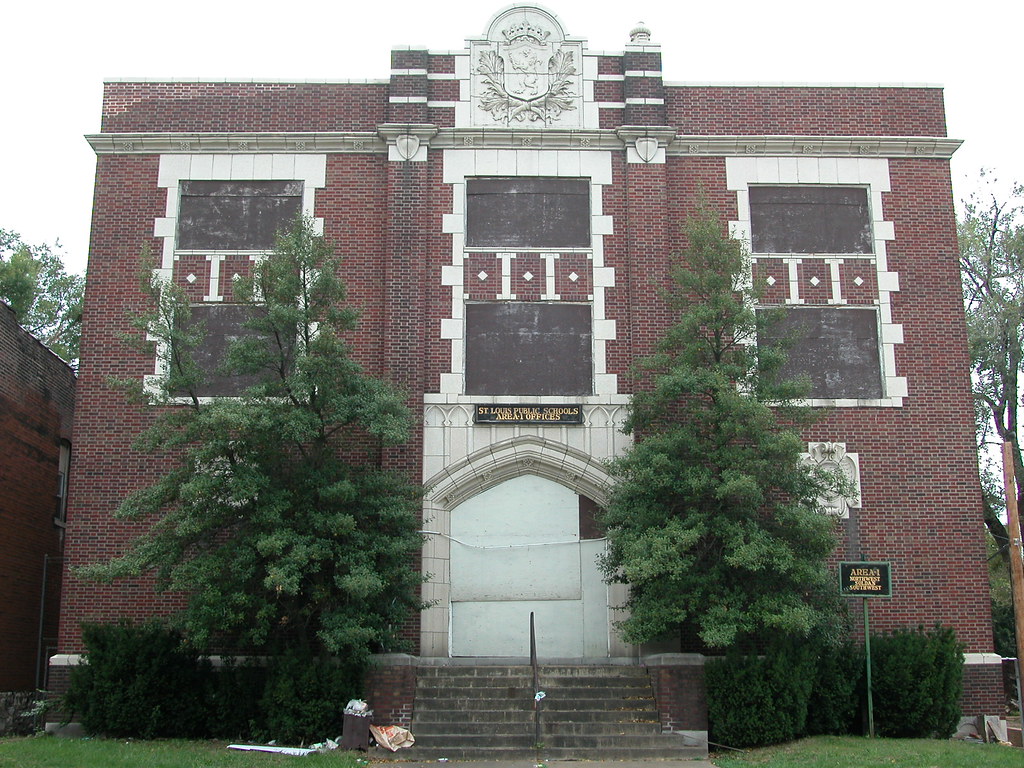
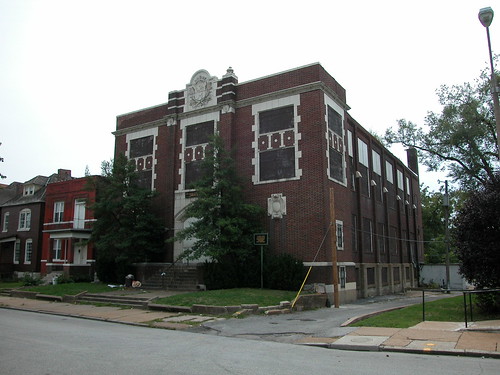
The large vacant brick building at 5234 Wells Avenue in the Academy Neighborhood bears a sign reading “St. Louis Public Schools / Area 1 Offices.” The imposing Jacobethan building has the symmetry, grace and quality of construction that is consistent with the stock of the St. Louis Public Schools, but it really does not resemble the buildings designed by William B. Ittner or Rockwell Milligan. Stylistically, there is some connection, but the plan, siting, lack of ornamentation on the side elevation and detailing is different. The massive terra cotta heraldic shield that caps the central entrance bay as well as the cartouches under the flanking window bays are clearly the work of another architect.

There’s a good reason for this: the building was not built for the St. Louis Public Schools. The Mt. Calvary Evangelical Lutheran Church built this building in 1928 as a private religious school (cost was $40,000). Architect Albert Meyer designed the building, likely trying to match the renowned architecture of the public school district. Eventually, however, the congregation moved west and the closed school met the needs of an expanding St. Louis Public School district. Yes, the district expanded to the point of buying other school buildings within the lifetimes of many living city residents.

The Mt. Calvary school became Wells School and then Emerson Branch School. The last use was as the Area 1 Offices, housing regional administration for the Northwest, Soldan and Southwest high schools. The district closed the building in 1995 and sold it in 2006 to Grizzly LLC, a St. Charles-based firm. Today the building sits empty with no plans for reuse.

MGT of America recommended that the St. Louis Public Schools consider selling the downtown headquarters building and reusing existing schools for offices. This building, already converted, would have fit the bill. Its small size would also have made it a suitable alternative school. Too bad the district sold it.

Area 1 Offices building in September 2006.

Area 1 Offices building in May 1988 (photograph by Landmarks Association of St. Louis).

Categories
Housing South St. Louis

Wild Style: Near-Twins on Wyoming

by Michael R. Allen

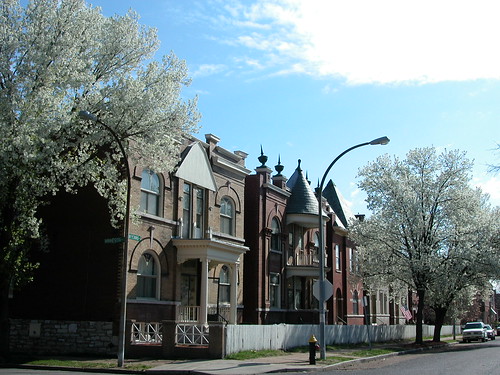
The flowering of Bradford pear trees on Wyoming Street is a good opportunity to showcase the cool, strange buildings at the northeast corner of Wyoming and Minnesota in Benton Park West. These two four-family buildings were built in 1896 by one D. Steimke for the cost of $3,700. A lot of construction was underway in Benton Park West at the time, although the July 1903 Sanborn fire insurance map page that includes this block shows more vacant than built-upon lots in the vicinity.

Now the area is one of the city’s most densely built-out and populated areas with a racial diversity unmatched in the city. The blocks upon blocks of brick buildings, the prevalent pedestrians of all walks of life, the playing children, the street trees — this adds up to city life at its best. Back in 1896, this big picture was still a handful of pieces, and the flats at 3023-25 and 3029-31 Wyoming were among the most unique pieces. They still are.

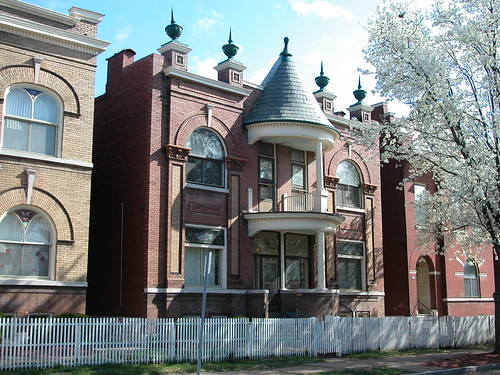
These regal buildings are twins in plan, mass, fenestration pattern and setback. The differences show a colorful architectural imagination at work. The corner building takes the plan and emphasizes horizontal lines with stone belt courses, flattened segmental arches and a dentillated cornice underneath a shaped parapet. A front porch forms a balcony. The windows on the front elevation probably have no twin anywhere else in the entire city.

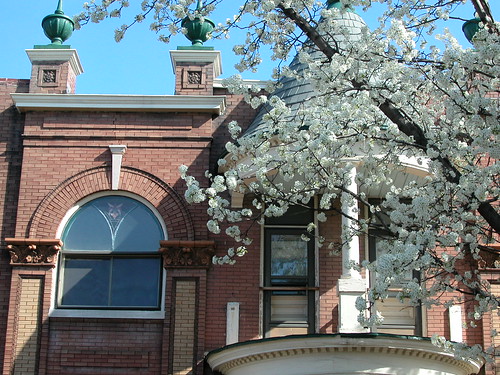
The inner building takes the plan and goes upward with verticality noted in each gesture. False pilasters with inset bricks of a different color rise up to robust Roman arches on the second floor windows. The shaped parapet forms bases for four urns topped by heavenward-directed finials. Here the center porch repeats the Roman arch shape in its curve and rises to form a tower that terminates in a conical turret. For the porch assembly alone, this house earns its rank as one of south city’s most unique.


These two homes are fine illustrations of the late 19th century drive to experimentation in St. Louis residential architecture. Their eclectic classical revival style shows a wide range of influences and forms greatly enabled by the use of varied masonry units. Throughout the city, builders, draftsmen and architects of the period were crafting a turn-of-the-century sensibility truly unique to the city.

Categories
Historic Preservation Missouri Legislature Public Policy

Missouri Senate Now Considering $100 Million Cap on Historic Tax Credits

by Michael R. Allen

Yesterday, the Missouri State Senate took a few steps toward passage of the Quality Jobs bill favored by Governor Jay Nixon. The new version of the bill, which stalled but indicates the direction the Senate is heading, includes a $100 million cap on the state’s historic rehabilitation tax credit, an amount $70 million less than the figure for credits issued in 2008.

Floor debate lasted until well after 11:00 p.m., with several amendments offered. Two good amendments adopted were one by Sen. John Griesheimer (R) to remove language that would subject tax credits to appropriation by the General Assembly and another offered by Sen. Brad Lager (R) to remove prohibitions on layering different tax credits. Lager had written that prohibition but offered the removal as a compromise.

Lager, one of the most ardent opponents of the historic rehabilitation tax credit, stated yesterday that $100 million was the highest cap on the historic tax credits that he would accept.

Keep calling and writing your senators, representatives and governor. Governor Nixon has yet to make any promise to support the historic tax credit. Nixon’s influence could prevent a cap from being included in the final version of the bill.

Categories
Downtown I-70 Removal JNEM Streets

Memorial Boulevard

by Michael R. Allen

Yesterday evening I happened to be driving south on I-70 through downtown St. Louis. Often this drive passes by and barely registers in my mind, but this time I could not help but vividly see something — something that was not there. As I rode the elevated lanes that divide and conquer the area between downtown and the riverfront, I looked south at the point where 4th Street comes close to I-70. There, the highway and the street form a wedge shape filled by overabundant sidewalk space, a parking lot and the Hampton Inn.

I imagined that instead of being elevated ahead of a descent, I was driving at grade from Cass Avenue all of the way to the Poplar Street Bridge. The highway became an urban thoroughfare allowing for easy local access and great views. I could foresee stopping at traffic lights as pedestrians walked from the casino over to restaurants on Washington Avenue, or from downtown apartments to the river for a stroll. Instead of a gravel lot, I saw a completed Bottle District with modern mid-rise residential buildings. Lumiere Place presented an attractive face to downtown.

Straight ahead, I did not see the weary concrete sidewalks and parking lot ahead of the Hampton Inn, but a new flatiron office building with a fountain in the middle of the plaza where traffic between the boulevard merged with Fourth Street. The sensation was akin to the view of downtown Chicago offered at the point near the Drake Hotel where Lake Shore Drive meets the north end of Michigan Avenue. That view always gives me a giddy feeling, because the essence of the entire urban density of Chicago seems to come into view there. The options there are staying on Lake Shore Drive for the breathtaking view of the lake or turning off onto the Magnificent Mile. There is no mediocrity in sight.

Yesterday, I saw a similar picture. I could make a right turn and veer off into the excitement of downtown, lured by the refined architecture of the Missouri Athletic Club, or head straight for that section of downtown that is right at the Gateway Arch. Either way I was going to see our urban core at its best. When I was right at the Arch, instead of dangerously looking up through aging concrete infrastructure, I caught a red light and had at least 20 seconds to take in the glistening sheen of the Arch skin reflecting the golden sunset.