Categories
Clearance Events Historic Preservation McRee Town People South St. Louis Urbanism

Talking About McRee Town

by Michael R. Allen

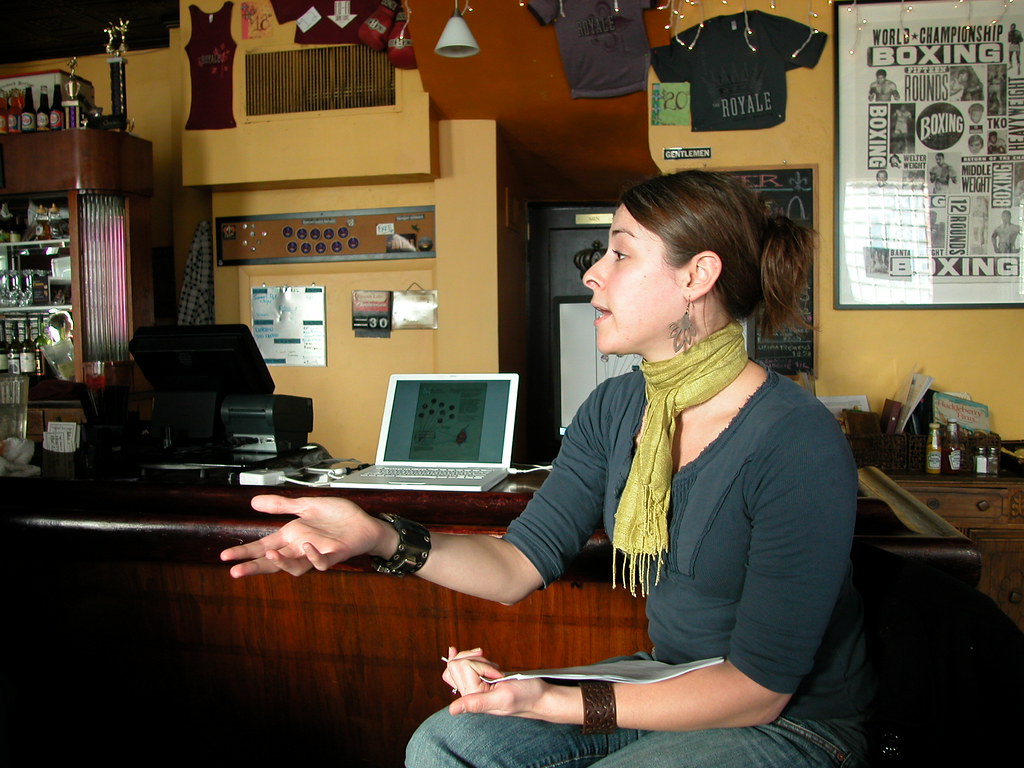
Jackie Jones introduces her presentation.

Yesterday afternoon St. Louis University doctoral student Jackie Jones presented her dissertation thesis, “Picturing a Neighborhood: McRee Town in Saint Louis, Missouri,” to a crowd at the Royale, 3132 S. Kingshighway. The interesting venue for Jones’ presentation and resulting discussion offered a relaxed setting for what remains a controversial topic: the wholesale clearance of six blocks of an urban neighborhood by the Garden District Commision and resulting replacement by new housing. Jones disavowed any stance on the clearance, instead focusing on how images were used to justify the clearance in the press — and how other images contradict the story told by the Commission’s carefully-selected images.

Here’s Jones’ own description of her presentation:

In 2003, the Garden District Commission demolished more than two hundred buildings on the eastern half of the McRee Town neighborhood in Saint Louis. The Commission, a private coalition headed by officials from the nearby Missouri Botanical Garden, demolished six blocks of historic brick homes and apartment buildings that housed primarily low-income renters and homeowners, relocated hundreds of residents, erected twenty-five acres of market-rate, single-family, suburban-style housing on the cleared land, and ceremoniously renamed the area Botanical Heights. This presentation explores how visual representations of McRee Town between 1998-2003 helped legitimize this urban renewal project and the dislocations it caused in the lives of McRee Town residents. It engages viewers with the photographs of burned-out, boarded-up, weed-infested buildings that populated newspaper reports and public relations documents during these five years, and juxtaposes them with photographs taken by Genevelyn Peters, a McRee Town resident prior to the neighborhood’s destruction. These images – of family, homelife, play, and community – complicate and challenge the dominant understanding of this neighborhood and its residents as criminal and atomized by presenting images that depict a vibrant neighborhood community.

People listen to Jones’ making a point.

The people present included someone involved in the decision to clear the six blocks, residents of Botanical Heights (the new housing development), the area’s Neighborhood Stabilization Officer Luke Reven and others. While I had to leave before discussion was over, discussion touched on the damaging impact of I-44 construction in the early 1970s, the way in which similar images as those taken in McRee Town galvanized Lafayette Square and Soulard residents to pursue preservation instead of clearance, the deceptive nature of photographs and whether or not the term “suburban” applies to Botanical Heights.
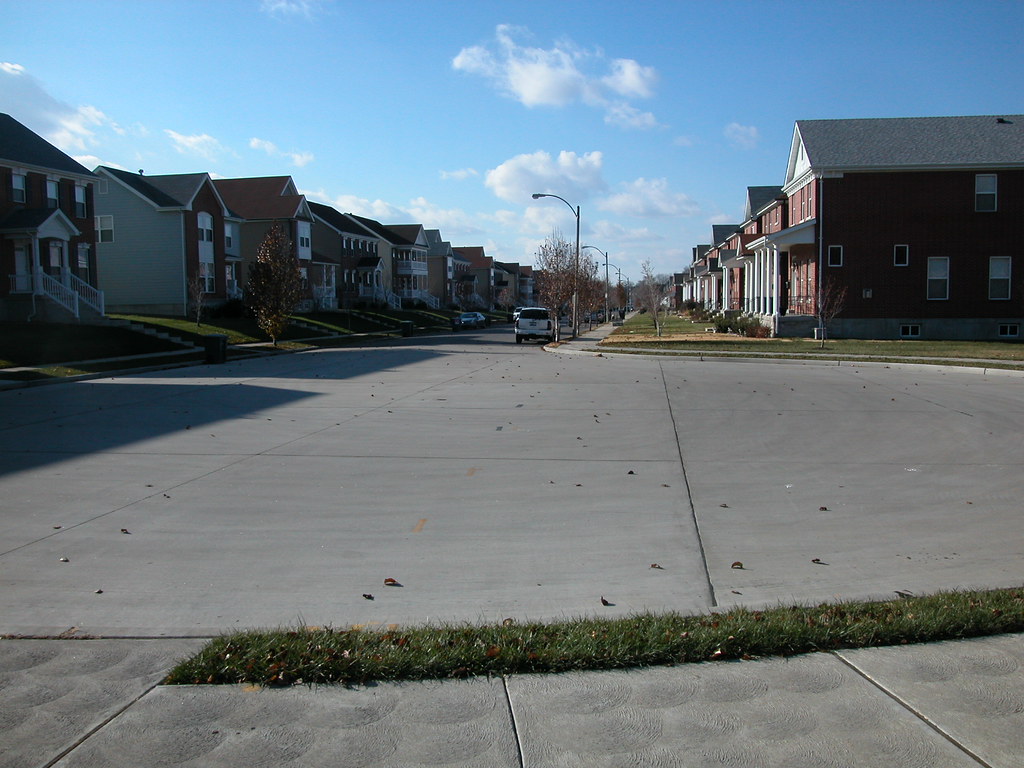
Looking west down McRee Avenue from 39th Street.

On another note, if Royale proprietor Steven Fitzpatrick Smith is attempting to revive the tradition of the discussion salon, count me in!

Categories
Historic Preservation Media SLPS

Historic Preservation Should Be Part of St. Louis Public Schools Facilities Plan

by Michael R. Allen

KWMU aired my latest commentary today, on my birthday: Historic Preservation Should Be Part of St. Louis Public Schools Facilities Plan

Categories
Infrastructure St. Charles County St. Louis County Streets

St. Louis Area Makes a List for Obama Administration

by Michael R. Allen

An article in the December 26 edition of the St. Louis Business Journal reported that the City of St. Louis has created a 400-page report on its federal infrastructure funding priorities, while St. Louis County has created a 200-page document of the same. The governments will deliver these reports to the incoming presidential administration of Barack Obama in response to his promise to channel federal dollars into public works programs across the nation.

The city’s report outlines some big-ticket priorities: $900 million for the North/South MetroLink line, $219.5 million in streetscape improvements, $160 million in public school building improvements, $80 million in airport improvements and $59 million to implement the Gateway Mall Master Plan. According to Deputy Mayor Barbara Geisman, all of these projects are ready to start as soon as they are funded, but full funding is unlikely immediately. Still, the city’s placement of MetroLink expansion at the top of its list is smart, since that is a crucial component of building a strong city economy and connecting citizens to jobs. The city’s list carries some basic but crucial needs: street and transportation improvements and school renovation. (The Gateway Mall project is another story, but something does need to happen to the mall area.) These are important to stabilizing our neighborhoods, and Geisman should be commended for placing a high priority on these things.

Moving beyond the ready-to-go ideas, perhaps the city would consider a future request for an urban homesteading program. The program could find funding to stabilize and market the Land Reutiliation Authority’s thousands of vacant homes across the city, generating hundreds of construction jobs and getting tax-free property back on city tax rolls where it can generate money to fund roads and schools.

St. Louis County’s list starts with a $200 million, 3.3-mile expansion on Highway 141 at the top followed by the $105 million needed to retain existing Metro public transportation in the outer county. A significant and less costly item on the St. Louis County list is $24 million to fund a Midwest China Trade and Commercialization Center at NorthPark. While the China cargo hub prospect is not a done deal, it has the potential to bring more jobs to the St. Louis area in the next decade than any other prospect.

Other requests headed to the Obama administration are a predictable $510 million highway spending request from the Missouri Department of Transportation and a $66 million request to extend Page Avenue farther into St. Charles County, so that one may have a straight drive from downtown St. Louis to Mid Rivers Mall Drive. These requests are the usual pave-it-and-they-will-come junk.

Obviously, the disparate requests show the problem of regional political fragmentation. Inevitably, there will be partial funding of many requests rather than full funding of something big and transformational. Imagine what might happen if the regional governments pulled together with one request for the North/South MetroLink line this year, and further extensions in the future, rather than place the burden solely on the City of St. Louis. Imagine if the Missouri Department of Transportation put some of the needed Metro funding in its request.

Remember when we imagined that Obama could become president? Now that the dream is real, it’s time to imagine other changes closer to home. Or, we can all fight over the pie for the next eight years, but it doesn’t take much imagination to guess where that will get the St. Louis area.

Categories
Architecture Industrial Buildings North St. Louis Riverfront

Kraushaar Brass Manufacturing Company

by Michael R. Allen

I frequently pass by this industrial building at 2509 N. Broadway in the north riverfront industrial corridor, and have long wondered about the distinctive stepped south elevation. On that side, the parapet steps up a full floor above the apparent building height to support a chimney. My first assumption was that the chimney was the remnant of a demolished interconnected taller building. That assumption didn’t seem right, though. Time for research.

The 1909 Sanborn fire insurance map (Volume 3, page 52) shows this building alone, with no building standing to the south. The stepped section chimney is part of the building, which Sanborn shows as being a three-story section of the Kraushaar Brass Manufacturing Company. Building permits indicate that the building at 2509 N. Broadway was built in 1904 at a three story height. Since the building was part of an active brass foundry, a destruction of the top story by fire is possible. Several metal-industry related buildings in the north riverfront areas lost top floors to fire. Early processes often resulted in industrial accidents, and we know that heat rises. However, my guess is as likely as simple decapitation of a floor deemed useless for some reason.

My research on Kraushaar Brass Manufacturing is incomplete. Records show that the company was founded by Charles Frederick Kraushaar, a Prussian immigrant born in 1847 who arrived in St. Louis after 1870. Kraushaar started a brass foundry on this block (city block 330, bounded by Broadway, Warren, 9th and Benton streets) in 1873 that expanded in size rapidly. In 1911, when Kraushaar retired, he resided at 3627 California Avenue in south city. His company made a lot of light fixtures, and its products appear in Missouri state government procurement records.

One mystery solved, dozens more created…

Categories
Downtown

Dapper Dan’s Closes Its Doors

by Michael R. Allen

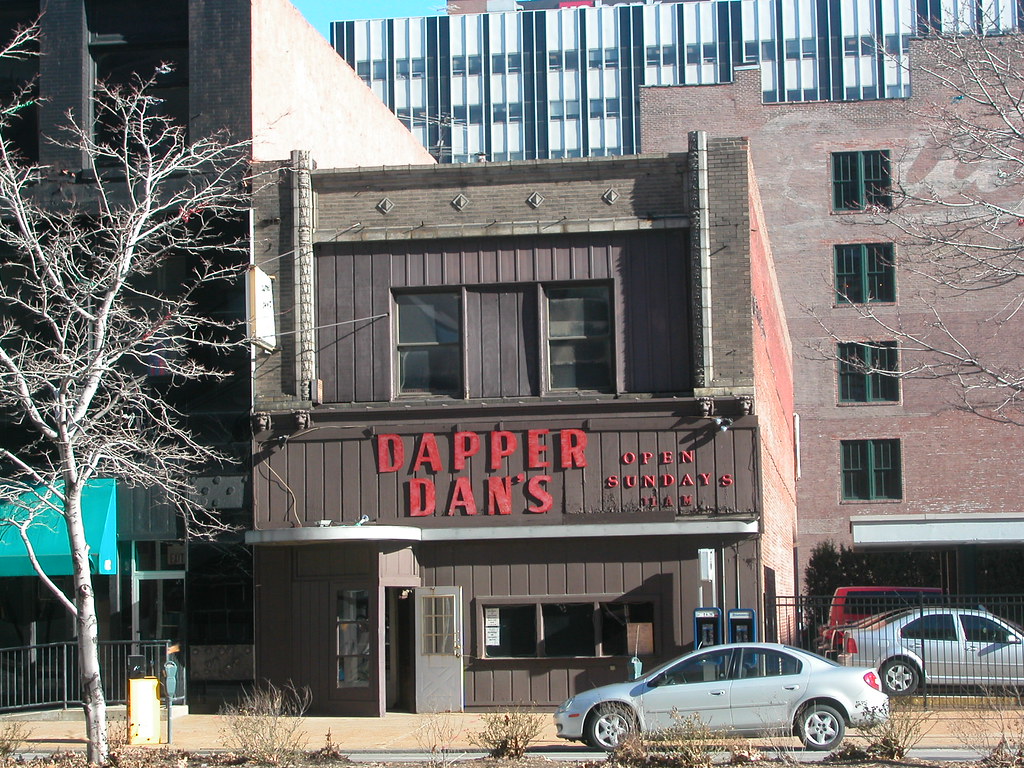
As Skip to the ‘Lou reported, Dapper Dan’s closed on Saturday. Located at 410 North Tucker Boulevard, Dapper Dan’s was a downtown institution built on another’s legacy. Dapper Dan’s opened in 1976 in the space that reigned as the legendary Bismarck Cafe from 1923 through 1972. The Bismarck was known for turtle soup and cloaked booths where politicians, businessmen, reporters and mobsters would huddle over a meal or drinks. Dapper Dan’s, as Bill McClellan described well in his column last week, was of a different era for downtown. Born at a time when fortunes were declining, it was a haven for the working class to whom the city center was left as the elite retreated westward.

I first encountered Dapper Dan’s a few years ago, with the erstwhile Mickey McTague as my guide. McTague was then still working for the Sheriff’s Department, whose ranks gave the bar more than a little business over the years. Mickey introduced me to Rich Dallas and his daughters, and a cast of regulars that included Jefferson Arms residents, a parking lot attendant and a many retired folks. In subsequent trips, I saw these people and others, ranging from city workers to packs of youth waiting for their favorite bands to perform at the Creepy Crawl next door. Once, my colleagues and I took a prospective co-worker to Dapper Dan’s to give him an off-the-record account of what he might be getting himself into by taking a job in historic preservation. Either the drinks dulled his senses or he had a strong will; he came to work for Landmarks and remains here today.

However, never did I encounter a full Dapper Dan’s. I have been at a full Maurizio’s, and a crowded Missouri Bar and Grill. Dapper Dan’s did not pull in as many people. I think this is because the people it pulled have spread out. Just as the businessmen and politicians moved their meetings closer to their homes and even jobs in the Central West End and St. Louis Hills, the working class spread outward. Remember, the steepest population loss in St. Louis history was recorded between the 1970 census and the 1980 census. That Rich Dallas could open a downtown business in that period and keep it alive for another 32 years is testament to his canny and his loyal customer base.

Downtown will move on without Dapper Dan’s, just as it has lost many other of its hard-boiled establishments like Carl’s Two Cents Plain, Jimmy’s, Amitin’s and a plethora of others. I regret being too ill over the weekend to pay my final respects, because there will be nothing else like Dapper Dan’s with its weary, time-worn urbanity.

What becomes of the building that housed Dapper Dan’s is an open question. The building, built in 1890, was once five stories tall. In the days of downtown despair, the owner of this building and its next door neighbor joined a short-lived fad of lopping “unnecessary” floors. This crude pragmatism saved the historic restaurant fixtures on the first floor, which remain pristine down to the men’s room details, but gave the building an awkward, jagged crown. Still, what remains is a great turn-key opportunity for a bar and restaurant. The old truncated Creep Crawl building next door has found new life as a pet clinic, indicating that there is a market for an amputee building.

Categories
Downtown Historic Preservation Planning Urbanism

A Different Washington Avenue

by Michael R. Allen

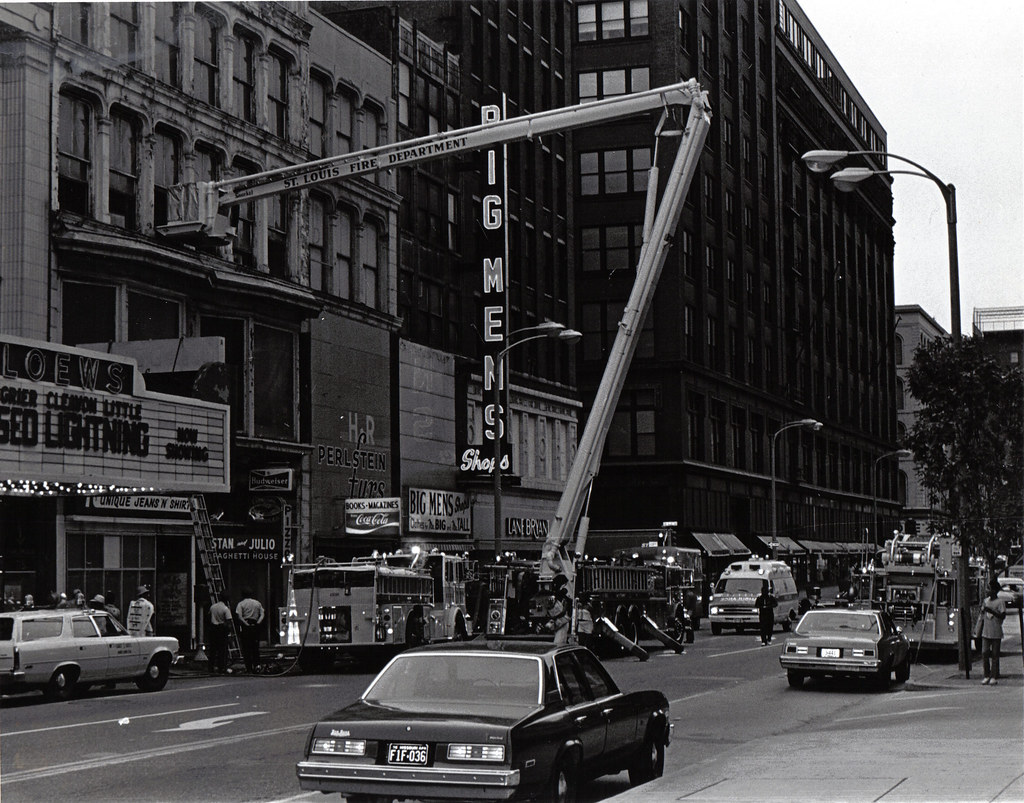
This photograph from the collection of Landmarks Association of St. Louis shows a section of Washington Avenue in 1978. Obviously, the photographer was intrigued by the Fire Department’s activity, but ended up documenting more than just a one-alarm call. This view shows the north side of Washington from the mid-point of the 700 block east through the 500 block.

From the left, one sees Loews Theatre still in business with its marquee advertising “Greased Lightning.” Then there is Unique Jeans ‘n Shirts, Stan and Julio’s Spaghetti House, H.R. Perlstein Furs, Amitin’s Books, the Big Men’s Shop and Lane Bryant. On the next block east is the Stix, Baer and Fuller Department Store, later Dillard’s, long before any skybridge marred its lovely commercial facade. Beyond the department store is the old May Company Building, now 555 Washington and then home of the Dollar Store.

This retail environment was dense with stores and small-scale buildings. The 700 block, with the exception of the theater, was occupied by narrow four-to-six-story buildings. These small buildings were the lifeblood of downtown retail in the 20th century, offering low rents and lower operating costs to owners. The buildings and the shops also imprinted streets like Washington, Locust, Olive and others with architectural variety and commercial abundance.

Alas, this photograph captures that downtown street life in end times. By the time this photograph was taken, city planners had decided to smother the retail environment here with the colossal failure that was St. Louis Centre. Opened in 1985, St. Louis Centre stands diagonally across from the Lane Bryant Store here. To build St. Louis Centre, two blocks of modestly-scaled historic downtown buildings — all with ground-floor retail — were leveled. St. Charles Street was closed. The two giant department stores, Stix and Famous-Barr, were joined to the mall rather than being separated by a diverse array of urban retail accessed on the sidewalks.

Retailers like Lane Bryant moved into St. Louis Centre and failed. Establishments like Stan and Julio’s lingered until city planners again decided to stamp unitary order onto functional, if messy, urban life. In 1989, the 700 block of Washington was seized for construction of an addition to the convention center. Some retailers, like Amitin’s, moved westward on Washington, but many closed their doors forever. The buildings fell. Today, the view captured in 1978 is depressing. Where delightful urban life thrived sits the giant convention center, with its sidewalks a pedestrian danger zone of taxi-dodging. The Stix building is empty, with a giant skybridge fused onto its facade that blocks sunlight and site lines.

Fortune may lead to rehabilitation of the Stix buidling, demolition of the skybridge and reconstruction of St. Louis Centre. However, the very urban architectural and commercial character of this stretch of Washington is lost.

Categories
Historic Preservation Preservation Board South St. Louis

Preservation Board Blocks NLEC Demolition Plan

by Michael R. Allen

Yesterday, the St. Louis Preservation Board unanimously upheld staff denial of a demolition permit for the house at 4722 Tennessee Avenue in Dutchtown. The New Life Evangelistic Center (NLEC) applied for a demolition permit in September, and the Cultural Resources Office denied the permit shortly afterward. NLEC appealed the denial to the board. At the November meeting of the Preservation Board, NLEC representative Jeff Schneider waved the right to a timely appeal in order to return with a stronger presentation.

Schneider failed to do so. Yesterday, he asked the board for yet another continuance despite the fact that several people, include Dutchtown South Community Corporation Executive Director Kelly Kress and myself, had already attended a meeting with prepared testimony against the appeal.

Schneider did bring engineer Michael Mahaney, who attempted to make the case that the building was structurally unsound although he has not yet been inside of the building or produced a detailed assessment.

Board member Mike Killeen made a motion to defer consideration for one month but withdrew the motion after both Cultural Resources Office Director Kathleen Shea and Board Chairman Richard Callow stated that board members, staff and citizens had as much a right to timely consideration of the appeal as the appellant. No one of the board disagreed with Shea’s assessment that the proposed demolition met none of the criteria for demolition established by the city’s preservation ordinance.

Alderwoman Dorothy Kirner spoke against the proposed demolition, and Kress and myself were recognized by the chairman but did not speak since the board’s stance was already clear. David Richardson moved to uphold staff denial, and the board unanimously supported that motion. The matter may be far from over, though.

Also yesterday the board unaimously approved National Register nominations for the Gill Buidling, Liggett & Myers Historic District, the Bel Air West Motel and the Grand-Bates Suburb Historic District. The board unanimously granted preliminary approval to plans to build a new house at 2308 S. 10th Street in the Soulard Historic District.

Categories
Downtown East St. Louis, Illinois Green Space I-70 Removal JNEM Laclede's Landing Planning Riverfront

Drawing the Connections

by Michael R. Allen

Robert W. Duffy’s article “To connect the Arch to the city (and the river), find the middle” in the Beacon broadcasts the good news from this weekend: a group of concerned citizens forged a coalition to address the issue of reconnecting downtown St. Louis to the Arch grounds and the riverfront, and vice versa.

The meeting and consensus for forward movement potentially could tie together many disparate strands of thinking:

  • Former Senator Jack Danforth’s call for improving access to the Arch grounds and making the setting more attractive.
  • The notion of removing I-70 downtown advanced by Rick Bonasch, myself and others, which is enabled by construction of a new Mississippi River Bridge north of downtown.
  • The National Park Service’s release of a draft General Management plan for the Jefferson National Expansion Memorial.
  • The call from open space advocates and preservationists to refocus public discussion from the museum prospect on connecting the Arch grounds to surrounding urban fabric.
  • The outpouring of many good ideas in the recent student charrette on the Arch grounds and riverfront.
  • Mayor Slay’s recent attempt to focus planning energy on the St. Louis riverfront.
  • Chivvis Development’s efforts to revitalize Chouteau’s Landing.
  • Plans by Great Rivers Greenway District to develop a South Rivefront Trail that would connect to the North Riverfront Trail in front of the Arch.
  • Plans for new development at the Bottle District and a second phase of Lumiere Place north of downtown.
  • Ongoing efforts to redevelop the North Riverfront Industrial Historic District north of Lumiere Place.
  • Efforts to improve the East St. Louis riverfront, including construction of an architectural museum.Finally, there is the very real prospect that the Obama administration will look for an initial wave of federally-funded public works projects and will push for long-term funding for urban infrastructure projects.

    All of these ideas and plans are in various stages of reality. Most have yet to move beyond talking points and renderings. Isn’t the moment ripe to link these plans together through a master vision for the central St. Louis riverfront? The people who came together on Saturday think so, and will spend the next few months trying to link the many ideas for making the city’s front entrance a beautiful one.

  • Categories
    Demolition Fire Housing McRee Town

    Folsom Avenue Blues – Part Two

    by Michael R. Allen

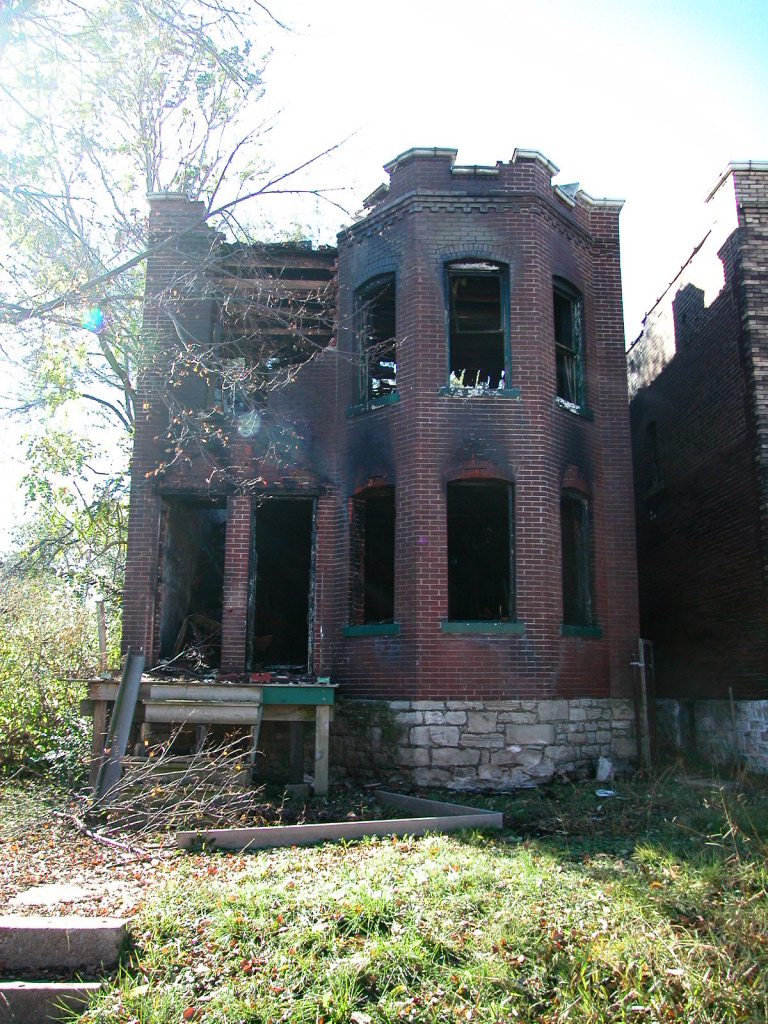
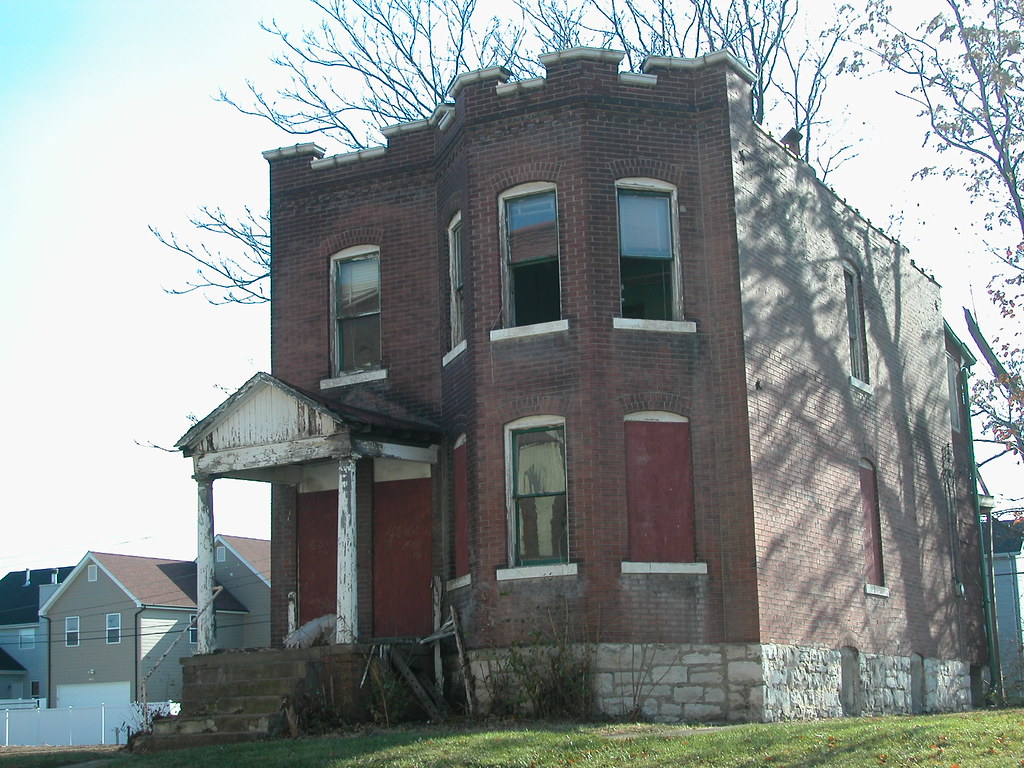
    Here are some images showing the 3900-4000 block of Folsom Avenue in McRee Town on October 31, 2004. As the images show, the castellated two-flats were more abundant then, providing a sense of their effect on the block.

    One of the buildings had recently experienced a suspicious fire.

    Categories
    Demolition Historic Preservation McRee Town

    Folsom Avenue Blues

    by Michael R. Allen

    The houses at 4042 and 4046 Folsom Avenue.

    The house at 4062 Folsom Avenue.

    Three houses remain on the south side of the block of Folsom Avenue between Lawrence and Thurman avenues in McRee Town. Last month there were four, until the Garden District Commission had the other one wrecked.

    As the backgrounds in these photographs indicate, these houses are survivors — more remnants than fabric. These houses are located in the six block section of McRee Town slated for total demolition by a 2004 redevelopment ordinance, and how they survived to the present day is pure chance. These should have wrecked in the architectural massacre that played out in 2004, and should have been gone in time for the residents of the new Botanical Heights to never get a sense of the working class vernacular that made McRee Town a special place.

    Instead, the four identical two-flats remained for awhile. The flats at 4056 and 4062 Folsom had long been vacant before demolition started at 4056 Folsom last month. However, the flats at 4042 Folsom remain occupied and privately owned. The Garden District Commission intends to have all gone at some point. Of course, the architectural character of this block was once created through intense repetition. There were once 20 of these bay-fronted, castellated two story flats in a row. The effect must have been exquisite. Right across the street from the mighty Liggett and Myers Tobacco Company plant stood a row of modest rental flats whose iconography proclaimed in chorus: every person’s home is his castle!

    Alas, the three remaining buildings are probably too broken-hearted to proclaim anything. Maybe there is a soft whimpering “save me,” but fate is sealed. These houses are not to stand the test of time, but be replaced with new houses whose relative extravagance may proclaim exactly the same message as before, only louder and more insistently.

    Yet there is hope for other remaining sections of McRee Town: on the December 22 agenda of the St. Louis Preservation Board is consideration of the Liggett and Myers Historic District, a National Register historic district funded by the Garden District that would get the other six blocks of McRee City and related industrial property onto the National Register (again, in the case of the six residential blocks and the Liggett and Myers plant that were de-listed in 2004). The working class castles west of Thurman may get to sing for some years more.