Categories
Gravois Park Planning South St. Louis Tower Grove South

A Positive Outcome on South Grand

by Michael R. Allen

Both sides of South Grand Avenue between Winnebago and Chippewa Avenues are much improved due to the diligence of concerned citizens taking effective action. Above is a photograph of the Grand South Senior Apartments at the southeast corner of Grand and Winnebago in Gravois Park, completed last year. The building introduces contemporary architecture, adds density and created several storefronts on the site of a mid-century Sears store demolished in 1994. This sort of infill is desirable and practical, and the design is not breathtaking. Why does it warrant an entire essay?

Well, this outcome was far from certain back in 2005. At that time, the site was owned by the Pyramid Companies, which had purchased the Sears site and adjacent city-owned land as part of the Keystone Place project. Although the redevelopment and blighting ordinances for the Keystone Place project outlined mixed-use moderate-density infill on the Sears site and forbade any drive-through commercial, Pyramid suddenly announced a bizarre request for a zoning variance to allow the relocation of the McDonald’s franchise across the street. (The sordid details can be read at Urban Review.)

Pyramid proposed moving McDonald’s to a new drive-through restaurant on the Sears site and acquiring the McDonald’s site for construction of a Grand South Senior Apartments. Keystone Place residents had bought expensive new homes from Pyramid with the assurance of the redevelopment ordinance protected them from fast food across the alley. Gravois Park residents and Alderman Craig Schmid (D-20th) also were riled by the attempt to breach a redevelopment law sought by Pyramid itself just ten years prior.

What ensued was wonderful: neighborhood residents organized against the change to the existing ordinance, and were joined by supporters of sound urban planning from across the city, including young members of the Urban St. Louis Forum. Even though the boundary of his ward was the alley east of the Sears site, Alderman Schmid stood up for his constiuents’ quality of life by opposing the proposed variance. Schmid attended a zoning adjustment hearing and spoke against the changes, eloquently explaining why development just ten feet outside of his ward affected his constituents’ quality of life as much as anything ten feet inside. Alderwoman Jennifer Florida (D-15th), whose ward included the Sears site, chastised Schmid, but his remarks provided cover for her ultimate decision to not support the variance sought by Pyramid.

The rest became history: the citizens of Gravois Park won. But so did Pyramid, and the residents of Tower Grove South to the west. Pyramid built Grand South Senior Apartments following its original redevelopment ordinance (although by the time the first resident moved in, Pyramid was bankrupt), and the pesky McDonald’s went out of business. At the end of 2009, the Mama Pho Vietnamese restauarant — which does not serve food by drive through ordering — opened in the old McDonald’s. This block of South Grand now has a new building and a re-purposed existing building, and no annoying drive-though on either side.

Categories
Art Downtown Events JNEM Riverfront

"Faces of the Riverfront" Exhibit Opens This Sunday


The Jefferson National Expansion Memorial will host a special exhibit from St. Louis artist Sheila Harris at the Old Courthouse from Feb. 14 through Aug. 22, 2010. Created especially for the memorial, the exhibit consists of nearly 40 watercolor paintings of buildings that once stood on the Arch grounds. Harris’ “portraits” of buildings depict structures from several generations of the city’s architectural history illustrating how the landscape of the riverfront evolved over time.

The exhibit will launch with an artist’s reception on Sunday, February 14, at 2:00 p.m.

Categories
Downtown

Didn’t Quite Make It

by Michael R. Allen

Categories
Mid-Century Modern

Motels in the City of St. Louis

by Michael R. Allen

The Winter 2009 issue of the Newsletter of the Society of Architectural Historians, Mississippi Valley Chapter contains my article “Motels in the City of St. Louis”, an overview of the 16 motels built in the city between 1958 and 1971.

By the way, the chapter now has all of its newsletters available in PDF format on its website. The quarterly newsletters, which date back to 1997 and are edited by Esley Hamilton, are a treasure trove of well-researched articles on the architectural history of St. Louis and Missouri. At $10, chapter membership is almost unreasonably affordable; the newsletter alone is worth many times that amount!

Categories
Historic Preservation Marine Villa South St. Louis

Sigma-Aldrich Now Owns "The Brick" Building

by Michael R. Allen

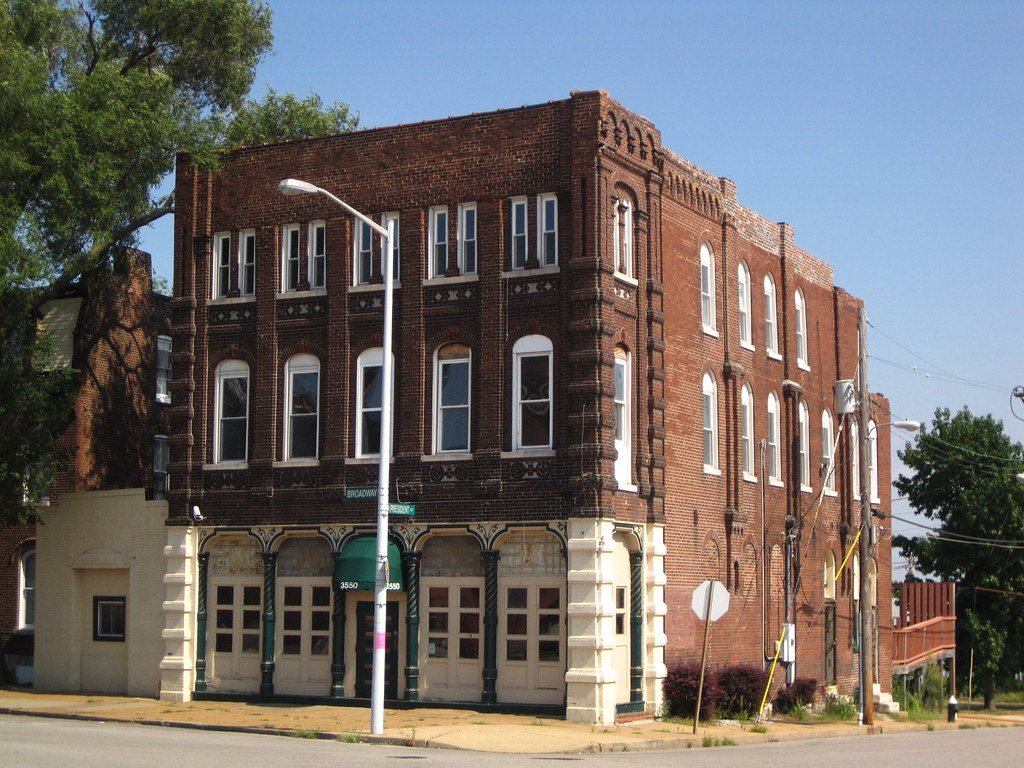
Last fall, chemical giant Sigma-Aldrich Corporation purchased the historic building housing The Brick bar located at 3548 S. Broadway in Marine Villa. The bar quickly shuttered and the building, built in 1887 by brick maker Paul Oehler, is now vacant. So far, Sigma-Aldrich has not announced plans for the building, although speculation of eventual demolition has begun. The Sigma-Aldrich plan sprawls on the southeast side of this stretch of South Broadway. In recent years, the company has wrecked many buildings on Broadway across from the Lemp Brewery complex.

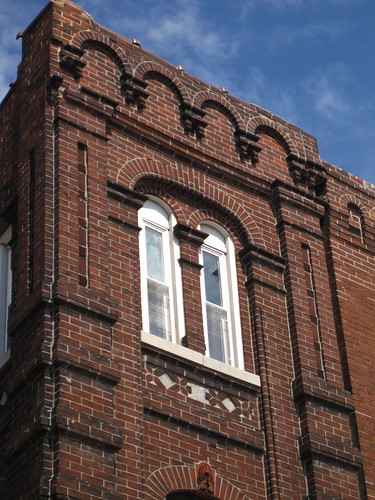
That the building is the work of a brick maker is no surprise. The masonry details of the corner building are unusual for a south city corner storefront. The strongly articulated piers, recessed planes, fine arches and what remains of the blind arcade on the top of the wall reward many viewings. The spandrels (areas under the windows) combine brick patterns and stucco in a manner that suggests later Arts and Crafts experimentation.

Oehler came to St. Louis from Germany in 1861, and quickly established one of south city’s largest brick manufacturing operations. His yard was locate don nearby President Street. Among the founders of the Concordia Turners, Oehler was prosperous. Oehler bought the corner lot in 1885, and by the end of 1887 had completed the substantial three-story building and adjacent one-story feed store.

The cast iron storefront is impressive, with ornate columns and tapered headers. (The false doors and stained glass transoms in the openings are not original.)

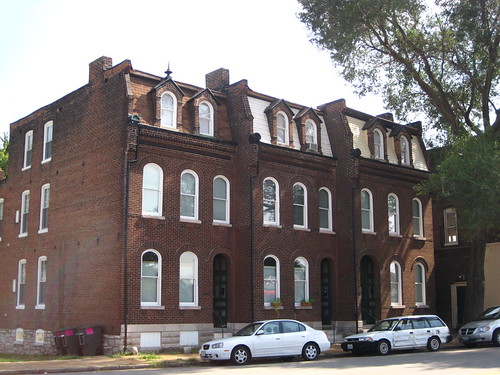
Oehler’s company did not make the transition from hand-made brick to hydraulic press production, and the business died with him. However, the family was quite well off from real estate investment alone. After Paul Oehler’s death in 1891, widow Franziska Oehler constructed the three residences at 3542-46 South Broadway in 1893.

The row’s staggered fronts articulate the bend that Broadway makes here. These are typical Romanesque residential buildings for their time. Handsome Roman arches create the window and door openings, ornamental brick friezes and cornices mark the top of the second floor and modest mansard roofs form the third floor. One of the brick dormers retains an original metal finial. The foundation fronts are trimmed in cut limestone. While the mansards are covered by later materials, the row recently was renovated by developer Ben Simms. The units are rentals — nothing fancy, just good apartments with a lot of historic character.

The residences and the the corner building comprise the National Register of Historic Places listing for the Oehler Brick Buildings (8/1/2008), written by Andrew Weil and myself for Landmarks Association of St. Louis. The listing recognizes the unique origin of these buildings, which provide a strong anchor on a changing section of South Broadway. With the Lemp Brewery across the street, and the houses and storefronts of old Marine Villa surrounding Broadway, the solid forces of old industry and brick architecture are palpable here. Sigma-Aldrich can help keep it that way.

Categories
Flounder House Housing LRA North St. Louis Old North

Old North, Infill and Historic Reference

by Michael R. Allen

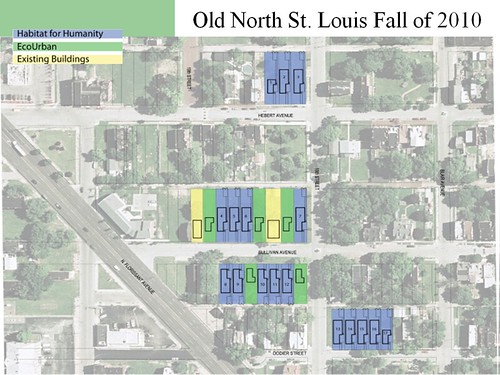
Image courtesy of the Old North St. Louis Restoration Group.

Last week, residents of the Old North St. Louis neighborhood got a look at a preliminary site plan and renderings for 17 new homes to be built by Habitat for Humanity and five homes to be built by EcoUrban homes. As the plan above shows, these houses will be built on Dodier, Sullivan and Hebert streets between Blair and Florissant Avenue. All will take the place of vacant lots owned by the city’s Land Reutilization Authority in a part of Old North adjacent to the neighborhood’s most dense northern section.

Amid deep recession, this is great news. Old North will get its first-ever major wave of new construction not developed with the Old North St. Louis Restoration Group as a partner. This private market activity is essential for the neighborhood, and the timing is hopeful that even more development will arrive when the economy recovers. Most important, the new development expands homeownership without compromising the economic diversity of Old North.

Image courtesy of the Old North St. Louis Restoration Group.

On top of the other positive aspects of the development, the design of the new Habitat homes is most certainly contemporary. (EcoUrban has yet to submit elevations.) The homes at left above are two-story, narrow, modified flounder houses. The others are basic modern flat-roofed, single-story homes. The houses share a design vocabulary, eschewing any historic reference or even material use. The lines are rectilinear and crisp. The cladding for all of the new houses will be concrete fiber board on the front sections in a jack-on-jack layout, with concrete weatherboard on the rear elevations. My one concern is that the deep recess of the entrances makes each home’s connection with the sidewalk needlessly remote.

There is nothing about the designs that make them inappropriate to Old North. In fact, their juxtaposition with existing historic brick buildings will make for a pleasant realization of the neighborhood’s aspirations of continued development. If Old North is to grow in the 21st century, it will grow with 21st century architecture. To date, save for the handful of Section 235 houses built there in the 1970s, neighborhood infill efforts there have relied on historical reference that has been pleasant if not progressive.

Historic reference is infill is not necessarily undesirable or inappropriate in Old North or other city neighborhoods. Perhaps the lack of solid materials and smart use of historic elements has soured referential infill to many critics and designers. There certainly are few examples of “faux” historic homes in the city worth their architectural salt. However, the anti-replica argument ignores the fact that the city’s prized 19th century styles, such as Italianate or Second Empire, were in their heyday referencing European styles. Early 20th century styles like Georgian Revival or William B. Ittner’s Jacobethan school style were attempts to renew and reinterpret older styles. Few today complain about the results.

Still, the Habitat and EcoUrban homes bring architectural sensibility that is of its own time. While many city neighborhoods have local historic district ordinances that forbid minimalist infill, Old North does not. The loss of historic fabric there makes any such design code unworkable. A neighborhood with more vacant lots than buildings cannot hold new construction to standards set by its buildings — they will some day be outnumbered by new. The new buildings might as well be good work from their time, as the proposed buildings are. The remote possibility that someone might intelligently revive a historic style found within Old North, however, should not be foreclosed by current fashion.

Categories
Historic Preservation Public Policy

Obama Proposes Eliminating Save America’s Treasures and Preserve America Funding

by Michael R. Allen

President Barack Obama’s fiscal year 2011 budget contains mixed news for historic preservation programs. Obama is proposing retaining at current levels the $46.5 million appropriation to State Historic Preservation Offices and the $8 million appropriate to Tribal Historic Preservation Offices. However, Obama proposes eliminating appropriations for two successful grant programs: Save America’s Treasures ($25 million) and Preserve America ($3.175 million). These programs are funded through the federal Historic Preservation Fund (HPF).

Obama proposes no cuts to the Land and Water Conservation Fund (LWCF), despite the face that the $900 million annual authorization for the LWCF and the $150 million annual authorization for the HPF share the same source of funding: lease money from oil and gas drilling on the outer continental shelf. Neither have ever received their fully authorized appropriations. Surely our president knows that sustainability is as much about retaining existing buildings and neighborhoods as it is about preserving wilderness. After all, President Obama has championed weatherization funding and homeowner energy efficiency tax credits.

All of these proposals are subject to Congressional approval. Those who see the benefit of the preservation programs should contact their representatives immediately.

Categories
Abandonment Rust Belt

Buffalo Building Trustee Wants Negative Value Assessment

by Michael R. Allen

According to an article in The Buffalo News, a lawyer representing the trustee for the vacant Statler Towers in downtown Buffalo is asking the city to assess the building at a negative value:

Attorney Peter Allen Weinmann warned that if the city refuses to dramatically slash the assessed value of the Delaware Avenue building, it could further hinder efforts to develop the empty complex that towers over Niagara Square.

The trustee plans to demolish the building, an act that has already generated controversy. Asking the Buffalo Board of Assessment Review to assign a negative value to the building is an unprecedented act by a property owner in New York, and certainly unusual.

Categories
North St. Louis Penrose Storefront Addition

Stone Church

by Michael R. Allen

The frame one-story commercial building at 4709 Natural Bridge Road went up in 1914, early in the heydey of the thoroughfare. Later, by 1965, a church congregation took over the building and added the projecting, crenellated stone entrance bay. In so doing, the congregation largely masked the modest building behind and created one of Natural Bridge’s smallest architectural landmarks. Today, the building houses the Christian Servant Missionary Baptist Church.

Categories
Infrastructure Mass Transit St. Louis County

Metro Funding Serves County’s Interest

by Michael R. Allen

This week, the St. Louis Post-Dispatch carried a commentary by NiNi Harris entitled “County residents should vote own interests”. Harris makes the case for St. Louis County voters’ approving the sales tax measure for Metro that will appear on the April 6 ballot.

Instead of the usual — and correct — arguments in favor of mass transit as something the region needs to have to be competitive and maintain an urban quality of life, Harris demonstrates that the sales tax measure will help St. Louis County maintain its quality of life. The services that county voters take for granted are dependent on workers’ being able to easily get to jobs in the county. For many workers, that means catching the bus.

Voters might not consider the fact that even health care costs are associated with the availability of public transportation:

The quality of hospital care is not only determined by the physicians and registered nurses, but also by the LPNs, the people who do the laundry and cleaning and food service staffs. The quality of overall care can be maintained without mass transit only by increasing wages or providing other transportation.

After all, according to Harris:

It’s not just a few workers about whom we are talking. Last year, Metro buses, MetroLink and the Metro service for the disabled provided rides for almost 53 million boarders.

Can the county maintain its quality of life with diminished Metro service? Absolutely not.